A New Year in Iraq: Day 8


Ashura: Beginning the Arabic New Year and National Holiday on Day 8 by Steve Clemens

The Islamic calendar starts when the Prophet Mohammed travels from Mecca to Medina and is 11 days shorter than the Gregorian calendar. The month of Muharram marks the beginning of the New Year and is a time for celebration - yet it is muted here because 10 days later, a time called Ashura, Imam Hussein, son of Imam Ali, was killed so a time of mourning coincides with the New Year, especially for Shia Muslims who revere Ali and Hussein in a special way. The 10 days leading up to Ashura, which occurs on November 24th this year are days of mourning. Because he was killed in Karbala, there will be a pilgrimage from Najaf to Karbala starting soon and many people on the streets are wearing black and black flags decorate much of the twin cities of Najaf and Kufa here. One of our Iraqi friends tells Joan and I how to appropriately greet others when it is both a New Year and a time of mourning. He translates the Arabic into: “May Allah be pleased with your sorrow”.

One of the delegation members noted on the internet this morning that there had been some car bombings north of Baghdad and we notice right away as we step out of the Governor’s guest house that security has been increased as we see three military personnel waiting outside before we drive off for today’s adventures. We have not requested the security but it is evident that the Governor wants to insure the safety of his guests even though reports show the homicide rate of Najaf is significantly lower than in the US as a whole – by a factor of four!  

Today is also Friday, the traditional day of worship for Muslims so we are essentially taking the day off as a delegation and have instead been invited to spend the holiday in the homes of two key Muslim Peacemaker Team members, Dr. Azar Maluki, the dermatologist, and Zuhair Sharba, the Chamber of Commerce head with their families. It is a wonderful and energy-giving experience – especially to engage with children in their homes. Dr. Azar and his wife Shema have three children in a beautiful new home just blocks from the University where he teaches and practices. The home took several years to complete and it is stunning, most notably the ornate ceiling designs using mirrors.

After introductions, we sit and talk and eat – tea is served, a cake was made by Shema with the inscription of “Minnesota and Najaf” as well as other sweets and fruit are passed among us. Several delegation members played games with the children and Shema beamed throughout, obviously pleased to host these guests in her home. A tour of the home by an obviously proud Iraqi professional concluded our 2-hour visit and we left with gratitude for this glimpse of Iraqi home life. Dr. Azar has his own small generator outside his back door but tells us the national government usually increases the amount and duration of electricity from the national government to this area during Ashura because of the large increase of religious visitors present. We transferred into an 11 passenger van (made in Korea) and headed across town to Zuhair’s abode.

Just before entering Zuhair’s house, across the street was a neighborhood generator with multitudes of wires entering and exiting the mud brick structure. Maybe it was a portend for the future? The Sharba residence was built in the 1980s before economic sanctions crippled most of Iraq if you weren’t related to Saddam Hussein or his Baath Party. He, too, seems proud to have us as honored guests in his home. Two of his four daughters and his son are there to greet us but later we are told it was a third sister, a married adult, who cooked the entire meal – and what a meal it was. None of us can get over the huge amounts of delicious foods are placed before us with a seldom-ending plea for us to take more. Today’s New Years  feast was preceded with fruit, candied nuts and tea before we moved to the dining room table almost 3 hours later. There we encountered two types of rice, a traditional bowl of a stew-like combination of hummus, meat, and tomato, a beautiful plate of vegetables and olives, and a huge platter of chicken, lamb, and beef and chicken sharwma. There was that much for every 4-5 of us and after sitting down, we are handed a bowl of soup in addition. Sodas, water, and yogurt drinks also were included in the feast that seemed to engulf the entire table. It made many American Thanksgiving meals look anemic.

Our host relished the opportunity to begin serving us by providing huge portions of the one type of rice on our plates and each of us knew we might never go hungry again after seeing what lay ahead. After more than enough, we retired back into the original sitting area to enjoy fresh melon fruit, chocolate candy and nuts, and coffee or tea. Fortunately the 3-4 power outages didn’t begin until after we had finished the meal and had also concluded the giving of gifts to one another. David had thoughtfully brought some balloons which the grand children and adults enjoyed. After more than 5 hours with this second Iraqi family, we were ready to give them the rest of the evening together as we returned to the guest house.

The generosity and hospitality of these friends and this culture are lessons we can take to heart as we complete our first full week here. We hope to travel some in the days ahead but our schedule always seems to need some adjusting so we are learning to go with the flow.  

Bridge Building on Day 7


Bridge Building: Day 7 In Iraq. By Steve Clemens

The day started with Kathy getting fashion tips from Hiba. She fixes Kathy’s hijab first and then goes to adjust Joan’s but decides Joan has already learned how to do it the proper way! Although Fr. David has a lot of experience in Palestine, Iraq, and other Middle Eastern locations, one of the staff at the guest house insists on wearing the keffeyah differently. David allows for the adjustment although I’m sure it was just a matter of local preference.

After an hour of shopping in the souk of the old city, we were invited to lunch at the Guest House of the Shrine of Ali. A simple meal, very tasty and sufficient. Then we are told that our friend Zuhair wishes to greet us nearby. I knew Zuhair as the head of the Najaf Chamber of Commerce, but he seems to wear many hats around here. After being escorted into the large reception room behind the Shrine of Imam Ali, we are served tea, water, and coffee as we sat around visiting. Then Zuhair shows us the model of the on-going and planned construction around the Shrine to accommodate the millions of visitors who come each year. Under Saddam there was little improvements allowed in this section of the bold city we are told but since 2005 there are ambitious plans for improvements to this third holiest site for Shia Muslims. Zuhair also gifts us with a book translating a message from Imam Ali about the role and style of leadership before inviting us to his office upstairs. Only then does it dawn on me that having an office in this building means he has a very significant role at the Shire and we learn he is on the Board of Directors and is helping oversee part of the $600 million construction project using his capacity as an engineer and businessman.

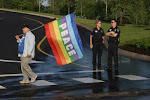
After a very engaging visit with him, we hustle back to our transport vehicles to get to the bridge crossing the Euphrates in Kufa for our Bridge Vigil in solidarity with the on-going Lake Street Bridge Vigil which happens every Wednesday afternoon/evening in Minneapolis. I brought along a rainbow striped “PEACE” flag and the Muslim Peacemaker Team had numerous other banners made with messages such as “Plant a Tree … Harvest Peace”, “Iraqi people are our brothers and sisters”, “Minneapolis is our Sister City”, Najaf is our Sister City”, “If you want peace, join us”, “Peace begins with me … and You”, “Kindness is Charity”, “Allah is Peace … Peace is Islam”.

On the bridge, traffic moved slowly so I was able to call out “Salaam” or “Salaam Alekium”, peace and peace be upon you, smiling broadly in friendship and hope. Several stopped and asked where I was from and I told them “America” and the at-first puzzled look gradually turned to a smile and the young man said, “Good! shukran” (thank you). I remembered my inaugural demonstration in Baghdad almost 10 years ago in front of the United Nations Development Office shortly before President Bush commenced this destructive war. We were supporting Hans Blix and the UN weapons inspectors rather than the mad rush to war. I held a “No War” sign on Abu Nuwas Street facing the traffic on that busy Baghdad artery and saw faces smile and horns blowing in support. I had the same feeling tonight, looking into the faces of Iraqis, no longer an “enemy” as we work hard to become both friends and peacemakers together. With the able partnership of the Muslim Peacemaker Team we are making inroads in our demands for a culture od peace. We can always use more “fellow travelers” on the road to reconciliation. 

A Day of Service - Day 6 in Iraq


A Day of Service: Day 6 Back in Iraq by Steve Clemens

The action was purely symbolic. After our tax dollars were spent creating rubble in this land of early civilization, it is time Americans started cleaning up the mess that was created by our destructive obsessions. Picking up litter and debris from a neighborhood street is designed as a symbolic act of repentance (I didn’t pack sackcloth in my suitcase for this trip) as well as an act of humility for Americans who came as conquerors rather than partners.

Members of the Muslim Peacemaker Team as well as a representative of the NGO organizing Najaf as the 2012 Cultural Capital of the Islamic World joined with us in picking up in the neighborhood where Sami Rasouli resides. I was honored to have his youngest son, Omer, just turned 5 years old, as my partner. He held the trash bag as I picked up and then I held it for him. Several of the neighbors came out to see what we were doing and some wanted to take photos as well.

Sami described the virtually non-existent garbage collection process for neighborhoods which are not part of the downtown tourist area and remarked, “If you are a Prince and I am a Prince, who will lead the donkey?” as an explanation why many men in the Arab culture stand by and let the women do a lot of the work. He hopes to break the stereotype and Omer was eager to join us.

Actually today was a day which called for a lot of flexibility. We no longer had access to the Foreign Ministry’s vehicles for today so MPT secured some 4 seat pick-up trucks and some cars to transport us with MPT members as drivers. Last night we decided that today we would go to a school as a brief stop before our service project to distribute the letters Jess Sundin gave me from her daughter Leila’s class. The original plan was for ½ the group to go to the girls elementary school and the other half to the boys school across the street but we all ended up at the girls school.

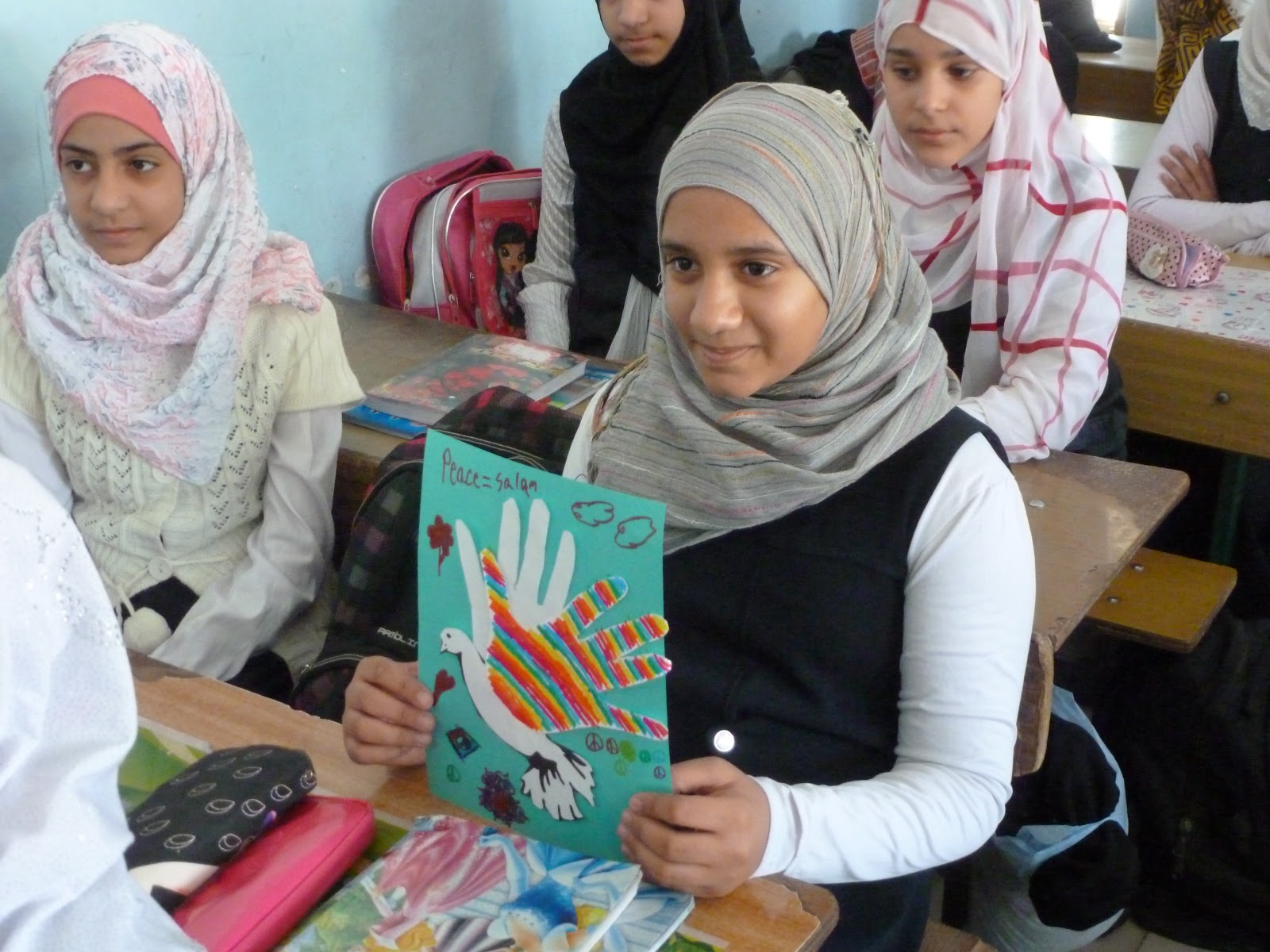
After being greeted by a supervisor/inspector from the Education Ministry, the Principal told us she had a brother who lives in Minnesota who is married to a woman from Lebanon. She welcomed us and introduced us to one of the teachers of English. I read the letter Jess had written to the school and Sami translated it so all could understand and showed them the photo of the Leila’s class. The teacher suggested we give the letter to the sixth grade English class since the students would better be able to read the English words.

The girls smiled broadly and greeted us as we entered and Sami asked me to say a few words before distributing the 16 letters. Since there weren’t enough letters for the approximately 25 girls, the teacher handed them out to each recipient. Each “letter” had a dove on the backside which the American students had decorated. That small gesture of reaching out to other students will hopefully help these future leaders of Iraq see at least some Americans in a different light than the fear and anger they experienced during the occupation.

The plan was to do the trash pickup and then travel to the local Al Sadr organization – a “Black Panther-style nationalist” group who show their solidarity with the poor by service programs. By their opponents they are mostly know for their militancy but by those who receive necessary aid, they become heroes. Alas, it was not to happen today as our schedule kept slipping. The school visit, designed for 20 minutes lasted almost an hour and then we walked nearby to see where Sami and his family lives. Their baby had been fussy the other evening so we missed seeing Suad and Roi’ea but we got to spend time with them this morning. The home is simple but welcoming.

Sami explained to us how the water filter works in his home. First he filled a small bowl with filtered water from his wall-mounted unit and then a second bowl of water from the tap – city water from Najaf. After it set for a minute and both appeared to the naked eye to be alike, Sami put a saline tester into first the filtered water, then the tap. As he was doing this, he explained that 1-120 was acceptable for drinking. The filtered water scored 31 and the initial reading for the tap water was a little over 120. Sami said, “Oh, I should have shaken the filtered water out of the device before measuring but even before he could, Deborah, who was filming this “experiment” exclaimed, “Wait, Sami, the numbers are continuing to go up!” She counted over 200, over 300, up and up until it stopped at 986. But Sami wasn’t finished his demonstration. He next took an electrolyzer, similar to an immersable hot water heater, placed it in the cup of filtered water and plugged it in. As it heated the water toward boiling, it grew amber in color from the minerals in the water reacting to the heat. Next the tap water. As it heated up, it grew darker and darker until almost pitch black. He removed the electrolyzer, stirred the tap water and we were both amazed and horrified as he said, “Many of the poor families have only this to drink because they can’t afford a filter or the bottled water.

Sobered by the stark inequalities, I still needed to demonstrate my faith in the water filters that my wife Christine and I have contributed toward under the IARP Water For Peace program. I asked Sami if I could drink a glass of his filtered water and he handed me a glass filled to the brim. It tasted fine, and now, eight hours later I am still fine. Others in the group might not have been ready to drink up but a half an hour later when Suad, ever the gracious hostess brought it a tray full of glasses of filtered water, almost all the others drank as well. I’m convinced this Water For Peace project is a life-saver.

After learning about the present realities of trash pick up and sanitation in Najaf from Sami, we did our service project, washed up thoroughly afterwards and then walked to lunch since it was now too late to meet with the al Sadr people.

The sumptuous meal took quite a while of our afternoon, having to move from one table to another for our desert and then wait for the tea to be served at the end. By the time we left the restaurant, it was time for our bridge vigil to begin but we did not bring the signs with us. The original plan had us returning to the guest house for a rest before the vigil. Instead, Sami asked if he could drive us to one of Najaf’s poorest neighborhoods. When delegations from Iraq come to Minneapolis, the city tour they receive does not usually include either the near Northside or Phillips Neighborhoods. I know Islamic Cultural Capital folk won’t include this neighborhood either but Sami wants us to see all sides of the reality of Iraq today. After all, if our guest house is a former Saddam palace, we need to experience the other side as well.

Sami takes us to the home of a man who worked as his gardener several years ago. He graciously invites us in and brings carpet for us to sit alongside the walls of his courtyard/garage because the lights have gone out in his house and he is not on the private generator list for the supplement. Actually, no one is on the list in this neighborhood because you don’t see all the additional wires connecting each house. Our host pours the men coffee as the women go to the side of the house to greet his wife and children. He tells us 14 live in his 200 square meter house and the man next to him has 23 people in his house.

Although we dropped in unannounced, the room quickly fills with other men who want to meet his visitors. As we prepare to leave, he asks us if we will return tomorrow because he’d like to host us for dinner! Sami tells us, “Please just tell him thank you (in Arabic) and I’ll respond to him.” These people are the salt of the earth and we are honored that they can receive us as friends. They may never meet the Governor while he will entertain us later in the week. Something to ponder as we close another full day.  

Day 5 in Iraq


What We Take For Granted: Day 5 in Iraq by Steve Clemens

It struck me in the middle of the night – why did it take so long to upload my photos to my blog? Only when one of my room lights mysteriously went on at 12:30 AM did I make the connection: certain outlets or fixtures are on only when the national power grid is on; others stay functioning when the generator is running because the power is down. Here I thought maybe the light bulb was defective when in reality it was my assumption that electricity should work all the time.

I remember the panic I went into 10 years ago in Baghdad when as a matter of habit I rinsed my toothbrush after brushing with the tap water – momentarily forgetting that I was told clearly that only bottled water was safe in sanctions-riddled Iraq just before the war. Again, I take safe drinking water for granted. Here we must stick to bottled water because the water treatment plants have not yet been restored to a healthful state.

It might be easier on my nerves if I didn’t sit in the front seat of the vehicles that ferry us from site to site here because the drivers are not only aggressive cutting in and out of traffic – there really isn’t any specific lane the cars and trucks stick to. Because there are so many bridges, underpasses, and highways under construction we frequently are making U turns and it often seems to me that the oncoming traffic doesn’t plan to stop for us. So far, praise be, we haven’t wrecked although a guy on a motorcycle glanced off the car in front of the one I was in the other day and our driver rolled down his window to be sure he was OK before taking off.

Air. The dirt seems to hang in the air for several days after the mini-sandstorm we had on Saturday. Locals tell me it takes a good steady rain to really clear it and so far we’ve had “rain” two or three times, including thunder and lightning last night, but not enough to wash the grit from the sky. Again, I take clean air for granted.

Food. Arab hospitality here seems to go overboard in the quantities of food we are served at almost every meal. I assume a lot of it goes to waste but I’m not around when the scraps are picked up. Does it go to the poor, to the wild dogs outside, to employees’ homes, or just in the trash? I fight the urge not to care about such important justice matters yet want to be a gracious recipient of the hospitality. I take it for granted that I’ll have enough to eat; many others in our world do not.


History. This morning we traveled to a smaller town, Al-Mishkab and met with the mayor of a town which (he claimed) was settled before either Kufa or Najaf. Resting beside the Euphrates River, it is (or was) an archeological treasure trove because of the nearby 50+ sites dating back to when Christians and Jews were the primary residents – well before the founding of Islam. However, in 2003 after the U.S. invasion and occupation, many of these sites have been looted of the ancient artifacts by “foreigners”. Because they were speaking in Arabic, I couldn’t discern if the predominate feeling was one of anger or great sadness about the grave robbers but it was clear that they held the U.S. responsible. After all, U.S. troops famously stood aside as the Baghdad Museum was looted and trashed, instead protecting the Ministry of Oil. Secretary of War Rumsfeld laconically said, “Shit happens” when it comes to war - as if it was inevitable.

We drove out past farming villages raising cattle to see one of the areas where numerous holes had been dug and where shards of pottery were scattered around the empty holes. Farmers were threshing their rice several hundred yards in the distance. There was a definite sense of melancholy in looking at the empty holes realizing the amount of grave robbing that occurred. I often take for granted that people will respect history but there are always some interested in seeking a quick profit instead.

Food and water. Our next stop nearby led us past acres of rice fields irrigated by the nearby Euphrates. We visited a rice research facility and talked with the manager. He told us of all the various varieties of rice and especially focused on the amber rice produced in that area of Iraq which commanded high prices for its quality, taste, and the labor needed to bring it to market. He was especially concerned about the significant drop in the water level of the Euphrates and its growing salinization, both of which were affected by the dams Turkey has placed on the river before it enters Iraq. The Fertile Crescent, Mesopotamia, won’t be so fertile without water to grow the food.

There has been a lot to learn as part of this Sister City/Reconciliation delegation. Too often I take for granted my ability to fly halfway around the globe for peace and justice, failing to remember what responsibilities need to go hand-in-hand with my privileges.