Showing posts with label Sister City. Show all posts

Farewell to Iraq, Day 12


Farewell to My Friends in Iraq: Day 12 by Steve Clemens

We deliberately left the last day fairly unscheduled so we could begin the process of packing – especially all the gifts we were given by the Iraqis we met. We’ve been given pens, keychains, a mirror, a crystalline sculpture, books, jewelry, prayer beads and holy Karbala mud-stones. I purchased an Iraqi flag for the student we help support at Augsburg College as well as a wall map of Iraq – labeled all in Arabic. I’ve gotten a few other small gifts but I’d rather leave any extra money I have for the work of the Muslim Peacemaker Team.

I tell my friends before another Iraqi delegation comes to Minneapolis, I will have to take a convoy driving class and practice lurching forward, slamming on the brakes, blowing the car horn, nosing out other vehicles and totally ignoring all traffic lanes – all to make our Iraqi visitors feel at home once they are in the Twin Cities. This trip has been very instructive to those of us on the IARP Board to realize how over-structured we’ve scheduled our guests when they are in Minnesota. After feeling we had little time to catch our breath here, we now have a much better understanding of the rigors we’ve put others through, especially after the recovery period from jet-lag.

It will take me some time to reflect and collect my thoughts about this experience. We’ve witnessed both some of the challenges our friends encounter as well as the myriad harbingers of hope. Najaf is both very conservative and relatively safe so it is difficult to see it as the same as the entire country. Certainly listening to Cathy Breen’s stories of visiting friends she made before the war or as refugees who have now returned has been quite sobering. Yet despite those obstacles, she still has been overwhelmed by her gracious acceptance into many homes and workplaces. The fact that she has been able to travel alone (with the help of MPT) is testament to both her fortitude, courage, and determination. Her Catholic Worker experience in New York City has helped her cope in a multitude of situations.

We’ve benefited by being an eclectic delegation for this trial run. Fletcher and Joan Hinds from Duluth brought both their experience with Kurdish delegations but also Fletcher’s high energy and ability to connect with others, especially some of the young male drivers we’ve had these 12 days. David Smith’s encyclopedic knowledge of world religions as well as Biblical history has helped all of us get a better picture from the times of Nebuchadnezzar  and Ezekiel, the Tower of Babel and early Jewish and Christian history here to couple what we are learning of Islamic and Arabic history. Joan Haan has been a godsend in connecting with new people and Deborah Kalin’s passion for the empowerment of women and her determination to help document this delegation’s experience on video are valuable additions. And Kathy McKay, the organizer, spokesperson, and leader of our group has been freeing for all of us. But none of this could have happened without the planning and commitment of Sami Rasouli and his colleagues from MPT.

We will all bring back our unique perspectives and interpretations of what we experienced here. An obvious next step is to help nurture the budding partnerships with educational intuitions both here and there as well as new business ventures and potential NGO collaborations. People in Najaf are ready to move on from the Saddam era as well as the disastrous wars and sanctions. Highway intersections are under construction, new hotels, restaurants, housing, and other developments are evident all over - yet there still is the deficit of reliable electricity, potable water, trash pick-up and disposal, … Questions about corruption in the government linger as many fear a culture of favoritism continues – only with new faces replacing Saddam or tribal sheiks. At least from our perspective, the challenges for women in the culture are significant if not monumental.

But what sticks out most for me are the broad, genuine smiles, the hugs, the kissing on the cheeks (although strictly along same gender lines!) when we connect with those who had the courage to visit us first. We have been welcomed, honored, and appreciated –so, whatever the challenges, the human spirit is rising to the occasion. I hope it will not be another 10 years before I am able to return to further experience this land and her people. If we are “sisters” as cities, we need to continue to deepen the relationship. Maybe next Spring, another delegation will come? 

Generosity. Day 10 in Iraq


Generosity: Iraq Day 10 by Steve Clemens

The dinner was held in one of Najaf’s best restaurants according to the former owner of Sinbad’s in south Minneapolis who sold his business to return to help his home nation rebuild during the war. Sami Rasouli and another member of his Muslim Peacemaker Team escorted us to the Holy Shrine of Imam Hussein in Karbala, about an hours drive north of Najaf if one doesn’t allow for the 4-5 checkpoints we must encounter on the 80 kilometer trip. After returning to Najaf and seated at the restaurant, Joan and I were chatting with Mohammed across the table. Mohammed mentioned to me that he had liked what I had written in my blogs which he found cross-posted on my Facebook page and then asked Joan if the “Joan Haan” on his Facebook search was her page. After she affirmed that she was, he sent her a “friend request” and they were connected on Facebook.

Joan, in her direct manner, looked at Mohammed and asked him why his name appeared as “Eng Mohammed” on her screen, commenting that it was a name she hadn’t heard before in Arabic. I said I thought it stood for “engineer” and Mohammed laughed and said, “Yes, I’m an engineer”. With so many Mohammeds, Alis, Ahmeds, etc here, other abbreviations are in order - just like one of my other new friends, Ahmed, who has tacked “Pre” on to his Facebook name because he is a Petrochemical Resources Engineer in his paying job. Then Joan suggested we talk face-to-face rather than text each other across the table. Light-hearted conversation continued through the meal and it wasn’t until the tea was served that conversation for us got serious very quickly.

Our host, a very successful contractor who has made a significant amount of money recently in helping rebuild Najaf since 2004, stood up as Sami translated. The first words were quite shocking to me: “Before you came here, the US was known as the #1 killer of Iraqis. But you came in peace. And today you did the most difficult thing in taking the time and effort to visit the Shrine of Imam Hussein. It shows that you come as friends and God is bringing us all closer together. Now children and adults [here in Najaf] can see a new face of Americans. You came and provided water filters with Sami under the Water For Peace, you sent letters to schoolchildren. Now reconciliation is happening.”

Joan leaned over the table to have better eye contact with our host. “Actually you, with your words to us have initiated this reconciliation with us. And we are so very grateful for your kind words.” All of us in the delegation are acutely aware of how dangerous this reconciling work can be – for both sides. There are those who want to keep us apart, who profit by our animosity and the weapons produced to “protect” ourselves from the other. For Iraqis, they risk being seen as collaborators with the nation whose “Shock and Awe” campaign was designed to force an immediate cowering surrender. For American peacemakers, we risk getting identified with “Muslims”, “terrorists”, and the “other”.

Only as we reach out and offer the olive branch to each other, to look across the table and see the other as our sister, our brother can that healing salve of reconciliation be allowed to help relieve the festering boil of resentment and retaliation. “Reconciliation is now happening”, our host continued. “You’ve come here to help us [with water filters, letters for peace, …], now that Sami has helped me secure a visa [for travel to the US], maybe I can come to your country and help you.” He continued, remarking about people losing homes to foreclosure and other ills in the US.

And then he gave us the invitation: next time, don’t wait for the Governor’s invitation. You don’t even need to contact the Governor – I’m inviting you, I’ll put you up. I want you to return –soon!

It was a long day. The trip to Karbala dusty. I was tired, full, ready to stretch out on my bed and think about what I could write for my blog today. In those brief minutes, with those heartfelt words, I/we were revived. Sami said in his translation, “His heart is full of love and he just keeps repeating how glad he is to be here with you.” This is what the Iraqi & American Reconciliation Project is all about: getting on with the business of healing peoples whose heart has been broken and now want to be whole again. Thank you Hussein for opening your heart to us. May we always be ready to reciprocate in kind.     

Bridge Building on Day 7


Bridge Building: Day 7 In Iraq. By Steve Clemens

The day started with Kathy getting fashion tips from Hiba. She fixes Kathy’s hijab first and then goes to adjust Joan’s but decides Joan has already learned how to do it the proper way! Although Fr. David has a lot of experience in Palestine, Iraq, and other Middle Eastern locations, one of the staff at the guest house insists on wearing the keffeyah differently. David allows for the adjustment although I’m sure it was just a matter of local preference.

After an hour of shopping in the souk of the old city, we were invited to lunch at the Guest House of the Shrine of Ali. A simple meal, very tasty and sufficient. Then we are told that our friend Zuhair wishes to greet us nearby. I knew Zuhair as the head of the Najaf Chamber of Commerce, but he seems to wear many hats around here. After being escorted into the large reception room behind the Shrine of Imam Ali, we are served tea, water, and coffee as we sat around visiting. Then Zuhair shows us the model of the on-going and planned construction around the Shrine to accommodate the millions of visitors who come each year. Under Saddam there was little improvements allowed in this section of the bold city we are told but since 2005 there are ambitious plans for improvements to this third holiest site for Shia Muslims. Zuhair also gifts us with a book translating a message from Imam Ali about the role and style of leadership before inviting us to his office upstairs. Only then does it dawn on me that having an office in this building means he has a very significant role at the Shire and we learn he is on the Board of Directors and is helping oversee part of the $600 million construction project using his capacity as an engineer and businessman.

After a very engaging visit with him, we hustle back to our transport vehicles to get to the bridge crossing the Euphrates in Kufa for our Bridge Vigil in solidarity with the on-going Lake Street Bridge Vigil which happens every Wednesday afternoon/evening in Minneapolis. I brought along a rainbow striped “PEACE” flag and the Muslim Peacemaker Team had numerous other banners made with messages such as “Plant a Tree … Harvest Peace”, “Iraqi people are our brothers and sisters”, “Minneapolis is our Sister City”, Najaf is our Sister City”, “If you want peace, join us”, “Peace begins with me … and You”, “Kindness is Charity”, “Allah is Peace … Peace is Islam”.

On the bridge, traffic moved slowly so I was able to call out “Salaam” or “Salaam Alekium”, peace and peace be upon you, smiling broadly in friendship and hope. Several stopped and asked where I was from and I told them “America” and the at-first puzzled look gradually turned to a smile and the young man said, “Good! shukran” (thank you). I remembered my inaugural demonstration in Baghdad almost 10 years ago in front of the United Nations Development Office shortly before President Bush commenced this destructive war. We were supporting Hans Blix and the UN weapons inspectors rather than the mad rush to war. I held a “No War” sign on Abu Nuwas Street facing the traffic on that busy Baghdad artery and saw faces smile and horns blowing in support. I had the same feeling tonight, looking into the faces of Iraqis, no longer an “enemy” as we work hard to become both friends and peacemakers together. With the able partnership of the Muslim Peacemaker Team we are making inroads in our demands for a culture od peace. We can always use more “fellow travelers” on the road to reconciliation. 

Back in Iraq


Day One: Back in Iraq, 10 years later. By Steve Clemens November 9, 2012

I had left Iraq just 3 months before the US war-of-choice began in March 2003. My experience with the Iraq Peace Team was powerful and life-changing because I was able to act on my faith rather than my fears. So this land between the Tigris and Euphrates has a special place in my heart.

Once again, we are overwhelmed with hospitality. As soon as we entered the Najaf airport terminal building after our 2 ½ hour flight from Istanbul, I immediately recognized the broad, effusive smile of Sameera, a member of the Muslim Peacemaker Team who had traveled to the US several years ago with the first Iraqi delegation from Najaf. They came bearing an invitation for Minneapolis to become a Sister City with Najaf and Sameera was one of the three women in that delegation of 14. She spoke very little English (about as much as my pitiful attempts at Arabic) but one always knew she was overflowing with love and peace by her warm smile and the way she embraced other women.

Sameera is still a typical Shia Muslim woman from one of the most conservative cities in Iraq. When she arrived in Minneapolis, she didn’t offer her hand to men in greeting because that was to her upbringing a culturally inappropriate thing to do. But by the end of the two and a half weeks in the Twin Cities, she shook my hand and thru the interpretation of Dr. Askouri, another delegation member whose spoke fluent English, she told me she wanted me to come visit Najaf. My response at the time to her and the others who invited me to come to their hometown was, “I’ll have to wait until the U.S. withdraws its occupation forces first.”

Well, with the exception of some military guards in the Green Zone and several consulates, some military trainers for the Iraqi Army, and still many military “contractors”, the U.S. troops are gone. So I was free to come as an unarmed (and without a security detail escort) civilian ready to engage in citizen-to-citizen diplomacy.  Apparently, that diplomacy involves a lot of food! (More on that later.)

Besides Sameera, I also noted the friendly smiles of Hiba from the Governor’s office and Ali and Nasir from the Iraqi Foreign Ministry Office in Najaf lined up to greet us along with my dear friend and peacemaker, Sami Rasouli – the prime instigator and encourager of the Sister City relationship. Sami had returned to his original hometown in September after he and his wife Suad welcomed their new daughter into their family while in the US for 3 months this summer. Sami had helped arrange our flights and now was there to guide us through the process to secure our visas needed for our 12 day visit.

After being escorted to a separate, quieter waiting room, as we continued to greet one another, the Iraqis unfurled a huge banner welcoming us. And then a second banner! Sami told us the whole city is buzzing with the news of our visit – even though none of us could pass as dignitaries or even elected officials!

After collecting our luggage and getting our passports stamped, we were escorted out into the 80+ degree heat (now about 8:30 AM) to the awaiting SUVs which will drive us to the Governor’s Guest House where we will stay as his honored guests. It is quite a shock to learn it is one of many former palaces built for Saddam Hussein, now deposed but not easily forgotten. We’d prefer to stay in more humble abodes (and will do some home-stays with local Iraqis) during part of our visit but it is impossible to turn down such offers of genuine hospitality.

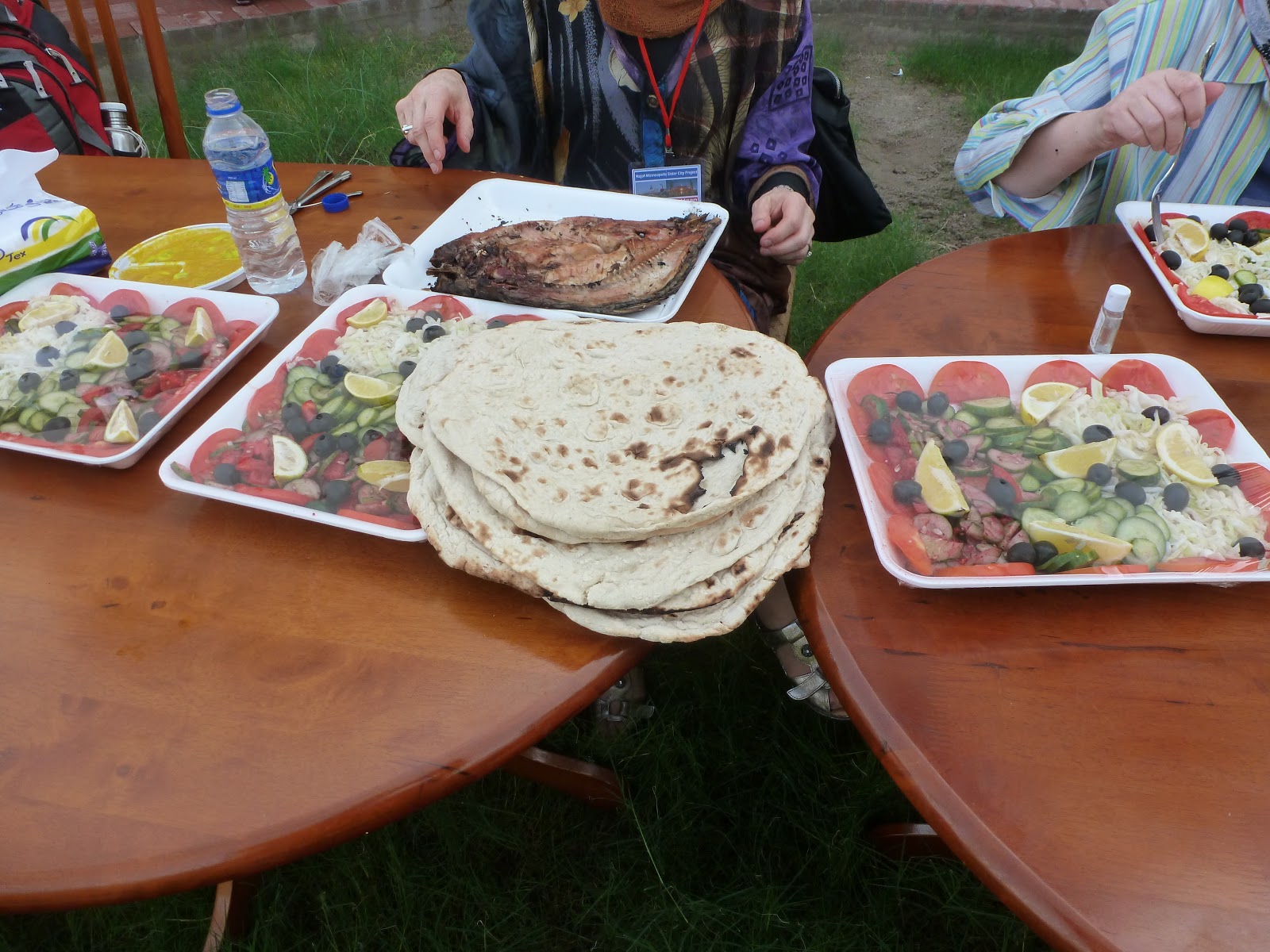
At the Guest House we are given a bag with some dried figs and canned nuts “to hold us over” if we were still hungry from our 31 hour-in-transit experience with 9 time zone changes. Not being a seasoned world-traveler, my body-clock is thoroughly confused – but I’m not hungry. But as soon as we are given our assigned, spacious rooms, we are reminded that there will be “breakfast” waiting for us in the restaurant on the level below our rooms. It is 10 AM by the time we begin to eat the fresh Iraqi bread (one of my favorite memories of my stay in 2002), cheeses, jellies, and other assorted foods – and the requisite hot tea, this time sweetened to our own desires rather than pre-sweetened.

We are given some time to freshen up and/or crash on our beds before being invited for lunch at 1 PM. We eat outside in the shade and feast on freshly-caught carp cooked on the grill. Tasty and nourishing! I ask Joan Haan, a good friend and fellow delegate to share the huge portion with me, knowing that we’ve already been told to gather at 5 PM to ride into the “old city” of Kufa for dinner and a welcome reception with the Governor of the Province of Najaf. Looks like we’re getting a real “taste” of citizen diplomacy.

It is hard to say in just a few words why I am here. I want to say, “I’m sorry,” for the actions of my government. I want to work on re-establishing relationships between Iraqis and Americans which forgo weapons and domination. I want to visit new friends in their homes and listen deeply to their stories, to weep and laugh with them. Most of all, I want to look my fellow peacemakers from the Muslim Peacemaker Team in the eyes and say, thank you for your courage and your witness. How can we work together to build a peaceful and just society?

I brought along with me a copy of the book by Greg Barrett just released before our trip, The Gospel of Rutba: War, Peace, and the Good Samaritan Story in Iraq. It retells the account of three of my friends injured as they left Iraq during the days of Shock and Awe – Christian Peacemaker Team members befriended and healed by “the enemy”. Their story, embellished by their return trip several years later to thank their saviors, reminds us of the importance of this work of reconciliation. I look forward to 12 days of connecting in ways that transcend “diplomacy” and help us re-connect with our common humanity and our relationship as sisters and brothers. These Iraqis are looking for partners; they have much to teach me when I’m ready to learn. “Inshalla”, God willing, as my Muslim friends remind me.  


A Message to Hillary from an Iraqi Doctor


A Warning to Secretary Clinton: Economic Sanctions Kill the Innocent by Steve Clemens. November 1, 2011
I sat across the table from my new friend, Dr. Ali, an Iraqi Radiologist who was visiting Minneapolis as part of the Sister City delegation from Najaf, Iraq. We were between scheduled appointments in a busy schedule which was set up by The Iraqi & American Reconciliation Project, the sponsoring nonprofit organization which helped bring 8 medical personnel and a journalist from Minneapolis’ newest Sister City to the country that continues to occupy his nation and people. What he told me yesterday morning serves as a cautionary tale that our Secretary of State, Hillary Clinton, must weigh before she continues her threatened assault on Iraq’s neighbor – and our latest nemesis – Iran. Her proposed weapon of economic sanctions should not be cavalierly invoked before we learn the lessons from our most recent experience in Iraq.
Dr. Ali was only 11 years-old when President Bush the Elder led the movement to place economic sanctions on the people of Iraq, hoping to force the withdraw of Saddam Hussein’s troops from neighboring Kuwait in 1990. An unprecedented bombing campaign and a very brief 3-day land war in 1991 that left Iraq in shambles but Saddam remaining in power quickly followed it. The U.S.-led economic sanctions remained in place for an additional 12 years until President Bush the Younger decided to complete his daddy’s war with his own. In the interim, President Bill Clinton kept the comprehensive economic embargo in place despite the cries from humanitarian officials who pointed out the consequences to the people of Iraq, especially the children. Hillary Clinton’s predecessor, Secretary of State Madeline Albright, serving under her husband’s presidency, notoriously observed that she thought “it was worth it” when asked by a journalist about the excess deaths of more than a half-million Iraqi children midway through this cynical attempt to have the Iraqi people rise up to overthrow the brutally repressive Saddam regime.
I visited Iraq in December 2002 as part of the Iraq Peace Team just a few months before our present long war was reignited the following March. For many of the Iraqi people, economic sanctions, combined with U.S. bombing on average every three days during the Clinton years, were just a continuation of war in a lesser form. I visited hospitals and schools, water treatment plants and homes and talked with Iraqis during that trip, shocked at the devastating toll the Iraqi people paid from wars and sanctions. I had no idea that almost 10 years later I’d be sitting across the table at the Riverside Perkins restaurant over coffee and hearing another personal story of the continuing tragedy.
At age 11, and coming from a Kurdish family now relocated just outside of Baghdad trying to avoid the bombing campaign, Ali had neither the power or the ability to rise up to overthrow the oppressive dictator, ostensibly the goal of the economic sanctions campaign – but he now bore the brunt of it. He told me that he often only had one or two meager meals a day for many years. In school he noticed how his teachers often had to take second jobs to support their families and his father had to take second and third jobs to support his large family which included four brothers and three sisters – with Ali as the oldest sibling.
He went on to tell me about his mother’s breast cancer that was diagnosed in 2000 while Ali was in Medical College. Her cancer remained untreated because no chemotherapy or radiation treatment was available due to restrictions under the economic sanctions. She died 1 ½ years after diagnosis, at age 40, from lack of proper treatment; her youngest child just over one-year old. The frustration and horror of not being able to get the medical care she needed was a major factor in Dr. Ali choosing to make Radiological Medicine his specialty after he graduated and completed his two-year medical internship. After six years of Medical College and two years of government-mandated internship, Dr. Ali worked another four years to become Board Certified as a Radiologist. He now must work five years in a placement approved by the Ministry of Health (based on need and his ranking in exams) before he is free to practice wherever he’d like in Iraq.  
Although he doesn’t speak the Kurdish language, Dr. Ali hopes to learn it and someday move back to the northern region of Iraq where his relatives come from. He would like Americans to better appreciate the suffering the Iraqi people have undergone not only from the wars but also the economic sanctions which so degraded and destroyed his country in less dramatic and slower (but as deadly) a way.
Now, if only Secretary Clinton and President Obama would take the time to talk to everyday Iraqis before threatening the mothers and children of Iran with the same failed policies. Hillary Clinton talks about empowering girls and women yet her strategies make them some of the first victims. One of the greatest tragedies from our wars is that we either learn nothing from them or learn the wrong lessons. As Armistice Day approaches on November 11th, let us join with my friends of Veterans For Peace to remember and reflect rather than glorify war and our warriors.