Showing posts with label Iraq. Show all posts

A Time to Forgive or Forget?


Standing outside UN Development Program office in Baghdad Dec. 9, 2002

After 20 Years – Is It Time to Forgive? By Steve Clemens


March 20, 2003 marked the beginning of (another) US invasion of Iraq. It was based on lies and anti-Muslim fears and resentments, but average Americans often believed their national leaders and the corporate media which basically silenced those who opposed military intervention.


Having traveled to Baghdad in December 2002 as part of an ad-hoc “Peace Team”, with the intent to be present with the Iraqi people in the face of a threatened “Shock and Awe” bombardment, I returned back to Minnesota 3 months before the war actually began. I used those 3 months to speak to more than 60 groups at schools, colleges, community centers, and churches about what I saw and learned about Iraq – hoping to galvanize the vocal opposition to the war. I concentrated my pictures with the faces of children, noting that these are often the primary victims of the brutal sanctions regime placed on the country by the US and Britain since 1991, and photos of power plants and water treatment facilities in complete disrepair.


After the war and occupation dragged on -much beyond the “cakewalk” promised by Rumsfeld and others, and well beyond the “Mission Accomplished” photo op of our President decked out in a flight suit on the deck of a carrier off the coast of San Diego, the mood in our nation began to gradually turn as more US military, mercenary contractors, and even embedded journalists failed to return or returned with missing limbs, head traumas, and/or PTSD. Notions of “the long war” arose as the occupation past the length of the Vietnam fiasco. And Afghanistan continued to demand more military sacrifices as well.


A local restauranteur I hadn’t met yet, Sami Rasouli, decided to return to his native Iraq city of Najaf to see for himself. Some local friends approached me to ask if I would join their efforts to find ways to financially support him and to help “broaden” his voice by sharing some of the Iraqi art he brought back with him to dispel the myths about the land and culture we were destroying. Those efforts eventually coalesced into what became The Iraqi and American Reconciliation Project, an NGO based in Minneapolis which worked to educate and encourage and heal the toxic divides in our country over the war and between Americans and Iraqis.


At Sami’s behest, we worked to have Minneapolis become a Sister City with his home city of Najaf, and Sami brought numerous delegations of Iraqi professionals to the US when visas could be secured. Finally, after President Obama removed US troops out of the country (and before returning them to attack a rising ISIS a little more than a year or two later), IARP accepted an invitation by the governor of Najaf to visit our Sister City in November 2012. The governor had us stay in a “guest house” overlooking the Euphrates River – a former gaudy palace built by Saddam Hussein during his brutal reign. Despite the destruction wrought in their nation and homeland by US and British militaries and mercenary contractors, the Iraqi people we met welcomed us with smiles, tears, and embraces. It seemed to me that they were willing to forgive -if not forget- those of us who traveled a great distance to be with them.


But the governing system foisted on the Iraqi people by the Occupiers, and, at the encouragement of former exiled “elites” like Chalabi, emphasized sectarian divides and power and privileges given disproportionally to sectarian militia or tribal leaders mostly at the expense of the ordinary Iraqi citizens. Corruption was rampant – both by US
contractors who skimmed off much of the money allocated to rebuild schools, hospitals, power grids, water treatment plants, … - as well as sectarian “leaders” who saw their opportunity to regain what they claim Saddam “stole” from them. Tragically this continues today.


On the 20th anniversary much of the US media used the term “mistake” when describing the invasion, war, and occupation. There were few voices that really identified it as a “crime” even though that same media used that term to describe Putin’s invasion of Ukraine. The irony of forgetting Abu Ghraib, “black sites” run by the CIA, Guantanamo prisoners, as well as the destruction of civilian infrastructure is not lost on other nations or Iraqis as we, as a nation, pivot to a Cold War with China as well as a proxy war with Russia.


We can’t ask the Iraqis to forgive us if we work diligently to forget what we did and fail to learn that military might cannot install either democracy or civility. Iraq continues be seen as still “unstable”. The US State Department lists Iraq as “Level 4: Do Not Travel” as of January 3 of 2023, adding, “Do not travel to Iraq due to terrorism, kidnapping, armed conflict, civil unrest, and Mission Iraq’s limited capacity to provide support to U.S. citizens.”


So, short of traveling back to Iraq – and, is there a government official there who would even invite us? – how can we work for healing and reconciliation today? At least one way is to get to know and welcome the Iraqis who have come here as immigrants, asylees, refugees, and visitors. Listen to their stories. Hear and learn from their experiences. Pay attention to the poets and artists, the playwrights and storytellers. Visit their mosques and attend iftar gatherings during the holy month of Ramadan. Ask questions. Have empathy. Open your arms. Welcome them to your homes. Say, “I’m sorry” without any expectations of hearing a word of forgiveness. How are individuals able to forgive what nations do to others? And read – start with A Stranger in Your Own City: Travels in the Middle East’s Long War by Ghaith Abdul-Ahad.

On Not Seeing American Sniper

American Sniper Movie

I have chosen not to see Clint Eastwood's new "blockbuster" film, American Sniper, for several reasons: I don't wish to add to the sales figures which continue to make it the #1 movie at the box office for 3 weeks running; I rarely spend $6-12 for a first-run movie, waiting until it comes to my local neighborhood theater for $2 senior rate; but, more importantly, what this movie symbolizes to my Iraqi friends.

When I traveled back to Iraq for the first time since going to Baghdad in December of 2002 as part of a Peace Team, the people I met in Najaf, Karbala, and Babil (Babylon) in November of 2012 were happy to greet an unarmed American - and they told us so. Unarmed, coming not to conquer nor correct but rather to connect and communicate face-to-face. Not looking through the scope of a rifle for potential targets but rather mingling with the masses in the souk, at the Shrines to their revered ancestors and leaders, and at the universities and grade schools. Looking there, instead of finding "insurgents" I found inquisitive people eager to engage me as a potential friend and partner. 

Yes, I must admit I also encountered some bitterness and disgust at what some had felt was directly linked to the American invasion and the long military "occupation" which followed. Some of my Iraqi friends think many of the corrupt and ineffectual politicians now running their nation were put in place or funded by - or at least took advantage of the chaos created by - the American military intervention. Many of my Iraqi friends, while having no love lost for the departure of Saddam Hussein, see the present conflict arising between Sunni and Shi'a Muslims as being a result of a divide-and-conquer strategy by America and it's principal ally, Israel. 

So a U.S. movie which doesn't bother to take the time to explain WHY a patriotic Iraqi might become an "insurgent" to fight against a foreign invader trying to put in place a government in his/her own nation - but instead has as its flawed "hero" someone whose autobiography calls all Iraqis "savages" ... Well it isn't hard to connect the dots to see how American Sniper will not help us work for the needed reconciliation between Iraqis and Americans. 

Ironically, all the controversy surrounding this movie might serve as a good reminder to Americans that all too often wants to "move on" to the next event-of-the-day (or week or month) that those on the receiving end of the American Empire don't have the luxury of moving on when infrastructure and relationships remain tattered and broken for most of our Iraqi friends. 

Remembering the Holy Innocents


Remarks for Children of War Candlelight Service December 28, 2012 by Steve Clemens
Children are our most precious resource. They are our future as well as reminders of our past. They embody our hopes yet their vulnerability makes them available prey for those who seek domination over others.
Ten years ago this evening, Peter Thompson and I were here showing photos of Iraqi children we had met – having just returned from Baghdad three months before our war-of-choice began. We don’t know the fate of most of those children but all of them had their lives severely impacted by the actions of our nation and its military machine. So part of me comes with a heavy heart tonight, remembering their smiling faces, their eagerness to have their photos taken – wondering if they were allowed to make it to their teens and early 20s, and if so, with what physical, emotional, and psychological scars?
So the opportunity presented itself this year to return to Iraq, now that most of the US troops are gone and we are no longer at a state of war with them (although war was never declared – small comfort to those on the receiving end of bombs and bullets); some of us received a beautiful engraved invitation from the Governor of the Province of Najaf. My immediate response was “let’s go!” Originally planned for March, it didn’t happen until November after messages of disappointment that the cultural celebration we were invited to participate in had been postponed and then canceled.
Many of you know that Minneapolis is a Sister City with one of the largest cities in Iraq, the holy city of Najaf. This city is about two hour’s drive from the capital city of Baghdad and has an older, neighboring city, Kufa, which lies on the Euphrates River making it very similar to our own Twin Cities. Najaf is home to the world’s largest cemetery because it is also the location of a shrine to one of Islam’s most revered leaders, Imam Ali, the son-in-law of the Prophet Muhammad and many devout Shia Muslims wish to be buried near his shrine. The photos being shown tonight were taken in the Province of Najaf at schools and neighborhoods I visited last month with friends from the Iraqi & American Reconciliation Project.
When we hear the Bible story of the birth of Jesus, what follows quickly is a story of the visit of “Wise Men from the East” who have heard of a special child being born. Empires are always fearful about anyone who could disrupt the present order, especially the potential of other leaders arising who could contest their domination of others. Herod, the King appointed as a vassal ruler for the Roman occupiers of the land we now know as Palestine and Israel, owed his power and wealth to the Romans and would tolerate no opposition. If “Wise Men” traveled a great distance to “worship” at the birth of a new leader, this baby was a threat unless he was part of Herod’s “royal” family. Therefore, an order goes out from the palace to kill all the newborns. Joseph and Mary, having been warned in their dreams, quickly take their infant son out of the country. But, the story goes, many infant children did not escape the terror of an empire bent on keeping power over others – even if the victims were children under the age of two!
Many here tonight know about the war against Iraq in 1991 that was followed by 13 years of brutal economic sanctions against the Iraqi people. Some of you know how those economic sanctions destroyed much of Iraq’s economy, devaluing the currency to such a drastic degree that many children dropped out of school to try to earn a little money to help feed their families. Iraq lost many, many children, a whole generation to that cruel policy kept in place by the US and British governments. United Nations experts estimated that more than ½ million children died unnecessarily because of those policies. This service tonight is the 15th year we have gathered to remember the young victims of war. It was that cruel, relentless policy of economic sanctions which led Marie and others to begin this service of remembrance and reflection. Tonight, even as we gather, those economic sanctions are now directed toward new victims in Iran.
Most Americans think the second Iraq War is over since most US troops left Iraq last December. The past several years had witnessed far fewer deaths than the period of intense fighting by people labeled as “insurgents” which occurred primarily during 2005 to 2007. But the aftermath of war and the chaos following the devastating destruction of the nation’s infrastructure continues. Despite billions and billions of US tax dollars squandered under the promise to rebuild Iraq into a flowering democracy, there still is only intermittent electricity available from the national electrical grid which must be supplemented by neighborhood generators, privately owned, and sold to those who can afford the greatly additional charges. The water flowing from the taps is polluted and contaminated, a toxic stew for the poor who can’t afford the cost of a water-filtering device and the weekly and monthly costs of replacing filters.
But less I paint too dark a picture, there was another startling sight: Iraqis who had every right to sneer and scorn visitors from the nation which had visited them with such wanton destruction welcomed us last month with not only open arms but warm hearts. We were lavished with so much food and affection we felt like royalty. The fact that we came unarmed, as friends rather than conquerors, was deeply appreciated. I could go on about our visit but that will have to happen another time since our focus tonight is on the children.
Many of the children we met when visiting schools where the Muslim Peacemaker Team had installed water filters had not even been born before the US campaign of “Shock and Awe”. They never lived under the brutal dictatorship of Saddam Hussein. Although the effects of war linger, they are no longer victims but survivors who need and want partnerships with us. The older high school students and young adults in the colleges we visited were eager to try out their English with us. Many are seeking exchange programs to study abroad to widen their horizons. But there remain many challenges. Visas to come to the US are very difficult to come by and the cost is prohibitive for most who continue to struggle economically.
In a poor neighborhood we visited, the families lived in “homes” they were allowed to build as squatters - but they did not own the ground under those structures. A family that graciously welcomed us in apologized when the lights went out so we were forced to meet outside so we could see one another. As the men sat and discussed in one area, the women and children gathered by their kitchen area where they learned that some of the children did not attend school because they couldn’t afford the “uniform”-dress expected of them. 
This year, however, the thoughts of many Americans will be focused on the 20 innocent children gunned down at the Sandy Hook Elementary School in Connecticut two weeks ago. And we should mourn their loss as well as the teachers and other adult school staff. Maybe this loss will help us as a people gain empathy for the other Holy Innocents victimized each week in Afghanistan, Pakistan, Somalia, Yemen, and elsewhere by un-manned aerial vehicles, drones, with the names of Predator and Reaper as though they are part of nature’s own cycle of life and death rather than the macabre machinery of military domination.
The Biblical story of King Herod killing the Holy Innocents in his frantic attempt to destroy any possible competition to his political rule is how all empires react to threats they perceive. If we wish to stand with the Holy Innocents, we must stand in opposition to empire, the creator of more victims. The candles we light are reminders that even in the midst of darkness, we are called to bear witness to the light we have been given. Quakers are known for reminding us that everyone has a spark, a glimmer, a light within – that of God or the divine within each of us. May we fan, feed, nurture that spark within us, within each other as we remember the lives lost, the futures squandered, the hopes dashed by war and help us to recommit to stand with the survivors demanding an end to the violence – especially that visited on children. 
We remember the survivors of the empire’s violence – first Moses, escaping from the decree of the Pharaoh to kill all male Hebrew children, then Jesus, being taken to Egypt to escape the murderous King Herod; they were survivors. These children whose photos you see are also survivors. May we stand with them as we say a loud “No!” to those who seek to do them harm.

Planting Peace on Day 9


Planting Peace on Day 9 in Najaf, Iraq by Steve Clemens

The interpreter called me aside saying, “Mr. Steve, this man would like to ask you a question”, after we had just planted 70 trees in the street median of the Salam District of Najaf, Iraq’s Sister City to Minneapolis. The young man in his 20s, the left side of his face obviously indented and scarred, looked at me and asked through the interpreter, “Do you know a humanitarian organization that can help me [fix my facial injuries]? I was injured by the Americans while I was a student at the University.” I told him I was sorry for his injury and I would ask others when I returned to the US.

This happened after a busy morning and afternoon. The session in the morning was held at a women’s development organization (NGO) led by Dr. Batool, one of the 25% of the Iraqi Parliament who were elected as women. (The Constitution of Iraq mandates a minimum of 25% females in the legislature.) The women among our Minnesota delegation were hoping for a more intimate conversation about women’s concerns in both Iraq and especially the conservative area of Najaf. However all the interpreters were male and the program was moderated by a man. It was my hope to give the women the space they needed for this important dialog, much of which happened out of my hearing during lunch.

Many of us felt the conversation was cut short in order to leave for our next appointment and then we waited for the trees and the Plant A Tree Team to arrive. But it was worth the wait. When the young people arrived with the 70 Iraqi-type of locust trees (raised in Kuwait), we quickly sprang into action. One man dug a hole in the sandy soil of the median strip between at least 3 lanes of traffic on each side (as if traffic actually stayed in designated lanes!). The holes were at least a meter from the last or next plant. A seedling tree about 12-15” high was removed from the plastic bag which protected the root ball. Then either an American or an Iraqi gently placed the young tree into the hole while the other scooped damp sandy soil around the roots.

Cameras clicked to capture the moment; traffic slowed to see what was happening; the Plant a Tree members held a sign: “Plant a Tree … harvest peace”. The city manager who helps provide the trees came by to greet us and have his photo taken alongside us and the Team.

After we finished and posed for a group photo, I asked Ahmed, the group’s coordinator and obvious animator if there were any young women who were part of this organization. He smiled a little sheepishly at first and then pointed to the 2-year old daughter of one of his Team who had indeed helped us push sand into the hole and said, “One”. I encouraged him to recruit more. He inquired if there were any NGOs in the US that might partner with them, I told him there are many environmental groups in the US and we should look for them together with our Facebook connections.

I’ve read numerous accounts of US troops bulldozing down hundreds of date palm trees here in their rush to control the landscape and people in 2003. Our 70 trees are just a small symbolic part of our repentance and a beginning journey of reparations coupled with a genuine desire for partnership as we move forward toward a greener and more peaceful world. 

A Day of Service - Day 6 in Iraq


A Day of Service: Day 6 Back in Iraq by Steve Clemens

The action was purely symbolic. After our tax dollars were spent creating rubble in this land of early civilization, it is time Americans started cleaning up the mess that was created by our destructive obsessions. Picking up litter and debris from a neighborhood street is designed as a symbolic act of repentance (I didn’t pack sackcloth in my suitcase for this trip) as well as an act of humility for Americans who came as conquerors rather than partners.

Members of the Muslim Peacemaker Team as well as a representative of the NGO organizing Najaf as the 2012 Cultural Capital of the Islamic World joined with us in picking up in the neighborhood where Sami Rasouli resides. I was honored to have his youngest son, Omer, just turned 5 years old, as my partner. He held the trash bag as I picked up and then I held it for him. Several of the neighbors came out to see what we were doing and some wanted to take photos as well.

Sami described the virtually non-existent garbage collection process for neighborhoods which are not part of the downtown tourist area and remarked, “If you are a Prince and I am a Prince, who will lead the donkey?” as an explanation why many men in the Arab culture stand by and let the women do a lot of the work. He hopes to break the stereotype and Omer was eager to join us.

Actually today was a day which called for a lot of flexibility. We no longer had access to the Foreign Ministry’s vehicles for today so MPT secured some 4 seat pick-up trucks and some cars to transport us with MPT members as drivers. Last night we decided that today we would go to a school as a brief stop before our service project to distribute the letters Jess Sundin gave me from her daughter Leila’s class. The original plan was for ½ the group to go to the girls elementary school and the other half to the boys school across the street but we all ended up at the girls school.

After being greeted by a supervisor/inspector from the Education Ministry, the Principal told us she had a brother who lives in Minnesota who is married to a woman from Lebanon. She welcomed us and introduced us to one of the teachers of English. I read the letter Jess had written to the school and Sami translated it so all could understand and showed them the photo of the Leila’s class. The teacher suggested we give the letter to the sixth grade English class since the students would better be able to read the English words.

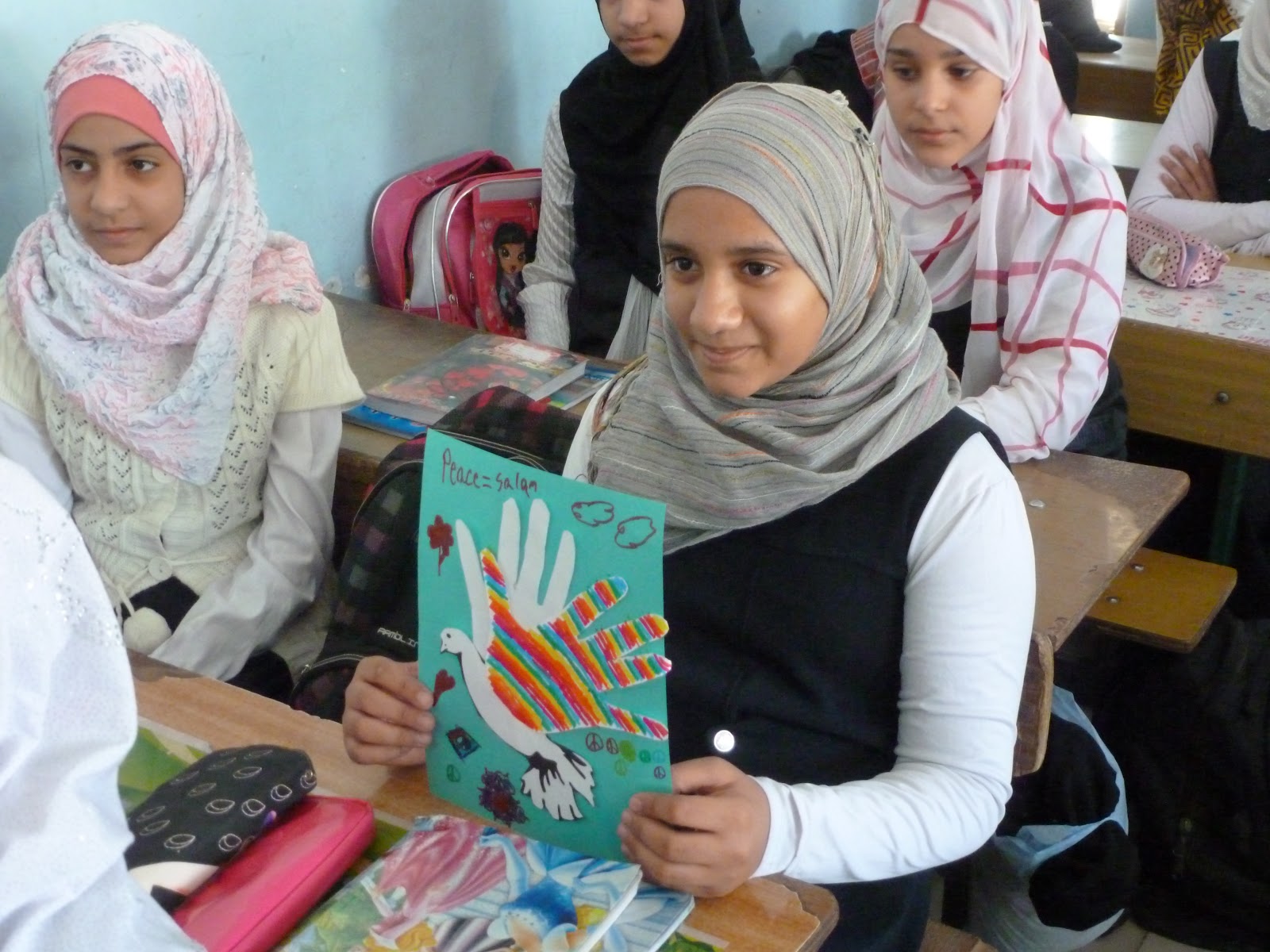
The girls smiled broadly and greeted us as we entered and Sami asked me to say a few words before distributing the 16 letters. Since there weren’t enough letters for the approximately 25 girls, the teacher handed them out to each recipient. Each “letter” had a dove on the backside which the American students had decorated. That small gesture of reaching out to other students will hopefully help these future leaders of Iraq see at least some Americans in a different light than the fear and anger they experienced during the occupation.

The plan was to do the trash pickup and then travel to the local Al Sadr organization – a “Black Panther-style nationalist” group who show their solidarity with the poor by service programs. By their opponents they are mostly know for their militancy but by those who receive necessary aid, they become heroes. Alas, it was not to happen today as our schedule kept slipping. The school visit, designed for 20 minutes lasted almost an hour and then we walked nearby to see where Sami and his family lives. Their baby had been fussy the other evening so we missed seeing Suad and Roi’ea but we got to spend time with them this morning. The home is simple but welcoming.

Sami explained to us how the water filter works in his home. First he filled a small bowl with filtered water from his wall-mounted unit and then a second bowl of water from the tap – city water from Najaf. After it set for a minute and both appeared to the naked eye to be alike, Sami put a saline tester into first the filtered water, then the tap. As he was doing this, he explained that 1-120 was acceptable for drinking. The filtered water scored 31 and the initial reading for the tap water was a little over 120. Sami said, “Oh, I should have shaken the filtered water out of the device before measuring but even before he could, Deborah, who was filming this “experiment” exclaimed, “Wait, Sami, the numbers are continuing to go up!” She counted over 200, over 300, up and up until it stopped at 986. But Sami wasn’t finished his demonstration. He next took an electrolyzer, similar to an immersable hot water heater, placed it in the cup of filtered water and plugged it in. As it heated the water toward boiling, it grew amber in color from the minerals in the water reacting to the heat. Next the tap water. As it heated up, it grew darker and darker until almost pitch black. He removed the electrolyzer, stirred the tap water and we were both amazed and horrified as he said, “Many of the poor families have only this to drink because they can’t afford a filter or the bottled water.

Sobered by the stark inequalities, I still needed to demonstrate my faith in the water filters that my wife Christine and I have contributed toward under the IARP Water For Peace program. I asked Sami if I could drink a glass of his filtered water and he handed me a glass filled to the brim. It tasted fine, and now, eight hours later I am still fine. Others in the group might not have been ready to drink up but a half an hour later when Suad, ever the gracious hostess brought it a tray full of glasses of filtered water, almost all the others drank as well. I’m convinced this Water For Peace project is a life-saver.

After learning about the present realities of trash pick up and sanitation in Najaf from Sami, we did our service project, washed up thoroughly afterwards and then walked to lunch since it was now too late to meet with the al Sadr people.

The sumptuous meal took quite a while of our afternoon, having to move from one table to another for our desert and then wait for the tea to be served at the end. By the time we left the restaurant, it was time for our bridge vigil to begin but we did not bring the signs with us. The original plan had us returning to the guest house for a rest before the vigil. Instead, Sami asked if he could drive us to one of Najaf’s poorest neighborhoods. When delegations from Iraq come to Minneapolis, the city tour they receive does not usually include either the near Northside or Phillips Neighborhoods. I know Islamic Cultural Capital folk won’t include this neighborhood either but Sami wants us to see all sides of the reality of Iraq today. After all, if our guest house is a former Saddam palace, we need to experience the other side as well.

Sami takes us to the home of a man who worked as his gardener several years ago. He graciously invites us in and brings carpet for us to sit alongside the walls of his courtyard/garage because the lights have gone out in his house and he is not on the private generator list for the supplement. Actually, no one is on the list in this neighborhood because you don’t see all the additional wires connecting each house. Our host pours the men coffee as the women go to the side of the house to greet his wife and children. He tells us 14 live in his 200 square meter house and the man next to him has 23 people in his house.

Although we dropped in unannounced, the room quickly fills with other men who want to meet his visitors. As we prepare to leave, he asks us if we will return tomorrow because he’d like to host us for dinner! Sami tells us, “Please just tell him thank you (in Arabic) and I’ll respond to him.” These people are the salt of the earth and we are honored that they can receive us as friends. They may never meet the Governor while he will entertain us later in the week. Something to ponder as we close another full day.  

Day 5 in Iraq


What We Take For Granted: Day 5 in Iraq by Steve Clemens

It struck me in the middle of the night – why did it take so long to upload my photos to my blog? Only when one of my room lights mysteriously went on at 12:30 AM did I make the connection: certain outlets or fixtures are on only when the national power grid is on; others stay functioning when the generator is running because the power is down. Here I thought maybe the light bulb was defective when in reality it was my assumption that electricity should work all the time.

I remember the panic I went into 10 years ago in Baghdad when as a matter of habit I rinsed my toothbrush after brushing with the tap water – momentarily forgetting that I was told clearly that only bottled water was safe in sanctions-riddled Iraq just before the war. Again, I take safe drinking water for granted. Here we must stick to bottled water because the water treatment plants have not yet been restored to a healthful state.

It might be easier on my nerves if I didn’t sit in the front seat of the vehicles that ferry us from site to site here because the drivers are not only aggressive cutting in and out of traffic – there really isn’t any specific lane the cars and trucks stick to. Because there are so many bridges, underpasses, and highways under construction we frequently are making U turns and it often seems to me that the oncoming traffic doesn’t plan to stop for us. So far, praise be, we haven’t wrecked although a guy on a motorcycle glanced off the car in front of the one I was in the other day and our driver rolled down his window to be sure he was OK before taking off.

Air. The dirt seems to hang in the air for several days after the mini-sandstorm we had on Saturday. Locals tell me it takes a good steady rain to really clear it and so far we’ve had “rain” two or three times, including thunder and lightning last night, but not enough to wash the grit from the sky. Again, I take clean air for granted.

Food. Arab hospitality here seems to go overboard in the quantities of food we are served at almost every meal. I assume a lot of it goes to waste but I’m not around when the scraps are picked up. Does it go to the poor, to the wild dogs outside, to employees’ homes, or just in the trash? I fight the urge not to care about such important justice matters yet want to be a gracious recipient of the hospitality. I take it for granted that I’ll have enough to eat; many others in our world do not.


History. This morning we traveled to a smaller town, Al-Mishkab and met with the mayor of a town which (he claimed) was settled before either Kufa or Najaf. Resting beside the Euphrates River, it is (or was) an archeological treasure trove because of the nearby 50+ sites dating back to when Christians and Jews were the primary residents – well before the founding of Islam. However, in 2003 after the U.S. invasion and occupation, many of these sites have been looted of the ancient artifacts by “foreigners”. Because they were speaking in Arabic, I couldn’t discern if the predominate feeling was one of anger or great sadness about the grave robbers but it was clear that they held the U.S. responsible. After all, U.S. troops famously stood aside as the Baghdad Museum was looted and trashed, instead protecting the Ministry of Oil. Secretary of War Rumsfeld laconically said, “Shit happens” when it comes to war - as if it was inevitable.

We drove out past farming villages raising cattle to see one of the areas where numerous holes had been dug and where shards of pottery were scattered around the empty holes. Farmers were threshing their rice several hundred yards in the distance. There was a definite sense of melancholy in looking at the empty holes realizing the amount of grave robbing that occurred. I often take for granted that people will respect history but there are always some interested in seeking a quick profit instead.

Food and water. Our next stop nearby led us past acres of rice fields irrigated by the nearby Euphrates. We visited a rice research facility and talked with the manager. He told us of all the various varieties of rice and especially focused on the amber rice produced in that area of Iraq which commanded high prices for its quality, taste, and the labor needed to bring it to market. He was especially concerned about the significant drop in the water level of the Euphrates and its growing salinization, both of which were affected by the dams Turkey has placed on the river before it enters Iraq. The Fertile Crescent, Mesopotamia, won’t be so fertile without water to grow the food.

There has been a lot to learn as part of this Sister City/Reconciliation delegation. Too often I take for granted my ability to fly halfway around the globe for peace and justice, failing to remember what responsibilities need to go hand-in-hand with my privileges.