Choosing Jail: Experimenting With Redemptive Suffering
Busted in Front of Nuke Weapons Plant
Two Minnesotans Arrested For Declaring Independence by Steve Clemens. July 5, 2010
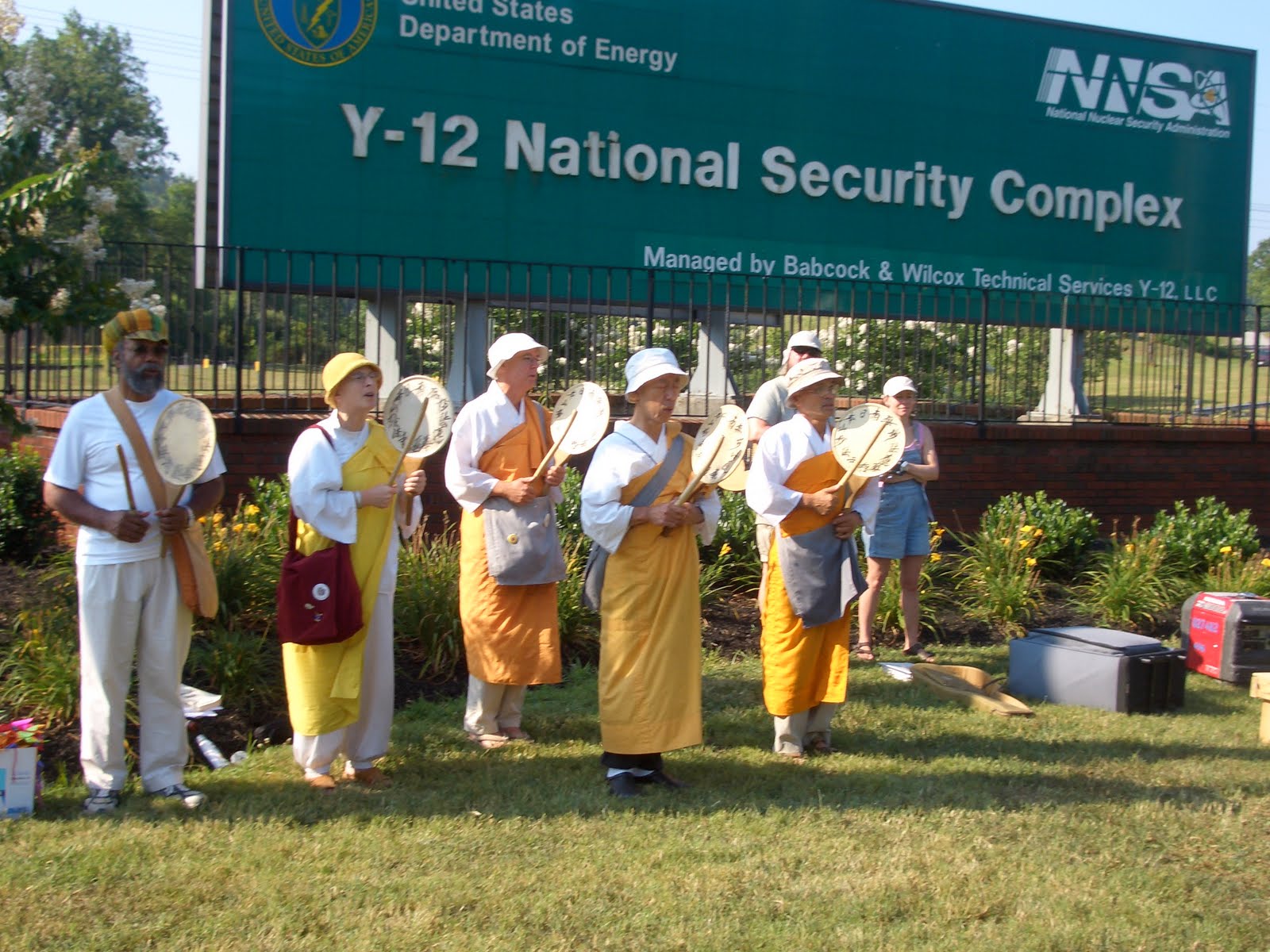
37 anti-nuclear activists were arrested this morning at the entrance to the Y-12 Nuclear Weapons Plant outside Oak Ridge, TN as part of a group under the statement “Declaration of Independence from Nuclear Weapons at Y-12”. Twenty-three people were arrested for blocking the highway entrance to the plant with a banner inscribed with “Independence From Nuclear Terrorism” while 14 others went under the barbed wire fence and nonviolently entered the property. The former group faces state “obstruction of highway” charges, a misdemeanor; the latter group faces federal trespass charges. This more serious charge can result in up to one year in prison and a fine of up to $1,000.
The group arrested included Steve Clemens from Minneapolis and Pepperwolf from Red Wing. Both are members of the local AlliantACTION group which protests radioactive weapons made by Minnesota’s largest war profiteer, Alliant Techsystems in Eden Prairie at a weekly vigil. They attended a weekend conference held in eastern Tennessee along with three others from the Twin Cities area. The conference, “Resistance for a Nuclear Free Future” was scheduled to celebrate the 30th anniversary of Nukewatch, The Nuclear Resister, and the Plowshares 8, the first act of nuclear disarmament by activists at the GE weapons facility in King of Prussia, PA.
Four of the original Plowshares 8 members were present as was the widow of a fifth. They were joined by close to two dozen other Plowshares activists, one of who has served over 18 years in prison for his nonviolent resistance to the bomb. Over two hundred attended the event held at Maryville College, about 25 miles from Oak Ridge, the site of the enrichment of the uranium for the first atomic bomb dropped by the US on Hiroshima, Japan in August 1945.
But the Y-12 Plant, renamed the “Y-12 National Security Complex” after the September 11th attacks, is not just an historical landmark – it remains as a central cog in the nuclear weapons machinery today. OREPA, the Oak Ridge Environmental Peace Alliance, is one of several groups organized in opposition to our present nuclear policy. They informed the conference about the misnamed “Life Extension Program” under which the Y-12 plant is refurbishing all US nuclear weapons so that they can continue to threaten others for another 100-120 years. Under the guise of “modernization”, they are part of a plan to build a whole new generation of nuclear weapons with greater accuracy – now to hit unknown targets with the collapse of the Soviet Union, the excuse used in the past to justify the trillions spent since the 1940s.
The arrested activists carried with them “A Declaration of Independence from Nuclear Weapons at Y-12”. Stating “… Current Law requires an end to all planning, preparation, production, threat, or use of nuclear weapons and adherence to the fundamental rules and principles of Humanitarian Law”, the declaration described the illegal nuclear weapons designed at the Y-12 plant and claimed that “… we exercise our duty to protect children and future generations.”
Ironically, the new START Treaty President Obama is pursuing is being coupled with a promise to spend billion of tax dollars to build newer nuclear weapons to replace some of those being dismantled by the Treaty in order to secure Republican votes in the Senate for it. In fact, Obama’s 2011 budget calls for an increase of 14% for the NNSA nuclear weapons program, the largest increase for any federal agency while at the same time calling for zero increase in education and the environment. As one conference speaker said, “follow the money. Bob Dylan once said, ‘Money doesn’t talk – it swears!’”
Despite the seriousness of the conference topic, there was much laughter and celebration. Guy and Candie Carawan, folk singing troubadours from the bygone labor and civil rights struggles traveled from nearby Highlander Center to lead the conference in songs; several anti-nuclear activists from Australia led a contingent of clowns which greatly enlivened the resistance arrests. Puppetistas and skits both informed and entertained. It was a celebration of continued nonviolent resistance to both nuclear power generation as well as nuclear weapons over the past three decades.
Many of those gathered had been “jailed for justice”, many meeting one another behind jail bars over the years. There were many joyful reunions from people scattered all over the country. Two of the veteran leaders of the movement told jokes or funny stories from their numerous protest actions. A priest in his 70s wept as he listened to a sister arrestee talk about what their action together decades ago did to change her life and inspire her life-long commitment to peace with justice.
Although many Americans associate the “ban the bomb” movement with either the 1950s or the 1980s, a young peoples contingent calling themselves “Think Outside the Bomb” is stepping forth to join the veterans of the anti-nuclear movement. And as politicians look desperately for alternatives to the environmental and climate threats posed by fossil fuels (think of the catastrophe in the Gulf of Mexico and the recent coal mine disaster, not to mention mountain-top removal or threats to wilderness areas), many are jumping on a bandwagon under the illusive promise of nuclear power as a “clean energy”. Nevermind the fact that Wall Street refuses to finance new nuclear facilities, there is no feasible solution to either nuclear waste storage nor any viable plan BP deep water oil rig.
This conference and the act of resistance by the activists are timely reminders that we must be careful of our decisions and directions, choosing peaceful, sustainable technologies for future generations and ourselves. Many of my own personal heroes and mentors were there including Liz McAlister , Kathy Kelly
, and Frank Cordaro. And I met several peace legends for the first time including Brad Lyttle, a Freedom Rider and activist since the 50s , Sr. Anne Montgomery, also in her 80s and continuing to resist. It was a privelege to be arrested with them.
A Difference Between Night and Day: A Tale of Two Judges

A Difference Between Night and Day: A Tale of Two Judges by Steve Clemens. April 25, 2010
My trials were 7 months apart, almost to the day. One was in neighboring Ramsey County, the other in my home county of Hennepin. Both were for the same charge: criminal trespass and both ended with a somewhat similar sentence: continuance towards dismissal with conditions. In Ramsey County it was “no same or similar for 1 year”; in Hennepin it was “no arrest for trespass at ATK for 6 months.” However, the Ramsey sentence, besides being longer in duration also harbored a more threatening restriction – no arrest [for protest] anywhere in the world, whereas the Hennepin County Court Judge, instead of threatening told us we were welcome to “return to the scene of the crime” (so to speak) by attending the weekly Wednesday morning vigil; we were just to avoid going on Alliant Techsystems property for the next six months. But, if we did, we’d still qualify to get the jury trial we originally planned for –albeit not a speedy one.
I think the differences we experienced in court demonstrate how subjective justice can be with our present system. Much of the experience depends on the judge assigned to one’s case. On the surface, I’d suppose that an African American judge might be somewhat more sympathetic to civil disobedience and principled public protest because without precisely that happening 50-60 years ago during the Civil Rights struggle, we would likely not have many jurists of color on the Bench. That said, one only has to look at the record of Clarence Thomas on the US Supreme Court to disabuse one of stereotyping Black judges as progressive.
But it was an African American District Court Judge I faced in September 2009 for the prior year’s arrest at the Republican National Convention. Judge Edward Wilson, however, had no patience whatsoever with our desire to discuss the US Constitution, International Treaties and Laws, UN Resolutions, or even the MN State Constitution in our “Claim of Right” defense for the trespass charge. Never before had I faced a judge so controlling in this my 5th jury trial on identical charges. In fact, 3 of the prior 4 juries found me “not guilty” after hearing our testimony; the only guilty verdict coming in the wake of 9/11 and the initial popularity of the Afghan War.
So, given Judge Wilson’s hostility, especially evident when I attempted to testify in my own behalf and was interrupted about 30 times by either the Judge or the Prosecutor, it was no surprise that the Ramsey County Judge slapped a $100 fine (or 20 hours of community service), insisting that it also be done in his county, not “anywhere in the world” like his “no arrest” restriction plus $81 in “court costs” which could not be substituted with community service.
The contrast in the Hennepin County Courthouse this week couldn’t have been more pronounced. At first, our trial date was set for April 15th, Income Tax Day. The assigning judge instructed us to go to Courtroom 753 and present our case to Judge Peter Cahill. I’ve written elsewhere about that experience (A Hearing in Lieu of a Trial) which concluded in an official Court Hearing on Friday, April 23rd. Over the weekend I wrote letters to ATK’s new CEO, Mark DeYoung as well as to Eden Prairie Police Lieutenant Tracy Luke inviting them and other arresting officers to attend the Hearing to see what we had to say. Email requests for media coverage were sent to local reporters as well in the days prior to the Hearing.
Promptly at 9 AM, Judge Cahill took the bench and welcomed us. I made a few prefatory remarks about how we wished to proceed and thanking Lt. Luke for her presence in the Courtroom. I made an Opening Statement on behalf of all the four defendants and then Sr. Kate McDonald took the stand. The 80-year old nun began by reading the “Commitment to Practice Nonviolence” statement that is read every Wednesday morning at the beginning of the circle of sharing time during the vigil by the driveway entrance to Alliant Techsystems. She described how she and 20-30 others come every week to call for the end of the production of indiscriminate weapons, calling instead for “peace conversion with no loss of jobs”. She talked about her present literacy teaching work with immigrants and why she felt the need to walk up the driveway on that October morning in an attempt to talk with the CEO of Minnesota’s largest weapons manufacturer.
Geri Eikaas, a 71-year old grandmother who joined the weekly vigil two years ago as the company was moving to Eden Prairie from Edina, took the stand next. She talked about her long involvement with Amnesty International in working to free political prisoners and prisoners of conscience. Recounting how that world-wide movement was sparked by the efforts of one man, Englishman Peter Banenson, who wanted to protest an unjust imprisonment of two students he had never met before who were given a 7-year prison sentence for “toasting freedom” in Portugal, Ms. Eikaas stated that individuals can do great, wonderful things. While she continues to write letters on behalf of political prisoners half a world away, she also wanted to personally address what was happening in her own backyard. On the witness stand she looked at a newspaper photo from 2004 of two Afghanis sitting on a wooden bench at a Red Cross center in Kabul. Both had lost a leg to Soviet landmines that had probably been planted in 1979. Those victims, she said, were part of the Soviet legacy. Noting Alliant’s manufacture of landmines, cluster bombs, and depleted uranium munitions, she said she didn’t want more victims as America’s legacy in that same nation. That is why she felt compelled to act.
Noting ATK’s claim that “If our American men & women are sent in harms way, we want to see them protected and we take that very seriously.” quoting Rod Bitz, one of their public relations staff, Geri went on to describe another spokesman for ATK’s ammunition division announcing their plan to “go after international business to offset any slump in our business with the U.S. Army.” Showing that ATK is now selling AK-47 bullets to Afghanistan, while also noting the estimate that about 1/3 of all material given to the Afghani Government ends up on the black market, she wryly asked, “How long do you think it will be before these same munitions are used on our American soldiers?” She ended with a sad question: “Who profits? Who Dies?”
The Judge was seen taking notes and was obviously engaged with the testimony. He paged through the 32-page document, Employee Liabilities of Weapons Manufacturers Under International Law, which the group had carried with them to give to the CEO; now the Judge had a copy, marked Exhibit 1 after it was put into evidence for the case. As Ms. Eikaas finished, he started to ask a question about some of these weapons but then said he’d wait to hear the rest of the testimony because he felt it might answer some of the questions he had. With that, he called another 71-year old defendant to the witness stand.
Roger Cuthbertson often flies one of his colorful kites on days when the wind is right during the vigil. One of the kites he likes to fly over the parking ramp in front of ATK’s entrance reads “PU DU” referencing his personal disgust and outrage over the manufacture, sale, and use of depleted uranium weapons. Roger described in greater detail how depleted uranium weapons and cluster bombs work in battle and continue to kill, maim, and cause serious health issues, primarily to civilians, long after a war has ended. His description of these weapons confirmed how indiscriminate they are in affecting not just other enemy combatants but also our own soldiers and civilians.
Mr. Cuthbertson told the court he had been a public school teacher for 32 years after serving two years in the Philippines as a Peace Corps Volunteer at its very beginning during President Kennedy’s Administration. He said, “I guess you could say that I have been a person interested in peace and justice and active citizenship, for about 50 years. I have been protesting against weapons production even before Alliant Tech was formed out of its parent company, Honeywell.”
After speaking at length about some of ATK’s indiscriminate weapons, Cuthbertson concluded, referencing the arrest took place during a special vigil honoring Mahatma Gandhi’s 140th birthday, “What was resonating in my mind on Oct 2, 2009 when I tried to visit ATK was Gandhi’s statement, “Whatever you do may seem insignificant to you, but it is most important that you do it.” I read this statement out loud to my friends gathered at ATK before our action. I did do something that day. What I did was not violent or threatening in any way. I did not hurt any one. I am not trying to evade the consequences of my action. I do not feel guilty of any committing any offense. I did not destroy property. I thought long and hard about my action before taking it. I made sure I was reasonably well informed. I thought of my children and my grand children and the kind of world I want for them and for the millions of children like them around the world. Some people were a little bit inconvenienced by my action, but that is all the harm that was done. What I did is to demand a chance to talk to the decision makers at Alliant Tech about their immoral, illegal activities. What ATK is doing is more than inconvenience. It is producing large scale violence and death for profit.”
It was shortly after 10 o’clock when I took the witness chair. I’m always a little nervous or anxious every time I’m called to testify although it seemed easier this time without the awkward position of having the Judge seated on one side of you and the jury on the other side. This time it was only the Judge, Court Reporter, the Court Clerk, and many friends in the audience section of the courtroom. Fortunately my wife had the day off from work and was able to be there in support. Besides a copy of what I had to say, I also carried photos, a letter, and a collection of other documents I carried on the day of my arrest which I hoped could be placed into evidence. Juggling all those things and trying to remember to pour a glass of water for my parched throat added to my own personal drama.
I described a little about myself and how a semester abroad in college sparked my interest in international law. My commitment to peacemaking saw its genesis when I had to register for the Draft during the height of the Vietnam War. Quoting what is known as “the supremacy clause” of the US Constitution, I then read brief excerpts from Treaties signed by our federal government that now are considered (according to the Constitution –if not most US Judges) “the supreme law of the land.” I read from The Hague and Geneva Conventions, the CCW Treaty of 1980, the Treaty establishing the Nuremberg Tribunals and the Nuremberg Principles. All of this to the effect of highlighting the prohibition in international law of “indiscriminate weapons.”
I recounted my journey to Iraq just prior to the start of this present war as part of the Iraq Peace Team. Showing photos of a Pediatric Cancer doctor and two of his patients, I shared what he told me about the dramatic rise of cancers in the area where depleted uranium was used in the 1991 War. I showed photos of myself and Iraqis in the area called “the Highway of Death” to see some of the destruction wrought by depleted uranium weapons in that first war. Showing an additional photo taken the day of the arrest of a new Iraqi friend, I described the Sister City visit of Dr. Najim Askouri, an Iraqi nuclear physicist, to Minneapolis in the two weeks prior to October 2 and how the letter I carried with me that day told ATK’s CEO about the Iraqi delegate’s deep concern and anger at the contamination of their country by dU weapons make by his company.
I concluded my testimony by describing how the International Committee of the Red Cross, charged by the United Nations with promulgation and promotion of the Laws of War, calls us to “sensitize public opinion” and use the national courts and the media to help implement it. That is one reason we think raising these concerns within the Judicial Branch of the government is necessary to help stop the scourge of these already illegal weapons. I ended by reciting the words to the song we sing each week as we gather for the vigil:
Who will speak if we don’t?
Who will speak so their voice will be heard?
Who will speak if we don’t?
We were in court to try to give voice to those thousands victims of war – especially the children who are disproportionately crippled, maimed, sickened, and killed by these indiscriminate weapons.
Our testimony had taken about 90 minutes. The Judge announced a recess so the Court Reporter could have a break and he said it would be a longer recess so he had time to consider written memoranda we gave him which better described the case law basis for our “claim of right” defense. When the Court resumed, Geri Eikaas gave a Closing Argument and then we awaited a response from Judge Peter Cahill.
Judge Cahill told us he was a Public Defender, a private criminal defense lawyer, a city prosecutor, and a county prosecutor before becoming a judge. He said he was curious about what we would have to say in our defense and then remarked, “I found a group of people who were very sincere, very compassionate, and I have to give you credit for one thing I don’t always see among protesters: and that is humility. There is not an arrogance about your message, there is more a plea for, almost a desperation, to hear of the injuries of others as you try to stop the violence you see around the world. That’s refreshing. I think your actions are consistent with the highest standards of the traditions of civil disobedience.”
He went on to say, “With all of you out-ranking me in age, you are the kind of people I want to be like when I grow older. Your message is serious and your message is compelling, as I said. The information you provided was very educational to me and worth my time.” …
“You may be right that depleted uranium munitions may violate international law. Cluster bombs might violate international law. But that’s not why we are here today. And to be honest, I think it is way above my pay grade as a State Trial Court Judge to decide those weighty issues of international law. I’m here because we have a trespass case. And this case demonstrates the tension that exists between property rights and what we hold to be the most sacred rights, the Bill of Rights, the First Amendment rights to freedom of expression.”
The Judge said he couldn’t speculate how a jury might have decided the case. He did admit, “If your claim of right, based on international law, is sincere and in good faith, it would amount to a defense.” Because of the disposition we had already agreed upon in choosing to accept a Hearing in lieu of a jury trial, the Judge did not have to determine our guilt or innocence. It seemed, at least to this defendant, that he was relieved that we had already decided that matter.
Then he told us, “I am imposing $1 in court costs – or, by your conscience, one hour of community service – which can’t include protest activity at Alliant Techsystems. I would encourage you to consider devoting time, maybe your hour, to Gillette Children’s Hospital.” He went on to tell us that his now deceased older sister had suffered from polio all her life and what wonderful care she had received at the local Children’s hospital. He sensed our own compassion and hoped we could channel some of it toward local children like he had received on behalf of his sister. I could tell we had connected on a human level. It was no longer an authority figure looking down at some criminals from the bench but rather fellow citizens wanting to make our community a better place for everyone.
It wasn’t just the sensitivity of the sentence imposed. It was the tone and demeanor of the Judge in the Courtroom that gave me the impression that I really had been heard. What a complete difference between those two Courtroom experiences, one on the east side of the Mississippi, the other on the west. I want a justice tempered by mercy, informed by compassion – calling us to a community that embraces those marginalized and too often victimized in the process. My morning in Courtroom 753 on Friday April 23 was a sign of hope that at least one Judge is ready to listen.
Why Do We Focus on ATK?
By Steve Clemens, Gandhi’s Birthday Action, October 2, 2007
• They make illegal weapons
• They profit from war and death
• They sell their weapons all over the world
• This is their World Headquarters
1. Illegal Weapons:
According to the Laws of War and International Humanitarian, weapons which fail to discriminate between combatants and the civilian population are “indiscriminate” and, therefore illegal to be “manufactured, sold, stockpiled, or used.”
• Anti-personnel landmines – ATK is one of the leading manufacturers of landmines in the U.S. since it’s spin-off from Honeywell and has recently bragged about developing two new versions of “smart” ones called the Spider and the Matrix. Anti-personnel landmines have been declared illegal by Treaties although our country has refused to sign it. Since more than 80 nations world-wide have signed the Treaty, it is in effect.
• Cluster Bombs- ATK is one of only two manufacturers of the CBU-87, an air-dropped cluster munition used in both Afghanistan and Iraq by the U.S. Military. International Law experts state that a “dud rate” of greater than ½ of 1% would make this weapon “indiscriminate”. The cluster bombs ATK makes have been shown to have a “dud rate” of between a low of 5% and as high as 30% - and, as such, have been specifically mentioned in United Nations Resolutions as illegal because of their indiscriminate nature. Although the term used is “dud”, unexploded cluster bombs litter the landscape and explode for decades to come – often killing children and farmers.
• Depleted Uranium Munitions- The use of waste product from the enrichment of uranium, the hard, dense, yet still radioactive –and a toxic “heavy metal” to boot – depleted uranium bullets and artillery shells have been used in Iraq, Afghanistan, and the Balkans. Although difficult to prove scientifically, it is widely believed to result in cancers, birth defects, toxic poisonings and other deadly health maladies in both the civilian population and can affect the troops that use these weapons as well. Again, like cluster bombs, depleted uranium weapons are specifically outlawed by a UN Resolution.
• “The Gun that Can Shoot Around Corners”- (XM25 Air-Burst Assault Weapon) – Designed to explode beyond walls or other objects without being able to “see” what is behind them. Is it a combatant – or a child? What will happen when “criminal elements” in our society get a hold of them and use them against the police? By it’s very nature it is indiscriminate.
• Critical Components of Rockets and Missiles Designed to Deliver Nuclear Bombs- The rocket motors for the first-strike Trident Submarine nuclear missiles as well as the land-based Minuteman III nuclear missiles are made by ATK. These are weapons which, if used, can lead to a nuclear holocaust or the end of human life on this planet.
2. Profiting From Death:
Profits have soared since 9/11
ATK is the largest supplier of ammunition to U.S. Military –worth protesting even if it is not illegal.
Convicted of price-fixing by the U.S. Government! (AeroJet and ATK colluded to keep the prices of cluster bombs high by agreeing not to bid against each other.)
3. Selling Weapons All Over the World:
According to their own website, ATK has sales representatives in 60 different countries and sells to BOTH SIDES in some conflicts.
4. World Headquarters Are Here:
Housed in this building are the key decision-makers for this corporation. They bear a particular responsibility for the choices they make regarding what this company makes and sells. They are the ones who can choose Peace Conversion with no loss of jobs.
Please go to www.alliantACTION.org for more information on this Merchant of Death and the creative ways we have tried to nonviolently resist it.
Are We Dismissed Too Easily?
By Steve Clemens. Feb. 1, 2007
On February 1st, a group of peace activists gathered in the undersized Hennepin County Courtroom in Edina, MN to once again face charges of “criminal trespass” for entering the property of Alliant Techsystems, our local war profiteer and notorious manufacturer and seller of indiscriminate and illegal weapons such as cluster bombs, depleted uranium munitions, land mines, as well as rocket motors for delivery of nuclear bombs via missiles. 78 defendants were on the court docket and most had showed up for trial, claiming their innocence even though the Edina City Prosecutor offered a deal of only a $5.00 fine for those choosing to plead guilty. Many defendants were anxious to have the opportunity to speak in court about their convictions which led them to this collective act of resistance to this present war (where some of these weapons have been used) and to corporations profiting from war and offensive weapons which masquerade as “national defense”.
Before the trial began, the Prosecutor requested to meet with a smaller representative group of the defendants. When he inquired as to what we’d like to see happen, Tom Bottolene, a long-time member and often-times spokesperson for AlliantAction, the group coordinating the weekly vigil presence in front of the offices of this war profiteer stated, “We’d like to see these charges dismissed.” Patrick Leach, the Prosecutor for the City of Edina where Alliant Techsystems (ATK) has their world headquarters, readily agreed. He expressed his concern about the cost to the city of having a number of police officers waiting around in court, ready to testify against us rather than out performing their public safety roles.
AlliantAction has faithfully voiced opposition to the weapons made by ATK for more than ten years, with several hundred having been arrested for nonviolent protest over the years. Four times in that 10 year period juries have found defendants “not guilty” of criminal trespass charges after they have carefully listened to testimony about ATK as a war profiteer and maker of illegal, indiscriminate weapons. When defendants have been allowed to submit copies of International Law outlawing indiscriminate weapons to the juries, they have been acquitted. After two consecutive juries returned with “not guilty” verdicts within a week of each other in Dec. 2004, the City Council of Edina passed a new trespass ordinance which removed our right to a jury trial by making the trespass charge a petty misdemeanor. Now we could only receive bench trials before a Judge.
When we had the ability to present our case to a jury, the groups of defendants often cooperated with the prosecutor prior to the trial by stipulating much of the case against us, thus negating the need for police officers coming to court to identify us and give testimony about the “fact” that we were on ATK’s property and refused (nonviolently) to leave until arrested. This allowed us to focus our trials solely on the questions we had about the weapons ATK made and sold and its legality under International Law. As a form of protest to our right to a jury trial being removed by the new Edina City ordinance, our trial group chose not to stipulate the evidence against us, putting the burden back on the state to prove we were guilty of the crime of criminal trespass.
In our conversation with the Prosecutor, we stated that if we were able to testify in front of a jury of our peers, we were likely to resume our previous tactic of cooperating and stipulating to the evidence and thus speed up the process of the trial. To better place this discussion in its rightful context, it must be mentioned that there is at present an active appeal which disputes the legality of the new Edina trespass ordinance and the oral arguments will be heard on Feb. 7 with a decision by the Appeals Court required within 90 days. If the ordinance is overturned because it is more restrictive than the state statute or because it was passed by the City Council in a defective and illegal manner, the trespass charges against us would be thrown out. In light of that context, the Prosecutor stated that he would move to dismiss the charges against us. Tom Bottolene and Char Madigan agreed to plead "guilty" in an attempt to preserve our legal position with the appeal.
Part of the conversation with the Prosecutor also centered on the relationship between the police and the protestors. The representative group of defendants agreed that we wish to continue to make it clear that our protest is against the war profiteer rather than the city or its law enforcement personnel. However, the question that still remains: Who will hold ATK accountable for war crimes and crimes against humanity?
Why I'm going to Jail -
Steve Clemens, Spring 2002
In late October, I first heard reports that the U.S. was using cluster bombs in Afghanistan. The report, from Human Rights Watch, also stated that the type used, the CBU-87, was "manufactured by Alliant TechSystems of MN". Immediately, my thoughts were of the reports I had heard years ago about cluster bombs in Laos.
In 1975, I first heard reports from Mennonite Central Committee volunteers about the plight of civilians in Laos who were being blown to bits by the unexploded cluster bombs that were dropped on that nation during a secret bombing campaign during the Vietnam War. Millions of "bombies", the individual bomblets dispensed out of a large cluster bomb unit, had failed to detonate when they hit the ground but remained armed and deadly- de facto landmines, waiting for someone or something to move it or disturb it in some way. Children saw the brightly colored objects and were naturally drawn to them. Farmers struck them while preparing the soil for their crops. Some landed in trees, ponds or lakes, or even buried several feet into the ground. After monsoon rains, new bombies were exposed, ready to destroy whatever moved them. The Mennonites and Quakers were raising funds to purchase specially armored tractors to help plow the ground while keeping local farmers safer.
I had thought that with the recent passage and ratification of the International Land Mine Treaty, these weapons would be clearly and unequivocally banned. For years, hundreds, if not thousands, of demonstrators regularly gathered at Honeywell and demanded that they cease production of cluster bombs. After Honeywell spun-off its weapons business to Alliant TechSystems, much of the public protest faded.
When I moved to Minneapolis in 1990, another movement was getting started: the Ban the Landmines Campaign. A natural focus for the campaign was Alliant Tech since they continued to manufacture these indiscriminate killers in the 1990's. Handicap International and other international groups encouraged Minnesotans to focus protest on Alliant. After several demonstrations which included civil disobedience and arrests, some with convictions and fines, others having the charges dropped or never brought to trial, The City of Hopkins charged 79 demonstrators with criminal trespass after we blocked the entry doors to the company.
At our trial, we were acquitted on the basis of a claim of right due to International Humanitarian Law which forbids the manufacture, sale, or use of weapons of indiscriminate destruction. In preparation for that trial, I restudied the concepts of International Law I first learned in a course on International Law and Politics I took outside The Hague, Netherlands while in college.
In 2000, the focus shifted from landmines to depleted uranium weapons that Alliant was producing.
Reports coming from Iraq and Kosovo of deaths and illnesses, combined with reports from Gulf War veterans made these issues more urgent. About 40 or so people were arrested for trespass and the charges were reduced to a petty misdemeanor to prevent us from having a jury trial. At the bench trial which ensued, moving testimony was given by several defendants who had traveled to Iraq and John LaForge from the Annathoth Community laid out the nature of Du weapons and International Law. The judge found us guilty and sentenced us to a $25. fine. I informed the judge that I felt a fine was a tax on my conscience and that I would choose to send a $25. donation to Doctors Without Borders for their work with radiation victims instead. Apparently that was acceptable since I have not heard from that court since I sent a copy of my letter to the judge.
Alliant Action, the group organizing weekly and bi-annual non-violent witness at Alliant, had scheduled one of its twice-yearly larger protests at Alliant for the day following Election Day in 2001. I planned to attend but was not going to risk arrest since I had booked an airplane flight for the next day to go to PA to celebrate my father’s 80th birthday. Even one’s activist life has to prioritize some things and this was an event I had looked forward to long before the events of Sept. 11th. I was conflicted in that I felt it was my responsibility as a world citizen to incarnate my opposition to the existence and use of cluster bombs.
As 65 of us gathered to begin the witness, I asked to read an excerpt of the Human Rights Watch paper on the use of cluster bombs in Afghanistan. Others shared remarks before we proceeded with signs and “caution” or warning flags, marked “ATK landmines ”, “depleted uranium”, or “cluster bombs” on them. These flags were to be planted near the entrance to Alliant as a symbolic gesture of warning neighbors about what Alliant produces. Those who were risking arrest proceeded beyond the boulevard into Alliant’s parking lot- headed for their main entrance. They were met by the police and Alliant security and told if they did not leave, they would be arrested.
The police office in charge told the rest of the crowd that those arrested would be transported to the Edina city jail to be booked and would be released “in about an hour or so and would be asked to report to the court at a later date”. At that point, I knew I could be true to my conscience as well as pay the respect due to my father as well. I stepped forward and started walked peacefully toward Alliant’ s entrance. When stopped after a few yards by an Edina Police Officer and an Alliant Security Officer, I told them I was there pursuant to International Humanitarian Law and that the cluster bombs the company was making was in violation of those laws. They responded with, “You are trespassing on Alliant Tech’ s property. If you do not leave, you will be placed under arrest. Do you understand this?” After responding, “Yes”, I was escorted by the police officer to an awaiting police car, handcuffed, and placed in the car with two others and driven to the Edina Police station.
Upon arrival there, we were greeted warmly by others who had also been arrested. As I was escorted to the open holding cell, it appeared that, at 52, I might be the youngest person arrested that day. (It later turned out that there were several younger people who had been transported to the jail earlier than I had and were already being processed.) It seemed like an honor to be arrested with a group of my elders in the peace movement. After the fingerprinting, photographing, and other booking procedures, friends drove us back to the original rally site to reclaim our cars. I left to return to the staff meeting at Habitat for Humanity, for which I was now over one hour late.
After our arraignment at the end of the month, we were asked to return again for pre-trial procedure and to set a trial date. One of the 16 arrested decided she would plead guilty because of her status as a college student made it difficult for her to schedule to go to trial with us. After her plea, she was sentenced to 8 hours of community service.
The remaining 15 defendants requested that we all be tried together even though we had a right to individual trials. We met together 3-4 times before the trial to go over who wished to say or do what during the trial. We chose to go pro se, or represent ourselves, without the presence of a lawyer. Two defendants were interested in helping select the jury rather than to testify. Others agreed to present an opening or closing statement, and the majority of us decided we would agree to testify as to why we did what we did.
Minnesota law contains a provision in its trespass law that allows a defendant a “claim of right” if he/she has good reason to believe that another law or statue gives us a right to be on the property. Several of us in the group has used this defense successfully (and also without success) in the past. We decided to raise the issue of International Humanitarian Law, Customary Law, and the Laws of War, as an affirmative defense in our case. (The US Constitution says that Treaties entered into by the US are “the Supreme Law of the land” and supersedes local law.)
The Prosecutor, Marsh Hallberg, representing the City of Edina, submitted a pre-trial Motion in Liminie requesting that the Judge forbid testimony or evidence about International Law as irrelevant in this case. On the morning of March 25th, the Monday Christians remember as Holy Week, our trial was scheduled to begin. In a meeting in the Judge’s chambers prior to the start of the trial and the selection of the jury, that morning, this motion was discussed. Judge E. Anne McKinsey stated that she would reserve judgment about allowing International Law in as evidence but would allow us to testify about our beliefs as to why we were there at Alliant. When the prosecutor asked the judge if he could inform the jury about our prior arrests (and convictions) at Alliant as a way to demonstrate our lack of good faith, I told the Judge that some of us had been previously acquitted by a jury of these same charges on the basis of International Law, thus making our claim very reasonable. The Judge chuckled, agreed, and told the Prosecutor he might not want to bring up the issue of our past actions at Alliant!
In selecting a jury from the pool of 16 potential jurors, the two defendants leading the voir doir, Kate McDonald and Barbara Pratt, asked the panel if any had family members who were or are in the military or worked in “defense industries”. The panel was asked if they felt one could be patriotic and protest at the same time and if any had themselves been involved in public protests. However, the most revealing question was “Who do you consider a hero and why?” After the first few to respond answered with their parents or their father, Barb rephrased the question to refer to someone in the public sphere that we might all know. When the responses included President Bush (twice), President Reagan, Oprah, and Billy Graham, it was clear that our jury was unlikely to be made up of “our peers’ . On the brighter side, ML King and Barbara Jordan were cited by the only black juror, helping to balance the fact that her husband, brother, brother-in-law, and father had all been or were presently in the military. After settling on 7, (6 jurors and 1 alternate), the trial finally got underway.
We had previously agreed to stipulate virtually all of the facts of the case so the prosecutor only called one witness, the police office in charge at the scene that day. Sgt. Phil Larsen was very clear that we were completely non-violent and cooperative with him and his other officers. He chose to remain in the courtroom to hear all the testimony that followed. He told me during a break in the trial that he admired us for taking the consequences of our action and he felt it his responsibility to hear what we had to say in our defense since he had arrested us.
Mary Lou Ott gave the opening statement for the defense. She tried to look each juror in eye as she told them it was not our goal to get arrested for the sake of getting arrested. If it was, she said, “I could have parked my car in front of a fire hydrant and I wouldn’t have to go through all this.” She asked the jurors to listen with their hearts as well as their heads. She went on to remind the jurors that many of the defendants have been vigiling at Alliant for 5 years, rain or snow.
Marguerite Corcoran was the first to take the witness stand. She believes that life is sacred and must be protected. Most times she’d prefer to let the “experts” decide things but after seeing video footage of Nazi atrocities some years ago, the refrain kept echoing in her head: “And the German people knew what was happening.” She, like virtually all of us, have written, called, and visited with our elected representatives; but she felt the obligation as a citizen and a Christian to speak out against indiscriminate weapons. Her intent was not to break the law but rather to ask ATK to not make these weapons. She talked about meeting victims of landmines. On cross-examination, Marsh only asked her if she knowingly “crossed the line”, that her action was deliberate. It clearly was.
Pepperwolf shared about her role as a teacher and school librarian. She works with kids and teaches them how to solve their problems and disputes “with words” rather than with hitting or weapons She talked about a book she recently shared with her students about “what if our world were a village of 100 people”. How many would be Americans, how many would go hungry or not have clean drinking water. If there is enough food produced to go around, her students asked, “why are so many people going hungry?” It is necessary for her to protest a company (Alliant) that profits from violent solutions.
Char Madigan, one of 5 nuns of the Sisters of St. Joseph of Carondelet on trial, discussed how economic violence continues to exploit people. She insisted that “money-wealth needs to be replaced with common-wealth” so all God’s people can be fed, housed, treated with dignity. She stressed that she had not only a right, but also an obligation to be at Alliant. Property rights must never protect violations of International Law.
Rita McDonald, another CSJ nun , talked about our role as whistle-blowers. Kathleen Rouna followed with a plea to end the degradation of our environment that was occurring because of the weapons containing depleted uranium that Alliant produced and the US has used in the Gulf War and in Kosovo. She reminded the jury of her concerns for ALL life, not just human life that is at risk.
Tom Bottelene told the jury that Alliant’s corporate logo and their abbreviation for the stock exchange is ATK. “It sounds like attack- that is kind of arrogant on their behalf.” He then tried to enter evidence about the weapons Alliant TechSystems makes. However, the Prosecutor objected and the Judge sustained the objection, allowing Tom to testify only to what “he believed” that they made. Even though Tom’s “evidence” was taken from Alliant’s own web page, and they boast about what product they make, The Judge would not allow the jury to consider that evidence. He was also prevented from discussing the fact that the US Government, earlier in 1994, had sued Alliant Tech for violations of the Anti-T rust Act by engaging in price-fixing with the only other company in the world that manufactures the type of cluster bomb most frequently used by the US. When Tom asked that Article VI from the US Constitution be entered into evidence, the Judge once again sided with the prosecution and would not allow it.
Tom was able to talk briefly about cluster bombs, landmines, and the OICW, the new combat weapon Alliant is developing for the Army that would allow its user to “shoot around corners” without knowing who or what was behind them. Tom looked Sgt. Larsen right in the eye when he said, “We know all these weapons that are produced eventually find there way to be sold on the black market. We’d hate to see these weapons get into the hands of criminals to be used against our police.” (After leaving the witness stand and taking a brief recess, Sgt. Larsen came up to Tom and asked for a copy of the documents about this weapon that the Judge would not allow Tom to read and enter into evidence.) Tom also showed how Alliant sells its weapons in more than 40 countries around the world, profiting by selling to countries on both sides of on-going international conflicts, including countries in the Middle East, both Pakistan and India, and hot spots in Central and South America.
Sister Rita Steinhagen talked about her travels to Central America during the US funded Contra War in Nicaragua , seeing and meeting with victims of weapons which couldn’t discriminate between combatants and civilians- and then saw some of these weapons in a museum there that were clearly stamped, “Made in the USA”. Silence implies consent and she will not be silent. This cannot continue to happen “in our name”. If only Alliant could learn to put this creative genius, which is now put to use making weapons, to use making items that could benefit humanity. Mary Ellen Halverson followed by talking about the role of the corporate whistle-blower, warning the greater community of corruption and what is wrong at the heart of some of these large corporations. She mentioned the growing scandals surrounding Enron, Global Crossings, Monsanto, and other corporate giants and stated that, like Paul Revere, we have to sound out the alarm. We have knowledge of the harm that Alliant’ s products are doing all over the world. We have the responsibility to ‘blow the whistle’ on them.
I was next on the witness stand. After giving some brief biographical info about being a husband, parent, working for Habitat, and being part of the Community of St. Martin and taking the Vow of Nonviolence annually, I briefly described living at Koinonia Partners and having the opportunity to meet some of those victimized by US militarism. I mentioned my interest in landmines after having met Chou Ly and Sovath and described briefly the Walk In Peace Program of Jubilee Partners.
I described my summer semester abroad in Europe while enrolled at Wheaton College, highlighting the course on International Law and Politics outside The Hague, and visits to Geneva and the concentration camp outside Munich at Dachau. My interest in International Law was fed by my anti-war activism, including reading a book by Telford Taylor, chief prosecutor at the Nuremberg War Crimes trials on how the US was guilty of war crimes by its indiscriminate bombing in Indochina. I talked a little about the Nuremberg Principles and how they became the basis for the Charter of the United Nations. The trial at Nuremberg established the responsibility for citizens to speak and act against policies of their own governments that lead to war crimes and crimes against humanity.
My testimony continued with an account of November 7 and how I informed the group about the use of ATK cluster bombs in Afghanistan within the last month. I then described how the CBU-87 cluster bomb works- its 202 bomblets within the 1,000# canister, the 3-fold function of the weapon: able to pierce 5” of steel armor, start fires, and the 300 metal fragments which rip apart human flesh as its “anti-personnel” component. I showed a picture of the bright, yellow colored bomblet that attracts children because it could be mistaken for a toy. I reminded the jury of how the US had previously dropped food parcels, also yellow in color, the weeks before. I told the jury about the “failure rate” of these weapons (between 5-30% fail to detonate as designed and become de facto landmines, waiting for someone or something to touch them).
Realizing I could not enter the actual wording of International Law or treaties that the US has signed, I described the role of the Red Cross and its responsibilities to promote International Humanitarian Law. It is significant that this body called for a moratorium on cluster bombs 14 months prior to our November demonstration to be followed by discussions to make explicit their complete ban. More than 50 other human rights and other NGO’ s have endorsed such a moratorium. My testimony was getting too long for the jury to comprehend so I closed with two pleas to warn the public about these weapons. The first was from a UN Subcommittee which stated we have a DUTY as world citizens to publicize the use of illegal weapons, based on a ruling of the International Court of Justice relative to the use of sea mines. The second was a call from the CEO of the Diana, Princess of Wales Memorial Fund stating that “countries must feel the force of public opinion” regarding the manufacture and use of cluster bombs.
In preparing for my testimony, I was greatly aided by reading some of the excellent work done on indiscriminate weapons and International Law by Karen Parker and Virgil Wiebe.
Mary Lou Ott then took the stand as the final defendant to testify. With a long history of active witness for social justice and peacemaking, she concentrated on how she and her husband Gene tried to raise their children to embrace the discipline of nonviolence. She saw faces of angry white protestors objecting to the integration of public schools on the TV screen in the 60’s and realized she didn’t want to have that kind of anger control her life. She committed herself to work for change. When her sons became old enough to be drafted for war, she made it clear that “I didn’t want my boys to kill another mother’s son.”
With that testimony, the defense rested. Marsh Hallberg led off with the closing argument for the prosecution. He stated we had no claim of right and said that jurors should not confuse motive with intent. “These are really good people. I’ d like to have them as my neighbors. I’d like to work in a food line with them. I’d like to go to church with them.” But, the question isn’t whether the defendants are good people or not. He said he didn’t’ have a clue as to what Alliant manufacturers. This trial isn’t the proper forum for an international debate. The defendants can bring up these issues at the UN or other places. The defendants think if they act in good conscience there shouldn’t’ t be consequences. Our country will be in chaos if all of us just act on our conscience. They crossed the line to vent their frustration. They wanted a public forum and media attention. They desired greater attention to their cause. They have the right to a trial. We have to balance the freedom of expression with our rights in our society. It took a lot of time and energy away from our police department and cost the taxpayers more than $5,000. for this action. “I’m asking you to enforce the law.”
Char Madigan closed for the defense: “Our deepest hope is that you will understand that our intent was to obey a greater law. Our intent is to protect citizens. It is the intention of the law to protect the common good. Our claim of right is reasonable, not arbitrary. We’ve named the International Laws, the Nuremberg Principles, the weapons that are made and are indiscriminate. We didn’t make up the Nuremberg Principles. We didn’t make up the Geneva Accords. We need to stop the madness. The jury is part of our system of checks and balances and it is our hope that you will find us not guilty of trespass.
Mr. Hallberg had the final say: This is a domestic trespass case. This court is the wrong forum for the issues these defendants care about. The Judge instructed the jury and sent them out. After about 1 1/2hours, the jury was excused for the night and was scheduled to continue deliberations the following day. We were called back to the courtroom after the jury reached their verdict the next morning, having met for about 45 minutes. When they filed into the room, we knew the news was not good for us: none of the jurors would look at us and several had frowns on their faces.
After all 15 of the guilty verdicts were read, the jury was dismissed. Although the prosecutor requested that sentencing be delayed, noting that a number of the defendants had prior arrest records, we asked the judge to sentence us right away. Because one defendant was on probation for a previous nonviolent offense at Alliant, and 3 others were not able to be present in the courtroom that morning, only 11 of us were sentenced by the judge: 90 days in jail plus a mandatory $300. fine. 80 of the 90 days and the fine were stayed or suspended if the defendants were not arrested and convicted of trespass, breach of the peace, or disorderly conduct for the next year. The judge then said the remaining 10 days would be served by doing unsupervised Community Service of our own determination.
At that point I stood and told the Judge that I objected. I have committed my whole life to serving others. My job is working with Habitat for Humanity. What we did at Alliant Tech was a service to the world community. And, for me, service is something that comes from the heart, not because one is compelled to do it. I asked the Judge if she would consider sentencing me to jail instead of the Community Service. After a brief pause to think it over, the Judge agreed to amend the sentence to all of us to include the option of a jail sentence if we chose not to agree to do Community Service. However, she asked us to make our choice right then, at the time of sentencing. Due to present guidelines at the Hennepin County “Workhouse”, a 10-day sentence is served by a 7-day incarceration. Judge McKinsey said that we would have 120 days to inform the court by letter that we had completed the Community Service, or, if we had decided not to comply with that sentence, to inform the court of the date you would surrender to begin the jail sentence.
Char Madigan was the first to choose incarceration over Community Service. Like many of the defendants, her whole life has been in service to her faith and other people. Rita Steinhagen and Rita Foster made it a trio of nuns who would go to jail. Other defendants requested that “community education” be considered as Community Service and the Judge agreed. Some defendants will use this as an opportunity to continue to educate others about the realities of these weapons and Alliant’s choice of profits over people. When it came my turn, I told the Judge that I couldn’t make the decision I wanted to make, to choose jail over Community Service, without first consulting my wife and my sons- but she should expect to receive a letter from me stating that I would self-surrender for jail at a time our family could agree upon. Several other defendants are considering which choice best fits them. Despite some different choices in sentencing, we remain committed to one another and to converting the work of Alliant Tech to something that is life-affirming rather than serving death.
At this point, it appears that at least 4 of us will report to the Hennepin County Workhouse for our sentence on May 20th. My initial concern about that date was mistaken- I had thought it would fall on the week of my youngest son’ s final exams. Since I enjoy studying with him as he prepares for them, I was afraid that my choosing to go to jail that week might send a discouraging signal to him. However, after checking the calendar, I would be released in time to help him study. So, I will join those 3 Sisters in reporting that day so we can stand in solidarity together, even though we will be locked in separate jails. And for those who wonder about my commitment of service, I have already scheduled to use up 2 ½ weeks of my vacation this summer by going to work as a volunteer at Holden Village, a Lutheran Retreat Center in the Cascade Mountains of Washington with my son Zach, two weeks after I get out of jail.
The support and love we have received from our friends and community all through this process has made this a truly blessed Holy Week experience for us.