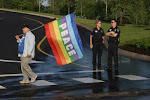
Embodied Solidarity

Embodied Solidarity by Steve Clemens. April 13, 2016

To the casual observer, the sight might have been striking to a proponent of “American exceptionalism”: 25 activists who appeared to be white according to our nation’s obsession with racial identity, arms linked together, taking instructions and directions from a group of black women. Blocking the tracks of the Light Rail transit system as well as two adjacent streets, this action shut down the traffic outside Target Field for the Minnesota Twins home opener.

On the other side of this publicly funded stadium, another group of Catholic Workers and local faith community leaders were being led by another group of women of color in blocking a different intersection as some dropped a large “Justice 4 Jamar” banner from the over-looking parking ramp by the main entrance to the ball park. Inside, as the National Anthem was being sung, two additional activists hung banners over the large black wall in centerfield. They read, “ Re-open Jamar’s Case” and “Target Field: End Your Slave Labor.”

Back outside, signs reading “White Silence = Violence”, “White Silence Kills”, and “White Silence Killed Jamar” were directed at the predominately white-looking crowd attempting to enter the stadium. Some shouted encouragement, others angrily “flipped us the bird” or yelled for us to “Get a Job!” We sang, and chanted, led by our cadre of brave black women until the police issued their third warning to leave under threat of imminent arrest for trespass. Our leaders from Black Lives Matter Minneapolis and the Black Liberation Project moved to the sidewalk with the others who had served as marshals as the police started to handcuff those of us remaining who were blocking the train and the street.

Less than two weeks before, my wife Christine and I were invited to be part of a walk along the Minnesota River led by Ojibwa elder, Sharon Day. The women carried a bucket of water drawn from the source of the river in west central Minnesota to be poured back into the river at its confluence with the Mississippi at a place called Bdote by the Dakota people. I was honored to carry the eagle staff behind the woman carrying the copper pail. We prayed for the river, thanked her for her gift of life to the land. We offered tobacco at ceremonies at the beginning and ending of each day of the walk with a moving ceremony at the conclusion of the walk on Friday near the repressive reminder of Ft. Snelling and it’s 1862-63 concentration camp for Dakota women and children. On Wednesday of the walk, we passed the memorial where 38 Dakota warriors were hung by the US Government in 1862 and while the tears and sadness of the memories from our past lingered as we walked, the river, fighting the pollution caused by industrial agriculture run-off, kept calling us to continue our prayerful journey. As the young Native girls threw an offering of corn, berries, wild rice, tobacco and other traditional symbols tied in a red cloth into the river at the end, two eagles circled overhead. I remembered a Native friend who told me that “eagles circling” are carrying our prayers to the Great Spirit.
In another two months, Christine and I will join some Muslim friends at an Iftar – the meal to break the daily fast during the holy month of Ramadan at a local mosque. We have done so for the past several years as a way for Christians, Jews, Muslims, and others gather to help break down the stereotypes and walls that often divide Americans. I remember how pleased my Iraqi friends were when our delegation visited the Holy Shrines in Karbala and Najaf, Iraq several years ago.

“Embodied solidarity” is a term used by a Wheaton College professor, Dr. Larycia Hawkins, as she donned an hijab during the weeks of Advent as many Muslims were being vilified in the media at the instigation of some Presidential candidates as well as religious “leaders”. She wanted to show with her body her oneness and connectedness to those often seen as “the other”. It cost her her job at the college, my alma mater after a storm of protest arose from the broader “evangelical” community. I already had many of my own reasons for distancing myself from Wheaton so this merely added to my list of grievances. But I am thankful for her witness and example. I, too, want to place my body in alliance with peoples pushed to the margins in our society, culture, and nation. 

Part of the time outside the Twins stadium I stood arm-in-arm with my dear friend, Kathy Kelly. She had told me in the past,  “Where you stand determines what you see.” I would add to that, “With whom you stand can also change your perspective.” Following the leadership of Lena Gardner and Candace Montgomery of Black Lives Matter Minneapolis, the inspiration of Rev. Osagyefo Sekou of the Fellowship of Reconciliation, the love and compassion for the water evidenced by Sharon Day of the Indigenous People’s Task Force, the passion of the action coordinators from the Black Liberation Project, and the insights and observations of my numerous Muslim friends has helped give this 65 year-old male who has for decades identified himself as “white” a window into a world of exciting and challenging diversity. Thank you!


As our signs read, “White silence kills.” Let’s break the silence among those who identify in our culture as “white” and recognize that racism against black people hurts me and you. Failure to include queer and transgender people diminishes all of us. We have much to learn (and repent for) from our indigenous neighbors. Muslims need to hear you embody a message of “welcome!” I don’t want to live in the mythical American “melting pot”. We don’t all need to blend together into some unidentifiable porridge; rather let’s embrace our diversity as we embrace one another and determine to reject the cancer of white supremacy which has poisoned our world. And, as Rev. Sekou beautifully and forcefully remind us in our training for “militant nonviolence”, we do this work out of “deep abiding love” and filled with “joy”.


Receiving the Sullivan Ballou Award

Remarks for Sullivan Ballou Award. March 13, 2016 by Steve Clemens

Last evening my friend Dan asked me if I was supposed to give a speech today at this award event. I told him, “I hope not.” But in thinking about it this morning, I figured, why not?

I must say first of all that Judges usually send me off to jail – they have never offered me money for my activities! Sullivan Ballou calls us to “act from the heart” and the award is meant to recognize acts of compassion.

The word compassion has been defined by others as “to suffer with”. 38 years ago, as Christine and I were planning our wedding, we decided to chose “Clemens” as our common last name primarily because one of it’s Latin roots means “compassionate” and we thought it as a goal to strive for. She’s been my partner and co-conspirator in this work ever since.

The best route to a life of compassion, I’ve found, is exposure to the lives and stories of “the other”.
In my years at a high school boarding school for boys it was rooming with Sun Bin Lee, my Asian-American roommate and playing sports with Bob Seebacher, one of the few Jewish students at this Christian Prep school. In college it was rooming with Ron Potter, the de facto leader of the black students on campus and our Latino friend Aric Carillio. Learning from their stories and experiences.

It led me to volunteer work with street gangs in Philadelphia and later to work in a poor black community in the Mississippi Delta region. In Washington, DC I heard stories told by Don Luce of the Tiger Cages for political prisoners in Vietnam and by Mennonite Central Committee worker Max Ediger about the plight of the Montenyaard peoples in the highlands of Vietnam who were bearing the brunt of napalm attacks from the US as well as attacks from all sides in that Vietnamese civil war.

I heard stories from Central American refugees from El Salvador and Guatemala as I helped transport them (against US law) from the Texas/Mexican border to Georgia and then to Canada where they were granted asylum.

I visited Bob Redd on Georgia’s Death Row for 10 years; Christine and my young sons joining me for the visits for the last several years before he died in 1989. I’ve met other prisoners as their equals in many jails and prisons as a fellow prisoner over the years. Each had a story to tell to help crack open the hardness of my heart.

Following the invitation from Kathy Kelly to be part of the Iraq Peace Team in Baghdad in December 2002, I joined the group to remain in solidarity with the Iraqi people to face the bombs from my own nation with them. I met some of those victimized by our previous war in 1991 who were now suffering from cancers purportedly caused by exposure to depleted uranium used by US troops.

I was fortunate to travel to Afghanistan to plant trees for peace on the Afghan New Year in March five years ago. There I met courageous young peacemakers – many who had lost a parent, sibling, cousin or friend to the violence of the Taliban or US drone strikes. We continue to have conversations with each other over Skype and FaceBook connections.

Lately my Native American brothers and sisters have helped me expand my horizon for compassion to the land, the rivers and lakes, and all its creatures. They call me to listen to the rocks, listen to the waters, listen to the animals and embrace the Spirit within.

My work with IARP seeking reconciliation will continue – though not as a Board Member. I’m grateful for the work of this organization as well as my friends in the Muslim Peacemaker Team in Iraq for finding ways to hear one another’s stories and continue to work for healing, peace, and reparations.  


Through all of this, compassion does not come naturally to me – often it is the prodding and pushing of Christine , my sons, other friends, and fellow activists that has proceeded my acting. So, on behalf of all of them, I accept this award in hopes that all of us, together, can help heal our world.

[The Sullivan Ballou Fund info can be found at: http://www.sullivanballoufund.org/]


Open Letter to Secretary of State John Kerry

[Written after attending hearing on Tar Sands pipelines in Federal Court yesterday]

Dear Secretary Kerry,

As a parent whose son and daughter-in-law work for you in West Africa, I was deeply ashamed of the inability of your department's dismissal of the rights of Indigenous Peoples exhibited by the lawyer arguing against Honor The Earth, MN350.org, and the Sierra Club's position at the Enbridge Pipeline hearing in front of Judge Michael Davis yesterday in the US Federal Courthouse in Minneapolis.

I wanted to stand up in the courtroom and shout the words of Jim Morrison's cry in The Door's song so many years ago when we were young men: "What have they done to the earth?/What have they done to our fair sister?/Ravaged and plundered, ripped her and bit her/ Stuck her with knives in the side of the dawn/ Tied her with fences and ...dragged her down!" The song, appropriately, is titled, "When the Music's Over".

To hide behind legal technicalities of a permit granted by LBJ in 1968 for a pipeline with "unlimited" capacity to cross our national border - before any of us knew the stalking horse of global climate change was marching over the horizon - exhibited the worst aspects of the collusion of corporate interests and mindless bureaucracy in the service of denial and greed.

Who is going to represent the interests of the Earth? Of the danger filthy tar sands "oil" and its poisonous diluents cause to our Great Lakes, the Mississippi, and our pristine lakes with their abundance of wild rice growing over "sky blue waters"?

As Secretary of State, you must help our nation respect and honor the Treaties signed by our government ensuring the rights of our indigenous friends to fish, hunt, and gather (yes, that life-giving wild rice) in perpetuity. Your lawyer said the State Department's only interest was the point at which the pipeline(s) crossed the border between The U.S. and Canada - leaving the issue of what the pipelines are carrying and it's destination to other faceless bureaucrats.

Climate change is real. The time is short. Please, please, please conduct a thorough environmental review of the Enbridge Pipeline 67 (Alberta Clipper) and Pipeline 3 replacement - and consult with the Indigenous Nations, including Winona LaDuke and White Earth, before this climate-threatening project continues.

Steve Clemens
Minneapolis
A Forty-Year Crime Spree by Steve Clemens
Near the end of March marked the 40th anniversary of my first arrest beginning a life of crime that has averaged about an arrest per year – or arrest-able actions. Truth be told, it actually began three years earlier when I burned my Selective Service Registration Card after one of Nixon’s speeches and mailed the ashes back to my local Draft Board. I had registered as a Conscientious Objector when I turned age 18 in the fall of 1968 but then my lottery number was 254 when the military draft switched to that system in the government’s attempt to lessen the growing anti-Vietnam War protests. 

Despite the likelihood that my Draft Board would never be sending me an induction notice given my relatively “safe” lottery number and the withdrawal of combat troops from South Vietnam so, after I graduated from college and losing that “educational deferment”, I decided to do my “alternative service” by volunteering with the Mennonite Central Committee, first in rural Mississippi and then in Washington, DC. I arrived in the nation’s capitol city just a few weeks after President Nixon resigned in disgrace following the exposure of the Watergate scandals.

I soon was invited to join a Monday evening Bible study group at the Community For Creative NonViolence (CCNV) led by Phil Berrigan and Liz McAlister. We used Abraham Joshua Heschel’s provocative book, The Prophets, as a jumping-off point for our discussions on how we as Christians could embody the Gospel for our own times. The end of January 1975 found me helping as volunteer staff for “The National Assembly To Save The Peace Agreements” with thousands gathering to hear anti-war speakers and listen to Joan Baez and other musicians who arrived for the rally.

In February I joined my housemate John Swarr in going to the White House tour entrance and reading aloud a copy of the Paris Peace Accords to those awaiting entrance to the President’s home and office – highlighting the ways our government was violating the agreements we has signed. When threatened with arrest if we didn’t leave after being there for more than an hour, we both left – not ready (yet) to cross that line of deliberate civil disobedience. As our Monday night group processed our experiences, the radical Catholic couple from Jonah House – especially Liz – were gently urging me to consider risking arrest as a next step in my journey as a Christian peacemaker.

President Gerald Ford was asking Congress for more funds to support the flagging efforts of the South Vietnamese troops who had replaced the American soldiers under Nixon’s “Vietnamization” of the war. At the same time attempting to quell anti-war protests, he had also proposed what we called a “punitive clemency” program stating that draft resisters who had gone to jail or fled to Canada or other countries or had gone “underground” could have their rights restored and criminal records amended if they returned, surrendered to authorities, and completed two additional years of some approved community service. This “offer” was seen by many of us opposed to the war as a continued justification for what we felt was not only illegal but also counter-productive. Someone suggested we should respond to the President personally.

Little did we know that this proposed act of civil disobedience would be the last large arrest before the Saigon regime fell to the North Vietnamese and NLF troops the next month. The plan for the action was simple: a group of us would gather for the daily tour of the White House and once inside, we would gather on the lawn of the building and refuse to leave until we were granted a meeting with President Ford. I carried with me a typed letter to the President outlining why I was participating. Many of those joining the group had years if not decades of nonviolent arrests and expected that we would be given a warning to leave prior to arrest. Those not planning on going to jail that day should leave at that time recognizing that those remaining would likely be handcuffed and hauled to jail. I’m not sure any of us expected the President to meet with us.

There were 62 arrested that March 1975 afternoon, the largest mass arrest at the White House to that date. Human Rights activist Dick Gregory, Catholic priest Daniel Berrigan, former-nun Elizabeth McAlister, Ladon Sheats, and many others became my co-defendants that day. What a group to serve as mentors for a first arrest! It took several hours for the arrests and to be transported to the jail. As we were being booked, the elderly gentleman processed in front of me told the arresting officer his name and “occupation” when asked. He responded, “James Peck, war resister”. I hadn’t met him before but I knew well his steadfast commitment to justice and nonviolence when he was savagely beaten during the Freedom Rides in the Civil Rights struggle in the South as well as his opposition to nuclear weapons testing and drills in the 50s. It was an honor and privilege to be booked with an American hero!

Yes, I was nervous that day. Other than a parking ticket while in college, I prided myself in being a law-abiding, conscientious citizen. To not “obey” a police officer or Secret Service officer went against everything I was taught – and the decision to do so did not come easily. I was greatly relieved to discover that we were being “released on our own recognizance” (ROR) after being booked, photographed, and fingerprinted. I felt proud that I survived the close to 6-hour ordeal and especially grateful for my companions.

It wasn’t until our debriefing time the following Monday evening during our regular Bible study that I discovered that not all of us were released: apparently 3 of the group remained in jail because they felt that if they weren’t white and well-educated with jobs they wouldn’t have been offered ROR. They chose to act in solidarity with the poor black men who so frequently populated those DC jails. Boy did I have a lot to learn – I never even considered not acting on my privilege!

Liz delivered her first child before our trial and was nursing infant Frida Berrigan in the courtroom. I clearly remember her standing up in that courtroom with her newborn resister and telling the Judge she was compelled to act on behalf of the future generations. (That mother’s milk –and example - has obviously nurtured Frida’s exemplary activism for peace and justice in her own right).


We were given a 60 day jail sentence which was suspended provided we weren’t arrested again during our probation period of 15 months-2 years. It was a good start and introduction to a life of crime and punishment – but also one of deep joy and commitment. I can’t say our world is better off today but I’m certain it would have been worse if not for groups of nonviolent seekers of justice, peace, and compassion. I’m so grateful for this mentoring.


On Not Seeing American Sniper

American Sniper Movie

I have chosen not to see Clint Eastwood's new "blockbuster" film, American Sniper, for several reasons: I don't wish to add to the sales figures which continue to make it the #1 movie at the box office for 3 weeks running; I rarely spend $6-12 for a first-run movie, waiting until it comes to my local neighborhood theater for $2 senior rate; but, more importantly, what this movie symbolizes to my Iraqi friends.

When I traveled back to Iraq for the first time since going to Baghdad in December of 2002 as part of a Peace Team, the people I met in Najaf, Karbala, and Babil (Babylon) in November of 2012 were happy to greet an unarmed American - and they told us so. Unarmed, coming not to conquer nor correct but rather to connect and communicate face-to-face. Not looking through the scope of a rifle for potential targets but rather mingling with the masses in the souk, at the Shrines to their revered ancestors and leaders, and at the universities and grade schools. Looking there, instead of finding "insurgents" I found inquisitive people eager to engage me as a potential friend and partner. 

Yes, I must admit I also encountered some bitterness and disgust at what some had felt was directly linked to the American invasion and the long military "occupation" which followed. Some of my Iraqi friends think many of the corrupt and ineffectual politicians now running their nation were put in place or funded by - or at least took advantage of the chaos created by - the American military intervention. Many of my Iraqi friends, while having no love lost for the departure of Saddam Hussein, see the present conflict arising between Sunni and Shi'a Muslims as being a result of a divide-and-conquer strategy by America and it's principal ally, Israel. 

So a U.S. movie which doesn't bother to take the time to explain WHY a patriotic Iraqi might become an "insurgent" to fight against a foreign invader trying to put in place a government in his/her own nation - but instead has as its flawed "hero" someone whose autobiography calls all Iraqis "savages" ... Well it isn't hard to connect the dots to see how American Sniper will not help us work for the needed reconciliation between Iraqis and Americans. 

Ironically, all the controversy surrounding this movie might serve as a good reminder to Americans that all too often wants to "move on" to the next event-of-the-day (or week or month) that those on the receiving end of the American Empire don't have the luxury of moving on when infrastructure and relationships remain tattered and broken for most of our Iraqi friends. 

Day 2 of the Drone Trial in Des Moines

-->

Drone Trial Day 2, With a Verdict by Steve Clemens. June 29, 2014
The jury was out for only 30 minutes – the shortest deliberation I’ve experienced in at least 7 other jury trials. When Judge William Price made clear before the noon break that he wouldn’t permit jury instructions which would allow jurors to consider our justification, it was almost certain to me that we would be convicted. That is why we had started out day 2 of our St. Patrick’s Day 7 Drone Protest trial with what is referred to as an “offer of proof”.
Out of the presence of a jury, the offer of proof is testimony submitted for the record which could be used in the appeal of a case of testimony which is disallowed in the official “evidence” the jury considers in rendering their verdict. Michele Naar Obed was sworn in (actually she affirmed rather than swore the oath which was to tell the truth – but not necessarily the “whole truth”) and took the stand to tell part of her story. She lived in Iraq for three years, working with Christian Peacemaker Teams, first in Baghdad and then in the Kurdish region in the north. She joined CPT realizing saying “No” to war was not enough – she wanted to say “Yes” to something that worked to prevent war and heal its wounds. She told the judge, “I have witnessed drones flying over northern Iraq and I’ve met [extended] family members where an entire family with 5 children were killed in their car after visiting family members in the mountains by a missile fired by a drone. She met another mother whose child was only “pieces” and asked “how can I bury her with so little left?” That woman grabbed Michele’s arm, knowing she was an American, telling her, “Can’t you tell people [in your country] to stop this?” She told the Judge she “has taken numerous opportunities to try to deliver that message from this Kurdish woman and when this [nonviolent] action was proposed, I felt I needed to try to talk about it [to members of the military at the airbase.”
Elliott Adams, followed her powerful testimony with his own. He described volunteering for Vietnam as a paratrooper and had also served in the U.S. Military in Korea and Alaska. After his military service, he traveled to several war zones, including Panama, Gaza, and Grenada to talk to others and see for himself the realities of war. He served in public office for about 15 years, worked in the Fire Department, served on the School Board, done many things in a life-long effort to make this a better world.
“I took an oath to defend the US Constitution when I entered the military … and [that oath] has no expiration date. … I went to the Iowa National Guard Base to uphold the law. … to exercise my First Amendment rights and to petition my Government for a redress of grievances. … The rulings of the Nuremberg Tribunals obligates me to act. … Article 6 of the Us Constitution … and Supreme Court decisions uphold International Law as part of our own law.” He went on to cite several US Supreme Court decisions about the relevancy of International Law and referred to the Law of War and the illegality of indiscriminate weapons. He then added that drones also violate US laws as well, citing the War Crimes Act. He referenced the Geneva Accords. As a treaty signed by our government, “It is part of our law, not separate from US law, and it applies in every court.”
His voice cracked and quieted considerably when he got more personal: “When I was in Vietnam, I was tested about whether I would follow small laws – orders from my [military] officers – or follow the big laws,” referring to International laws and norms about warfare. “And I followed the small laws. If someone had warned me, I might not have crossed that line.”  [Referring to that line between acting morally and what has now haunted him for decades since his time in Vietnam – not crossing a property line at the National Guard base.] “I needed to warn my fellow brothers and sisters.”  
The former National President of Veterans For Peace, Elliott Adams, began to list all the ways he’s tried to deliver the message including writing letters to Congress, the President, to the editor. He’s testified before Congress. “The Nuremberg Principles 4 and 7 say I must act.” He described the Hellfire missile [fired by military drones] as equal to 14 sticks of dynamite; it is by it’s nature indiscriminate. Where they are exploded will have “collateral damage.”
He concluded with a plea to the Judge, asking rhetorically, “Where should I try to seek a redress of grievances? At a Starbucks?, at the Salvation Army?, the Post Office since it is a Federal facility? – No, the air base [where these weapons will be operated from].” He lamented the fact that according to the rules of war, if military drones are “piloted” from this Des Moines airbase, this area will become a legitimate military target.
Other defendants were willing to add to the “Offer of Proof” but our lawyers felt this powerful testimony was enough to lay an adequate basis for a future appeal if we decide to go that route. At that point, 8:50 in the morning, the State rested its case and our lawyers entered their motion for a directed verdict of acquittal on two grounds: the State’s witnesses didn’t know exactly where the property line was for the base, claiming it was the responsibility of the Civil Engineers; and, the defendants attempted to raise a justification and the State’s evidence did not show we didn’t have justification.
The Prosecutor claimed he just needed to establish the elements of the trespass defense and argued that “without justification” is not an element unless it is recognized by the court as an affirmative defense. He stated they had “proven it was private property” and the Major testified they were at least “50 yards past [the painted line].”
Judge Price said “when someone is there to petition the government, just having [military] officers telling them to leave is not sufficient.” He went on to point out that we were advised to leave by both the military and the Des Moines Police, saying he felt this was sufficient evidence to give the decision to the jury. “At this point, no justification has been raised [since the offer of proof was not delivered before the jury]. The State can’t anticipate all possible defenses. …Reasonable minds can differ on this.” He stated the case should continue to go to the jury and dismissed the Motion to Dismiss. He said both Michele and Elliott could testify about their personal backgrounds and history but his ruling on the Motion in Limine would continue meaning they couldn’t talk about their “philosophical beliefs” in describing their attempts to deliver it [our letter of indictment] to the military.
“The place to petition the Government is not in this Courtroom but rather the halls of Congress and on the streets of America. It does not give rise to justification to being in a particular place,” the Judge stated.  Funny, but I was always taught in high school civics that the Judiciary was a third and co-equal branch of Government and all three should be held responsible for the failings and oversights and excesses of the other two. I guess not in his courtroom!
The Judge had previously noted that some law students serving as interns at the Iowa Appeals Court were present to observe and looked at them when he remarked wryly, “The Appellate Court has given us no guidance in this matter,” referring to the “without justification” language in the trespass law. After the Prosecutor remarked, “We’re not here to punish speech but to punish conduct. We’re not here about the First Amendment,” Michele said, “I have a question. If we carried chains and a lock [to lock the gates of the airbase closed], would the Prosecutor try to use that as evidence against us?” after the Judge stated he would not allow the letter of indictment we carried into evidence. The Judge allowed that we would be permitted to say our intent was to present that document but said what we carried “was a slippery slope. You could carry a book [and what it to be submitted as “evidence” for the jury to consider].” As a sop to the defendants for ruling against all our other motions, he did allow the photos we carried or had taped to our bodies as evidence – over the objections of the Prosecutor.
When the jury entered the room at 9:40, the State officially rested its case and our defense was allowed to begin. Ruth Cole, a 26-year old member of the Rye House Catholic Worker Community in Minneapolis was the first on the stand even though this was her first trial! She talked about her education in the field of Early Childhood Education, teaching in elementary school and her special interest in helping children suffering from childhood trauma. She described the Catholic Worker values and commitment to hospitality as well as advocacy. She said their goal was to “live your life in a way that creates social justice.” When asked by the Prosecutor [attempting to defeat any “necessity defense”] if she felt in imminent danger while at the airbase, Ruth was clear with conviction in her answer: “I represent more than myself, … my “body” was not in danger but I am connected to others who are.” I was so proud to hear a first-timer when pressed in court to have such an insightful answer.
Julie Brown, a Des Moines Catholic Worker, skated as close as she dared to the Judge’s “philosophical” line when she asked, “How can you mourn your own child who is now just in small pieces?” She told the jury she carried the photo of a child who had been killed in a drone strike “in case they [the military personnel] wouldn’t talk to me. I had to find another way to communicate my message.”
Elliott Adams described his military and post-military experience when questioned by our lawyer. After saying he “felt obligated to go to the base to prevent war crimes; it is my responsibility as a citizen,” he was prevented by the Judge from talking about his belief of “small laws” versus “big laws”. He told the jury he was open to more suggestions about ways he could petition his government, recognizing that this Judge wasn’t interested in performing that function in this trial.
Chet Guinn, a retired Methodist minister, had worked for the church for 44 years and continues to function in ecumenical and interfaith circles. When he attempted to read an excerpt of a statement from the World Council of Churches condemning military drones, he was prevented from doing so by the Prosecutor’s objection. Stating that his birthday was only 6 months different from Martin Luther King, he claimed, “I wanted to inject King’s values into our society today.” As soon as he tried to continue that he believed King would be protesting drones with us today, he was cut off and he wasn’t able to continue about his wealth of experience during Freedom Summer 60 years ago and his life-long work for peace and justice. It was an honor to have this man with us. He told us during our trial prep gathering, “I know I came late [to the demonstration] but I felt it was necessary to have the church present.”
Michele Naar Obed told of her degree in medical pathology as well as her commitment to nonviolence. She told of her decision to join Christian Peacemaker Teams and spending 3 years in Iraq during the recent war. However, she was cut off and not allowed to talk about her witnessing the use of drones and meeting with victims’ families when the Judge ruled in favor of the Prosecutor’s objections.
Eddie Bloomer, another military veteran and member of Vets for Peace told how he has been a member of the Des Moines Catholic Worker family for 21 years. “As a former member of the military, I love my country,” he stated while trying to explain his participation that cold St. Patrick’s Day morning last March.
The Judge called a recess at 10:40, leaving me as the final defense witness. When I got to the stand 15 minutes later, when asked by our lawyer what I carried with me that day, I showed the indictment, and described the blue scarf I wore that day, saying it had been given to me by friends in Afghanistan. I then held up the large photo of Abdulhai that I carried and told the jury he and his friends gave me a letter to carry back to the US to deliver to the President via Keith Ellison, my Congressman, three years ago this Spring. It called on our President (and all other combatants) to end the use of military means and use diplomacy instead. They have never heard back from either the Congressman or the President. I wanted to carry their message to the airbase that morning. I also talked about 4 presentations by a Pakistani Federal Police Officer, Mubarak Zeb, who described how drones make his law enforcement job much more difficult in his home country, especially in the tribal areas.
The lawyers and Judge discussed jury instructions while five of the defendants went to lunch with some local supporters. After lunch, despite our objections, the Judge allowed the State to present a rebuttal witness – a Lt. Colonel who is the Base Civil Engineer to officially establish the base property line. Although none of us testified in any official capacity as to where the property line was, thus no “rebuttal” was warranted, The Judge let him say the property line was 70’-80’ from the fence (not the more than 50 yards testified to the day before by the Major) but he had to admit on cross examination that all of the “Federal Property” keep out signs were posted on the fence and gate, a line we did not cross.
The closing statements were next and jurors were forbidden from taking any notes during them “since they aren’t evidence.” The Prosecutor said “This isn’t the ‘Crime of the Century’ but it is a crime. It is not less of a crime if no one is hurt. … Liberty can only be maintained when laws are enforced. …Motives are immaterial to the fact that they [broke the law].” Michele quoted from the Bible where she said she was instructed that if she had a disagreement with a brother or sister to go to them directly, then go with another, before you go to court. That was what she was trying to do in speaking directly to the National Guard. “Which is more important,” she asked, “property or life? We came to humanize, to bring life, to bring hope. We walked down that drive to change hearts and minds of the people behind that fence. We tried to uphold the Spirit of the law.”
Elliott told the jury that he remains haunted from his experience in Vietnam because he followed only the “small laws.” Glenn Downey, one of our pro-bono lawyers concluded by again talking about lines and boundaries. Finally, in rebuttal, another Prosecutor said they [the State] must prove 3 elements of trespass – “everything else is smoke and mirrors. … The only thing that matters is that they were on that property. We need to take all laws seriously. They chose to get arrested.” No word, apparently that, for him or the State, “all laws” might include the “bigger laws,” International Law, which Elliott and others of us wish the court (and jury) would address.
30 minutes later we had our answer and off we went to jail for reasons of conscience and compassion.