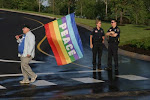
Drone Protest Trial in Des Moines - Day 1

Drone Trial for St. Patrick 7, Des Moines, IA – Day 1

Judge William Price, Iowa District 5C, greeted the 7 defendants facing trial for Criminal Trespass at the Polk County Courthouse. Built in 1902, his regular courtroom was so small that he couldn’t fit in all the defendants or the lawyers – not to mention the 70 prospective jurors and any members of the public coming to support us. Judge Price huddled with our two pro-bono defense attorneys and the two prosecutors while the prospective jurors watched a movie about service as a juror. Next thing I saw was 30 of those jurors filing out of the courtroom and back to the jury pool office. It was discovered that in our type of misdemeanor charge with multiple defendants, we will each get only 2 strikes rather than the 4 we were expecting after a pre-trial discussion yesterday afternoon. With defense and prosecution each getting 14 strikes, and needing a jury of 6, with a reserve in case any jurors were struck for cause, it was decided that we would question 40 jurors rather than 70.

The Prosecution would be handled by David Albretch and Jim Hathaway and our pro-bono lawyers for five of us are Larry James, a former Prosecutor who now handles mostly pro-bono (no charge to the defendants) cases and Glen Downey, a recent resident of Iowa, having moved here from the Pittsburgh area where he was an English Professor before becoming a lawyer who handled many protest/free speech-type cases. He is not a member of the Iowa bar yet but has been given permission to handle our case with Larry’s presence in the courtroom. James is a gregarious and enthusiastic lawyer who also was a former military officer at the air base where we were arrested! Downey shared some of his work defending Greenpeace and other protestors in Pennsylvania as we walked to lunch. Two defendants, Michele Naar Obed from the Hildegard Catholic Worker House in Duluth and Elliot Adams, former National President of Veterans For Peace have asked to go “Pro-se” (represent themselves) so they can retain the right to ask questions of the other witnesses and make their own closing statements. The Judge warned them at the start that they should be aware that we all face a maximum sentence of 30 days in the Polk County Jail so they had better weigh that before proceeding on their own. Both Michele and Elliot are very experienced as defendants in civil resistance cases so they weren’t surprised at the Judge’s attempt to discourage them in going this route.

Voir Dire, the legal term for questioning prospective jurors didn’t start until a few minutes before 11 and the Judge’s questions took us up to a lunch break. Of the 40, there were 4 people of color and the pool seemed to include younger people than my last trial in Winona in February. Normal questions like “do you know any of the lawyers or defendants?, have you ever been a juror before?, and do you have any family members or friends who are police officers?” also included some others likely unique to this case: “have any of you participated in a demonstration?, and do any of you subscribe to ‘Jury Nullification’?” Three or four admitted to the former, including an older man who stated he marched for civil rights in the 60s and was in “peace demonstrations” in the 70s. Later we found out he served in the Peace Corps two years and had helped out at “the Catholic Worker” community in the past! (Can you guess who was the first prospective juror struck by the Prosecution?)

In contrast, a construction worker volunteered that he was responsible for “readiness” with his military unit and felt “harassed” by people opposed to the military mission with which he was engaged. When asked by the Prosecutor how he would respond to someone on his property “who refused to leave”, he quickly smirked and said he’d “turn the hose on them.” The Prosecutor quickly tried to turn his remark into a joke by saying something to the effect of recent “hot” [temperature-wise] days but the man’s demeanor didn’t waiver from grim determination. (He earned his place on our list of those to strike.)

By 2:30 we had selected a panel of three women and three men and the Judge began to instruct them about the procedures for the case. Don’t talk to anyone else (including each other) about this case; don’t do any research on your own about this; don’t watch the news, don’t read the newspaper.   

The trial resumed after the 3 PM break with opening statements by a Prosecutor and a Defense Attorney. Albrecht painted the case as an issue about the right to “exclude others from your property… their decision to break the law has consequences.” Downey countered by observing that there are many boundaries and lines in our world today and they sometimes change. “What or where the line is today may not be where that line is tomorrow, or next year, or even next century… Where one person sees a hard line or boundary, another sees an opportunity for change or advancement.” He concluded that the jurors should listen to all the facts and evidence … “and then you follow the law and your conscience and do what is right” because in a democracy, that is what you do.

Day 1 concluded with 3 witnesses for the Prosecution. Chief Master Sergeant Jeff White was in charge of day-to-day security at the 132nd Iowa Air National Guard Base on the blustery St. Patrick’s Day morning that we were arrested. He described his duties and how he called a higher-ranking officer on duty to issue the order for us to leave after 7 of us stood in front of the closed gate by the base entrance. When asked if the people who were later arrested were “peaceful”, he would only grudgingly say, “they were non-compliant”. When pressed further by Elliot Adams, one very schooled in both military procedure and principled protest, Chief White admitted that no one attempted to go over the fence, under the fence, through the fence or around it. Even though he stated the “defendants blocked the gate”, he later admitted that the military had already closed the gate before the demonstration started and instructed all base personnel to use a different entrance/exit than where the anti-drone protestors were. When pressed about exactly where the base property began and public property ended, he admitted that was the responsibility of civil engineers rather than security forces on the base.

Major Ken Hartman, the Wing Executive Officer who also serves as the Public Affairs spokesperson for the airbase told the jury that he served as “the voice of the Commander” at any protests outside the base. He said the 7 of us were creating a “safety hazard” in that we were “impeding traffic flow” but later admitted the gates were already shut before we “stepped over the line” and no one attempted to enter or leave the base from that entrance while we were there. He was the one to issue the formal warning to us to leave or we would be arrested and he then asked the Des Moines police officers to arrest us. He admitted that it “was all very cordial” and He didn’t remember us asking him to speak with the base commander or to deliver the letter of indictment we carried with us. When pressed, he agreed his did not wish to engage in any conversation with us.

However, Lt. Russell Schafnitz, the Des Moines Police Department Commander of the STAR (Strategic Tactical Response Team) Unit was the arresting officer on the scene. After identifying all the defendants from their photos taken during the arrest and then locating us in the courtroom, he told the jury that the defendants told him they “would leave if they were able to have a dialog with the National Guard members first”. He said we discussed the First Amendment with him as well as our desire to “seek a redress of grievances”. He made a point to shake Michele’s hand after he left the stand while exiting the courtroom after she asked him, “Did you handcuff me?” He replied, I didn’t handcuff anyone that morning and Elliot Adams added how appreciative all of us were by the way we were treated by Schafnitz and the other Des Moines police at the scene.

As the clock approached 4:30, the Judge called it a day, stating we should be in the courtroom by 8:15 tomorrow. Our lawyers want us to gather at 7:30 to discuss an “Offer of Proof” we will submit to preserve some testimony in the event of an appeal since the Judge previously granted a Motion in Limine which states “The defendants may present before the jury the general reason that they were present at the place of arrest (eg; to object to the presence of drones) and the general outcome they were seeking but are prohibited from expounding on the reason they harbor the belief as to why the conduct they were protesting was wrong. This Court finds that as a matter of law the philosophical reasons for the conduct of the Defendants is not justification as a matter of law and is therefore not relevant to the trial of these cases.”


Obama and Our Need For Exodus

-->
The President as Pharaoh: Drones Reveal Hardness of Heart by Steve Clemens. March 30, 2014

As we approach the Biblical season of Passover and Easter, it is instructive to explore some of the implications of "exodus" for us today. Having read Rabbis' Waskow and Berman's excellent Freedom Journeys, calling us to re-enact the struggle for liberation from bondage every year, I took to thinking about our Commander-in-Chief in the light of the forces aligned against Moses and his oppressed people.

The scriptures do not tell us the name of the political leader; he is known by his title as the Pharaoh. So one lesson we can learn is to concentrate on the role an individual plays within the power structure rather than dwelling on the personality of the individual. I admit to having great difficulty with this when it came to Nixon during Watergate or Cheney during water-boarding. What is it about water? Moses' journey begins in the basket in the bull rushes and then continues in the escape through the Red [Reed] Sea.

What I want to focus on is the Biblical narrative about "hardness of heart." Pharaoh suffers from this disease and the result is a series of plagues affecting the land and the peoples. In reading Bill Wylie-Kellermann's new collection of the writings of Episcopalian lawyer and lay-theologian William Stringfellow, William Stringfellow: Essential Writings, Christians have too often limited their view of "the fall" as affecting individuals when Biblically the estrangement from the Divine effects all of creation - especially institutions which are known in scripture as "principalities and powers".

William Stringfellow defines hardness of heart as "loss of moral discernment" and having a "paralyzed conscience". It is a social pathology that possesses both persons and institutions. So it is really the President in his institutional role rather than focusing on the individual embodying that office that should be our focus. Yes, he [or she] should be held accountable for his actions as an individual like all of us - but in his role as President, Commander-in-Chief, head of the executive branch of government, he is more accurately a pawn of those large principalities and powers. In 1973, Stringfellow wrote: “It is more accurate, more truthful, to perceive the president as a victim and captive of the principalities and powers.”

The recent verbal jousting between Senator Feinstein of the Senate Intelligence Committee and the head of the CIA over spying on Congress by the latter is an excellent example of how these institutions have a life of their own. The struggle between Edward Snowden and Attorney General Eric Holder over the "stealing" of NSA "snooped" documents is another.

Stringfellow's contention that the primary purpose of these principalities in their "fallen" state is their own survival and that they ultimately are in service of death rather than life serves as a sobering warning to all opponents - both moral and political - that they won't surrender without a fight. So when immigrant rights advocates label President Obama as "Deporter-in-Chief" because of the record number of deportations of undocumented immigrants under his presidency, they are recognizing the confluence of individual accountability with the reality of institutional momentum (and a life and will of its own). The principality of ICE (Immigration and Customs Enforcement) has been a vehicle used in separating families through deportation as well as a primary source of profit for corporate-run prisons. Like most federal and state bureaucracies, it develops a life of its own -concentrating on its rules and procedures caring little for the lives crushed in the process. We would like to live under the illusion that the President could dramatically change things if he wanted. In fact, the deferred deportation policy he put in place about a year and a half ago has definitely brought relief and some security for a small group of "Dreamers" (including two friends of mine), but it has hardly slowed the machinery of deportation for others.

There are many other arenas where we could explore the tension between proclaimed individual values and the contradiction of policies which emanate from the White House. The one I wish to focus on is the use of drones - unmanned aerial vehicles - now becoming the go-to strategy for fighting "the war on terror", even as that name has now fallen out of favor.

Although he died in early March 1985 and was very ill for years prior to that, Stringfellow's writings in the 1960s and 70s was especially prescient in two areas: what he identified as "the idolatry of National Security" and his caution about the rise of "technological totalitarianism". Military-armed drones (or even more pernicious - armed drones flown by the CIA) embody the confluence of both of these demonic forces. The irony of having a Nobel Peace Prize recipient scheduling a meeting every Tuesday to go over a "kill list" for extrajudicial assassination by drones makes our President more Pharaoh-like.

When the drone is seen as a vehicle of technology used for totalitarian purposes, it is easier to recognize it as a tool of a principality serving death rather than something which "protects our troops". The members of the Iowa National Guard who await their new "mission" [sic] of "piloting" Reaper drones over purported declared and non-declared "enemies" become unwitting accomplices in the war crimes committed over video screens. The airbase on the outskirts of Des Moines used to host F-16 fighter jets but when that function was ended, the community is told that this new Reaper drone command center could help "save jobs." Like the mantra of creating jobs in rural areas by siting new for-profit prisons, a multitude of sins are covered under the guise of economic salvation versus human degradation.

Besides the excuse that this new drone mission will save jobs, the other compelling reason for reliance on this developing technological fix for warfare is saving the lives of American pilots or airplane crew members while still being able to visit “hell” on our enemies. Under the pretext of saving lives, technology allows us to better sort out those who should live and those who should die. However, this too is an illusion as the plethora of killed and injured “innocent civilians” in Afghanistan, Pakistan, Yemen, and Somalia readily attests. “We are creating enemies faster than we can kill them” has been a recent lament from some military leaders who have concluded that drone warfare might be counterproductive.

William Stringfellow reminds us: “Two major blunders based upon false perceptions or delusions have repeatedly been indulged … One is the presumption of rationality in the nation’s leaders. That presumption is often coupled with the superstition that incumbency in high office, notably in the White House, somehow enhances the faculties of sanity and conscience, whereas the evidence is that occupancy of the presidency, or similar heights, is a pathetically dehumanizing ordeal, harmful to both sanity and conscience. … In fact, the captive status of the person occupying the office has now reached such proportions that the presidency has become a pseudo-monarchy functioning as an elaborate façade for an incipient technocratic totalitarianism. That sham points to a second tactical error: imputing malice to the nation’s reputed leaders. If [the President and other top officials] … can be said to be wicked men, that is of much less moral significance, or political relevance, than the enthrallment of men such as these with the power of death and their entrapment and enslavement by the powers and principalities in relation to which they nominally have office.” He goes on to enjoin us, “In the face of death, live humanly. … Amidst babel, speak the truth.”    

The truth is that there is a direct line from hardness of heart to a dependence on drones. We need our own exodus out of empire and into the wilderness where we can stand side-by-side with those targeted – but also that is where we can encounter the Divine.


Description: https://mail.google.com/mail/u/0/images/cleardot.gif

St. Patrick's Day Witness Against Drones


Reaping the Whirlwind by Steve Clemens

The tears were streaming down my cheeks as I walked towards the shuttered iron gates in front of the Iowa National Guard base in Des Moines. The tears were a combination of reaction to the cold wind in our faces as seven of us walked slowly and deliberately toward the base entrance as well as my emotions remembering the victims at the receiving end of military drones. I carried a large photo of my Afghan friend, Abdulai, with his statement underneath: we wish to live without wars. Now 17, he has only known war or the threats of terror his whole life. When I met him in Kabul in March a few years ago, he showed me pictures of their march in the downtown area of his nation's capital city where they marched by the Embassy for the United Nations wearing the sky blue scarves calling for an end to war.

I brought one of the blue scarves of the Afghan Peace Volunteers back to the US with me and wore it in solidarity with those courageous peacemakers back in the country where the US drones prowl the skies. My friend, Frank Cordaro, sent me an invitation to join the annual Midwest Catholic Worker Faith and Resistance Retreat which would focus on faith-based nonviolent resistance to drones. Veterans For Peace were co-hosts with the Des Moines Catholic Worker and we learned of the plan-in-progress to bring control of Reaper drones to the local National Guard base in their city. The Reaper and Predator are unmanned aerial vehicles (aka drones) which are armed and rain deadly munitions from the skies which are designed for both "extra-judicial execution" and the sowing of terror on intended (and mistaken) targets.

We engaged in nonviolence training on Sunday afternoon before listening to Kathy Kelly from Chicago-based Voices For Creative Nonviolence (www.vcnv.org) who reported on her recent trip to Afghanistan and her work against drones. Overnight I'm sure many of us wrestled with the uncertainties ahead: would we held in the cold jail until the next morning, would we face state or federal charges - the latter threatening fines of $500 as well as 6 months in prison? The stakes could be significant. I promised my wife I would do my utmost to NOT be in jail when my oldest son returns from West Africa this August for his wedding! But also weighing on me are the stakes and risks for those threatened by Hellfire missiles fired from miles overhead - out of sight and accompanied by the distant "hum" of the drone's engine.

People always ask, "Is civil disobedience effective?" Am I tilting at windmills when trying to prevent or discourage our nation's head-long rush into wars ostensibly to prevent terrorism by terrorizing others? Even some of our retired military leaders ( including Stanley McCrystal and former Defense Secretary Robert Gates) recognize that the use of drones which often kill "innocent civilians" serves as a recruiting tool for more "insurgents" - thus reaping the proverbial whirlwind. Before leaving for the peace witness this morning, we gathered at the Catholic Worker House to sing, pray, and gather our thoughts. Ruth, one of my fellow arrestees from the south Minneapolis-based Rye House Community shared with us some writings from Thomas Merton as well as one of my mentors, Dan Berrigan. He wrote that we must act on our conscience and leave the results to God. We heard part of the prayer called the Breastplate of St. Patrick, on this, his feast day, as we piled into car pools for the 15 minute ride to the air base.

The seven of us arrested as we stood arm-in-arm facing the closed iron gate, one from a new Catholic Worker House in Duluth, one from Rye House in Minneapolis, two from the Des Moines Catholic Worker, a leader of the national Veterans For Peace movement, and a 85-year old retired Methodist minister from Des Moines joined me in receiving a "ban and bar letter" from the military base and a court date of March 25 to enter a plea on the state criminal trespass charges. We were treated courteously and professionally by the arresting officers of Des Moines STAR (Special Tactics and Response) unit as we reminded them of our vow of nonviolence we recited before we walked down the driveway this morning. We informed them our protest was directed at the arrival of the drones-mission [sic] rather than at them as we we placed under arrest on placed in a "paddy wagon" - how fitting for St. Patrick's Day!


Letter to Judge Thompson Regarding Restitution


Feb. 10, 2013
Chief Judge Jeffrey Thompson
Winona County Courthouse
171 W. Third Street
Winona , MN 55987

Dear Judge Thompson,
I am writing to inform you that I will not willingly pay the court-ordered restitution of $200 as the result of our conviction for the frac sand protest of April 29, 2013 and our trial verdict of February 6. To do so would make us further complicit in human-caused climate change because of your decision to make such a payment as restitution to frac sand profiteers rather than a fine which might accrue to victims of crime. Your choosing that penalty directly implicates you in support of the on-going destruction of the landscape and the endangerment of our water and air.
I know our trial was about us, the defendants, but you took the opportunity with the jury excused to lecture us about civil disobedience and taking the consequences for our actions. I wish you had continued in that vein and would talk about the role of the courts and judges in sentencing people like Martin Luther King. Would you have ordered him to pay restitution to the racist governmental leaders? Would you have ordered him to “behave himself” and not risk arrest again for one year as our world is increasingly threatened by potentially apocalyptic climate change?
You strive to be “content neutral” in your rulings from the bench but my I remind you of the late historian Howard Zinn who forcefully wrote histories of social change and said, “You can’t be neutral on a moving train”? I understand your argument about the quicksand nature of protests which land before the courts, running the gamut from landmines to abortion, from Klu Klux Klan to civil rights. But you did choose to take sides in court when you agreed with Prosecutor Flaherty to order restitution in this case. Where is restitution really needed? Can you order restitution to the Mississippi River because it is being endangered? Can you order restitution to our air, to the water table? Why is it that corporations, a legal construct designed to limit liability, are favored by our judicial system rather than nature itself which seems to have no standing before the court?
If the judiciary is to, in fact, act as a check-and-balance on the other two branches of our government in our “messy democracy”, at what point will it weigh in on crucial political issues to help move public opinion? You pointed out how difficult it is to change public opinion within a democracy. Was your sentencing designed to be your “public comment” on the frac sand industry which threatens both the beauty and livability of your city for the sake of short-term profits? Or could you use your position to take a risk by speaking out on behalf of the river flowing by just blocks from your judicial chamber?
Enclosed is the $85 court costs fee. You can gather my account number and bank off the check if you wish to seize my money to pay those you see as “victims” of my “crime” but I will not pay it voluntarily. I bear you no ill will or animosity. I felt you treated us respectfully in the court. My lack of compliance is an act of conscience, a withdraw of consent on behalf of the governed. Please also note my Rosa Parks stamp on the envelope.
Sincerely,

Stephen D. Clemens
MNCIS #85-CR-13-985

Day 4 of Frac Sand Trial - Part 2


The Verdict Comes In, The Struggle Continues by Steve Clemens. Feb. 6,2014
Winona Frac Sand Trial, Day 4 – Part 2

At 3:45 PM, the solemn jury reentered the courtroom and I knew immediately that we were found guilty because they did not look at the defendants nor did they smile. Juror #2 handed the 20 verdict forms to Judge Thompson who looked them over before reading them in alphabetical order. The jury finds defendant Michael Abdoo, guilty. Then 19 more names were read, one at a time with the word “guilty” as the choral refrain. I think all of us were a little shocked because we were certain that several defendants were not properly identified by the police or were not warned properly according to the testimony heard. I suspect even the Judge was somewhat surprised in one or two cases.

But ultimately, all of us did the action together; it is fitting that we are all treated alike.

The Judge asked the Prosecutor if he would give his recommendation for sentencing since some of the defendants had traveled great distances to be there and would prefer not to have to return for sentencing at a later date. Judge Thompson said he was sure some of the defendants probably had prior records but it was his preference to sentence us all alike if the Prosecutor didn’t object. He did not. The Prosecutor recommended “a stayed sentence with unsupervised probation for one year under the condition that they remain law-abiding and in good behavior, stay away from CD Corp properties and the Hemker facility on Old Goodview Road, and pay reasonable restitution.”

Defense Attorney McCluer turned around to huddle up with the defendants still in the courtroom and asked us what we thought. He was surprised (and pleased) that a fine was not tacked on to the request. We all agreed to the fairness of the first part but were all opposed to paying any restitution. McCluer told the Judge we were OK with the Prosecutor’s recommendation including the omission of a fine. The Prosecutor then said it was an oversight, not a deliberate omission.

Before passing sentence, the Judge asked each defendant if he/she wished to make a statement. There wasn’t enough time for me to capture each comment. Most defendants said they were morally opposed to paying restitution to companies profiting off of frac sand. “It would be morally unethical”, “it is morally abhorrent”, “it would be a moral hardship” were a few of the phrases. Matthew Byrnes indicated he’d rather be held in contempt – “put me in jail” before voluntarily paying it. Many Catholic Workers stressed they had little or no income but were willing to do service in educating the community in lieu of restitution.

I took the time to thank my co-defendants for making me an “honorary” Catholic Worker after the article in this morning’s Winona newspaper said I was a “Minneapolis Catholic Worker”. I told the judge I was grateful for being able to act together with these people.

John Heid said that the Judge had remarked at the beginning that this was going to be a new experience – trying more than 20 of us at a time. John said Gandhi talked about “experimenting with truth”.  That’s what we did and it is likely we will be back before you again (and again). John continued, “I’m not promising to be good, but I am promising to try to follow my conscience.”

Diane Leutgeb Monson, one of the coordinators of the retreat and action chose not to testify today in order for the jury to get the case sooner. But she did make a brief statement before sentencing which included observing that this experience is part of the journey – now we have to carry the message out to the community. Dan Wilson said his actions were on behalf of all. “I did this for you [Judge Thompson] and for your kids and their kids.”

Our attorney said he felt so moved by John Heid’s statement that he’d like to make a comment as well. He spoke of an ancestor of his who was sentenced to death by Queen Victoria for his part in the Irish struggle against England. “If you grant us some leniency, we’ll try to do better next time.” McCluer smiled, knowing the reference was double-edged, referring to the defendants as well as his ancestor. He continued, “He was sentenced to death but was able to escape and eventually went to Mexico and fought with the Irish Battalion in the Mexican-American War.”  

The Judge followed the recommendation of the unsupervised probation with conditions and added a $200 fine/restitution and the mandatory $85. court fees imposed by the state. He noted the many objections to restitution and said you can consider this a fine or restitution. You have 90 days to pay it. If you don’t, it will be turned over to a collection agency for collection and they’ll charge a recovery fee as well. McCluer later told us he could have made it a condition of our probation but chose instead to past it on to a court-collection firm if we don’t pay.

The entire experience - preparation, action, trial, sentence was joyful "experiment" in nonviolence. I’m glad I took part. An on-going “experiment with truth.”


Day 4 of Frac Sand Protest Trial - Part 1


Putting Our Fate Into The Hands Of The Jurors by Steve Clemens. Feb 6, 2014
Day 4 of Winona Frac Sand Protest Trial

At 9 AM the jury was seated and defense witnesses continued their testimony. Veteran activist and Catholic Worker farmer, Mike Miles was the thirteenth defendant to take the stand. With a degree in Zoology and a Masters in Youth Ministry, Mike told us the premise of one of his seminary courses was that one cannot know God unless you are doing justice. He said he has found himself "walking up driveways I shouldn't have - because of my commitment to nonviolence.” He knew if he got arrested he would have his "day in court and hopefully be able to tell the truth, the whole truth, to a jury serving as the conscience of the community.” However, the Judge quickly told the jury to completely disregard Mike's statement that he felt confident the morning he walked on to the frac sand loading site at the Winona port because he had been acquitted before by a jury for doing a very similar thing under a Claim of Right defense. When asked by defense attorney McCluer why he stayed and risked arrest after being asked to leave by a police officer, Miles said because of the urgency of this issue: how frac sand is used to extract more oil and gas out of the earth. "We must do everything within our power [to try to prevent or mitigate climate change ]", he responded. When asked if walking on the property was the only recourse left, Miles cheerfully said, "No. There are many arrows in the quiver of nonviolence" and he has used a variety in his long history of activism.

Mike Abdoo became the last defendant to testify after a discussion the previous evening about our lawyer's desire to keep our testimony brief so the jurors could get the case before noon. He is a recent member of the Lake City Catholic Worker after having been a Winona Worker previously. In that role, he "attended numerous public hearings, took part in public protests, wrote letters”, and other myriad activities over 1 1/2 years trying to stop the frac sand industry. He described sand on the sidewalks, sand coming in windows, clogging air conditioner filters as the mining of silica sand exploded in the area about two years ago. His wife is now expecting their first child and "she drinks out of a well - that's terrifying" when recognizing the threats to clean water that this short-term profit industry can cause. He wanted to do "whatever we could do" to stop this.

The defense rested by 9:35 and the jury was excused while the judge and attorneys discussed his jury instructions. Our lawyer requested a broader instruction on Claim of Right, suggesting Hennepin County's Judge Jack Nordby's instructions but Judge Jeffrey Thompson ultimately disagreed. He said as judge he was trying to keep the issue focused on our actions rather than the content of our beliefs. He described how he marched in protest during the Vietnam War after the invasion of Cambodia while a student at Carleton College. But here in this court, we need to be "content neutral" in deciding this case. We need a standard appropriate for any kind of protest. He went on to list a variety of protests which have come before courts including land mines, the people from Westboro Baptist Church, the Klu Klux Klan, abortion, ... citing several cases he has read on appeal.

After denying an expansive view of Claim of Right, he also denied McCluer's request for an instruction on a necessity defense saying that the action taken must directly address the harm caused and the danger must be imminent. In this case he felt defendants still had legal remedies. "Democracy is a messy process. Over time, over a long period of time, maybe you can change people's minds - if you are lucky. But this doesn't mean you can break the law. It is a difficult process to change peoples' mind but the law doesn't allow you to break the law to do so. Civil disobedience means you break the law and take the consequences." He then quoted a favorite TV crime-fighter, Baretta, saying, "Don't do the crime if you can't do the time."

When the jury returned, the Prosecutor said he would not call any rebuttal witnesses. So he was asked if he wished to make his closing arguments. He gave "the State's view", saying even "polite" persons cannot break the law. "Just because the defendants were peaceful doesn't mean they can break the law. The words "frac", "sand", or "silica" won't be found in the Judge's instructions. Trespass is the crime, not protesting. These people made a conscious decision to break the law. This was civil disobedience, a planned event. A deliberate act. Purposely breaking the law. Their strong feelings turned into a criminal act. I urge you to follow the law in this case. They [the defendants] should be held responsible for that.”

Richmond McCluer rose to give the closing for our defense. He asked the Judge for use of the courtroom easel so he could draw a crude "thermometer" with a vertical line with 0% on the bottom, a 50/50 line in the middle, and 100% at the top. His defense asks a clear question: "is it [the case] proven by the State? Every element? The police cannot convict them of a single crime. Even the Judge can't unless the defendants waive their right to a jury trial. Only the jury can do that.

On his diagram he started speaking and writing words as he progressed up from zero to 100. “Hunch”, “suspicion”, “strong suspicion”, “probable cause”. Above the 50/50 line in the middle he continued with “preponderance”, “clear and convincing”. At the very top, by 100% he wrote "certainty". Just below that level, he said and wrote "proof beyond a reasonable doubt." He proceeded to inform the jury that in a civil trial 51%, anything over 50%, “preponderance”, is enough to decide a case. But not in criminal cases. “No one can be 100% certain but we do ask for proof beyond a reasonable doubt."

"Some defendants told you they did it [trespassed] to prevent a greater harm. Some said they had no choice [after trying other legal means]. Some said they believed they had a Claim of Right. Some simply did not have the charges against them proved. The defendants acted with the knowledge that only the community can convict them. It is the conscience of the community and it has given the responsibility to you [the jury]." He illustrated his point with the story of two dogs in Winona, concluding, "What do 99% of people do when they see that poor dog outside in the freezing cold? There are a very rare few who cannot sit idly by. These people [pointing to the defendants] could not sit idle and I'm honored to represent them. I'm asking you to do justice."
Prosecutor Flaherty used his rebuttal time to tell his jury that “any fact can be proved by direct or circumstantial evidence.” After describing the latter, he said, “They [the police] did a good enough job in this case. … When you do an act, there are consequences. They made a conscious choice to protest and break the law or protest and not break a law. It is not about beliefs but what you did. Law punishes you not for what you believe but what you did. This case is about deliberate violation of the law and you should hold them accountable.
The jury instructions were given at 11:35 and 20 minutes later they left the courtroom to begin deliberations.

Day 3 of the Frac Sand Trial

The Whole Truth? By Steve Clemens. Feb.5, 2014
Winona Frac Sand Trial, Day 3

When my name was called by Richmond McCluer, our defense attorney, I walked up before Judge Jeffrey Thompson and told his clerk I would "affirm" rather than "swear" the oath to " ... Tell the Truth, the Whole Truth, and nothing but the Truth, so help me God." I affirmed - but was quickly reminded that in U.S. courts, that is virtually impossible if you want to fully inform a jury about your motives and intent.

I was actually the third witness as the defense started its case. Because of the large number of defendants ( even though after another case dismissal this morning winnowed it down to 19 from the original 35), I knew our time on the witness stand would have to be compact. But when one is facing three months in jail, you would hope for plenty of time to have your say.

Dan Wilson, a former member of the Winona Catholic Worker and one of the organizers for our nonviolent witness against the silica (frac) sand industry which took place last April was first on the stand. With his degree in Biology, we hoped he could describe some of the purported health risks of mining and transporting silica sand. He was able to state he was trying to protect the area from full-scale frac sand operation because the sand in the landscape serves as both an aquifer and filter for water which eventually empties into the Mississippi despite the energetic efforts by Prosecutor Mike Flaherty to pretend this should be just and open and shut trespass case. Despite his considerable knowledge about frac sand, he wasn't able to share the truth as he knows it. When asked about his arrest, he replied, "It's not something we enjoy but what we feel called to [do]."

James Johnson, another former Winona Catholic Worker, now a special education teacher here, told the jury about the myriad of public hearings and meetings he has participated in and attended in Winona County on the silica sand controversy. He was constantly interrupted by the Prosecutor's objection but was able to express than he is "saddened that people are profiting of the pain of others." He also stated that taking this action which entailed risk brought him joy.

I was next to take the stand after my public oath to tell "the whole truth." No such luck. Time and time again objections to relevance were voiced by Mr. Flaherty. The Judge, cognizant of the long line of witnesses still to go, clearly wanted testimony truncated. Once I broached the Claim of Right provision in Minnesota's trespass law, the trial came to a screaming halt. The Judge immediately ordered the jury out of the courtroom so the lawyers, judge, and I could attempt to resolve the impasse created when the Judge insisted that the only instruction related to Claim of Right he would give the jury must be related to a property interest. After I reminded him of my reading of the Brechon case ( involving Honeywell protesters) that defendants must be given wide leeway in explaining their motives and intent to a jury - even if that was a mistaken reason - but reasonable, in good faith, and nonviolent, the Judge relented and said he'd give me a maximum of two minutes to give my rationale ( but no legal arguments!) with the jury present. Needless to say, one cannot give " the whole truth" ( as I understand it) under such constraints. I left the witness stand wondering why I put so much effort into preparing testimony which won't be allowed by some judges.

But I was followed by Marie Shebeck, a gentle White Rose Catholic Worker from Chicago. She described the reasons she joined the action along with explanations about the values of this movement begun by Dorothy Day and Peter Maurine.

She was followed by Will Hesch-Bruggeman, a local teacher who was passionate about health risks to children posed by mining and transport of this toxic and carcinogenic sand. He told jurors the school he teaches at is less than seven blocks from the site where he was arrested. His wife brought their 5-month old daughter to the courtroom yesterday and Will talked about health dangers to expectant mothers and those in the womb. On April 29th last year, Will had two very personal reasons to risk arrest with us!

70+ year-old Roberta Thurstin-Timmerman is our elder among the arrestees. She did us proud as she proclaimed, "I have a voice and a body - I can speak for those who can't." She was clear she was speaking on behalf of not only young children but also flowers, plants, and trees. "I love this world God gave us and the children of this world shouldn't be subjected to these things which can be stopped. If we can stop this [frac sand mining] so we can study the health effects, it [getting arrested] was worth it.

Joe Kruse talked of his love for the sand bluffs near his boyhood home across the river in LaCrosse, WI but went on to lament the devastation he has witnessed after visited several frac sand mines in Wisconsin and told of spills in a nearby county which destroyed trout streams. "[The frac sand industry] is really a trespass on a common resource - water. "I was glad when the police arrived [at the protest site]", he said after describing an irate sand-hauling driver who threatened them with his huge truck. But he concluded his testimony stating he was willing to risk this on behalf of children.

Barb Kass, an activist grandmother, said "silica sand is the wrong answer. It allows us to think we can continue to over-consume oil and gas products." She tried to talk about the importance of "invitation" in standing in solidarity with others but when she tried to briefly illustrate her point with a personal example from her family's powerful solidarity action with indigenous spear fishermen in Wisconsin, the prosecutor quickly objected and the judge told her to "move on" to another topic. Many of us in the courtroom came to Winona at the invitation of local residents who needed our solidarity to pull off such an ambitious public witness. She reminded the audience that the local Catholic Worker community "has been doing this hard work for a long time", making it clear that we were primarily standing behind and alongside them. Her granddaughter turned 4 the day of the arrest and Barb beautifully described her resistance act as a "present" to that precious child. (She also shared ice cream with the younger generation she was protecting.)

Stalwart Quaker/Buddhist activist John Heid kept the courtroom mesmerized with his passionate (and compassionate) explanation to the jury of why nonviolence is "a way of being" for him, not just an interesting philosophy or tactic. He said, "I don't use the term 'protest', this [action] was a prayer. The heart of what we were doing is nonviolence. I felt invigorated, very alive" when going to the site for the vigil. He drew a distinction between law, authentic law, and conscience. After our lawyer told him (while John was on the stand, in front of the jury) that he advised John not to take the witness stand since the prosecution's evidence against him was muddled at best and insufficient, John quipped, "I've always had a tenuous relationship with lawyers!" The judge roared with laughter because he had already faced Heid in his courtroom for previous acts of nonviolent resistance where he represented himself.

While many others (including myself) tried to slip in references to great practitioners of nonviolence in recent history, John quickly reminded the jurors, " [Martin Luther ] King and Gandhi were all criminals - they all broke the law. We idolize the law," he lamented. He described some of his fellow Quakers as " mystics with feet", saying that this is a prophetic vocation. He described his action as "putting my feet where my heart and soul are." Suddenly the hard pews in the courtroom were mystically transformed into church pews - if only our churches were as committed to peace and justice as John continues to model it for us! His testimony made the boring tedium of yesterday's prosecution witnesses worth sitting through to get to the heart of the matter.

Becky Lambert, a farmer like Barb Kass, talked about the huge threat to the soil this mining entails. "These mines are getting closer and closer to our [Lake City, MN Catholic Worker] farm. If our landscape is destroyed, so is what we do." She described the Catholic Worker passion for sharing food, breaking bread with others. She described carrying food to the demonstration site saying, "we hoped to share our food with the workers and police officers." It was a sign of intended reconciliation. When asked if risking arrest was a kind of last resort after trying other legal means to stop frac sand mining and transport, Becky said, "this is what I could do at the time. We stopped the work for one day. This [appearing in court for the trial] is part of the witness."

During one of our courtroom breaks, Rachel Stoll, the next witness, told me she is younger than my youngest son! When she took the stand she eloquently described the benefits of leaving the sand in the ground as a means to protect our river and the water table. She told how all the planning meeting for the action were open to the public and stated our flyer advertising the faith and resistance retreat before the day of action called our plans for Monday, April 29 as "Gospel Obedience" rather than civil disobedience. She felt "compelled to act" and she "felt joy knowing we were doing the right thing."

Matthew Byrnes was the last defendant to take the stand on this long day in court. Again, he was told by our lawyer that he risked conviction by taking the stand because he, too, had poor evidence presented against him by the prosecution witnesses. But he strode confidently to the witness stand after affirming his oath like two other Quakers before him did. He observed that the City of Winona seems to listen more to protests than listening at meetings. The previous city-wide moratorium on frac sand facilities (which had expired before our April 29 witness) was only first discussed by the city after a dramatic protest by Catholic Workers and supporters raised the issue to their agenda. The moratorium was put in place so health effects of silica sand could be studied but no information was ever released to the public. Since our mass arrests, an air monitor has been installed on the downtown YMCA and the Governor traveled to Winona to state that frac sand as an industry was not good for southeastern Minnesota. The judge told Matthew that he couldn't draw causal effect from our actions to these but Matthew concluded his testimony stating about his arrest, "It was the only decision I could do as a moral person."