



Disarm the Troops! Bring them Home!
by Steve Clemens. January 2008
Jim Steinhagen, a leader of the local chapter of Veterans for Peace told his story about his participation in the Korean War at the recent annual gathering of the Minnesota Alliance of Peacemakers. When he discussed his own personal naivety in enlisting in the Marines with his high school buddy at age 17, it struck me that those of us seeking alternatives to war continue to send the wrong (or at least confusing) messages to our young people about military “service”.
When conscientious people opposing the present war put up signs “Support the Troops – Bring Them Home,” it sends a mixed message. How does one “support” those, who, for a variety of reasons, chose to be trained to kill others on the basis of orders from a “superior” officer or the “Commander-in-Chief”? Clearly the primary responsibility for the war must lay with those who planned it, ordered it, and voted to pay for it with our tax dollars (or, more accurately, with debt to be placed on future generations).
But remember those provocative and attractive posters from the Vietnam era: “What if they gave a war and nobody came?” If no one “volunteered” for our “Volunteer Army,” how could our politicians choose to go to war on false and manufactured evidence? Our politicians know that if we continue to permit many to go uncounted as we claim “full employment” and continue to allow the minimum wage to be set significantly below a “livable wage,” and allow college costs to skyrocket while loans and grants to students expire, there will always be some driven by an economic conscription to “enlist”.
There will always be young people who are motivated by a narrow view of patriotism who think they are serving their country by “protecting” it and thus they sign up to put on the uniform and pick up a gun. Yet another group exists, those with an over-flowing of testosterone who see the uniform and gun as an extension of their “manhood.” There are some who enlist seeking “discipline,” and others who are promised that they can avoid prosecution or incarceration by enlisting. All of the above groups will fill out the ranks of the military.
I truly believe there are some in the military who actually see their commitment as “service” but it is more accurate to identify those in uniform as “military forces” rather than “military service” when one takes a hard look at the ways our military is used around the world to protect corporate greed and domination, rather than the professed task of genuine national “defense.” The very nature of basic training for the various military branches is designed to break down normal, human defense mechanisms in order to rebuild a new identity as one who is ready and willing to kill-on-command.
The 1980s PBS TV series, War, based on the book by the same title by Gwynne Dyer, a veteran from several nations’ militaries, includes an episode called ”Anybody’s Son Will Do” which was filmed at Parris Island, NC, a Marine Corps basic training facility. To visualize the dehumanization which passes for molding “a few good men” is sobering.
( http://chat.wcc.cc.il.us/~kwestman/Anybodys_Son.htm ).
Yet it is also hopeful – there is something within the human spirit which must be destroyed before one is able to kill when ordered to do so. I believe there is a healthy, God-given resistance to killing instilled in us that must be broken and then rebuilt if we are to be of any use as one who kills without question.
In 1980 when President Carter ordered the reinstatement of Selective Service registration for a future draft as a warning shot over the bow of the Soviet Union ship of state, he is reputed to have said that our nation needed to reach young men before they got to age 22 or so in order to influence them before they had made up their own minds. Now scientific research is replete with research showing that the teenage brain is still growing and developing and society can’t expect fully-developed reasoning in some areas until the early 20s. It is no wonder that military recruiters want to be active in our high schools when decision-making is more impulsive and subject to manipulation.
Let me be clear: I don’t “blame” the troops. One only has to look at the PTSD, suicide rates, broken marriages, the number of vets who end up homeless and on the streets to see that they are victims as well. There is something about teaching another human being to kill – without questioning orders - that scars the soul and psyche of even the most macho among us. Many of the survivors of combat return home with what is referred to as “the thousand yard stare.” Chris Hedges, former New York Times war correspondent and author of the excellent book, War is a Force that Gives Us Meaning, describes the “addiction” that war often engenders in its participants and continues to keep hold of them.
I think the American public in general feels somewhat embarrassed about its unwillingness to directly fight and sacrifice for war – or at least this war. People know, at least subconsciously, that those burdens are placed disproportionately on the poor, the less educated, and those with fewer options so, out of that guilt, we profess special “honor” and “respect” for those who are “willing to die for our country”. But doesn’t this make many of our troops mercenaries? It is hard to separate out how much of the incentive to enlist is out of patriotism and how much is economic desperation; what part is the macho urge to dominate others versus the attitude of wanting to serve one's country?
I don’t blame the “grunts”- it is the politicians who determine the policy; soldiers are merely functionaries - yet they also must be held accountable - but to a lesser degree than “the Masters of War”. We can’t expect those with questionable educational backgrounds to have the savvy to do political and social analysis about the nature of American geopolitical strategy before deciding to enlist; but when those troops engage in activities ordered by Washington bureaucrats to conduct “enhanced interrogations” which may or may not breach the strictures of the Geneva Conventions, can we still “support” those troops? The lessons of the Nuremberg Tribunals after World War II make it clear that “following orders” is no excuse.
What about the troops that drop cluster bombs and fire rounds and shells comprised of depleted uranium? Is the typical soldier supposed to study the Laws of War to discern the legitimacy of using such controversial weapons? Yet if the typical soldier refuses, especially in the theater of battle, there is often a terrible price to pay.
I think that many of the average soldiers go in to the military with honorable intentions. Rather than see their mission as projecting and expanding the edges of American Empire, they envision themselves as protectors and defenders of “our way of life.” Little analysis is spent on investigating whether that “way of life” is sustainable in a globe of limited resources. But is that really the responsibility of the troops?
Are those who serve as pawns in the hegemonic games of the political and military strategists, the corporate robber-barons, and the economic and academic elitists to be held responsible for “following orders” whose ends they don’t really comprehend? Whose responsibility is it to “educate” our young people to those realities before they enlist? Those of us who do recognize the “Domination System” for what it is have an obligation to warn those unsuspecting collaborators. To do so, we have to ask some hard questions of ourselves about how we benefit from that system before challenging others to take that “road less traveled”.
But while we do that necessary work to educate ourselves and others, lets at least stop parroting the phrase “support the troops” and be honest with young people about what “service”[sic] in the military is all about: being used by the Domination System to protect empire. Even a true patriot should see that it is not in the world’s best interest for that to continue. Our churches, synagogues, mosques, and other faith communities must withdraw their chaplains which bless and excuse this killing and its preparation. We must actively “counter-recruit” and create life-affirming alternative opportunities for those presently targeted by military recruiters. Maybe we can tape over the first word of those signs and replace it with “Disarm the Troops - Bring them Home!”

My Story with the Draft
My Story with The Draft
By Steve Clemens
I turned 18 in the fall of 1968 while enrolled as a freshman at Wheaton College, an evangelical school located in the western suburbs of Chicago. At that time there was an active military draft and all males were required to register with the Selective Service System within 30 days of their 18th birthday.
En route to Wheaton, IL from my home in eastern Pennsylvania, my parents and I stopped in Fort Wayne, IN to visit some relatives. We attended the Mennonite Church they were members of since we arrived on the weekend. In the Sunday School class I attended, there was a discussion about a Christian response to the war and I discovered my cousin, Jon Brandenburger, was declaring himself to be a “CO”. I had heard of Conscientious Objectors and knew that many Mennonites refused to fight and chose to do alternative service instead. Because most of my relatives had left the Mennonite tradition, it was not an issue I had faced before. While there were still a few members of Calvary Church, my home congregation, who were committed to the Mennonite understanding of a commitment to nonviolence, most members seemed to feel that was another legalistic area they could leave behind in seeking a new identity as evangelical Christians rather than Anabaptists. I had been “sheltered” from the realities of the Vietnam War and the draft by attending a private college-prep high school where everyone graduating was headed to college. In most public high schools, graduation often meant “the draft” for many classmates.
Just two days after this Sunday school discussion, I was handed an M-1 rifle and a uniform as part of my enrollment as a Wheaton freshman! Wheaton College had mandated two years of compulsory military training for all male students through its ROTC program. [ROTC stands for Reserved Officer Training Corps and, at Wheaton, was connected with the U.S. Army. If one completed all four years offered, one would be commissioned as a Second Lieutenant in the Army upon graduation.]Twice a week we were scheduled to rise before breakfast and to drill in our uniforms with our weapons. (The firing pins had been removed and were stored in a locked area in the ROTC offices.)
My first pangs of dis-ease or conscience arose as I found myself encouraged to chant with the student troops phrases to cadences which were very demeaning to women and most people in general. I was not even slightly aware of the burgeoning feminist movement on the horizon. I just felt that “Wheaton’s kind of student” wouldn’t casually demean others because of our faith commitment. It seemed that the uniform had a way of making one’s faith commitment a secondary issue when competing with the Army’s mentality. Along with drill, we had several classes each week in military history and strategy taught by Army Officers who were granted teaching status at the college. We also went to the firing range several times to practice our weapon skills.
I had gone hunting with my dad and brothers numerous times before I went off to high school at Stony Brook. We hunted squirrels, rabbits, ducks, pheasants, and deer. Whenever we practiced shooting our shotguns or rifles, my dad [a veteran of WWII as an Army infantryman who saw action in France and Germany] would tell us, “Never, ever, point your gun at another human being. Never, ever, point your gun at something you don’t wish to kill.” He was very emphatic that we practice safety whenever we were carrying a gun, to unload it while in vehicles, how to safely cross a fence, and so on. Whenever we sighted in a gun before deer season, we fired at circular targets and we realized that those targets were representative of the area of the deer we were to aim at- usually the area where the heart and other vital organs were located.
It didn’t take long on those Wheaton firing ranges to subconsciously realize that something was very wrong. These circular target were no longer representative of deer but were now used to represent the “Viet Cong”! This “hunting” practice was no longer fun. In the classroom, we discussed military strategy and history but never the morality of whatever war we studied. The assumption seemed to be that we accepted the notion of the “Just War Theory” but never dealt with the details of how these conflicts measured up to those standards. I started to wonder how to reconcile Jesus’ command to “love our enemies” with what we were being taught by our professed Christian army officers. But I kept these questions to myself since I didn’t hear anyone else asking them either.
I turned 18 on October 16th. This was a significant event for a male in 1968 because it meant I had to register with the Selective Service System for “the Draft”. This was a mechanism set up by the government to select which male citizens it would compel to serve in the nations Armed Forces. It was a strategy to channel some men into certain job areas by offering exemptions and deferments. It also served as a channeling device to encourage young males to continue in higher education, allowing them to postpone the date by which they would have to report for a physical exam to see if they were fit to be compelled to join the Armed Forces. By 1968, many people were noticing how the draft had a way of selecting what seemed to be a disproportional number of youth from the inner cities and/or people of color to go to serve. Many white males found ways to avoid the draft or enlisted to get a choice of military branch or assignment. Because of the high casualty rate in Vietnam, many tried to find ways to avoid being assigned to the Army infantry. Students enrolled in accredited colleges were granted deferments from the draft as long as they maintained a passing grade-point average. Some young men went to great lengths to avoid being drafted: stories abounded about kids who shot or cut off a toe, feigned mental illness or homosexual tendencies, fled the country or went into hiding, or sought to become ministers or teachers.
Fortunately for me, the Resident Assistant (RA) for my residence hall dorm wing was Dan Sharp, a quiet senior who also grew up in a Mennonite background. He asked me if I wanted to talk with him about the decision I faced with the draft. We read the Bible together and prayed and I felt that because of my Christian convictions and my understanding of Jesus’ teaching and example, I could not serve in the military. So, my next choice was “what kind of CO would I be”? At that time, when one registered for the draft, you could choose three options: Classification 1-A meant that you were available for military service. Classification 1-AO meant that you were available for military service as a non-combatant. Classification 1-O designated you as a Conscientious Objector. In order to be classified thusly, one had to fill out a lengthy form answering questions about your religious training and beliefs. One had to assert that you were opposed to all wars – if you were selective about some wars being “just” and others as “unjust”, Selective Service regulations stated that you did not qualify as a Conscientious Objector. You also had to decide whether your conscience allowed you to serve in the military as a non-combatant like a medic, a cook, or truck driver.
Despite the life-saving qualities that a medic would have, after more investigation it was made clear to me that the primary function of the medic in the military was to “fix up the wounded” in order that they could continue to fight. Serving as a truck driver or cook just freed up others to fight so I felt that I couldn’t serve in that capacity either. I did feel that I “owed” “service” to my country; and, as a Conscientious Objector, if drafted, I would be required to perform “Alternative Service”. Many COs who were drafted were assigned to work in mental hospitals, conservation or national park service, or even as subjects of medical experiments. Just like with the draft, one could “enlist” before being drafted which might allow more choice in one’s assignment. The local Draft Board was given the authority to determine ones appropriate classification and approve the “service” assignment.
At the time of my draft registration, if you were a full-time student, you could choose to “register” at either your home draft board or the draft board where your college was located. Other students told me that the Wheaton, Illinois Draft Board prided itself in never having granted an application for Conscientious Objection. [Draft Boards were comprised of local “volunteers” who were often military veterans and usually staffed by strong supporters of the present U.S. foreign policy.] My home draft board was located in Norristown, PA and had many young men from Quaker, Brethren, or Mennonite backgrounds who chose to register as Conscientious Objectors so my application would not be unusual. Since I had been baptized at age 12 at “Calvary Mennonite Church” [before the church dropped Mennonite from its identity four years later], I was almost certain my CO application would be granted. I wrote out my application for a 1-O classification and mailed it to my home draft board.
However, because I was already enrolled in ROTC, the college had automatically applied for a student deferment for me. The classification of 2-S would allow me to avoid being drafted as long as I was enrolled full-time in college and maintained a passing grade. Other deferment s were granted for those studying to be ministers, sometimes for inner-city school teachers, and for certain other occupations. Exemptions from the draft were given to ordained ministers and some other occupations. If one failed the physical exam or were declared “unfit” for other reasons (“moral” reasons like admitted homosexuality or a criminal record, or “psychological” reasons like schizophrenia) you received a classification of 4-F. The draft board kept a “pool” of those classified as 1-A, 1-AO, and 1-O and would summon a group for their induction physicals when more troops were needed.
I maintained my 2-S deferment until December 1969, when, for political reasons and because of growing opposition to the War in Vietnam, President Nixon announced there would be a national “lottery” and each birth date would be assigned a number and those with lower numbers would be drafted first and fewer deferments and exemptions would be offered. I clearly remember sitting in the college dorm watching the TV screen as the numbers were drawn and assigned to each of the 366 birthdates in a year. I was very relieved to note that the number assigned to October 16th was 254 – I could be assured that I could finish my college degree and even consider graduate school without the fear of “Uncle Sam” calling. Commentators on the TV were saying that anyone with a number lower than 100 would definitely be called, those between 100 and 200 were possible draftees, and those of us with numbers greater than 200 were likely to be “safe” or less likely to be conscripted.
After a year of grad school in Social Work, I chose to do my own “voluntary service” for my country and signed up with Mennonite Central Committee to work in rural Mississippi for a summer followed by a year in the Mennonite Peace Section Office on Capitol Hill in Washington, DC for a year. After that, I continued my voluntary service for another 16 years, working primarily to build affordable housing in southwest Georgia with an organization that became the birthplace of Habitat for Humanity.
At the time of my draft registration, I was not active politically. I grew up in a home that had voted Republican and only knew a handful of people who identified themselves as Democrats. My choice to be a Conscientious Objector was not a political decision against the Vietnam War. I remember “winning” an in-class debate in 9th grade on why the U.S. should be in Vietnam – well before President Johnson’s escalation in ’67 and ’68. For me, being a CO was a personal and moral choice, not a political act. It wasn’t until a year later, after spending a summer working in the inner-city of Philadelphia, that I started to publicly demonstrate against the war. Even then, although I had heard stories of “protesters” burning draft files or their own draft cards, I didn’t know anyone personally who was that “radical”. It wasn’t until after President Nixon expanded the war by invading Cambodia that I began to re-evaluate my own position.
After one of Nixon’s TV speeches defending the war in 1971, I went in to the bathroom and burned my draft card. I scooped up the ashes and placed them in an envelope and addressed it to my local draft board without my return address. As I said, at this time I personally did not know any “resisters” and had no support group to rely on if I made my resistance to the draft system public. After several months, I was courageous enough to write on an unopened letter I received from Selective Service: “Return to sender –obscene material” and from that point on, my resistance to the draft was public. However, by then many of the jails and prisons were full of resisters and many areas of the country were choosing not to prosecute men who were publicly refusing to carry their draft cards or who had burned them. The government’s hands were full in attempting to track down military deserters or those who publicly refused induction rather than to track down other non-cooperators.
I chose to supplement my resistance by being trained as a Draft Counselor and learn the rules and regulations of the draft laws to better aid those caught up in that pernicious system. I was only able to counsel a few men before the political pressure to end the war metamorphosed into Nixon’s “Vietnamization” Program which substituted U.S. troops for more money to pay South Vietnamese to fight on our (their) behalf. My anti-war sediment continued to expand and grow as well as my commitment to nonviolence and ultimately led to my first arrest for civil disobedience in the last major demonstration against the war in March 1975, a month before Saigon “fell” and the war was over. By the end of the war, I was advocating a position of refusal to register if one had the conviction, support, and fortitude to pay the consequences of such a decision – the likelihood of a 2-4 year prison sentence.
I have mixed feelings about the draft. On one hand, I think it is essential that every citizen make up their mind about participating in a war rather than leaving the fighting primarily to those who can’t find other “jobs” in the economy or can’t afford college costs and enlist in the military to get money for education. If everyone had to personally commit, it would be harder for our politicians to “choose” to go to war. On the other hand, I believe that there are many better ways to “serve one’s country” than to be trained to kill others. By having a draft, it sends a signal to our political leaders that war is always an option. I feel that “option” must be taken off the table if our world is not only to survive but also thrive.
By Steve Clemens
I turned 18 in the fall of 1968 while enrolled as a freshman at Wheaton College, an evangelical school located in the western suburbs of Chicago. At that time there was an active military draft and all males were required to register with the Selective Service System within 30 days of their 18th birthday.
En route to Wheaton, IL from my home in eastern Pennsylvania, my parents and I stopped in Fort Wayne, IN to visit some relatives. We attended the Mennonite Church they were members of since we arrived on the weekend. In the Sunday School class I attended, there was a discussion about a Christian response to the war and I discovered my cousin, Jon Brandenburger, was declaring himself to be a “CO”. I had heard of Conscientious Objectors and knew that many Mennonites refused to fight and chose to do alternative service instead. Because most of my relatives had left the Mennonite tradition, it was not an issue I had faced before. While there were still a few members of Calvary Church, my home congregation, who were committed to the Mennonite understanding of a commitment to nonviolence, most members seemed to feel that was another legalistic area they could leave behind in seeking a new identity as evangelical Christians rather than Anabaptists. I had been “sheltered” from the realities of the Vietnam War and the draft by attending a private college-prep high school where everyone graduating was headed to college. In most public high schools, graduation often meant “the draft” for many classmates.
Just two days after this Sunday school discussion, I was handed an M-1 rifle and a uniform as part of my enrollment as a Wheaton freshman! Wheaton College had mandated two years of compulsory military training for all male students through its ROTC program. [ROTC stands for Reserved Officer Training Corps and, at Wheaton, was connected with the U.S. Army. If one completed all four years offered, one would be commissioned as a Second Lieutenant in the Army upon graduation.]Twice a week we were scheduled to rise before breakfast and to drill in our uniforms with our weapons. (The firing pins had been removed and were stored in a locked area in the ROTC offices.)
My first pangs of dis-ease or conscience arose as I found myself encouraged to chant with the student troops phrases to cadences which were very demeaning to women and most people in general. I was not even slightly aware of the burgeoning feminist movement on the horizon. I just felt that “Wheaton’s kind of student” wouldn’t casually demean others because of our faith commitment. It seemed that the uniform had a way of making one’s faith commitment a secondary issue when competing with the Army’s mentality. Along with drill, we had several classes each week in military history and strategy taught by Army Officers who were granted teaching status at the college. We also went to the firing range several times to practice our weapon skills.
I had gone hunting with my dad and brothers numerous times before I went off to high school at Stony Brook. We hunted squirrels, rabbits, ducks, pheasants, and deer. Whenever we practiced shooting our shotguns or rifles, my dad [a veteran of WWII as an Army infantryman who saw action in France and Germany] would tell us, “Never, ever, point your gun at another human being. Never, ever, point your gun at something you don’t wish to kill.” He was very emphatic that we practice safety whenever we were carrying a gun, to unload it while in vehicles, how to safely cross a fence, and so on. Whenever we sighted in a gun before deer season, we fired at circular targets and we realized that those targets were representative of the area of the deer we were to aim at- usually the area where the heart and other vital organs were located.
It didn’t take long on those Wheaton firing ranges to subconsciously realize that something was very wrong. These circular target were no longer representative of deer but were now used to represent the “Viet Cong”! This “hunting” practice was no longer fun. In the classroom, we discussed military strategy and history but never the morality of whatever war we studied. The assumption seemed to be that we accepted the notion of the “Just War Theory” but never dealt with the details of how these conflicts measured up to those standards. I started to wonder how to reconcile Jesus’ command to “love our enemies” with what we were being taught by our professed Christian army officers. But I kept these questions to myself since I didn’t hear anyone else asking them either.
I turned 18 on October 16th. This was a significant event for a male in 1968 because it meant I had to register with the Selective Service System for “the Draft”. This was a mechanism set up by the government to select which male citizens it would compel to serve in the nations Armed Forces. It was a strategy to channel some men into certain job areas by offering exemptions and deferments. It also served as a channeling device to encourage young males to continue in higher education, allowing them to postpone the date by which they would have to report for a physical exam to see if they were fit to be compelled to join the Armed Forces. By 1968, many people were noticing how the draft had a way of selecting what seemed to be a disproportional number of youth from the inner cities and/or people of color to go to serve. Many white males found ways to avoid the draft or enlisted to get a choice of military branch or assignment. Because of the high casualty rate in Vietnam, many tried to find ways to avoid being assigned to the Army infantry. Students enrolled in accredited colleges were granted deferments from the draft as long as they maintained a passing grade-point average. Some young men went to great lengths to avoid being drafted: stories abounded about kids who shot or cut off a toe, feigned mental illness or homosexual tendencies, fled the country or went into hiding, or sought to become ministers or teachers.
Fortunately for me, the Resident Assistant (RA) for my residence hall dorm wing was Dan Sharp, a quiet senior who also grew up in a Mennonite background. He asked me if I wanted to talk with him about the decision I faced with the draft. We read the Bible together and prayed and I felt that because of my Christian convictions and my understanding of Jesus’ teaching and example, I could not serve in the military. So, my next choice was “what kind of CO would I be”? At that time, when one registered for the draft, you could choose three options: Classification 1-A meant that you were available for military service. Classification 1-AO meant that you were available for military service as a non-combatant. Classification 1-O designated you as a Conscientious Objector. In order to be classified thusly, one had to fill out a lengthy form answering questions about your religious training and beliefs. One had to assert that you were opposed to all wars – if you were selective about some wars being “just” and others as “unjust”, Selective Service regulations stated that you did not qualify as a Conscientious Objector. You also had to decide whether your conscience allowed you to serve in the military as a non-combatant like a medic, a cook, or truck driver.
Despite the life-saving qualities that a medic would have, after more investigation it was made clear to me that the primary function of the medic in the military was to “fix up the wounded” in order that they could continue to fight. Serving as a truck driver or cook just freed up others to fight so I felt that I couldn’t serve in that capacity either. I did feel that I “owed” “service” to my country; and, as a Conscientious Objector, if drafted, I would be required to perform “Alternative Service”. Many COs who were drafted were assigned to work in mental hospitals, conservation or national park service, or even as subjects of medical experiments. Just like with the draft, one could “enlist” before being drafted which might allow more choice in one’s assignment. The local Draft Board was given the authority to determine ones appropriate classification and approve the “service” assignment.
At the time of my draft registration, if you were a full-time student, you could choose to “register” at either your home draft board or the draft board where your college was located. Other students told me that the Wheaton, Illinois Draft Board prided itself in never having granted an application for Conscientious Objection. [Draft Boards were comprised of local “volunteers” who were often military veterans and usually staffed by strong supporters of the present U.S. foreign policy.] My home draft board was located in Norristown, PA and had many young men from Quaker, Brethren, or Mennonite backgrounds who chose to register as Conscientious Objectors so my application would not be unusual. Since I had been baptized at age 12 at “Calvary Mennonite Church” [before the church dropped Mennonite from its identity four years later], I was almost certain my CO application would be granted. I wrote out my application for a 1-O classification and mailed it to my home draft board.
However, because I was already enrolled in ROTC, the college had automatically applied for a student deferment for me. The classification of 2-S would allow me to avoid being drafted as long as I was enrolled full-time in college and maintained a passing grade. Other deferment s were granted for those studying to be ministers, sometimes for inner-city school teachers, and for certain other occupations. Exemptions from the draft were given to ordained ministers and some other occupations. If one failed the physical exam or were declared “unfit” for other reasons (“moral” reasons like admitted homosexuality or a criminal record, or “psychological” reasons like schizophrenia) you received a classification of 4-F. The draft board kept a “pool” of those classified as 1-A, 1-AO, and 1-O and would summon a group for their induction physicals when more troops were needed.
I maintained my 2-S deferment until December 1969, when, for political reasons and because of growing opposition to the War in Vietnam, President Nixon announced there would be a national “lottery” and each birth date would be assigned a number and those with lower numbers would be drafted first and fewer deferments and exemptions would be offered. I clearly remember sitting in the college dorm watching the TV screen as the numbers were drawn and assigned to each of the 366 birthdates in a year. I was very relieved to note that the number assigned to October 16th was 254 – I could be assured that I could finish my college degree and even consider graduate school without the fear of “Uncle Sam” calling. Commentators on the TV were saying that anyone with a number lower than 100 would definitely be called, those between 100 and 200 were possible draftees, and those of us with numbers greater than 200 were likely to be “safe” or less likely to be conscripted.
After a year of grad school in Social Work, I chose to do my own “voluntary service” for my country and signed up with Mennonite Central Committee to work in rural Mississippi for a summer followed by a year in the Mennonite Peace Section Office on Capitol Hill in Washington, DC for a year. After that, I continued my voluntary service for another 16 years, working primarily to build affordable housing in southwest Georgia with an organization that became the birthplace of Habitat for Humanity.
At the time of my draft registration, I was not active politically. I grew up in a home that had voted Republican and only knew a handful of people who identified themselves as Democrats. My choice to be a Conscientious Objector was not a political decision against the Vietnam War. I remember “winning” an in-class debate in 9th grade on why the U.S. should be in Vietnam – well before President Johnson’s escalation in ’67 and ’68. For me, being a CO was a personal and moral choice, not a political act. It wasn’t until a year later, after spending a summer working in the inner-city of Philadelphia, that I started to publicly demonstrate against the war. Even then, although I had heard stories of “protesters” burning draft files or their own draft cards, I didn’t know anyone personally who was that “radical”. It wasn’t until after President Nixon expanded the war by invading Cambodia that I began to re-evaluate my own position.
After one of Nixon’s TV speeches defending the war in 1971, I went in to the bathroom and burned my draft card. I scooped up the ashes and placed them in an envelope and addressed it to my local draft board without my return address. As I said, at this time I personally did not know any “resisters” and had no support group to rely on if I made my resistance to the draft system public. After several months, I was courageous enough to write on an unopened letter I received from Selective Service: “Return to sender –obscene material” and from that point on, my resistance to the draft was public. However, by then many of the jails and prisons were full of resisters and many areas of the country were choosing not to prosecute men who were publicly refusing to carry their draft cards or who had burned them. The government’s hands were full in attempting to track down military deserters or those who publicly refused induction rather than to track down other non-cooperators.
I chose to supplement my resistance by being trained as a Draft Counselor and learn the rules and regulations of the draft laws to better aid those caught up in that pernicious system. I was only able to counsel a few men before the political pressure to end the war metamorphosed into Nixon’s “Vietnamization” Program which substituted U.S. troops for more money to pay South Vietnamese to fight on our (their) behalf. My anti-war sediment continued to expand and grow as well as my commitment to nonviolence and ultimately led to my first arrest for civil disobedience in the last major demonstration against the war in March 1975, a month before Saigon “fell” and the war was over. By the end of the war, I was advocating a position of refusal to register if one had the conviction, support, and fortitude to pay the consequences of such a decision – the likelihood of a 2-4 year prison sentence.
I have mixed feelings about the draft. On one hand, I think it is essential that every citizen make up their mind about participating in a war rather than leaving the fighting primarily to those who can’t find other “jobs” in the economy or can’t afford college costs and enlist in the military to get money for education. If everyone had to personally commit, it would be harder for our politicians to “choose” to go to war. On the other hand, I believe that there are many better ways to “serve one’s country” than to be trained to kill others. By having a draft, it sends a signal to our political leaders that war is always an option. I feel that “option” must be taken off the table if our world is not only to survive but also thrive.
Zacchaeus the Tax Collector
Zacchaeus the Tax Collector . CSM Shared Word by Steve Clemens . Nov. 4, 2007
Luke 19:1-10 (New International Version)
1 Jesus entered Jericho and was passing through. 2 A man was there by the name of Zacchaeus; he was a chief tax collector and was wealthy. 3 He wanted to see who Jesus was, but being a short man he could not, because of the crowd. 4 So he ran ahead and climbed a sycamore-fig tree to see him, since Jesus was coming that way.
5 When Jesus reached the spot, he looked up and said to him, "Zacchaeus, come down immediately. I must stay at your house today." 6 So he came down at once and welcomed him gladly.
7 All the people saw this and began to mutter, "He has gone to be the guest of a 'sinner.' "
8 But Zacchaeus stood up and said to the Lord, "Look, Lord! Here and now I give half of my possessions to the poor, and if I have cheated anybody out of anything, I will pay back four times the amount."
9 Jesus said to him, "Today salvation has come to this house, because this man, too, is a son of Abraham. 10 For the Son of Man came to seek and to save what was lost."
Actually this text is scheduled in the lectionary as an alternate one because it falls on the Sunday closest to All Saints Day, when we often switch texts to remember the Saints who have gone before and whose spirits are with us now. We often use the “Cloud of Witnesses” text from Hebrews and probably leave ol’ Zacchaeus out of the list of those who’ve gone before – in favor of Abraham and Sarah, Priscilla and Aquilla, Oscar Romero and Tom Fox. So, instead, I want to give Zacchaeus his “15 minutes” of fame this week.
Some of you who are my age or older who were raised in the church might recall the Sunday School ditty about this story. We had the flannel-graph figure of Zacchaeus, placed it up in the tree so he could see Jesus coming in the distance, and then he hops down and takes Jesus to his house.
(song from childhood:)
"Zacchaeus was a wee little man,
a wee little man was he.
He climbed up in a sycamore tree,
the Lord he wanted to see.
And as the Savior passed that way,
He looked up in that tree.
And He said,
"Zacchaeus, you come down!
For I'm going to your house today."
You might not know it from this cute little Sunday School song that this story should be considered by most of us as one of the infamous “Texts of Terror”. The kind of sick feeling you get in your stomach- kind of what I felt this past June when I got a letter in the mail addressed to Christine and me from the MN Dept. of Revenue informing us that “We have selected your taxpayer account for examination under the authority provided by MN Statute 270C.31. Please provide the following documentation: [and then provided a list of six things we were to send in within the next 30 days relating to our Federal 1040 Forms for 2004, 2005, and 2006. …] Additional information may be requested if necessary.” Signed by Zacchaeus-oops!, I mean by Greg Ozmun, Revenue Tax Specialist.
Is this a “Text of Terror” because of how some of us feel about the IRS? Jesus might have had something to fear about this man since the Gospel stories indicate one of the charges leveled against him at his trial was that “He refuses to pay taxes to the Emperor!” What if Zacchaeus about to “audit” Jesus’ tax return?
Humm, “no where to lay your head, eh?” Better not have taken the mortgage interest deduction.
“Feeding crowds of 5,000? Where’d you get the bling to pay for that?” Did you get a receipt for the 5 loaves and 2 fish?
“Healing. Without a license. Have you paid your dues to the AMA?
“Have you listed the pharmaceutical samples you got as income?
No, the “Text of Terror” comes about when we realize that WE are the focus of this story. WE are the Zacchaeus figure. We’ve heard about this “Jesus” character and we want to see what all the fuss is about but we don’t expect to be singled out for our own audit!
Now, Zacchaeus didn’t become “Chief Tax Collector” for the area without some serious collaboration with the Coalition Provisional Authority - I mean, the hated Roman Occupying Army and maybe the Temple political structure.
But, look at the text again. When Jesus announces that he is coming over to Zach’s house TODAY – and he’s gonna “stay with him”, ol’ Zach knows the jig is up. I’m sure he’s heard about the other previous encounters Jesus has had with “rich folk”. Luke has written several stories about these encounters before we get to the Zacchaeus story in his Gospel. I’m sure word has gotten out what Jesus said to The Rich Young Ruler. “Sell what you have, give it to the poor, and come, follow me!” He also knew that there probably weren’t too many “formerly-rich” folk in Jesus’ entourage that day. Oh, I’m sure that at their annual “Motivational Speakers banquet” a year-or-two ago, there was that talk about the strange behavior of Brother Matthew – and how he went “off the deep end”, quit his IRS job, to follow this mystic teacher and preacher. He quit his job and now just hangs around with this “gang”.
I wonder if it was a long walk from the Sycamore Tree back to Zach’s pad? What was Zach thinking as he ran back to “straighten up the place”? Whatever it was, Luke tells us he didn’t wait for Jesus to clear his throat and give him a hard stare and start confronting him about his vocation and lifestyle. No, Zacchaeus stood up, looked Jesus in the eye and said, “Not only do I have too much, but I need to look at paying reparations for how I got this rich.” Now, tax collectors in those days got their money anyway they could. There were probably a couple of “busted kneecaps” in the area where Zach did his strong-armed collecting.
Zach says, “Here and now I’m giving half of my possessions to the poor.” Zach was ready to follow. He was ready for the invitation to be offered. Chances are, he personally knew “the poor”. But what about we “rich folk”? Do we know the poor? If we were to give half of our possessions to “the poor”, who would we give it to? How insolated or isolated are we from “the poor”? IF I defrauded anyone, … 4 x restitution. Does our lifestyle “defraud” others when close to half the world’s population lives on less than what I spent on a can of Pringles? How “Deserving” are the poor? What if I give them money and they don’t “spend it correctly?
Here is what I’d like each of you to do. On the back of the piece of paper that has today’s text, I want you to write the name of 1 or 2 people or groups that you have a personal relation with who is poor (or works with the poor) that you would give part of your own money to.
Then, I want you to get into small groups of not more than 6 people each, none from the same household together, and share what you’ve written and why with that group. Each group will have $100. to “give away to the poor” BUT you will all have to be in agreement/consensus with how/where it is to go. Each of you could designate part of it to go to 5 separate individuals or, as your group meets, maybe you’ll come to consensus about pooling your money together to give it to one entity to make it go further. Think about what you are going to say to that person or organization when you give them the money. If you can’t come to consensus after 5 minutes, you’ll need to return the money to me.
We won’t take the time to have each group report back to the whole body but after worship, I’d like someone from each group to write down to whom their money is going so all of us can see it.
The amazing thing about this story is that Zacchaeus didn’t say, “Oh crap! Now I’m screwed! What shall I do?”
“Can’t I just avoid Jesus? Why’d he have to pick me out?
No, he joyfully decided to cast his lot with Brother Matthew and other followers and radically change his life.
And Jesus says, Today Salvation has come to this household. The economics of the entire household are connected with what it means for Jesus to be “saved”.
Is it a Text of Terror? Or a Text of Liberation and Salvation? We can choose how to respond to Jesus.
_____________________________
Where the $ went:
Group 1: $60. to Peace House on Franklin Ave. (for homeless)
$40. to Christian Peacemaker Team in Columbia.
Group 2: $100. to El Salvador student scholarship fund (Kaydee Kirk connection)
Group 3: $10. Kinship mentoring program
$10. CPT
$20. local foodshelf
$30. fund for people being deported
$20. Open Arms (meals to those with HIV/Aids)
$10. (uncertain who this went to)
Group 4: $60. Genesis House (for recovering prostitutes in Chicago)
$40. student emergency fund for Anoka Ramsey College. (Erik Weiger recommendation)
Group 5: $100. MN Health Worker Volunteer fund for Ugandans recovering from HIV/Aids to purchase cows and pigs for food and economic recovery. (Johan Cavert recommendation)
Group 6: $20. Oxfam
$20. Homefulness (housing program in St. Paul)
$20. Evan. Lutheran Church in Jordan and Palestine
$20. Twin Cities RISE!
$20. One Acre Foundation (subsistence farming in Africa- recommended by Eric Berger)
Group 7: $20. to Rojas family in Northfield (home destroyed in recent fire)
$20. for 7th grade boy in Northfield
$20. Heartside (shelter? in Grand Rapids, MI)
$20. United for a Fair Economy (Tom Witt recommendation)
$20. Mennonite Central Committee work in Cambodia.
Luke 19:1-10 (New International Version)
1 Jesus entered Jericho and was passing through. 2 A man was there by the name of Zacchaeus; he was a chief tax collector and was wealthy. 3 He wanted to see who Jesus was, but being a short man he could not, because of the crowd. 4 So he ran ahead and climbed a sycamore-fig tree to see him, since Jesus was coming that way.
5 When Jesus reached the spot, he looked up and said to him, "Zacchaeus, come down immediately. I must stay at your house today." 6 So he came down at once and welcomed him gladly.
7 All the people saw this and began to mutter, "He has gone to be the guest of a 'sinner.' "
8 But Zacchaeus stood up and said to the Lord, "Look, Lord! Here and now I give half of my possessions to the poor, and if I have cheated anybody out of anything, I will pay back four times the amount."
9 Jesus said to him, "Today salvation has come to this house, because this man, too, is a son of Abraham. 10 For the Son of Man came to seek and to save what was lost."
Actually this text is scheduled in the lectionary as an alternate one because it falls on the Sunday closest to All Saints Day, when we often switch texts to remember the Saints who have gone before and whose spirits are with us now. We often use the “Cloud of Witnesses” text from Hebrews and probably leave ol’ Zacchaeus out of the list of those who’ve gone before – in favor of Abraham and Sarah, Priscilla and Aquilla, Oscar Romero and Tom Fox. So, instead, I want to give Zacchaeus his “15 minutes” of fame this week.
Some of you who are my age or older who were raised in the church might recall the Sunday School ditty about this story. We had the flannel-graph figure of Zacchaeus, placed it up in the tree so he could see Jesus coming in the distance, and then he hops down and takes Jesus to his house.
(song from childhood:)
"Zacchaeus was a wee little man,
a wee little man was he.
He climbed up in a sycamore tree,
the Lord he wanted to see.
And as the Savior passed that way,
He looked up in that tree.
And He said,
"Zacchaeus, you come down!
For I'm going to your house today."
You might not know it from this cute little Sunday School song that this story should be considered by most of us as one of the infamous “Texts of Terror”. The kind of sick feeling you get in your stomach- kind of what I felt this past June when I got a letter in the mail addressed to Christine and me from the MN Dept. of Revenue informing us that “We have selected your taxpayer account for examination under the authority provided by MN Statute 270C.31. Please provide the following documentation: [and then provided a list of six things we were to send in within the next 30 days relating to our Federal 1040 Forms for 2004, 2005, and 2006. …] Additional information may be requested if necessary.” Signed by Zacchaeus-oops!, I mean by Greg Ozmun, Revenue Tax Specialist.
Is this a “Text of Terror” because of how some of us feel about the IRS? Jesus might have had something to fear about this man since the Gospel stories indicate one of the charges leveled against him at his trial was that “He refuses to pay taxes to the Emperor!” What if Zacchaeus about to “audit” Jesus’ tax return?
Humm, “no where to lay your head, eh?” Better not have taken the mortgage interest deduction.
“Feeding crowds of 5,000? Where’d you get the bling to pay for that?” Did you get a receipt for the 5 loaves and 2 fish?
“Healing. Without a license. Have you paid your dues to the AMA?
“Have you listed the pharmaceutical samples you got as income?
No, the “Text of Terror” comes about when we realize that WE are the focus of this story. WE are the Zacchaeus figure. We’ve heard about this “Jesus” character and we want to see what all the fuss is about but we don’t expect to be singled out for our own audit!
Now, Zacchaeus didn’t become “Chief Tax Collector” for the area without some serious collaboration with the Coalition Provisional Authority - I mean, the hated Roman Occupying Army and maybe the Temple political structure.
But, look at the text again. When Jesus announces that he is coming over to Zach’s house TODAY – and he’s gonna “stay with him”, ol’ Zach knows the jig is up. I’m sure he’s heard about the other previous encounters Jesus has had with “rich folk”. Luke has written several stories about these encounters before we get to the Zacchaeus story in his Gospel. I’m sure word has gotten out what Jesus said to The Rich Young Ruler. “Sell what you have, give it to the poor, and come, follow me!” He also knew that there probably weren’t too many “formerly-rich” folk in Jesus’ entourage that day. Oh, I’m sure that at their annual “Motivational Speakers banquet” a year-or-two ago, there was that talk about the strange behavior of Brother Matthew – and how he went “off the deep end”, quit his IRS job, to follow this mystic teacher and preacher. He quit his job and now just hangs around with this “gang”.
I wonder if it was a long walk from the Sycamore Tree back to Zach’s pad? What was Zach thinking as he ran back to “straighten up the place”? Whatever it was, Luke tells us he didn’t wait for Jesus to clear his throat and give him a hard stare and start confronting him about his vocation and lifestyle. No, Zacchaeus stood up, looked Jesus in the eye and said, “Not only do I have too much, but I need to look at paying reparations for how I got this rich.” Now, tax collectors in those days got their money anyway they could. There were probably a couple of “busted kneecaps” in the area where Zach did his strong-armed collecting.
Zach says, “Here and now I’m giving half of my possessions to the poor.” Zach was ready to follow. He was ready for the invitation to be offered. Chances are, he personally knew “the poor”. But what about we “rich folk”? Do we know the poor? If we were to give half of our possessions to “the poor”, who would we give it to? How insolated or isolated are we from “the poor”? IF I defrauded anyone, … 4 x restitution. Does our lifestyle “defraud” others when close to half the world’s population lives on less than what I spent on a can of Pringles? How “Deserving” are the poor? What if I give them money and they don’t “spend it correctly?
Here is what I’d like each of you to do. On the back of the piece of paper that has today’s text, I want you to write the name of 1 or 2 people or groups that you have a personal relation with who is poor (or works with the poor) that you would give part of your own money to.
Then, I want you to get into small groups of not more than 6 people each, none from the same household together, and share what you’ve written and why with that group. Each group will have $100. to “give away to the poor” BUT you will all have to be in agreement/consensus with how/where it is to go. Each of you could designate part of it to go to 5 separate individuals or, as your group meets, maybe you’ll come to consensus about pooling your money together to give it to one entity to make it go further. Think about what you are going to say to that person or organization when you give them the money. If you can’t come to consensus after 5 minutes, you’ll need to return the money to me.
We won’t take the time to have each group report back to the whole body but after worship, I’d like someone from each group to write down to whom their money is going so all of us can see it.
The amazing thing about this story is that Zacchaeus didn’t say, “Oh crap! Now I’m screwed! What shall I do?”
“Can’t I just avoid Jesus? Why’d he have to pick me out?
No, he joyfully decided to cast his lot with Brother Matthew and other followers and radically change his life.
And Jesus says, Today Salvation has come to this household. The economics of the entire household are connected with what it means for Jesus to be “saved”.
Is it a Text of Terror? Or a Text of Liberation and Salvation? We can choose how to respond to Jesus.
_____________________________
Where the $ went:
Group 1: $60. to Peace House on Franklin Ave. (for homeless)
$40. to Christian Peacemaker Team in Columbia.
Group 2: $100. to El Salvador student scholarship fund (Kaydee Kirk connection)
Group 3: $10. Kinship mentoring program
$10. CPT
$20. local foodshelf
$30. fund for people being deported
$20. Open Arms (meals to those with HIV/Aids)
$10. (uncertain who this went to)
Group 4: $60. Genesis House (for recovering prostitutes in Chicago)
$40. student emergency fund for Anoka Ramsey College. (Erik Weiger recommendation)
Group 5: $100. MN Health Worker Volunteer fund for Ugandans recovering from HIV/Aids to purchase cows and pigs for food and economic recovery. (Johan Cavert recommendation)
Group 6: $20. Oxfam
$20. Homefulness (housing program in St. Paul)
$20. Evan. Lutheran Church in Jordan and Palestine
$20. Twin Cities RISE!
$20. One Acre Foundation (subsistence farming in Africa- recommended by Eric Berger)
Group 7: $20. to Rojas family in Northfield (home destroyed in recent fire)
$20. for 7th grade boy in Northfield
$20. Heartside (shelter? in Grand Rapids, MI)
$20. United for a Fair Economy (Tom Witt recommendation)
$20. Mennonite Central Committee work in Cambodia.
This Is What Democracy Looks Like?
This Is What Democracy Looks Like?
By Steve Clemens. October 27, 2007
The chants rang out: “Who is a terrorist?” with the reply echoing, “Bush is a terrorist!” “This is what democracy looks like” – with the reply “Bush is what hypocrisy looks like!” Bless their hearts; people are angry and fed up with war and occupation. The need to vent their anger at the geo-political realities certainly seems necessary as the war for oil and domination continues in its fifth year - with signs that it might not abate until our military is completely broken or our political “leaders” grow some spine and stand up to the Administration.
I remember hearing Dick Gregory, the great humanitarian, civil rights activist, and comedian say during the protests against the Vietnam War, “If democracy is as good as we claim it is, we won’t have to shove it down others throats with the barrel of a gun. If it is so good, people will steal it!” The notion of going to war to establish “democracy” in the Middle East is preposterous. But chanting epithets on a street corner in south Minneapolis at noon on a sunny October day didn’t make me proud that “this is what democracy looks like” when it is coupled with angry personal taunts at the President or his policies.
Don’t get me wrong – I think those policies are not only misguided, wrong, and ultimately evil – and, yes, invading a nation which posed no threat to us and littering its countryside and cities with cluster bombs, depleted uranium munitions, and more “conventional” bombs dropped from thousands of feet above so the pilot cannot witness the human carnage below is an act of terrorism. But our political task is not to engage in self-righteous bombast but to find ways to invite our fellow country-folk (who voted in large numbers to keep Bush in power in 2004) to re-imagine what it could mean to renounce empire and rejoin the community of nations. Self-righteous anger can only get one so far – and we have an enormous job ahead of us to turn around the ship of state and convert it from a battleship to a hospital ship, cruise liner, or pleasure craft.
Do our signs and banners encourage dialog and conversion or do they serve as a bludgeon against our adversaries? Is our presence on the street corner friendly and inviting to those who might be ready to start on a new journey toward peacemaking?
I envision an open circle, welcoming for others to join in, holding candles lit up instead of cursing the darkness. Talking with each other, confessionally; what is it in my own lifestyle that encourages our political leaders to think that we want to maintain our comforts at the expense of others – thus requiring a military force to prevent others from getting what we have (to paraphrase LBJ before he invaded the Dominican Republic in the mid-60s.) Only when we are vulnerable to each other and open can we allow “the other” (be they our neighbors or even our “enemies”) to engage our common humanity and together seek a way out of our spiral of violence.
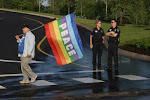
I stood silently with my rainbow-colored PEACE flag alongside my friends and fellow activists somewhat embarrassed at the projecting of evil solely on the other – the President and an ineffective Congress. Calling others “evil-doers” and labeling an “axis of evil” hasn’t worked out so well (in the long run) for President Bush. Why should we think it will work any better for us? Competent military leaders know you must “win the hearts and minds” of the nation you occupy to ultimately be successful. Maybe the peace community needs to recognize the same goal applies within our own nation which is presently “occupied” by the military-industrial complex.
Shouting and sloganeering rarely opens my heart to really listen to others. Can we find some other ways to offer our principled opposition to the war while inviting others into our (hopefully, expanding) circles?
By Steve Clemens. October 27, 2007
The chants rang out: “Who is a terrorist?” with the reply echoing, “Bush is a terrorist!” “This is what democracy looks like” – with the reply “Bush is what hypocrisy looks like!” Bless their hearts; people are angry and fed up with war and occupation. The need to vent their anger at the geo-political realities certainly seems necessary as the war for oil and domination continues in its fifth year - with signs that it might not abate until our military is completely broken or our political “leaders” grow some spine and stand up to the Administration.
I remember hearing Dick Gregory, the great humanitarian, civil rights activist, and comedian say during the protests against the Vietnam War, “If democracy is as good as we claim it is, we won’t have to shove it down others throats with the barrel of a gun. If it is so good, people will steal it!” The notion of going to war to establish “democracy” in the Middle East is preposterous. But chanting epithets on a street corner in south Minneapolis at noon on a sunny October day didn’t make me proud that “this is what democracy looks like” when it is coupled with angry personal taunts at the President or his policies.
Don’t get me wrong – I think those policies are not only misguided, wrong, and ultimately evil – and, yes, invading a nation which posed no threat to us and littering its countryside and cities with cluster bombs, depleted uranium munitions, and more “conventional” bombs dropped from thousands of feet above so the pilot cannot witness the human carnage below is an act of terrorism. But our political task is not to engage in self-righteous bombast but to find ways to invite our fellow country-folk (who voted in large numbers to keep Bush in power in 2004) to re-imagine what it could mean to renounce empire and rejoin the community of nations. Self-righteous anger can only get one so far – and we have an enormous job ahead of us to turn around the ship of state and convert it from a battleship to a hospital ship, cruise liner, or pleasure craft.
Do our signs and banners encourage dialog and conversion or do they serve as a bludgeon against our adversaries? Is our presence on the street corner friendly and inviting to those who might be ready to start on a new journey toward peacemaking?
I envision an open circle, welcoming for others to join in, holding candles lit up instead of cursing the darkness. Talking with each other, confessionally; what is it in my own lifestyle that encourages our political leaders to think that we want to maintain our comforts at the expense of others – thus requiring a military force to prevent others from getting what we have (to paraphrase LBJ before he invaded the Dominican Republic in the mid-60s.) Only when we are vulnerable to each other and open can we allow “the other” (be they our neighbors or even our “enemies”) to engage our common humanity and together seek a way out of our spiral of violence.
I stood silently with my rainbow-colored PEACE flag alongside my friends and fellow activists somewhat embarrassed at the projecting of evil solely on the other – the President and an ineffective Congress. Calling others “evil-doers” and labeling an “axis of evil” hasn’t worked out so well (in the long run) for President Bush. Why should we think it will work any better for us? Competent military leaders know you must “win the hearts and minds” of the nation you occupy to ultimately be successful. Maybe the peace community needs to recognize the same goal applies within our own nation which is presently “occupied” by the military-industrial complex.
Shouting and sloganeering rarely opens my heart to really listen to others. Can we find some other ways to offer our principled opposition to the war while inviting others into our (hopefully, expanding) circles?
14 Arrested at Headquarters of Local Arms Merchant
14 Arrested at Headquarters of Local Arms Merchant
By Steve Clemens. October 3, 2007 (published in www.tcdailyplanet.net)
October 2nd has been declared by the United Nations as “International Day of Nonviolence” in honor of the life and witness of Mohandas Gandhi, the leader of the nonviolent movement that ended British colonial rule in India. For a second consecutive year, AlliantACTION has sponsored a march and presence at Alliant Techsystems headquarters in Edina, MN on that date to honor Gandhi’s birthday. The theme chosen this year to celebrate one of history’s greatest nonviolent activists was “Peace Conversion With No Loss of Jobs”.
AlliantACTION has held a weekly vigil in front of Alliant Techsystems (ATK) headquarters for more than ten years on every Wednesday morning. However, to honor Gandhi and to broaden the circle of protestors beyond the normal group of 20-50 activists, the group added to the weekly presence by gathering on Tuesday where close to 100 people marched to the entrance of ATK. In a nearby park the group began with a song and reciting a “Commitment to Nonviolence” pledge. A poem was read to the circle and a brief talk informed those gathered about “Why We Focus on Alliant Techsystems”. Besides objecting to “profiting from war and death” and that “ATK sells its weapons all over the world –in more than 60 countries”, specific mention was made to the “illegal and indiscriminate weapons” designed, manufactured, and sold by ATK. Cluster bombs, anti-personnel landmines, and depleted uranium weapons were included in the list.
After the group had marched down Lincoln Drive to arrive at Alliant’s headquarters driveway, the group again circled to sing, hear quotes from Gandhi, and hear about the history and struggles about “peace conversion” – the “beating of swords into plowshares” where the crowd was encouraged to think of what peaceful and helpful products and services could be performed and sold by companies rather than seeking profits through making weapons. As the group said, “Happy Birthday, Gandhi”, members of the action brought forth dolls, books, a blanket, stuffed animals, toys, and even a huge stuffed “Elmo” Sesame Street character – placing them in a large over-flowing basket. Each person made a statement about their desire for this company to convert from making bombs and bullets and instead make toys, books, wind turbines, or other life-affirming products. As one member placed a stuffed dog in the basket, he said, “Dogs give love unconditionally – that’s what children need –unconditional love, not cluster bombs.” The event organizers announced that all the toys and books collected were to be delivered to the Incarnation House shelter in south Minneapolis later that morning.
After the basket of toys was filled, several members of the group announced their intention to give the balloons they were carrying to ATK security personnel and Edina Police Officers who had placed themselves across the driveway to prevent the activists from attempting to enter the building. The balloons were offered to them “to give to your kids or grandkids in celebration of Gandhi’s birthday”. They read a brief letter addressed to Alliant personnel stating that they were carrying a notebook entitled “Employee Liabilities of Weapon Manufacturers Under International Law” to give to them as well as asking the company to agree to “peace conversion with no loss of jobs”. Both the ATK security and the Edina police refused to accept either the offered balloons or the International Law documents before placing the 14 members of the group that ventured up the driveway under arrest for criminal trespass, a petty misdemeanor in Edina.
A bright, rainbow-colored kite flew over the gathering with the inscription “PU / DU” in reference to the disgust over the sale of depleted uranium (DU) weapons made by the corporation. Members of the circle clapped and thanked those who had been arrested for their nonviolent convictions and then posed for a photo in front of the corporate logo sign by the driveway entrance. One of the closing songs sung by the group before disbanding was set to the tune of “Home on the Range” and written by one of the weekly vigil circle members. It began,
“Oh, Alliant Tech please,
We ask you to cease,
Making products that cause
Death and pain.
May you ever increase
In products of peace
For folks that will
Keep this world sane…”
By Steve Clemens. October 3, 2007 (published in www.tcdailyplanet.net)
October 2nd has been declared by the United Nations as “International Day of Nonviolence” in honor of the life and witness of Mohandas Gandhi, the leader of the nonviolent movement that ended British colonial rule in India. For a second consecutive year, AlliantACTION has sponsored a march and presence at Alliant Techsystems headquarters in Edina, MN on that date to honor Gandhi’s birthday. The theme chosen this year to celebrate one of history’s greatest nonviolent activists was “Peace Conversion With No Loss of Jobs”.
AlliantACTION has held a weekly vigil in front of Alliant Techsystems (ATK) headquarters for more than ten years on every Wednesday morning. However, to honor Gandhi and to broaden the circle of protestors beyond the normal group of 20-50 activists, the group added to the weekly presence by gathering on Tuesday where close to 100 people marched to the entrance of ATK. In a nearby park the group began with a song and reciting a “Commitment to Nonviolence” pledge. A poem was read to the circle and a brief talk informed those gathered about “Why We Focus on Alliant Techsystems”. Besides objecting to “profiting from war and death” and that “ATK sells its weapons all over the world –in more than 60 countries”, specific mention was made to the “illegal and indiscriminate weapons” designed, manufactured, and sold by ATK. Cluster bombs, anti-personnel landmines, and depleted uranium weapons were included in the list.
After the group had marched down Lincoln Drive to arrive at Alliant’s headquarters driveway, the group again circled to sing, hear quotes from Gandhi, and hear about the history and struggles about “peace conversion” – the “beating of swords into plowshares” where the crowd was encouraged to think of what peaceful and helpful products and services could be performed and sold by companies rather than seeking profits through making weapons. As the group said, “Happy Birthday, Gandhi”, members of the action brought forth dolls, books, a blanket, stuffed animals, toys, and even a huge stuffed “Elmo” Sesame Street character – placing them in a large over-flowing basket. Each person made a statement about their desire for this company to convert from making bombs and bullets and instead make toys, books, wind turbines, or other life-affirming products. As one member placed a stuffed dog in the basket, he said, “Dogs give love unconditionally – that’s what children need –unconditional love, not cluster bombs.” The event organizers announced that all the toys and books collected were to be delivered to the Incarnation House shelter in south Minneapolis later that morning.
After the basket of toys was filled, several members of the group announced their intention to give the balloons they were carrying to ATK security personnel and Edina Police Officers who had placed themselves across the driveway to prevent the activists from attempting to enter the building. The balloons were offered to them “to give to your kids or grandkids in celebration of Gandhi’s birthday”. They read a brief letter addressed to Alliant personnel stating that they were carrying a notebook entitled “Employee Liabilities of Weapon Manufacturers Under International Law” to give to them as well as asking the company to agree to “peace conversion with no loss of jobs”. Both the ATK security and the Edina police refused to accept either the offered balloons or the International Law documents before placing the 14 members of the group that ventured up the driveway under arrest for criminal trespass, a petty misdemeanor in Edina.
A bright, rainbow-colored kite flew over the gathering with the inscription “PU / DU” in reference to the disgust over the sale of depleted uranium (DU) weapons made by the corporation. Members of the circle clapped and thanked those who had been arrested for their nonviolent convictions and then posed for a photo in front of the corporate logo sign by the driveway entrance. One of the closing songs sung by the group before disbanding was set to the tune of “Home on the Range” and written by one of the weekly vigil circle members. It began,
“Oh, Alliant Tech please,
We ask you to cease,
Making products that cause
Death and pain.
May you ever increase
In products of peace
For folks that will
Keep this world sane…”
Why Do We Focus on ATK?
Why Do We Focus on ATK?
By Steve Clemens, Gandhi’s Birthday Action, October 2, 2007
• They make illegal weapons
• They profit from war and death
• They sell their weapons all over the world
• This is their World Headquarters
1. Illegal Weapons:
According to the Laws of War and International Humanitarian, weapons which fail to discriminate between combatants and the civilian population are “indiscriminate” and, therefore illegal to be “manufactured, sold, stockpiled, or used.”
• Anti-personnel landmines – ATK is one of the leading manufacturers of landmines in the U.S. since it’s spin-off from Honeywell and has recently bragged about developing two new versions of “smart” ones called the Spider and the Matrix. Anti-personnel landmines have been declared illegal by Treaties although our country has refused to sign it. Since more than 80 nations world-wide have signed the Treaty, it is in effect.
• Cluster Bombs- ATK is one of only two manufacturers of the CBU-87, an air-dropped cluster munition used in both Afghanistan and Iraq by the U.S. Military. International Law experts state that a “dud rate” of greater than ½ of 1% would make this weapon “indiscriminate”. The cluster bombs ATK makes have been shown to have a “dud rate” of between a low of 5% and as high as 30% - and, as such, have been specifically mentioned in United Nations Resolutions as illegal because of their indiscriminate nature. Although the term used is “dud”, unexploded cluster bombs litter the landscape and explode for decades to come – often killing children and farmers.
• Depleted Uranium Munitions- The use of waste product from the enrichment of uranium, the hard, dense, yet still radioactive –and a toxic “heavy metal” to boot – depleted uranium bullets and artillery shells have been used in Iraq, Afghanistan, and the Balkans. Although difficult to prove scientifically, it is widely believed to result in cancers, birth defects, toxic poisonings and other deadly health maladies in both the civilian population and can affect the troops that use these weapons as well. Again, like cluster bombs, depleted uranium weapons are specifically outlawed by a UN Resolution.
• “The Gun that Can Shoot Around Corners”- (XM25 Air-Burst Assault Weapon) – Designed to explode beyond walls or other objects without being able to “see” what is behind them. Is it a combatant – or a child? What will happen when “criminal elements” in our society get a hold of them and use them against the police? By it’s very nature it is indiscriminate.
• Critical Components of Rockets and Missiles Designed to Deliver Nuclear Bombs- The rocket motors for the first-strike Trident Submarine nuclear missiles as well as the land-based Minuteman III nuclear missiles are made by ATK. These are weapons which, if used, can lead to a nuclear holocaust or the end of human life on this planet.
2. Profiting From Death:
Profits have soared since 9/11
ATK is the largest supplier of ammunition to U.S. Military –worth protesting even if it is not illegal.
Convicted of price-fixing by the U.S. Government! (AeroJet and ATK colluded to keep the prices of cluster bombs high by agreeing not to bid against each other.)
3. Selling Weapons All Over the World:
According to their own website, ATK has sales representatives in 60 different countries and sells to BOTH SIDES in some conflicts.
4. World Headquarters Are Here:
Housed in this building are the key decision-makers for this corporation. They bear a particular responsibility for the choices they make regarding what this company makes and sells. They are the ones who can choose Peace Conversion with no loss of jobs.
Please go to www.alliantACTION.org for more information on this Merchant of Death and the creative ways we have tried to nonviolently resist it.
By Steve Clemens, Gandhi’s Birthday Action, October 2, 2007
• They make illegal weapons
• They profit from war and death
• They sell their weapons all over the world
• This is their World Headquarters
1. Illegal Weapons:
According to the Laws of War and International Humanitarian, weapons which fail to discriminate between combatants and the civilian population are “indiscriminate” and, therefore illegal to be “manufactured, sold, stockpiled, or used.”
• Anti-personnel landmines – ATK is one of the leading manufacturers of landmines in the U.S. since it’s spin-off from Honeywell and has recently bragged about developing two new versions of “smart” ones called the Spider and the Matrix. Anti-personnel landmines have been declared illegal by Treaties although our country has refused to sign it. Since more than 80 nations world-wide have signed the Treaty, it is in effect.
• Cluster Bombs- ATK is one of only two manufacturers of the CBU-87, an air-dropped cluster munition used in both Afghanistan and Iraq by the U.S. Military. International Law experts state that a “dud rate” of greater than ½ of 1% would make this weapon “indiscriminate”. The cluster bombs ATK makes have been shown to have a “dud rate” of between a low of 5% and as high as 30% - and, as such, have been specifically mentioned in United Nations Resolutions as illegal because of their indiscriminate nature. Although the term used is “dud”, unexploded cluster bombs litter the landscape and explode for decades to come – often killing children and farmers.
• Depleted Uranium Munitions- The use of waste product from the enrichment of uranium, the hard, dense, yet still radioactive –and a toxic “heavy metal” to boot – depleted uranium bullets and artillery shells have been used in Iraq, Afghanistan, and the Balkans. Although difficult to prove scientifically, it is widely believed to result in cancers, birth defects, toxic poisonings and other deadly health maladies in both the civilian population and can affect the troops that use these weapons as well. Again, like cluster bombs, depleted uranium weapons are specifically outlawed by a UN Resolution.
• “The Gun that Can Shoot Around Corners”- (XM25 Air-Burst Assault Weapon) – Designed to explode beyond walls or other objects without being able to “see” what is behind them. Is it a combatant – or a child? What will happen when “criminal elements” in our society get a hold of them and use them against the police? By it’s very nature it is indiscriminate.
• Critical Components of Rockets and Missiles Designed to Deliver Nuclear Bombs- The rocket motors for the first-strike Trident Submarine nuclear missiles as well as the land-based Minuteman III nuclear missiles are made by ATK. These are weapons which, if used, can lead to a nuclear holocaust or the end of human life on this planet.
2. Profiting From Death:
Profits have soared since 9/11
ATK is the largest supplier of ammunition to U.S. Military –worth protesting even if it is not illegal.
Convicted of price-fixing by the U.S. Government! (AeroJet and ATK colluded to keep the prices of cluster bombs high by agreeing not to bid against each other.)
3. Selling Weapons All Over the World:
According to their own website, ATK has sales representatives in 60 different countries and sells to BOTH SIDES in some conflicts.
4. World Headquarters Are Here:
Housed in this building are the key decision-makers for this corporation. They bear a particular responsibility for the choices they make regarding what this company makes and sells. They are the ones who can choose Peace Conversion with no loss of jobs.
Please go to www.alliantACTION.org for more information on this Merchant of Death and the creative ways we have tried to nonviolently resist it.
Nonviolent Protest Continues Against Alliant Techsystems
Nonviolent Protest Continues Against Alliant Techsystems
By Steve Clemens
August 6th marked the 62nd anniversary of the atomic bombing of Japan. To remember those who died and those who continue to suffer the effects of radioactive poisoning from those two bombs and to remind us about current victims of uranium weapons, the Chicago-based Christian Peacemaker Teams organized a peace witness at the headquarters of the largest manufacturer of depleted uranium weapons in the U.S. – Alliant Techsystems (ATK) in Edina. About 40 people, many dressed in black clothing and carrying white roses to represent healing and remembrance for those who have suffered from nuclear weapons and DU participated in singing and calling out victims of depleted uranium weapons made by this company.
Vigilers held signs that read "Hiroshima: Never Again," and passed their white roses to others bearing signs representing victims of DU – Iraqi civilians, U.S. and Iraqi soldiers, children, Afghanis, etc. As the crowd sang out the words, "None can stop the Spirit, burning now inside us. We will shape the future. We will not be silent," eight participants carried their white roses up the driveway towards the front door of ATK, hoping to deliver their message of peace to corporate executives. When stopped by several ATK employees and Edina police, the eight attempted to engage them in dialogue. After police warned the group to leave or they would be arrested, the eight then knelt down in prayer and were arrested. They were Tarek Abuata (Bethesda, MD), Sally Ann Brickner (Green Bay, WI), Kryss Chupp (Chicago, IL), Steve Clemens (Minneapolis, MN), Delycia Fuestel (Lebanon, NH), Cliff Kindy (N. Manchester, IN), Martin Smedjeback (Sundbyberg, Sweden), and Colin Stuart (Ottawa, ON).
One week prior to the August 6th action, nine members of the AlliantAction Vigil Group – each owners of a share of ATK stock were arrested for attempting to attend the Annual ATK Stockholders Meeting for which they had all received invitations! When they tried to enter, they were told that because they had been previously arrested for trespass, they could not enter –even though they carried the invitations with them. Some who left after being challenged, went back up the driveway to be arrested in solidarity with those already under arrest. At least one Vets for Peace Member, Dr. David Harris as well as several associate members were part of the arrest group.
It has been reported in the local Edina Sun-Current that Alliant Techsystems is moving its headquarters next Spring to a site in Eden Prairie. The article states: “A relocation to its own building would give the company an opportunity to fortify its property with such protests in mind.” Principled nonviolence is always a threat to those who wish to hide behind trespass and private property laws to continue their illegal and immoral activities.
By Steve Clemens
August 6th marked the 62nd anniversary of the atomic bombing of Japan. To remember those who died and those who continue to suffer the effects of radioactive poisoning from those two bombs and to remind us about current victims of uranium weapons, the Chicago-based Christian Peacemaker Teams organized a peace witness at the headquarters of the largest manufacturer of depleted uranium weapons in the U.S. – Alliant Techsystems (ATK) in Edina. About 40 people, many dressed in black clothing and carrying white roses to represent healing and remembrance for those who have suffered from nuclear weapons and DU participated in singing and calling out victims of depleted uranium weapons made by this company.
Vigilers held signs that read "Hiroshima: Never Again," and passed their white roses to others bearing signs representing victims of DU – Iraqi civilians, U.S. and Iraqi soldiers, children, Afghanis, etc. As the crowd sang out the words, "None can stop the Spirit, burning now inside us. We will shape the future. We will not be silent," eight participants carried their white roses up the driveway towards the front door of ATK, hoping to deliver their message of peace to corporate executives. When stopped by several ATK employees and Edina police, the eight attempted to engage them in dialogue. After police warned the group to leave or they would be arrested, the eight then knelt down in prayer and were arrested. They were Tarek Abuata (Bethesda, MD), Sally Ann Brickner (Green Bay, WI), Kryss Chupp (Chicago, IL), Steve Clemens (Minneapolis, MN), Delycia Fuestel (Lebanon, NH), Cliff Kindy (N. Manchester, IN), Martin Smedjeback (Sundbyberg, Sweden), and Colin Stuart (Ottawa, ON).
One week prior to the August 6th action, nine members of the AlliantAction Vigil Group – each owners of a share of ATK stock were arrested for attempting to attend the Annual ATK Stockholders Meeting for which they had all received invitations! When they tried to enter, they were told that because they had been previously arrested for trespass, they could not enter –even though they carried the invitations with them. Some who left after being challenged, went back up the driveway to be arrested in solidarity with those already under arrest. At least one Vets for Peace Member, Dr. David Harris as well as several associate members were part of the arrest group.
It has been reported in the local Edina Sun-Current that Alliant Techsystems is moving its headquarters next Spring to a site in Eden Prairie. The article states: “A relocation to its own building would give the company an opportunity to fortify its property with such protests in mind.” Principled nonviolence is always a threat to those who wish to hide behind trespass and private property laws to continue their illegal and immoral activities.
Subscribe to:
Posts (Atom)