Day 4


An Eclectic Mix: Schools, Commerce, Cemeteries, and Ice Cream – Day 4 in Iraq by Steve Clemens

Our schedule was shifted for today when we noticed our school visits were on the itinerary for Friday when schools are closed for the weekly religious day. So off we traveled to three different schools. The elementary school principal met us but had to check with the local Ministry of Education before giving us access to the classrooms. Since the class we visited was 6 year-old girls, Joan Haan brought out the pictures and notes written by children from St. Paul’s Pilgrim Lutheran Church.

The girls beamed with excitement because of the attention they received from visitors from far away. I gave them each a packet of Skittles or Starburst candy from an after-Halloween sale but none of the girls opened it right away, carefully watching their teacher interact with these strangers. We couldn’t stay very long with two other schools to visit but did manage to photograph the water filter in the bathroom installed a year ago by the Muslim Peacemaker Team. Sami checked it out to make sure it was functioning properly and to check to see when the filter would need to be replaced.

As we gathered to leave, a cowbell was rung to signify either class change or recess time and young girls piled out of the dozen or so classrooms, some bold enough to come close to these visitors – some staring, some smiling. When we took out our cameras, they definitely were interested and acted as all kids from elementary age would – embarrassment, pleasure, curiosity, … . It was clear that after we left, the other classes were going to ask the students from the class we visited what these Americans were like.

The second stop was at a school for the blind and the Principal told us there were only 6 or 7 of them in the country and this school provided services for about 30 children. One student demonstrated how he used the computer with headphones and other adaptive equipment while a younger student read letters from a braille sheet after instruction from a teacher. This school too had a recently installed MPT water filter.

At the High School we discovered the Superintendent was an old classmate of Sami Rasouli, Sameera served as an Administrator, and Mohammed was a graduate of that program: an MPT triple-header. Our delegation split up to go to different classes and I went to a biology class and then an English language class. The students were bright and engaged. The Superintendent asked Kathy McKay if our Sister City program could secure 5-6 scholarships to colleges in Minnesota and we will certainly pass their interest on to the University of MN and other Twin Cities area schools.

Next stop was at the Najaf Chamber of Commerce and a visit with my good friend, Zuhair Sharba, the Chairman of a bustling and growing enterprise. Besides seeking new business partnerships and job opportunities, the center also has a small business program, a special program for women looking to start businesses or needing expert advice and assistance, and an arbitration center to resolve disputes which might arise when international companies try to fit their programs into Iraq’s reality.


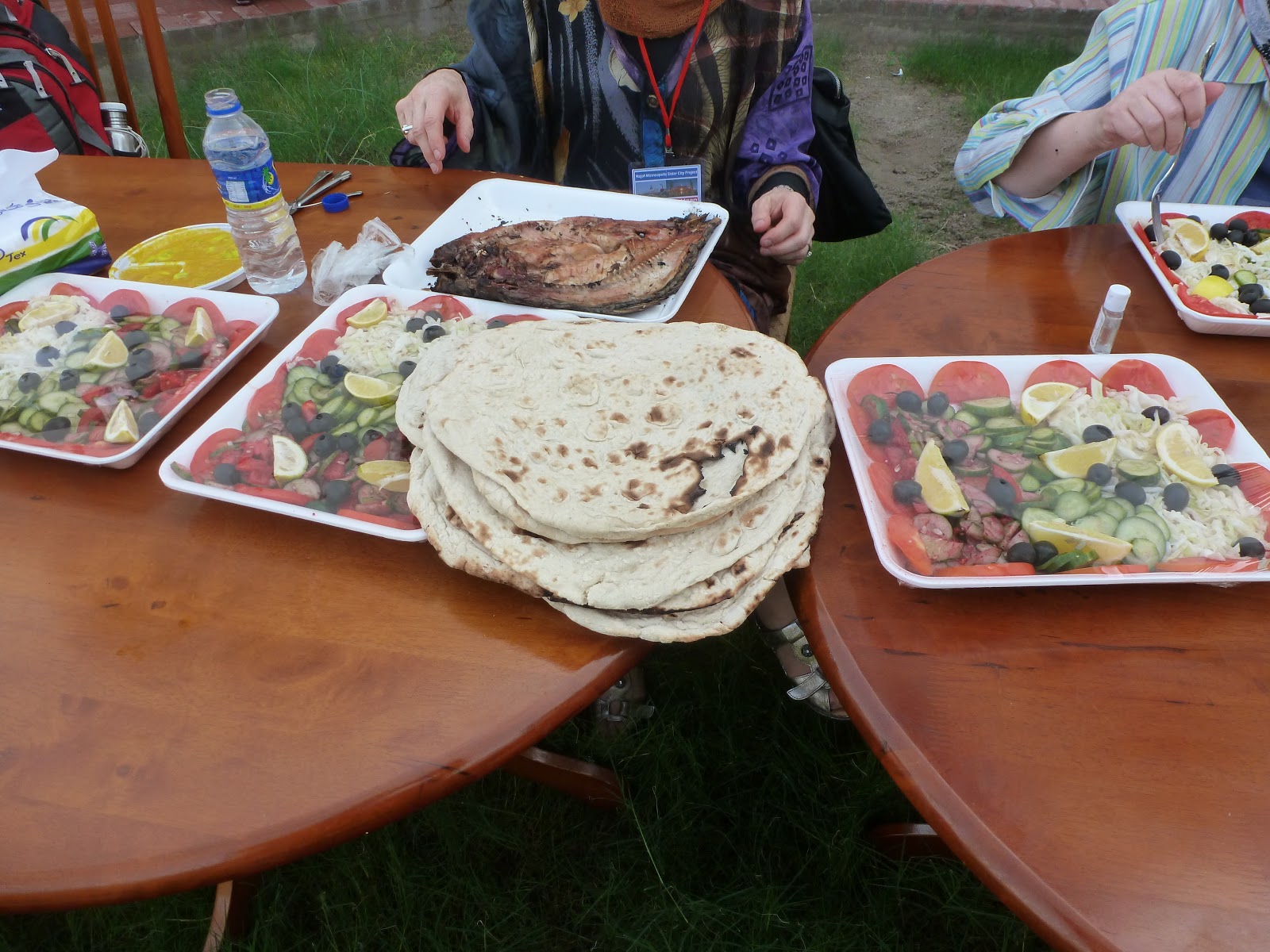
After meeting their board and staff, touring their facilities, and exchanging greetings and gifts, we were treated to a delicious lunch of fresh-grilled carp, chicken, vegetables and spreads, and fresh fruit. We didn’t sit down to eat until after 3 PM so some of us were fairly ravenous.

Trying to return to our previous schedule, we decided to drive by the world’s largest cemetery – it literally goes for miles – and then ended up on the upper deck of a parking ramp which overlooked a vast section of the place where most Shia Muslims hope their family members can be buried. The cemetery is more than a thousand years old and one looks over a sea of graves stretching into the horizon. In the background from where we stand at sunset is the brightly lit golden dome of the Shrine of Imam Ali, the reason for the popularity of the cemetery. After posing for the requisite photo, the group decides since we ate lunch so late – and most of us ate too much – that we’d forgo supper and instead stop at “Ice Pack”, an ice cream shop opened by a cousin of Ali, our photographer and media liaison for the delegation. Never needing a reason to celebrate with ice cream, we at least had the excuse that Deborah’s checked luggage finally arrived from the airport this morning and she now has a fresh set of clothes and other essentials – four days after first arriving.

I arrived back at the guest house tired but also needing to download my photos and write up another report for friends back home. Iraqis continue to want partnerships with us and make us feel so welcome despite the recent war and all the suffering which ensued. Iraq still has many needs but they are striving everyday to try to regain what they had before the wars and economic sanctions. Our delegation is a tangible sign of hope that a new a vibrant relationship can be had with at least some Americans. Hopefully, as we get over our fears and stereotypes, those relationships can grow and blossom.  

Day 3 in Iraq


Diplomacy By Facebook: Day 3 in Iraq by Steve Clemens

Sunday in Iraq is the beginning of the workweek so when we drove to the University of Kufa in the morning there was a myriad of students present. We met with Dr. Azar, a dermatologist I had met in Minneapolis when he was part of the inaugural Sister City delegation in 2009. He showed us his laser and UV equipment he uses in his practice and told us a lot about medical schools and research happening at the University which promises to be in on the cutting edge of graduate education in Iraq and ultimately in the Middle East. Later in the morning several of us were asked to do PowerPoint presentations about some of our work and passion in the Twin Cities. But what really grabbed me was the enthusiasm of the young students who are eager to meet us and share their dreams and goals.

And they ask about connecting with us on Facebook. When I asked Mohammed about connecting with me in this social media revolution, he spelled out his name so I could find him and “friend” him. I searched that evening finding at least a dozen men, most if not all Iraqis, with that same name so, being 62 and of a generation which has to ask our offspring how to do things computer-wise, I asked Mohammed if he’d send me a request thru Facebook to be my friend and then I could just say “Yes!”

However, to the chagrin of both of us, when he brought in his laptop and connected to the wi-fi network here at the guest house, he typed in my name only to discover we were already friends! Apparently thru Sami Rasouli he had befriended Luke Wilcox, our (only) staff member at the Iraqi & American Reconciliation Project when he traveled to Najaf last year to improve his Arabic. When I received a “friend” request in Arabic several months ago, I forwarded it to Luke asking if he knew who this person was before saying yes. Luke assured me the person behind the unintelligible (to me) Arabic scrawl was someone I’d want to connect with.

The problem for me was when I searched for Mohammed on my computer I couldn’t find him because the only name on his account was in Arabic and I don’t know how to begin to do that on my laptop. Furthermore, I confessed to my new friend that I’ve probably let some of the paranoia of the FBI infiltrate my own mind. After all, the homes of several of my friends in Minneapolis were raided by the FBI several years ago under the preposterous claim that they were giving “material support to terrorists”. Preposterous most of all since none of them have much in the way of material resources that they haven’t already poured into their anti-war and justice advocacy work. Because of their continued experience of being under suspicion (and threatened serious legal challenge) I’ve probably been too cautious in reaching out to others who speak a language I can’t comprehend.

But now that I’ve met Mohammed face-to-face and discover that he is not only on the faculty of the College of Pharmacy at the University, teaches computer science, and helps the Muslim Peacemaker Team with communications, he is also a great guy and fun to hang out with. He already has show my fellow delegate Joan how to better maneuver on her Facebook account and promises to help me as well.

And I’ve met Ahmed, friended him on Facebook, and he tells me about his exciting work in planting trees to not only beautify his nation but also help protect its environment. After I met him our first night, he had already sent me a “friend” request before I got back to the guest house that same evening. When I saw him the next morning at the souk in the “old city” section of Najaf, he smiled and told his buddies that he and I were already [Facebook] friends – as well as also being on track to becoming more than just friends in the virtual world. We hope our delegation can schedule some time to plant trees with him and his organization before we leave Mesopotamia.

At the University presentations, Deborah, one of our delegation spoke out clearly about wanting to empower the voices of women in our world and it was fascinating to see several young women crowd around her afterward – and then another group of female students came by to talk with her as we were finishing our lunch at a campus restaurant/hangout. I’m grateful to witness their enthusiasm especially when women are so “covered” and often out-of-sight in much of this conservative Shia culture.   

Several other young people inquire if any of us are on Facebook, hungry for relationships with these unarmed American visitors. Citizen-to-citizen diplomacy is greatly facilitated when we discover not only that we like each other but also we share so many similar dreams and challenges. 

Day Two of My Return to Iraq


An Iraq the Tea Party Would Love: Day Two Back in Iraq by Steve Clemens

I have to admit, the very sweet (hot) tea served in the tiny glass cups are a real treat even though I may regret the caffeine later tonight. So many families and individuals served me tea on my last sojourn to the Cradle of Civilization in 2002 that those precious memories are invoked every time I sip that hot, sweet beverage this week –although at the same time my heart breaks in not knowing how most of them survived during the war. One friend, a former teacher and an artist re-connected with me when she was able to be accepted as a refugee several years after the war exploded in her home town of Baghdad.

Fortunately Amal was able to sell enough of her oil paintings to international peacemakers and others that she was able to fulfill her plan to take her three young children to Syria during the early days of devastating bombing blasphemously named “Shock and Awe”. Awe, as I learned growing up in Sunday School was reserved for the wonder of the Divine, not the vain-glorious acts of mad bombers and empire builders. However, after Amal thought it was safe enough to return to her Karrada neighborhood in Baghdad, she had to flee again, this time to Jordan, after her children witnessed body parts lying on the street after several car-bombings near their apartment. Finally after another wait of several years she was able to come to New York as a war refugee, one of the very few our government has accepted of the many, many displaced families.

But I’m not sure that Amal’s story would resonate with my Tea Party friends [immigration not being a high priority issue] although I still have fond memories of drinking tea in Amal’s bomb-damaged house in Baghdad after 10 years had passed. (Her home was damaged when Bill Clinton ordered cruise missiles to strike a Republican Guard site across the Tigris River from her house and those bombs weren’t as “smart” as advertised.)

But the sight I saw this morning on our drive around the Kufa and Najaf city areas, and especially through the city neighborhoods, would illustrate the Tea Party ideology of “little government” to a T. Stretched across the highway, bundled together in what appears to be a haphazard fashion are dozens – if not close to a hundred - wires and cables. Ali, our driver and interpreter, tells us that someone in the neighborhood owns a generator; when the power goes out, this private entrepreneur sells his generator-powered electricity to his subscribers. [Honestly, just as I’m writing this, our power just went out 4 times for a few minutes. It is back on because this guest house has its own generator.]

When I saw the cobweb of wires suspended above the highway, I immediately had two reactions. First I thought of my young friend Mostafa who came to the US under the sponsorship of St. Joan of Arc Catholic Community in Minneapolis to receive medical attention and a prosthetic leg after suffering grievous injuries during the war when a live electrical wire hit him while he was playing on his flat-rooftop. All these electrical wires strung willy-nilly are an accident ready to happen. My second thought was when you “starve the beast” [government] enough, there are no resources left to re-build the necessary infrastructure we often take for granted: clean water and dependable electricity. The destruction of two wars which sandwiched a draconian economic sanctions regime, all at the behest of the American government, has reeked terrible damage to both of these necessities in Iraq today.

While the Water For Peace program run by the Muslim Peacemaker Team here in Najaf (and funded through donations to the Iraqi & American Reconciliation Project) and neighborhood privately-owned generators might be necessary stop-gap solutions, they are no replacement for what governments should be designed to provide. We do see signs of government-sponsored projects all around Najaf, especially highway projects to relieve the tremendous traffic congestion in an area that receives millions of visitors and religious pilgrims every year. In fact, some early neo-con enthusiasts for the War on Iraq back in 2003 had plans to completely re-make Iraq into a model economy for those obsessed with private enterprise as a cure-all. 

Naomi Klein, a Canadian investigative journalist wrote back then that proponents of that plan referred to “Baghdad, Year Zero” in their wet dreams of unfettered capitalism. Unfettered implies unregulated – at that is precisely what I see when the safety concerns embodied in haphazard wiring are either non-existent or ignored. How many more Mostafas will need the intervention of “charity” before the government is strong enough to not only regulate but also rebuild an infrastructure which negates the need for an electrical supplement? Lest you feel I’m aiming my criticism at the present government in Iraq, I should remind you that American tax dollars already paid billions of dollars to the mercenary military contractors to rebuild Iraq’s infrastructure after the initial fighting subsided but instead squandered the profits and subcontracted the work to other groups who apparently did the same.

I look in vain to see what American taxpayers bought over here.

So the Tea Party I want to embrace are these lovely people who have warmly and graciously welcomed our delegation and are eager to relate to “unarmed” Americans. Despite all they’ve suffered through decades of war and sanctions, they are ready to “party” with anyone who is able to embrace their humanity and dignity. I lift my cup of tea to such reconciliation.   

Back in Iraq


Day One: Back in Iraq, 10 years later. By Steve Clemens November 9, 2012

I had left Iraq just 3 months before the US war-of-choice began in March 2003. My experience with the Iraq Peace Team was powerful and life-changing because I was able to act on my faith rather than my fears. So this land between the Tigris and Euphrates has a special place in my heart.

Once again, we are overwhelmed with hospitality. As soon as we entered the Najaf airport terminal building after our 2 ½ hour flight from Istanbul, I immediately recognized the broad, effusive smile of Sameera, a member of the Muslim Peacemaker Team who had traveled to the US several years ago with the first Iraqi delegation from Najaf. They came bearing an invitation for Minneapolis to become a Sister City with Najaf and Sameera was one of the three women in that delegation of 14. She spoke very little English (about as much as my pitiful attempts at Arabic) but one always knew she was overflowing with love and peace by her warm smile and the way she embraced other women.

Sameera is still a typical Shia Muslim woman from one of the most conservative cities in Iraq. When she arrived in Minneapolis, she didn’t offer her hand to men in greeting because that was to her upbringing a culturally inappropriate thing to do. But by the end of the two and a half weeks in the Twin Cities, she shook my hand and thru the interpretation of Dr. Askouri, another delegation member whose spoke fluent English, she told me she wanted me to come visit Najaf. My response at the time to her and the others who invited me to come to their hometown was, “I’ll have to wait until the U.S. withdraws its occupation forces first.”

Well, with the exception of some military guards in the Green Zone and several consulates, some military trainers for the Iraqi Army, and still many military “contractors”, the U.S. troops are gone. So I was free to come as an unarmed (and without a security detail escort) civilian ready to engage in citizen-to-citizen diplomacy.  Apparently, that diplomacy involves a lot of food! (More on that later.)

Besides Sameera, I also noted the friendly smiles of Hiba from the Governor’s office and Ali and Nasir from the Iraqi Foreign Ministry Office in Najaf lined up to greet us along with my dear friend and peacemaker, Sami Rasouli – the prime instigator and encourager of the Sister City relationship. Sami had returned to his original hometown in September after he and his wife Suad welcomed their new daughter into their family while in the US for 3 months this summer. Sami had helped arrange our flights and now was there to guide us through the process to secure our visas needed for our 12 day visit.

After being escorted to a separate, quieter waiting room, as we continued to greet one another, the Iraqis unfurled a huge banner welcoming us. And then a second banner! Sami told us the whole city is buzzing with the news of our visit – even though none of us could pass as dignitaries or even elected officials!

After collecting our luggage and getting our passports stamped, we were escorted out into the 80+ degree heat (now about 8:30 AM) to the awaiting SUVs which will drive us to the Governor’s Guest House where we will stay as his honored guests. It is quite a shock to learn it is one of many former palaces built for Saddam Hussein, now deposed but not easily forgotten. We’d prefer to stay in more humble abodes (and will do some home-stays with local Iraqis) during part of our visit but it is impossible to turn down such offers of genuine hospitality.

At the Guest House we are given a bag with some dried figs and canned nuts “to hold us over” if we were still hungry from our 31 hour-in-transit experience with 9 time zone changes. Not being a seasoned world-traveler, my body-clock is thoroughly confused – but I’m not hungry. But as soon as we are given our assigned, spacious rooms, we are reminded that there will be “breakfast” waiting for us in the restaurant on the level below our rooms. It is 10 AM by the time we begin to eat the fresh Iraqi bread (one of my favorite memories of my stay in 2002), cheeses, jellies, and other assorted foods – and the requisite hot tea, this time sweetened to our own desires rather than pre-sweetened.

We are given some time to freshen up and/or crash on our beds before being invited for lunch at 1 PM. We eat outside in the shade and feast on freshly-caught carp cooked on the grill. Tasty and nourishing! I ask Joan Haan, a good friend and fellow delegate to share the huge portion with me, knowing that we’ve already been told to gather at 5 PM to ride into the “old city” of Kufa for dinner and a welcome reception with the Governor of the Province of Najaf. Looks like we’re getting a real “taste” of citizen diplomacy.

It is hard to say in just a few words why I am here. I want to say, “I’m sorry,” for the actions of my government. I want to work on re-establishing relationships between Iraqis and Americans which forgo weapons and domination. I want to visit new friends in their homes and listen deeply to their stories, to weep and laugh with them. Most of all, I want to look my fellow peacemakers from the Muslim Peacemaker Team in the eyes and say, thank you for your courage and your witness. How can we work together to build a peaceful and just society?

I brought along with me a copy of the book by Greg Barrett just released before our trip, The Gospel of Rutba: War, Peace, and the Good Samaritan Story in Iraq. It retells the account of three of my friends injured as they left Iraq during the days of Shock and Awe – Christian Peacemaker Team members befriended and healed by “the enemy”. Their story, embellished by their return trip several years later to thank their saviors, reminds us of the importance of this work of reconciliation. I look forward to 12 days of connecting in ways that transcend “diplomacy” and help us re-connect with our common humanity and our relationship as sisters and brothers. These Iraqis are looking for partners; they have much to teach me when I’m ready to learn. “Inshalla”, God willing, as my Muslim friends remind me.