


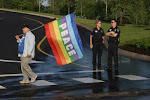

Taking It To The Courts by Steve Clemens. May 12, 2009
The immigration system in the U.S. is broken. Partisan political bickering compounds this political hot potato. Maybe the only branch of our tripartite government that can look at this issue dispassionately is the judiciary. It seems both the legislative and executive branches are bombarded by both interest groups and fear-mongering and remain immobilized to doing something.
But do we really want a dispassionate look? Yes and no.
Yes, because in a democracy, one needs a clear analysis of the situation, making sure that the majority doesn’t trample the rights of minorities. Fears, xenophobia, racial and ethnic stereotyping need to be set aside when determining correct public policy.
No, because I also want a passionate look at immigration. There is genuine suffering that presently occurs on both sides. Arizona cattle ranchers on the border with Mexico find their fences cut, cattle being killed outright or poisoned from eating the detritus left behind by migrants traveling through their lands. On the migrant side, families are being torn asunder. People are desperate to feed and provide for their families amidst Mexico’s economy which has been shattered in some sectors (agriculture, manufacturing, …) by globalization pressures. And that desperation drives them north, trying to find ways to survive and thrive. I want compassion – literally “with passion”.
The U.S. is not an island. Our economic and political policies drastically affect the lives of millions around the globe. Some Americans are truly fearful of being overrun by “outsiders” – maybe in similar ways to what our Native American ancestors experienced. By global standards, most of us have more than enough, certainly more than our fair share.
So, how does one bring it to the courts?
One way is through civil disobedience. It becomes a way to protest unjust laws and unjust situations and creates a public crisis by forcing the judicial branch to look at it. Granted, for the most part in U.S. history, the courts have done a pathetic job. We only have to view the “guilty” verdicts of abolitionists, suffragettes, civil rights agitators, and anti-war activists to see the failure of the judiciary in retrospect. But there have been a few victories; some judges find a defendant technically guilty but refuse to sentence them to any penalty.
Witness the recent case of a member of “No More Deaths” who was arrested and charged with “littering” for leaving bottles of water in the desert for migrant workers trying to get a better life for their families. He was found “guilty” but the judge refused to sentence him. In an ideal world, the Judge would refuse to pronounce the guilty verdict and instead fall back on the Universal Declaration of Human Rights that the U.S. has signed in 1948 as a justification for the humanitarian action.
Or remember the Federal Judge in Minneapolis who refused to find guilty demonstrators against the Vietnam War or nuclear weapons. Some prosecutors have chose to dismiss charges, not because they don’t have enough “evidence”, but because it is not in the public interest to criminalize some behavior. It may appear to outsiders that some of these decisions are made for other reasons (cost of a trial, difficulty to prove intent, busy court docket) but I hope it is due to the conscience and political sensibility of some prosecutors. Maybe some prosecutors are sensitive to world opinion and International Law that often gets short shrift in the U.S.
Some courts and some judges have done a better job on death penalty issues than the political process. It has been the courts that have led the way for some initial movement on the rights of GLBT people to marry – and now some legislators are trying to catch up. Maybe the courts can provide an opening for a just and compassionate resolution to our immigrant policy impasse.
My friend and retired trial attorney, Peter Thompson, reminded me that the best vehicle for getting the courts to address the immigration issue is not via civil disobedience where the court is left to only decide guilt or innocence -so conviction or acquittal doesn't really get to the issues, except indirectly. Civil disobedience cases really don't develop the law; civil disobedience can help build public opinion -it is rather through finding compassionate and determined lawyers to take up the thousands of cases of those caught up in this broken system. To get to the social and justice issues a judge needs to have a case before her that raises those issues. The way to reach these issues is through litigation of the deportation or exclusion cases of immigrants. The big problem here is that most lawyers won't take these cases.
Until or unless we can find and fund the lawyers who will, we’re left with artificially creating the crisis for the courts: by filling their dockets with those of us willing to sit or stand in the way, hoping to protect our brother and sister immigrants who are in danger. Sometimes it seems that civil disobedience is all we can do in the interim while we wait for (and create space for) the political process to catch up. I remember Dan Berrigan said after one of his many courageous and insightful protests, “I could not NOT do it”. That’s one reason for my civil disobedience last Wednesday at the ICE/deportation center in Bloomington, MN.

Am I Getting Too Old For This Stuff?

Am I Getting Too Old For This Stuff? By Steve Clemens. May 8, 2009
Déjà vu hit me when I starred at the one piece stainless steel toilet and sink on one side of my cell and the cracked pathetic excuse for a mattress and pillow laid out on the concrete slab bunk across my 8x10 cage. Was it really more than 28 years ago that I had my first prolonged taste of jail?
In February of 1981 at the age of 30, I joined five others in scaling the fence outside a nuclear weapons plant in Amarillo, TX and was rewarded with 6 months of “hospitality” at the hands of the government. I was “blessed” with three months in the Potter County Jail followed by three months in the Federal Prison in Texarkana. At that youthful age, I was fascinated by the life on the “inside”. As a college graduate with a sociology degree plus a year of social work graduate studies, the jail and prison experiences were like an extended field trip, studying the norms and mores of some new, exotic culture. It wasn’t so difficult to hop up into the upper bunk and you took whatever limited space was available for your exercises.
Yesterday was my first time in jail since my three months in federal prison in 2006. The years haven’t been as kind as I’d like. My back was aching despite taking ibuprofen before the planned civil disobedience action at the immigration deportation center. I supplemented it with extra strength Tylenol a couple of hours into our protest just before we sat in the driveway prior to our arrest. Fortunately our affinity group only sat down on the asphalt 15 minutes before arrest so we could quickly move to another spot if the action coordinators determined that to be the best strategy to prevent or delay the deporting of immigrants that day. But even the 15-20 minutes were uncomfortable and several times I had to unlink my arms from those of my fellow protesters to better brace my aching back.
When they came to arrest me, I mentioned my carpal tunnel problems with my wrist and the police fastened one hand with the flexi-cuff and attached it to a pair of metal handcuffs for the other. Then the cuffs were linked together behind my back in a way that wasn’t as painful as one pair of standard cuffs would be for the 15-minute ride to the jail. I chose to walk with the arresting officers rather than expecting them to carry me off like most of the youthful protesters had before me.
At the jail, most of the men were crowded in to the same holding cell that contained two concrete benches and the requisite stainless toilet and sink. For much of the time there were 13 of us in that “hold”, waiting to be called one-by-one for the booking process. Prior to being put in the holding cell, we were patted down and had to remove all but our T-shirts, trousers, and socks. The cellblock was cold and with only a T-shirt, I was slightly chilled.
But most of my fellow prisoners didn’t seem to mind the temperature. Jerry, the only other protester over 40 who was arrested, had already been processed after he nearly passed out when confined earlier in the arrest process. All of my holding cellmates exuded youthful energy while I was mostly content to sit and reflect on our nonviolent action. It was a long wait for the booking process and it became clear that we were not going to be given any food despite the “jail rules” sign on the wall that stated the meal times with the proviso that you had to eat your meal “within 30 minutes”.
Andrew had been kept in a separate cell and we requested of the police guard that he be allowed to join us after a few others had been booked and moved out of our cell, “Tank 2”. When they finally brought him to join us, he had somehow avoided having to surrender his watch, probably because his T-shirt was long-sleeved and covered it. He told us it was 1:30. I had arrived about 10AM with the last group of arrestees; the first group had arrived about an hour before. Careful reading of the “jail rules” posted in the hallway clarified that meals happened only after you were booked. I guess until they took your photo and fingerprints you didn’t need anything. Thank goodness none of us were diabetic.
I was asked to sign a form twice that I had received my “property” back before I could even check if it was all there. I thought I’d be able to get to put on my shirt (and jacket!) before my imminent release. I knew it was about 2PM. I passed some of the women who had been arrested with me as they were being ready to be escorted out of police custody. They had their clothes and property with them. They unlocked a cell door for me and I assumed that was where I could get dressed.
Instead I found it to be a solitary cell to wait until my fingerprints had been compared with the databases of the BCA (Bureau of Criminal Apprehension in MN) and the FBI. “It shouldn’t take too long,” one of the booking officers told me. And I was instructed to leave my plastic bag of my possessions outside before the door was slammed shut and locked. Somehow, those loud clangs of prison cell doors being slammed quickly invade my memories of 28 years ago! That’s when I found myself with the familiar “mattress and pillow” and the one-piece toilet/sink. I was too tired to care that there was no sheet, pillowcase, or blanket. I just stretched out my tired body on the concrete slab and dozed off. I was startled awake by a pounding on the small inoperable window with the obscure pane to allow light but not vision out near the top of the outer wall of the cell. I later discovered it was my “jail support” friends on the outside trying to let me know I was not abandoned.
Finally, at 4:40, seven hours after being placed under arrest, the door opened and I was instructed to grab my stuff and leave. I was told “the computer was down for awhile”. I was hustled out to a waiting room outside the booking area before I could open my bag and retrieve my belt, driver’s license, ATM card, shoes, shirt, pen, jacket, and my “Get Out of Jail Free” Monopoly card that my captors laughed at when I handed it to them. “That card doesn’t work here in Bloomington,” the police said. I signed my citation stating that I had been arrested for “disorderly conduct” and “trespass” with a June 16 court date in Edina. I know the drill. I’ve been there before. But disorderly conduct? We were nothing if very orderly and respectful before, during, and after arrest.
As I quickly dressed in front of a mother and her pre-school child in the waiting room, one of the jail support team entered and said with excitement, “Steve, we’re glad you’re out! Everybody’s waiting for you outside!” I walked into the sunlight and warm air to be greeted by at least 20-30 people and made to run the “gauntlet” of outstretched hands to give me “high 5s” for the protest action. They gave me a bottle of water, peanut butter and jelly sandwich, and an orange. I wanted to sit down, enjoy the sunshine and warmth and be grateful for these new friends.
I’ve grown accustomed to getting arrested with nuns in their 70s. We are often treated more quickly and respectfully by arresting officers and booked on-site. Somehow, this seven-hour ordeal seemed to communicate that someone takes our protest more seriously. I may be getting older but I’m still inspired by the Marv Davidovs, the Dan Berrigans, the Betty Mckenzies, and the MacDonald sisters in my life. It’s too late to turn back now. Until justice comes …
Demonizing Dissent [Again]


Demonizing Dissent [Again] by Steve Clemens May 8, 2009
At first, I was neither surprised or shocked to be met by helmeted Bloomington Police at the demonstration/civil disobedience action at the ICE/immigration deportation office on Wednesday. I had confronted the police in all their riot-gear fantasy outfits at the Republican National Convention when I was part of the Minnesota Peace Team. The equipment was the same. Some even had the squad numbers from the RNC on the sides of their helmets. The only thing lacking was the silly Ninja Turtle-like armored body suits.
With gas masks in their carrying cases strapped to their thighs, one of the more than 30 police present carried an M-16 rifle with a scope and clip of ammo in place. At least two police officers carried tear gas guns. Two others carried huge pepper spray canisters – much larger than the ones I saw used on the streets of St. Paul in September – with two additional canisters across the back just in case the 30 nonviolent protesters couldn’t be subdued with an initial application. Those officers not carrying that offensive gear all had the long batons and all carried Tasers as well as the traditional Police sidearms.
What were they expecting?
At the training prior to the demonstration, the Minnesota Immigration Rights Action Coalition (MIRAC) leaders were explicitly clear to all potential participants: our tactics and attitude would be nonviolent. Our protest was directed toward the victimization of immigrants who came to our country in an attempt to feed and support their families; families which have be devastated by NAFTA, CAFTA, and other “free trade/globalization deals which allows capital and consumer goods to freely cross borders but not people. Anyone paying attention would be aware of the devastating consequences this has had on the small family farmers and other working class families in Central America, especially Mexico.
Oh, we’ll pay a little attention to Mexico when we are frightened by stories of a swine flu pandemic but otherwise we can remain blithely ignorant about the daily realities of our neighbors to the south. Folks along the borders in the desert regions of Arizona and New Mexico may feel inundated and overwhelmed as the walls and fences we’ve constructed on the border callously funnel those desperate enough to cross to risk their lives walking through the desert – hoping to stay on the migrant trails, not getting sick, running out of water, or being caught by “la migra” before reaching Tucson or Phoenix.
So when American citizens want to nonviolently protest our government’s inhumane policy of deporting agricultural, domestic, food-processing and serving, and construction workers for lack of proper documentation, we are met with police in costume designed to intimidate. Although the police who did the actual arrests of the civil disobedients were courteous, a few of the police who handled the booking process at the jail could barely disguise their contempt for us.
In a nation founded on dissent that is celebrated every July 4th, we quickly relegate the responsibilities of citizenship and instead demand to be entertained and distracted, relying on the police to dispatch anything that might “disturb” our oblivion.
The demonstrators I joined on Wednesday are not merely “sunshine patriots” but are engaged, concerned, and dedicated citizens who are demanding a more just, equitable, and caring society. They/we don’t want our compassion and calls for solidarity to stop at artificial national boundaries but realize that our abundance often comes at the expense of others and it is time we recognize it.
Busted at ICE and then "put on ice”


Busted at ICE and then "put on ice”. By Steve Clemens. May 6, 2009
The five of us blocking the west entrance/exit from the Immigration and Custom Enforcement (ICE) office in Bloomington, MN were chanting with our arms linked together. “2-4-6-8, Stop the raids, Stop the hate! 3-5-7-9, Destroying families is a crime!”
We were one of four teams of activists who planned an action of civil disobedience unless President Obama announced an end to the ICE immigration raids and subsequent deportations that have increasingly taken place over the past several years despite the obvious brokenness of the present immigration system and policies.
There were two reasons for selecting Wednesday May 6th. It closely follows the 100th day of the Obama administration and it coincides with the normal deportation schedule from this ICE office. On many Wednesday mornings, undocumented people are driven from this building within eyesight of the Mall of America to the nearby MSP airport for deportation. Our goal was to try to physically block any deportations from happening that day as well as to put Obama on notice that a new policy must be forthcoming.
One of the reasons I chose to join the action was I had noticed the obvious lack of “gray hairs” in the planning and training sessions. I felt some of my 40+ years of experience with direct action and public protest might be helpful among a group that appeared primarily in their 20s and 30s. But I was pleasantly surprised at the discipline and commitment I saw evidenced by my fellow activists. The level of energy and enthusiasm was inspiring and I was proud to be included in their midst. They did the “heavy lifting” (the planning and coordination of the action) and I was happy to join these “young people” whom I’ve too often dismissed in the past.
Most of the teams had 7-8 members and after inter-locking arms they stretched a clothesline on which hung children's clothing to symbolize the age of some of the victims of this policy which has routinely separated a parent from their children under the guise of “enforcing the law”. As a push-back of my own, I carried with me a copy of the Universal Declaration of Human Rights which many nations around the world adopted at the UN 61 years ago. Its language reminds we signatory nations of the basic rights of all people – no matter their nationality, race, or status.
After we were informed we were under arrest for “unlawful assembly” and would be charged with trespass, we were handcuffed and carried to an awaiting bus for transport to the Bloomington jail. That’s when we were “put on ice”. I was in custody for seven hours before being released with my citation and order to report to criminal court in mid-June. Although more than 2/3s of the 30 arrestees were released before me, 5 or 6 still languished in the holding or solitary cells after more than 8 hours had past and I had to leave. Fortunately, a spirited group of “jail solidarity” folk remained behind to greet and thank the rest when they walked out.
What we were told was holding up the process was the claim by the police that we had to give our Social Security numbers as part of the booking process – this despite that many of the others who had already been processed and released had failed to disclose such! The Bloomington Police involved in the booking process had become a law unto themselves, deciding what to require before writing the citation for the misdemeanor charge which many other police departments like Edina and Eden Prairie have learned to do right on the scene of the arrest. Most of my previous arrests for similar civil disobedience involve processing in as little as 15 minutes!
We wanted to focus our attention on the immigration policy rather than the police but I came to realize both come down to the same issue: is priority given to paper over people? ICE officials hide behind policy that says, “if only their documentation was in order”. The Bloomington police had the driver’s license/ID of all the arrestees but that wasn’t enough for them – they wanted fingerprints, photos, place of birth, and other info besides the mysterious demand for a Social Security number – all for a misdemeanor!
But lest it sound like the lengthy processing time was all drudgery, I should mention two things. Our inconvenience and discomfort are a small price to pay in comparison to the fear and anger caused by the dismantling of families our deportation policies engender. And our time in the holding cells allowed for a lot of bonding and camaraderie. We discovered we could hear some of what was said from the women’s holding cell if we listened carefully from the vents in the ceiling. So the men and women traded songs and chants back and forth. Not only were the women more creative than we men, but both groups managed to keep the focus predominately on the immigration issue rather than the growing awareness that we hadn’t been fed at all while in custody - well in excess of normal eating hours. But again, our jail solidarity friends came to the rescue once we were finally released, greeting us with peanut butter and jelly sandwiches, oranges, and cold water. What a blessing!
While sitting in the jail, the thought came to mind: what if all law enforcement personnel treated civil disobedients with the same respect that they would treat Dr. Martin Luther King today if they had him in their cells instead of us. Who knows how history will judge those who today challenge the status quo in the same way he, Rosa Parks, Susan B. Anthony, Thoreau, and others did in their time.
Today, it was “no business as usual” at the ICE office in Bloomington – at least for three hours this morning. Now we all have to continue to keep our elected officials accountable for addressing the grievous wrongs these policies have wrought. Much of this is the result of NAFTA and other global economic polices which allow capital but not people to freely cross the border. We must put people before profits as well as people before paperwork!
Pillar or Pest?

Pillar or Pest? By Steve Clemens. May 4, 2009
On Friday evening, my brother Phil was honored at a banquet/fundraiser by the Harleysville Senior Center as a “Pillar of the Community”. It is a well-deserved honor for someone who has donated his “time, treasure, and talent” [Phil’s words] back to the local community. In his gracious and eloquent acceptance speech he hit most of the right notes. He observed that the honor really belongs to the entire team that embodies the Clemens Family Corporation and that he was accepting this on behalf of the “team”. His speech was peppered with the words generosity and stewardship. He acknowledged the role that family and faith has played in his economic and social “success”.
One thing that struck me was the courage Phil showed in addressing the crowd that certainly included some of the “movers and shakers” of the community. He cited statistics about some of the economic realities affecting our world. Paraphrasing his remarks, he told us that more than 50% of the world lives on less than $2 per day – the “poor” and among that group, many live on $1/day or less – “the extremely poor”. The people populating the middle include the middle income group making the equivalent of $4,000-6,000/year and the Middle Class earning up to $11,000/year. The balance of us, including most of those often labeled as “poor” in the U.S. are the affluent. In this context, Phil called on us to be good stewards of what we have been blessed with by God and to, in turn, be generous to others with our time, treasure and talent.
On the table before each of us was a piggy bank inscribed with a quote from Phil calling us to “live to give”. He asked us to place it on our dressers at home and every night to empty the change from our pockets and put it in that piggy bank. When it gets full, we are to take it to a charity and donate it for their work. It could be a start for each of us to put into practice Phil’s challenge to us. We could follow that small cash donation with offering to volunteer at that charity, sharing our talents and time as well. Phil’s remarks were well spoken and were received well as evidenced by the standing ovation at the end.
But I left with conflicting feelings. I have a lot of pride and gratitude for what my older brother has done for both the family business as well as the broader community. But the question that nagged at me was the recurring question, “why?” Why is more than half the world’s population living in abject poverty? Why does Phil identify even the “poor” in the U.S. as affluent? I don’t quarrel with his facts but I think we need to ask another question beyond the call to stewardship and generosity. What about the call to justice?
Charity is both good and necessary but it doesn’t challenge the structures which insure its own continuation. It reminds me of the famous quote from Catholic Archbishop Dom Helder Camara of Recife, Brazil in the 1970’s: “When I feed the poor, they call me a saint; when I ask why people are poor, they call me a communist!” Of course to ask these kinds of questions when one is being honored by one’s home town would be considered in bad taste. But Phil at least had the guts to even remind us of the global reality. For that I give him credit. But if you ask Dom Helder’s question, you quickly move from being a pillar to a pest.
The Harleysville Senior Center is a modest attempt to help rebuild “the commons” and the community. In years gone by, one’s immediate family or neighbors took care of the elderly. Today, our society seems to promote greed, individualism and privatization. Even though this state is known as the Commonwealth of Pennsylvania, the idea of holding wealth in “common” has long been dismissed as quaint and old fashioned – if not down right socialistic. So while the “affluent” within our society entertain themselves with the latest electronic gadgets and toys or go on “get away” trips, the less affluent Harleysville seniors depend on their Senior Center. It is great that it exists and has a staff that really is committed to serving those who use it. But how many neighborhoods have such a center, supported by ever-in-demand tax dollars?
I hear the complaints of many about the burden of taxation without the corresponding analysis of what should be commonwealth for all. While many industrialized countries have universal healthcare, Americans are told to fend for themselves. Many are fortunate to have jobs which help cover those costs but a growing number do not. It is not a matter of some are “lazy” and others “industrious”. Do you think most family farmers are lazy? Yet many of them have no ready access to affordable healthcare. The amount of physical energy expended by the local roofer, house or hotel cleaner, or even restaurant waitress is certainly greater than the corporate executive yet one has health insurance with all the bells and whistles while the other often goes without, hoping to survive the next medical crisis.
It isn’t simply a matter of greed although the recent reports of hedge fund managers and banking executive bonuses exhibited quite a bit of what could only be seen by others as avarice. When the economic system we are in seems to inevitably lead to a growing gap between the rich and the poor, charity becomes a Band-Aid when surgery seems to be more the need.
When we start honoring prophets instead of those who make profits (justified or excessive) as pillars of our communities, maybe we’ll have less need for charity and instead all share equally in the benefits of justice. The Clemens Family Corporation’s companies have practiced “profit-sharing” with its employees since 1951. That is certainly a step is the right direction. Healthcare has been an additional benefit for those who work for it. Terrific! But notice that word: benefit. Why is it not considered a right? Why should ones ability to get medical care be tied to ones employment?
Charity encourages generosity, and that is good. Justice demands we don’t leave others behind, and that is better.
Journey to the Dark Side
Journey to the Dark Side by Steve Clemens
In the entryway to the old CIA Headquarters in Langley, VA was a quote from the Gospel of John: “You shall know the truth and the truth shall set you free”. I don’t know if the same quote appears in the “new” building which the CIA moved into during the Reagan presidency. If not, I’d suggest a modification: “You might know the truth, and if you do, it will make you very uncomfortable.”
Author and journalist Jane Mayer joined Vice President Walter Mondale and Professor Larry Jacobs for a disturbing and thought-provoking panel Tuesday at noon at the U of MN’s Humphrey Institute. Their topic contained the subtitle “Learning from how the War on Terror turned into the War on American Ideals.”
Although Ms. Mayer did not go into the graphic details from her excellent book, The Dark Side, she did describe a mixture of bungling, ineptitude, and, yes, outright criminality which characterized the Bush/Cheney policies which directly led to torture and gross human rights violations.
Vice President Mondale seemed to be on the same page as Mayer. Despite his modest tone, his clear indignation of the abuse of the US Constitution and International Treaties was forthright. “Cheney didn’t trust the structures that were in place” was his remark when Jacobs asked him about his own experiences during crisis times in the White House. “If you are going to run the country, you have to be rational”, Mondale continued, responding to the picture of Cheney’s paranoia painted by Mayer after the 9-11 attacks.
Mayer had explained that instead of trusting the CIA and other intelligence agencies to filter out threats and rumors and only pass on credible reports to the Administration, the Bush Administration insisted on being able to look at all the “intelligence” [sic] that was gathered around the world and Mayer said anyone reading that unfiltered chatter would become paranoid.
Vice President Cheney felt he was a target soon after 9-11 and thought he was in mortal peril. He realized that his Administration “dropped the ball” in not acting prior to 9-11 and in his over-reaction now, finally, finds himself in moral peril. All three panelists agreed on the need to have more answers about what actually happened and who ordered what. Only after these uncomfortable truths come out would Mondale decide if prosecutions were necessary.
Jane Mayer stated that more and more information will be coming out in the near future: more graphic photos, more internal memos, more details of who did what. The only way to get ahead of this deluge of disclosure by a myriad of leaks is for the President or Congress to begin formal commissions of inquiry. Mondale’s experience on the Church Committee hearings in the post-Watergate Era about abuses by the CIA and the FBI gives him a unique perspective. When questioned about that experience and the criticisms he and other members faced, the former Senator explained that after describing the need in clearer detail, that committee’s work was approved by a 96-1 vote in the Senate. Jacobs read a brief excerpt from the Church Committee report that was unambiguous: the means are as important as the ends.
Already there is movement in the international community for exploring who is responsible for what during these years “on the dark side”. A Spanish judge is looking into the matter. But Mayer reminded her audience that the provisions of the Torture Convention treaty call first for a nation to police its own violations if it signed the treaty. Mondale agreed – it would be much better politically for the American public to face this shameful part of our history if our own government brought out the facts and the charges rather than leaving it in foreign hands.
The irony of all of this is that the “fear and anxiety exploited by zealots and fools” (the description recorded by Mayer made by Condoleezza Rice's former counselor Phillip Zelikow) actually has made us less safe. Because of the torture and other abuses visited upon some of the detainees at Gitmo or other “black sites”, some genuine “bad guys” may never be brought to trial, including a man described by Mayer as “the 20th hijacker”. What are we to do with them now if we can’t even give them a fair trial? Even though Cheney mistakenly thought he was poisoned in 2001 after overly sensitive sensors went off in the White House Situation Room, he, in fact, is one of those responsible for poisoning both our domestic and global relationships.
It was Cheney who said during those days of crisis that “we might have to travel to the dark side”. Little did he know that his political epitaph would read “The Prince of Darkness”. We must all call for accountability. Locally, we need to look no farther than the campus of the Law School of the University of St. Thomas who hired Robert Delahunty, one of the collaborators along with John Yoo and now Federal Judge Jay Bybee of legal “justifications” for “enhanced interrogations”. Will local pressure and public shaming finally strip him of his veneer of respectability?
We don’t need recrimination and revenge; we do need accountability and a clear record of what happened so we don’t repeat this again unknowingly.
In the entryway to the old CIA Headquarters in Langley, VA was a quote from the Gospel of John: “You shall know the truth and the truth shall set you free”. I don’t know if the same quote appears in the “new” building which the CIA moved into during the Reagan presidency. If not, I’d suggest a modification: “You might know the truth, and if you do, it will make you very uncomfortable.”
Author and journalist Jane Mayer joined Vice President Walter Mondale and Professor Larry Jacobs for a disturbing and thought-provoking panel Tuesday at noon at the U of MN’s Humphrey Institute. Their topic contained the subtitle “Learning from how the War on Terror turned into the War on American Ideals.”
Although Ms. Mayer did not go into the graphic details from her excellent book, The Dark Side, she did describe a mixture of bungling, ineptitude, and, yes, outright criminality which characterized the Bush/Cheney policies which directly led to torture and gross human rights violations.
Vice President Mondale seemed to be on the same page as Mayer. Despite his modest tone, his clear indignation of the abuse of the US Constitution and International Treaties was forthright. “Cheney didn’t trust the structures that were in place” was his remark when Jacobs asked him about his own experiences during crisis times in the White House. “If you are going to run the country, you have to be rational”, Mondale continued, responding to the picture of Cheney’s paranoia painted by Mayer after the 9-11 attacks.
Mayer had explained that instead of trusting the CIA and other intelligence agencies to filter out threats and rumors and only pass on credible reports to the Administration, the Bush Administration insisted on being able to look at all the “intelligence” [sic] that was gathered around the world and Mayer said anyone reading that unfiltered chatter would become paranoid.
Vice President Cheney felt he was a target soon after 9-11 and thought he was in mortal peril. He realized that his Administration “dropped the ball” in not acting prior to 9-11 and in his over-reaction now, finally, finds himself in moral peril. All three panelists agreed on the need to have more answers about what actually happened and who ordered what. Only after these uncomfortable truths come out would Mondale decide if prosecutions were necessary.
Jane Mayer stated that more and more information will be coming out in the near future: more graphic photos, more internal memos, more details of who did what. The only way to get ahead of this deluge of disclosure by a myriad of leaks is for the President or Congress to begin formal commissions of inquiry. Mondale’s experience on the Church Committee hearings in the post-Watergate Era about abuses by the CIA and the FBI gives him a unique perspective. When questioned about that experience and the criticisms he and other members faced, the former Senator explained that after describing the need in clearer detail, that committee’s work was approved by a 96-1 vote in the Senate. Jacobs read a brief excerpt from the Church Committee report that was unambiguous: the means are as important as the ends.
Already there is movement in the international community for exploring who is responsible for what during these years “on the dark side”. A Spanish judge is looking into the matter. But Mayer reminded her audience that the provisions of the Torture Convention treaty call first for a nation to police its own violations if it signed the treaty. Mondale agreed – it would be much better politically for the American public to face this shameful part of our history if our own government brought out the facts and the charges rather than leaving it in foreign hands.
The irony of all of this is that the “fear and anxiety exploited by zealots and fools” (the description recorded by Mayer made by Condoleezza Rice's former counselor Phillip Zelikow) actually has made us less safe. Because of the torture and other abuses visited upon some of the detainees at Gitmo or other “black sites”, some genuine “bad guys” may never be brought to trial, including a man described by Mayer as “the 20th hijacker”. What are we to do with them now if we can’t even give them a fair trial? Even though Cheney mistakenly thought he was poisoned in 2001 after overly sensitive sensors went off in the White House Situation Room, he, in fact, is one of those responsible for poisoning both our domestic and global relationships.
It was Cheney who said during those days of crisis that “we might have to travel to the dark side”. Little did he know that his political epitaph would read “The Prince of Darkness”. We must all call for accountability. Locally, we need to look no farther than the campus of the Law School of the University of St. Thomas who hired Robert Delahunty, one of the collaborators along with John Yoo and now Federal Judge Jay Bybee of legal “justifications” for “enhanced interrogations”. Will local pressure and public shaming finally strip him of his veneer of respectability?
We don’t need recrimination and revenge; we do need accountability and a clear record of what happened so we don’t repeat this again unknowingly.
A Duo of Dissidents
A Duo of Dissidents Debunk American Exceptionalism: Howard Zinn Dissects America’s “Holy Wars”; Tim Wise Decries the Downside of White Privilege. By Steve Clemens. April 9, 2009
In my youth when I was bored on a Saturday afternoon, I would occasionally turn on the TV and end up watching the charade known as “Professional Wrestling”. Even though the matches seemed highly scripted, it was interesting to watch the “tag team” matches where often you would have two “bad guys” paired against two “heroic types”. After the first wrestler pummeled his opponent senseless, he would quickly reach over to his tag team partner, slap his hand and the fresh “wrestler” would continue the attack on the helpless opponent, who, in turn, was trying desperately to get to his partner so he could get relief.
I witnessed a tag team event on Tuesday evening just off Summit Avenue in St. Paul. One “wrestler” was the thoughtful, scholarly historian/activist, Howard Zinn. He began the “match” at 5PM in a packed ballroom at Macalester College before a crowd gathered for a Philosophy lecture. Down the street, anti-racist author/activist Tim Wise was waiting for the “tag” so he could continue the fight against the same opponent at 7PM in an auditorium at the University of St. Thomas. The opponent: the myth of American Exceptionalism. By the end of the night, they had their opponent up against the ropes begging for mercy if one judged success by the reception of both audiences.
Both men hammered home a common theme: The myth of American Exceptionalism endangers both us and our world. The reputed and oft-claimed mantra that our nation or the American people or our “way of life” are somehow more moral, better, more noble than other nations or peoples is not only demonstrably false but those delusions of grandeur put us at greater risk.
Howard Zinn’s lecture asked the question, “Is a just war possible?” He said to answer this question, it might be best to look at the three wars in American history which are widely considered to be “just”. If you are familiar with Zinn’s A People’s History of the United States, a landmark book for reading history from the prospective of those on the lower rungs of the ladder of success and power, much of what he shared about the Revolutionary War, the Civil War, and World War II was not new information. What was powerful for me was how he linked all three of these wars as “Holy Wars” within the dominant American mindset. These are the wars that few Americans are willing to criticize publicly because they are considered “just wars”.
Throughout his hour plus talk, this historian asked rhetorically of his student audience: I bet you didn’t hear this story in your history classes in school, did you? Beginning with the war with England for American independence and following in chronological order the War Between the States and the war against the fascism in Germany and Japan, Zinn described the commonly assumed causes, listed some of the costs involved, and then commented on some of the results of these wars which are often seen as “just”. Even though there were questionable actions taken during these wars, for most people their just causes remain intact. But Zinn stressed the distinction between a just cause and a just war. War is not the best remedy for a just cause – and he made his case convincingly.
The Revolutionary War is often perceived as an “easy war”. There were “only” 25,000 soldiers killed on the side of the rebellious colonies. But, Zinn informed us, with a population of only about three million, the mortality rate was equal to 2 ½ million causalities in the U.S. today – no small figure. That is certainly part of the cost. But weren’t the results –independence from the empire of England – worth it? It depends on from whose perspective. One-fifth of the colonial population in 1776 were black slaves. Did their status change with independence? No, slavery not only remained, it was institutionalized in the Constitution! George Washington didn’t want blacks serving in his revolutionary army. I’m sure he realized the danger of training and arming folk who might not want to return to servitude afterward.
Did “Indians” benefit from the war for independence? The revolution was disastrous for them, Zinn contends. Prior to the war, the British Proclamation of 1763 prohibited whites from living west of the Appalachians, thus ceding the territory to Native Americans. It was “Indian Territory”. After the war, there were no limits to where whites would seek to possess the land and expel the previous occupants.
Women? The Declaration of Independence declared “all men are created equal”. There was no women suffrage. Women just weren’t considered in the calculus of the day. The “working poor”? Zinn called us to look at the Revolution in terms of class. There was conscription for the Revolutionary army –but the rich could buy their way out. The privates in the army were treated like dirt. Many had no shoes; they often weren’t paid –while the officers were well-clothed and well-fed. Did we ever learn about the numerous mutinies during the Revolutionary War? Washington had the leaders of the mutiny in New Jersey executed by their own fellow mutineers. The Constitution was a class document that benefited the wealthy class.
The war dead from the Civil War battles was over 600,000 – or equal today to 5-6 million killed. Did you learn about the draft riots in the North in your school lessons? What about the violence targeted at blacks in the North? In the South, class divisions were pronounced. Were you taught that slaveholders were a minority of the whites and if you owned 20 or more slaves you were exempted from the Confederate military draft? Plantation owners grew cotton for a cash crop rather than growing food and there were riots led by the wives of white soldiers in the South who were starving.
Sure, at the end of the Civil War, blacks were “free” – but how “free” were they? As the white power structure quickly repressed the radical reconstruction, Jim Crow replaced the unfulfilled promise of “40 acres and a mule”. Instead of being slaves, many blacks were forced economically to work as sharecroppers or tenant farmers –always in debt to the wealthier whites. Was this why the war was fought? Vagrancy and other Jim Crow laws led to the arrest of many black men who were then jailed, sent to prisons, and then “rented out” to white landowners as part of the chain gangs. Did the Civil War “free the slaves” or primarily tweak the nature of the oppression?
World War II is often referred to as “The Good War”. WWII left 50 million dead. Yes, Hitler committed atrocities – but so did we. We adopted a strategy of bombing enemy cities in an attempt to “destroy morale”. Nearly 600,000 German civilians were killed in the bombing of cities like Hamburg, Frankfort, and Dresden. In one night, 100,000 Japanese civilians were incinerated in the firebombing of Tokyo. Zinn talked about reading reports written by John Hersey shortly after Hiroshima was nuked.
Recalling his own participation in that war, Zinn talked briefly about his role as a bombardier. The super-secret Norden bombsight was to give the American bombers the advantage of hitting precise targets. Zinn said he was issued a sidearm so he could shoot and destroy the secret bombsite in the event of their bomber being shot down. Zinn wryly commented that he and his fellow airmen hoped it might fall into German hands so they too would frequently miss their targets like they had!
World War II was a fight to defeat fascists. Zinn asked us, “ What happens when you resemble the fascists in your own behavior?” The military itself is a fascist organization, he observed. War brutalizes everyone who engages in it. Everyone is poisoned by war. When you make war against a tyrant, you end up bombing and killing the people who have already been victims of that same tyrant you are trying to defeat. The civilians in a tyrannical state get victimized twice when war is the weapon of choice.
In war, you all become the bad guys. As far back as the Peloponnesian War, as the war progresses, the democratic Athenians become more and more like the Spartan enemy. War corrupts our language – especially the oft-touted term of “self-defense”. The idea of “defense” is completely absurd when you are bombing people half a world away. The “ends” (goal) of the war may be “just” –but you never know what you’ll end up with. But the “means” of war are certain – they are both horrible and immediate. We have a hard time imagining alternatives to war. Is it possible to wrest control from the powerful without war?
Well, Canada won its independence from England without a war. Yes, it took longer – but at much less a cost in blood and treasure. War is faster but we have to think more imaginatively. War is indiscriminate killing for uncertain ends. Zinn told us the first step we need to take is to change our consciousness and recognize that war is not a solution.
A few minutes after Zinn finished, anti-racist author and activist Tim Wise gave his audience down Summit Avenue some history lessons as well - but he started at a different, recent place. It has only been several months since the landmark election of America’s first black President. The title of his talk was taken from his most recent book, Between Barack and a Hard Place. Invited to speak on the St. Thomas campus by a diversity committee comprised of faculty and students, Wise clearly had many of the students, especially those of color, verbally agreeing with him. The prolonged standing ovation before the question and answer session following his talk confirmed that he not only communicated well but his message was one that isn’t often heard in academia or in the corporate mainstream media.
The day after Obama’s convincing electoral victory, The Wall Street Journal editorial proclaimed his election heralded a new “post-racial” reality for the United States. The WSJ statement included this: “Perhaps one promise of his victory is that we can put to rest the myth of racism as a barrier to achievement in this splendid country.” Commentators in the media and even the Washington Post were proclaiming that this historical election mysteriously resolved much of the racism that has plagued our nation’s past. But Wise quickly reminded us that some things haven’t changed with the color of our new President.
The poverty rate for blacks, Latinos, and Native Americans still is three times greater than their white American counterparts. Pay gaps for African American males, even with similar professional degrees and positions remain substantial. The net worth, even with the collapse of the housing bubble and mortgage meltdown remains radically disproportionate – average white families net worth is 11-12 times the net worth of average black families. It is not because white families have worked harder, prayed harder, or because we have superior investment strategies. As we have so recently seen, white folk have shown us how to lose a lot of money without any help from black folk! Even though these white bankers have stolen trillions of dollars through this fraud, we whites are still more afraid of a young black man in a hoodie walking the streets.
Coupled with other reminders of the racial disparities rife within American culture, Wise observed that people in positions of privilege often take for granted what others without that privilege struggle to overcome. He commented that he hadn’t even paid much attention to how he got to the podium that evening. He had taken for granted what a person with physical disabilities could not. He didn’t have to scout out the premises first to see if there was a ramp to use instead of stairs. Using a less politically-loaded example of able-bodied and those with disabilities, Wise helped his audience become a little less defensive as he moved in to tackle the racial divide which has created white privilege in this nation.
But Wise also used another analogy. He read the quote about being “post-racial” once again from the Wall Street Journal and then asked us to substitute gender for race to highlight the absurdity of the position. He asked us to think back to the election of Benazir Bhutto in Pakistan in 1988. Could we honestly say that her election signaled the end of sexism and patriarchy in Pakistan? How about when she was re-elected a second time in 1993? Why no one in their right mind would make such a claim!
What about the election of Indira Gandhi in India? Or Golda Meir in Israel? How about Margaret Thatcher in Great Britain? Who would be so naïve to think that the election to Head of State of one of these women would magically end gender discrimination in any of these nations? So why in the world would anyone think American is now “post-racial” solely because of the election of Barack Obama? Our culture has always been in denial about its racism. Denial is not the same as naïveté. Or ignorance. Denial is a much more willful act. It is a conscious or semi-conscious decision not to see things - an unwillingness or inability to see things right in front of us. You can’t solve a problem you can’t see.
Somehow, because many whites voted for Obama, or millions of us watch Oprah, or we can identify with the fictional Dr. Cliff Huxtable family of Bill Cosby fame means we whites no longer have “problems” with black folk. That is as long as folk are as intelligent, articulate, and attractive as those exceptional people of color. Oh, if only all black folk could be like Oprah, Barack and Michele, or Tiger or Conde! Wise identifies this obsession with “extraordinary exceptionalism” in his book as Racism 2.0. It is a software upgrade, an insidious upgrade that gives the impression of progress greater than the reality, running on the same flawed hardware that has poisoned relations between whites and peoples of color throughout U.S. history. Obama becomes the new archetype of acceptable black masculinity. We adopt a meritocracy.
But rather than leaving whites merely feeling guilty and ashamed, Tim Wise recognizes how dysfunctional and dangerous the delusions of white privilege are to those of us identified as “white”. He asked, in the immediate aftermath of the 9-11 terrorist attacks, did any of you see or hear a person of color ask, “Why do they hate us?” Wise has requested anyone over the past seven years to give him even one example of file footage from the media where a person of color asked that question in a public forum. No takers.
People of color in the U.S. know their lived realities don’t mesh with the myth of American exceptionalism. People of color have always had to know what other people were thinking. It is a survival skill in this culture. Only white haves the “privilege” of being oblivious to how others, the rest of the world, sees you. When you are white in this society, you take many things for granted. You don’t need to know what others think about you because your white privilege allows you to cruise along in your oblivion. People of color cannot take that risk in our society. They must always be on the lookout. Those in the dominant group don’t care. If we have a problem with you, we have a $400 billion “defense” budget and we will “light you up!” But 19 guys with box cutters and a bad attitude said, “OK – our boys are going to bring down these buildings anyway. How do you like us now?”
So the privileged folks come up with something stupid: “The hate us because of our freedom”. That is because only privileged people have the luxury to think that they are free. It gets you in trouble. You go into Iraq thinking surely they will greet us as liberators! Most black and brown folk did not think this war was a good idea.
We can’t sit back and wait for President Obama to say these things. Politically, he can’t. It is up to us to say them. After all, it was never his job – it is ours. It is our job to be agents of our own liberation. Change worth happening is always forged from the bottom up. We can’t surrender our agency to a President or anyone else to work for us. We need to be white allies in this struggle.
And that is where we go full circle; back to our historian who bothers to show us the history we were never taught in school. Zinn can remind us of all those brave rebels who have gone before us in the struggle to build a better America – one that is not feared but rather respected. Not an exception but rather a partner.
American exceptionalism makes us think the world sees us through our eyes –and that is dangerous to us because we remain ignorant about how they really feel. Tim Wise and Howard Zinn are reaching over the ropes, hoping they can “tag” us to join the battle against the obstinate foe of American exceptionalism. I’m hopping into the ring, will you?
In my youth when I was bored on a Saturday afternoon, I would occasionally turn on the TV and end up watching the charade known as “Professional Wrestling”. Even though the matches seemed highly scripted, it was interesting to watch the “tag team” matches where often you would have two “bad guys” paired against two “heroic types”. After the first wrestler pummeled his opponent senseless, he would quickly reach over to his tag team partner, slap his hand and the fresh “wrestler” would continue the attack on the helpless opponent, who, in turn, was trying desperately to get to his partner so he could get relief.
I witnessed a tag team event on Tuesday evening just off Summit Avenue in St. Paul. One “wrestler” was the thoughtful, scholarly historian/activist, Howard Zinn. He began the “match” at 5PM in a packed ballroom at Macalester College before a crowd gathered for a Philosophy lecture. Down the street, anti-racist author/activist Tim Wise was waiting for the “tag” so he could continue the fight against the same opponent at 7PM in an auditorium at the University of St. Thomas. The opponent: the myth of American Exceptionalism. By the end of the night, they had their opponent up against the ropes begging for mercy if one judged success by the reception of both audiences.
Both men hammered home a common theme: The myth of American Exceptionalism endangers both us and our world. The reputed and oft-claimed mantra that our nation or the American people or our “way of life” are somehow more moral, better, more noble than other nations or peoples is not only demonstrably false but those delusions of grandeur put us at greater risk.
Howard Zinn’s lecture asked the question, “Is a just war possible?” He said to answer this question, it might be best to look at the three wars in American history which are widely considered to be “just”. If you are familiar with Zinn’s A People’s History of the United States, a landmark book for reading history from the prospective of those on the lower rungs of the ladder of success and power, much of what he shared about the Revolutionary War, the Civil War, and World War II was not new information. What was powerful for me was how he linked all three of these wars as “Holy Wars” within the dominant American mindset. These are the wars that few Americans are willing to criticize publicly because they are considered “just wars”.
Throughout his hour plus talk, this historian asked rhetorically of his student audience: I bet you didn’t hear this story in your history classes in school, did you? Beginning with the war with England for American independence and following in chronological order the War Between the States and the war against the fascism in Germany and Japan, Zinn described the commonly assumed causes, listed some of the costs involved, and then commented on some of the results of these wars which are often seen as “just”. Even though there were questionable actions taken during these wars, for most people their just causes remain intact. But Zinn stressed the distinction between a just cause and a just war. War is not the best remedy for a just cause – and he made his case convincingly.
The Revolutionary War is often perceived as an “easy war”. There were “only” 25,000 soldiers killed on the side of the rebellious colonies. But, Zinn informed us, with a population of only about three million, the mortality rate was equal to 2 ½ million causalities in the U.S. today – no small figure. That is certainly part of the cost. But weren’t the results –independence from the empire of England – worth it? It depends on from whose perspective. One-fifth of the colonial population in 1776 were black slaves. Did their status change with independence? No, slavery not only remained, it was institutionalized in the Constitution! George Washington didn’t want blacks serving in his revolutionary army. I’m sure he realized the danger of training and arming folk who might not want to return to servitude afterward.
Did “Indians” benefit from the war for independence? The revolution was disastrous for them, Zinn contends. Prior to the war, the British Proclamation of 1763 prohibited whites from living west of the Appalachians, thus ceding the territory to Native Americans. It was “Indian Territory”. After the war, there were no limits to where whites would seek to possess the land and expel the previous occupants.
Women? The Declaration of Independence declared “all men are created equal”. There was no women suffrage. Women just weren’t considered in the calculus of the day. The “working poor”? Zinn called us to look at the Revolution in terms of class. There was conscription for the Revolutionary army –but the rich could buy their way out. The privates in the army were treated like dirt. Many had no shoes; they often weren’t paid –while the officers were well-clothed and well-fed. Did we ever learn about the numerous mutinies during the Revolutionary War? Washington had the leaders of the mutiny in New Jersey executed by their own fellow mutineers. The Constitution was a class document that benefited the wealthy class.
The war dead from the Civil War battles was over 600,000 – or equal today to 5-6 million killed. Did you learn about the draft riots in the North in your school lessons? What about the violence targeted at blacks in the North? In the South, class divisions were pronounced. Were you taught that slaveholders were a minority of the whites and if you owned 20 or more slaves you were exempted from the Confederate military draft? Plantation owners grew cotton for a cash crop rather than growing food and there were riots led by the wives of white soldiers in the South who were starving.
Sure, at the end of the Civil War, blacks were “free” – but how “free” were they? As the white power structure quickly repressed the radical reconstruction, Jim Crow replaced the unfulfilled promise of “40 acres and a mule”. Instead of being slaves, many blacks were forced economically to work as sharecroppers or tenant farmers –always in debt to the wealthier whites. Was this why the war was fought? Vagrancy and other Jim Crow laws led to the arrest of many black men who were then jailed, sent to prisons, and then “rented out” to white landowners as part of the chain gangs. Did the Civil War “free the slaves” or primarily tweak the nature of the oppression?
World War II is often referred to as “The Good War”. WWII left 50 million dead. Yes, Hitler committed atrocities – but so did we. We adopted a strategy of bombing enemy cities in an attempt to “destroy morale”. Nearly 600,000 German civilians were killed in the bombing of cities like Hamburg, Frankfort, and Dresden. In one night, 100,000 Japanese civilians were incinerated in the firebombing of Tokyo. Zinn talked about reading reports written by John Hersey shortly after Hiroshima was nuked.
Recalling his own participation in that war, Zinn talked briefly about his role as a bombardier. The super-secret Norden bombsight was to give the American bombers the advantage of hitting precise targets. Zinn said he was issued a sidearm so he could shoot and destroy the secret bombsite in the event of their bomber being shot down. Zinn wryly commented that he and his fellow airmen hoped it might fall into German hands so they too would frequently miss their targets like they had!
World War II was a fight to defeat fascists. Zinn asked us, “ What happens when you resemble the fascists in your own behavior?” The military itself is a fascist organization, he observed. War brutalizes everyone who engages in it. Everyone is poisoned by war. When you make war against a tyrant, you end up bombing and killing the people who have already been victims of that same tyrant you are trying to defeat. The civilians in a tyrannical state get victimized twice when war is the weapon of choice.
In war, you all become the bad guys. As far back as the Peloponnesian War, as the war progresses, the democratic Athenians become more and more like the Spartan enemy. War corrupts our language – especially the oft-touted term of “self-defense”. The idea of “defense” is completely absurd when you are bombing people half a world away. The “ends” (goal) of the war may be “just” –but you never know what you’ll end up with. But the “means” of war are certain – they are both horrible and immediate. We have a hard time imagining alternatives to war. Is it possible to wrest control from the powerful without war?
Well, Canada won its independence from England without a war. Yes, it took longer – but at much less a cost in blood and treasure. War is faster but we have to think more imaginatively. War is indiscriminate killing for uncertain ends. Zinn told us the first step we need to take is to change our consciousness and recognize that war is not a solution.
A few minutes after Zinn finished, anti-racist author and activist Tim Wise gave his audience down Summit Avenue some history lessons as well - but he started at a different, recent place. It has only been several months since the landmark election of America’s first black President. The title of his talk was taken from his most recent book, Between Barack and a Hard Place. Invited to speak on the St. Thomas campus by a diversity committee comprised of faculty and students, Wise clearly had many of the students, especially those of color, verbally agreeing with him. The prolonged standing ovation before the question and answer session following his talk confirmed that he not only communicated well but his message was one that isn’t often heard in academia or in the corporate mainstream media.
The day after Obama’s convincing electoral victory, The Wall Street Journal editorial proclaimed his election heralded a new “post-racial” reality for the United States. The WSJ statement included this: “Perhaps one promise of his victory is that we can put to rest the myth of racism as a barrier to achievement in this splendid country.” Commentators in the media and even the Washington Post were proclaiming that this historical election mysteriously resolved much of the racism that has plagued our nation’s past. But Wise quickly reminded us that some things haven’t changed with the color of our new President.
The poverty rate for blacks, Latinos, and Native Americans still is three times greater than their white American counterparts. Pay gaps for African American males, even with similar professional degrees and positions remain substantial. The net worth, even with the collapse of the housing bubble and mortgage meltdown remains radically disproportionate – average white families net worth is 11-12 times the net worth of average black families. It is not because white families have worked harder, prayed harder, or because we have superior investment strategies. As we have so recently seen, white folk have shown us how to lose a lot of money without any help from black folk! Even though these white bankers have stolen trillions of dollars through this fraud, we whites are still more afraid of a young black man in a hoodie walking the streets.
Coupled with other reminders of the racial disparities rife within American culture, Wise observed that people in positions of privilege often take for granted what others without that privilege struggle to overcome. He commented that he hadn’t even paid much attention to how he got to the podium that evening. He had taken for granted what a person with physical disabilities could not. He didn’t have to scout out the premises first to see if there was a ramp to use instead of stairs. Using a less politically-loaded example of able-bodied and those with disabilities, Wise helped his audience become a little less defensive as he moved in to tackle the racial divide which has created white privilege in this nation.
But Wise also used another analogy. He read the quote about being “post-racial” once again from the Wall Street Journal and then asked us to substitute gender for race to highlight the absurdity of the position. He asked us to think back to the election of Benazir Bhutto in Pakistan in 1988. Could we honestly say that her election signaled the end of sexism and patriarchy in Pakistan? How about when she was re-elected a second time in 1993? Why no one in their right mind would make such a claim!
What about the election of Indira Gandhi in India? Or Golda Meir in Israel? How about Margaret Thatcher in Great Britain? Who would be so naïve to think that the election to Head of State of one of these women would magically end gender discrimination in any of these nations? So why in the world would anyone think American is now “post-racial” solely because of the election of Barack Obama? Our culture has always been in denial about its racism. Denial is not the same as naïveté. Or ignorance. Denial is a much more willful act. It is a conscious or semi-conscious decision not to see things - an unwillingness or inability to see things right in front of us. You can’t solve a problem you can’t see.
Somehow, because many whites voted for Obama, or millions of us watch Oprah, or we can identify with the fictional Dr. Cliff Huxtable family of Bill Cosby fame means we whites no longer have “problems” with black folk. That is as long as folk are as intelligent, articulate, and attractive as those exceptional people of color. Oh, if only all black folk could be like Oprah, Barack and Michele, or Tiger or Conde! Wise identifies this obsession with “extraordinary exceptionalism” in his book as Racism 2.0. It is a software upgrade, an insidious upgrade that gives the impression of progress greater than the reality, running on the same flawed hardware that has poisoned relations between whites and peoples of color throughout U.S. history. Obama becomes the new archetype of acceptable black masculinity. We adopt a meritocracy.
But rather than leaving whites merely feeling guilty and ashamed, Tim Wise recognizes how dysfunctional and dangerous the delusions of white privilege are to those of us identified as “white”. He asked, in the immediate aftermath of the 9-11 terrorist attacks, did any of you see or hear a person of color ask, “Why do they hate us?” Wise has requested anyone over the past seven years to give him even one example of file footage from the media where a person of color asked that question in a public forum. No takers.
People of color in the U.S. know their lived realities don’t mesh with the myth of American exceptionalism. People of color have always had to know what other people were thinking. It is a survival skill in this culture. Only white haves the “privilege” of being oblivious to how others, the rest of the world, sees you. When you are white in this society, you take many things for granted. You don’t need to know what others think about you because your white privilege allows you to cruise along in your oblivion. People of color cannot take that risk in our society. They must always be on the lookout. Those in the dominant group don’t care. If we have a problem with you, we have a $400 billion “defense” budget and we will “light you up!” But 19 guys with box cutters and a bad attitude said, “OK – our boys are going to bring down these buildings anyway. How do you like us now?”
So the privileged folks come up with something stupid: “The hate us because of our freedom”. That is because only privileged people have the luxury to think that they are free. It gets you in trouble. You go into Iraq thinking surely they will greet us as liberators! Most black and brown folk did not think this war was a good idea.
We can’t sit back and wait for President Obama to say these things. Politically, he can’t. It is up to us to say them. After all, it was never his job – it is ours. It is our job to be agents of our own liberation. Change worth happening is always forged from the bottom up. We can’t surrender our agency to a President or anyone else to work for us. We need to be white allies in this struggle.
And that is where we go full circle; back to our historian who bothers to show us the history we were never taught in school. Zinn can remind us of all those brave rebels who have gone before us in the struggle to build a better America – one that is not feared but rather respected. Not an exception but rather a partner.
American exceptionalism makes us think the world sees us through our eyes –and that is dangerous to us because we remain ignorant about how they really feel. Tim Wise and Howard Zinn are reaching over the ropes, hoping they can “tag” us to join the battle against the obstinate foe of American exceptionalism. I’m hopping into the ring, will you?
Subscribe to:
Posts (Atom)