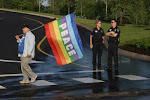
The Debut of the Minnesota Peace Team by Steve Clemens. September 2008.
(This is not meant to be a comprehensive report – just my own personal experiences during the week of the RNC.)
“You’re hot, you’re cute, take off your riot suit” was the best chant I heard as demonstrators sitting in the street confronted the “ninja-turtle”-clad riot police who had surrounded the group. I myself got caught up in calling the heavily armored-up police in the black padded costumes that included gas masks, long wooden batons, helmets and clear visors that name from the TV show of the early 90’s. They were everywhere.
Having a retired Chief-of-Police for a brother-in-law, I know first-hand the friendship and value of many of the “men and women in blue”. Virtually all the cops I talked to who were not “turtled-up” in the riot gear were friendly to me as I greeted them in the streets wearing my lime-green vest with Mn Peace Team emblazoned on the front and back. (We also wore bright yellow hats so we could find each other in crowds.) However, when the turtle costumes were donned, many of the cops took on a different demeanor. And when the face shields were lowered, any semblance of their common humanity with us seemed to fade away. Verbal communication with most ceased entirely. Force and intimidation became the tactic de-jour rather than friendly “community policing”.
Our job as newly trained (and very inexperienced) Mn Peace Team members was to remind those we encountered – police, protesters, counter-protesters, and bystanders – of the humanity and inherent worth of each other. It was our goal to attempt to de-escalate situations where others were likely to be physically hurt.
When you put on the Mn Peace Team vest, you are taking on a role as a non-partisan. In that role, we were going to try to protect demonstrator, counter-demonstrator, police, and bystander alike. Normally, training for this type of role should take days –if not weeks- with lots of role-playing and learning to make quick decisions as a team.
Hopefully, trust can be built between members because one’s own safety might depend on them – especially in the chaos and confusion engendered by mass marches with people angry with those in authority.
Anyone with an ounce of common sense knew there would be heated confrontations when the Republican Party decided to hold their national convention in the Twin Cites, a stronghold of Democrats, liberals, and progressives. With the notable exception of Congressman Ron Paul, all the candidates vying for their Party’s nomination supported the on-going war in Iraq and boasted of varying strategies to “win” it. With large numbers of the country now feeling the war was at best a mistake and at worst an illegal act of aggression, the stage was set for massive protests when the start of the convention was scheduled for Labor Day. It seemed only an “act of God” might intervene. (Hurricane Gustav did in fact limit the first day of the convention, giving the President and the Vice-President “cover” for not appearing – to the relief of some of the delegates who wanted an unpopular President to fade from view.)
Initial trainingOnly 3 months before the start of the Convention, Peter Dougherty, a Catholic Priest and member of the Michigan Peace Team, came to the bi-monthly meeting of the Minnesota Alliance of Peacemakers – a collective of more than 70 Twin Cities area peace and justice organizations. He described how the Michigan Peace Team over the past 17 years has tried to serve as a non-partisan presence in public situations where conflict might ensue – be it at a Klan rally, a state execution, mass marches or demonstrations where counter-demonstrators were likely to be present, or to protect human and civil rights workers. He appeared to be in his 70’s but with a fire in his eyes and a warm smile on his face. He thought that it would be a good idea for us to consider forming our own team to respond to the needs when the Republican National Convention came to town on Labor Day.
A couple of the MAP members travelled to Detroit to be trained by the Nonviolent Peaceforce and Michigan Peace Team over a period of several days and then returned to help train local volunteers for four consecutive weekends. The goal was to try to have 100 local people trained before the RNC so we could field numerous affinity groups for the many marches and other activities scheduled for the first week in September. Bright lime-green vests were ordered and we were told in the training that we might want to bring bandanas soaked in vinegar or lemon juice and goggles in case we were in situations where tear gas was used.
We did numerous role-plays and “hassle-lines” during the 10 hours of training. It was stressed that it was not our job to try to prevent civil disobedience or even heated verbal exchanges – just intervene if it appeared someone was in physical danger of being hurt. We discussed our own personal feelings about whether property destruction was “violent” and noted that people’s reaction to property destruction was often highly charged so we must be especially vigilant at those times. Although most of those trained had participated in nonviolent marches or demonstrations in the past, we were especially reminded of our non-partisan function when we donned the vests.
The Weekend BeforeWe heard word on Saturday morning that police, led by Ramsey County Sheriff Bob Fletcher, had raided the “Convergence Center”, the coordinating place for the “Welcoming Committee” and other anti-war groups on Friday night. Raids continued on Saturday morning and afternoon, this time targeting homes in Minneapolis and St. Paul where 7 or 8 people were arrested and the media claimed they would be charged with “conspiracy to riot”. The sheriff claimed to have found knives, buckets of urine, axes and machetes, bomb-making materials, and maps and anti-war materials which proved these culprits were serious troublemakers. The term anarchist was bandied about –labeling all protestors into this “troubling” term that apparently was designed to invoke concepts of “terrorism”. By calling someone or a group “anarchist”, one could dismiss them as crazy, violent, destructive youth bent on raising hell and threatening “the peace”.
Caught up in one of the raids was a group of journalists so it became clear that the purpose of the raids was primarily to intimidate and send a message rather than to effectively protect the city and its citizens. The journalists targeted happened to be a group that had documented police excesses in New York City during the 2004 RNC that cost the city millions in lawsuits against the police over-reaction to protesters there. Their equipment was seized. The fear and intimidation that spread was palpable.
I got a call on Saturday from two friends from Chicago who said they would probably contact me when they were in town. However, when the call came, it was to ask Christine and me for hospitality since the “Food not Bombs” house they were staying at in Minneapolis had been raided that morning. They had been handcuffed and ordered to lie on the floor for a couple of hours before being released. We told them we’d be glad to have them stay with us since we knew both to be principled activists even though others might label them as “anarchists”. Would our home be raided for merely providing Christian hospitality?
The Day Before the RNCBefore the decision to form the Peace Team, I had already decided I would join my friend from Veterans for Peace, Dr. David Harris, in a solemn march to the site of the Convention on the day before it started - focusing on the victims of the war from both sides. We planned to carry tombstone replicas with photos of Iraqi civilians or US soldiers killed during the war. David also wanted to provide an opportunity for those who might wish to commit civil disobedience to try to carry our message into the Xcel Center itself rather than turn around at the designated area for the march.
As we gathered at the State Capitol prior to the march, I was pleased to see at least two groupings of the bright Mn Peace Team vests with yellow hats. I went over and greeted the Team members for that day and one team leader asked about any plans for civil disobedience so they would know where to place themselves in case it provoked a violent response on the part of police or counter-demonstrators. I told him what I knew and told them I was glad they were present. (I’ve told the story of the arrest in another report.)
Sunday evening after I returned home from worship, I was surprised to discover that we had another 6 houseguests. Four young women and two young men from Bash Back, a queer anarchist group in Chicago and friends of one of our other guests had arrived!
Day OneMonday, Labor Day, was to mark the start of the Republican National Convention and was the date planned more than a year before for a large coalition of anti-war groups to march. March planners hoped for a turnout of 50,000 protesters. Close to 40 people gathered in the basement of a St. Paul Lutheran Church that would serve as the “command post” for the Mn Peace Team. After introductions, we were asked to divide ourselves into groups of 5-6 depending on how willing we were to “risk arrest”. The thinking was that potential arrests were more likely to occur closer to the triangle area near the Xcel Center, the turn-around area designated for the marches. Since it was only several hundred feet from the building where the delegates were meeting, it was assumed that more civil disobedience or other disturbances would more likely occur there.
Some members wanted to be on teams with others they knew. As the groups formed, introductions continued and we discussed health concerns, things that might “trigger” strong reactions within us, our gifts/strengths that we brought to the Team, and other information the affinity group might need to know since we would need to depend on and support one another. We wrote down cell phone numbers for each other, for our Coordinators for the day, for a local lawyer and for the street medics. Some who were experienced with mass protests wrote the legal collective’s phone number on their arm with a marker in the event of an arrest and our phones were taken from us.
We were told that the coalition that organized this large march did not want the Mn Peace Team either in their gathering at the State Capitol or during the march since they had trained their own marshals. So we decided our presence would be on the sidelines, looking for any incidents where we might be needed. Teams were stationed at various areas of the march.
I joined an affinity group with my fellow Pax Christi Board Member, Scott, two friends from the Nonviolent Peaceforce, a Quaker who had previously met Scott, and a volunteer who offered to take pictures of the Peace Team in action. Karen was going to start with our Team and then switch to another later in the day. An affinity group is to make decisions by consensus and we decided to go first to the Capitol grounds where the rally would be held and then walk the march route before it began – looking for any potential bottlenecks or areas where conflict might more readily arise.
In walking the ½ mile march route, we noticed how “caged-in” the last section of the route appeared – especially the triangle-shaped turn around where protesters would be walking in what looked like a 10’ wide cattle chute. Counter protesters would be stationed on one side of the 8’ high metal fences as the marchers were closest to the Convention site. About 15-20 of the counter-protesters had started to gather so we talked with them, explaining our presence as non-partisans. We also made a point of talking to the many police present. Before the march started, there was a mixture of police in their own uniforms and I was able to identify some from Hennepin County, Ramsey County, Minneapolis, St. Paul, Edina, Eden Prairie, Minnetonka, Arlington, VA, and numerous other locations. Almost without exception, we were greeted courteously when the cops were in uniform but those who appeared in the black riot armor (“turtled-up”) rarely would return eye contact or speak to us when their face shields were in place.
Since another affinity group planned to station itself close to the triangle, we decided to be near the area where the march turned on to 7th Street so we could look down both Wabasha St. and West 7th. We would be one block from the beginning of the restricted or “exclusion” zone that formed the security perimeter around the convention area.
We decided to eat our lunch since the actual march wasn’t to begin until 1PM but a phone call from the Team Coordinators for the day told us an “unpermitted march” had begun an hour before the agreed start time and was headed our way. As we scrambled to re-group, we saw groups of the black-clad riot police running towards the east. Because this was likely to be an area of conflict, we hurried as well to monitor what was happening.
Many of the young “anarchists” were also dressed in black but without the riot equipment and padded vests, shin guards, knee protectors, and tasers, guns, or other weapons carried by their “adversaries”, the police. Bandanas over their nose and mouth were more likely to be employed. A young man in his late teens would run into an intersection of the downtown street and shake the bells he had on a stick as the signal to gather. Others came into the intersection from all directions and danced and sang and then taunted the police who came running after this “illegal” “march or demonstration”. As a phalanx of the riot police marched together to seal off one street after another – often donning tear gas masks in case the order was given by the unit commander, the “anarchist” kids would disappear leaving the intersection to the media who was trying to “cover” the action. Then the process would repeat itself a block or two away in a game of cat and mouse.
So, for a full hour prior to the scheduled march, some of the police were otherwise occupied. From my limited position (not seeing all the provocation nor all the response), our team commented to each other a pleasant surprise about how patient and restrained the police response to these provocations was. While saying that, it also appeared to me that the enormous police presence in the downtown march area – especially the increasing numbers of the “ninja turtles” seemed to also send a message of intimidation to any “protesters”. There certainly did not appear to be a welcoming presence for those who wished to exercise their freedom of speech rights with the large police presence and the cage effect of the steel fence barricades.
Soon after 1PM, the first signs of the large anti-war coalition march were evident. Streams of people with signs, banners, T-shirts with slogans, filled the streets. Riot police took up positions which blocked Wabasha Street beyond the intersection with 7th forcing the marchers to stay on route. I can imagine what a frightening sight those up-armored cops must have been for some of the young children or first-time protesters in the march! The Peace Team chatted with bystanders as we watched in both directions for any signs of conflict. About halfway through the march we noticed that the black-clad riot police had sealed off even the sidewalks so that people wishing to leave the march or bystanders could not go further into the downtown area. A number of people complained bitterly and I could see the tension mounting against what appeared to be a heavy-handed police over-reaction.
The march lasted close to two hours and our instructions were to follow the end of it back to the State Capitol. As we followed the crowd up Cedar Street, we noticed the “ninja turtles” marching behind us. As soon as we crossed the bridge over the interstate highway, the riot cops sealed off the bridge and refused to allow anyone back into the downtown area. There was a Labor Day Picnic being held on the far side of downtown with some well-known musicians and other speakers and many march participants were eager to get to the site on Harriet Island. Despite their pleas, the police refused entry toward that site for close to two hours. Even a Minnesota Public Radio journalist was prevented from walking to her studio and office even though it was in sight of the blocked intersection.
A man in a wheelchair who worn a photo id around his neck that said Chaplain on one side and Catholic Charities on the other appeared and was verbally harassing and goading the “liberal” demonstrators. While he was yelling at any “anti-war protestors” who were foolish enough to engage him, another man verbally taunted the cops, claiming that they had illegally seized some of his equipment (it appeared to be his camera) so after yelling at them for more than 30 minutes, he spread his arms wide and told them to “ “shoot me, you mother *&#^%ers”. Our Peace Team had to remain alert, ready to intervene as the tension ratcheted up. Finally, without explanation, the cops lifted their blockade after two hours. Mentally and physically spent, our affinity team called in to the church and requested to be picked up for a ride back to the church.
When we arrived at the church, we were told that while we were prevented from being downtown some of “the anarchist” groups had broken a Macy’s window and several windows in cop cars as the police again chased them through the area. Considering all the destructive power of war that people were protesting, it seemed pretty minor damage compared to the overwhelming police presence. But we also knew that the “mainstream media” would choose to focus on the very few “troublemakers” and ignore the more than 10,000 peaceful protesters.
After a late supper, I went to bed, planning to take the next morning “off” from the Peace Team in order to attend the Peace Island Conference designed to highlight solutions to our global and local problems rather than just protest. I had earlier volunteered to help with the early registration and then I’d attend the morning session, helping with the Peace Team after lunch.
Day TwoAt 7AM I received a call from a close friend. She told me her son and 2 nephews went to the big march the day before and had then headed toward the Labor Day picnic at Harriet Island. Because police had shut down the bridge over the river, the three young men (two were high school seniors and the other a little older) went down to Shepherd Road to see if there was another way across to the island. My friend was trying to keep from tears as she said, “the police surrounded them and both of my nephews were arrested and charged with felonies for ‘conspiracy to riot’ because they carried masks in case tear gas was fired.” After I recommended the names of some friends who were lawyers and offers to “see what I could find out”, I learned that more than 100 young people had been swept up and arrested in this incident.
Listening to the radio on the way to St. Paul, I found it hard to concentrate on Peace Island and was relieved when I discovered that my help wasn’t needed at registration. I called right away to the Peace Team gathering at the church and asked if they could use me for the morning as well as the afternoon. They assured me that I could join one of the affinity groups about to form. I wanted to try to protect some of the young people from what was more clearly becoming police over-reaction and intimidation of peaceful protest.
I arrived at the church after the day’s orientation had begun. I stated a preference to help with the march the Somali group would begin at noon rather than the Poor People’s March at 4 because I still naively thought I could attend at least the evening sessions of Peace Island. The affinity group I joined hoped to be finished by 5, debriefed by 6 PM and then I’d be free to leave.
When we arrived at the State Capitol grounds where the march was scheduled to begin, there were no Somalis to be seen. “Ripple Effect”, a non-partisan music festival was getting ready to start, a sustainable ecology exhibit was set up on one side and the other side flanking the concert area contained the Quaker-sponsored “Eyes Wide Open” display of empty pairs of combat boots lined in rows by states with the names of the dead US Troops attached. Separately was also a display of empty “civilian” shoes –men, women, and children’s – to mark the untold Iraqi deaths from this war.
Finally, about ½ hour after I thought the march was supposed to begin, I noticed three Somali men so I approached them, introducing myself and my role as a Peace Team member, and asked if they were here for the Somali march. They smiled and said yes. I was told they were waiting for more of their friends who were “on the way” and the march would begin about 1PM. At 1, with only 6 men and one woman, they said we’d wait a little longer. Finally, the one who appeared to be the leader went on the Ripple Effect stage and welcomed anyone else here who wanted to join them in protesting US support for the Ethiopian occupation of Somalia. So few American citizens know about the US role in the politics in the Horn of East Africa but several young people joined making the march about 20-25 people with our five person Peace Team walking alongside them in the event of any threats.
The police presence in the downtown area looked completely different than the day before. It was hard to spot a “ninja turtle”-clad officer. The few cops we saw were in their uniforms with the city name and badge number visible. Downtown was much busier – it being a regular work day rather than the holiday we experienced the day before. The group chanted “We want peace!” “End the genocide in Somalia”. “Ethiopia out of Somalia.” “End US support of warlords!”
When the small marching contingent arrived at the triangular area closest to the Xcel Center, we discovered along with the marchers that not only was there no turn-around like the previous day but the police escort also ended. As marchers tried to return the way they came, they had to dodge cars at the intersections and none of the police gave any directions where to go so the group had to return on the sidewalk along Minnesota Street rather than march against the one-way traffic facing the marchers on Cedar. Up until this point the march was uneventful with 3 of the Peace Team close to the front of the march and the other two by the rear. As we crossed Twelfth Street, a van making a left hand turn barely missed one of our Team members and immediately close to 20-30 police arrived on the scene grabbing two people from the end of the march rather than stopping the driver of the van.
Both people who were grabbed were dressed in typical “anarchist” style and the cops quickly had them in custody. I noticed the commotion and rushed back to the intersection but the police would not let me cross over to the side where the two were being held. One of our Team Members had remained on that side and together all the Team Members carefully watched the cops’ behavior. After we informed the police that these young people had been invited to be part of the march by the Somali group (and, I think because we were watching closely), they released the two after about 15 minutes. We escorted them along with the three “street medic” friends who came by to be sure the cops didn’t follow them until they had returned to the Capitol.
We passed the word to the Team scheduled to be present with the Poor People’s March later in the day that the “return” after the march might not be part of the permit and might be “on your own” –prophetic words indeed. Our Team remained on the Capitol grounds occasionally checking out disturbances when the police would rush in to “search” someone’s backpack. In talking to several police officers who walked by, we discovered most had no idea what the Mn Peace Team was but many expressed gratitude for what we were about.
Several police officers had visceral reactions to the language some of the musicians used from the Ripple Effect stage. Some of the performers practiced a liberal amount of the F-word but what seemed to make some of the cops more nervous was when the word “riot” was thrown out several times. There seemed to be some dissonance between the hip-hop style of some performers and the overwhelmingly white cops. We suspected trouble might ensue when we heard the rumor that Rage Against the Machine, a popular band with the anarchist crowd might show up to play. The rumor also said that if they came, the police planned to shut off the sound – thus provoking a confrontation.
5 o’clock came around and two of the team chose to remain at the Capitol, joining another affinity team continuing its presence there. Three of us rode back to the church and rather than debrief, Katherine chose to quickly orient a new group of volunteer Peace Team members so they could return to the Capitol. I grabbed some supper at a nearby restaurant and just before heading over to Peace Island, I received a phone call informing me that fellow MnPT member, David Harris, had been pepper-sprayed by the police and might need some assistance getting home to Red Wing. I called Sue who was the support person at the church and she said David was OK to drive. Just before the 7PM session of Peace Island was to begin, I got another call that things were indeed heating up at the Capitol. When Rage Against the Machine showed up 15 minutes before the scheduled end of the concert, the police cut off the sound and the crowd was very displeased. If the cops wanted to ramp down a sense of confrontation, a compromise probably could have been reached. But it seemed to some of the Team members that they instead wished to provoke a confrontation.
I asked Chris, one of the day’s coordinators if she’d like me to return to duty and she said yes - if I could get there quickly. I had to return first to the church to get my green vest so other Team members could readily find me in the crowd. By the time I reached the Capitol grounds, virtually the entire crowd had marched downtown with the Poor People’s March that had come by right after the sound was cut off. Even though most of the crowd left, I saw three phalanxes of riot police marching toward the capitol and it appeared they were about to sweep the Capitol grounds. So I phoned in my situation and asked permission to stay and observe. After about 15 tense minutes, the “turtles” started to stand down. Some were removing their helmets and face shields and other were packing up their armored gear. After two of the units left and only one was remaining, I again called in and told the Team coordinators that I would try to join them on the march where once again things were heating up.
With no permitted return route for the Poor People’s March, confrontations were building near the triangle area. I can’t report first-hand what happened there although my frequent calls to Chris gave me some updates. I was physically prevented from joining the other affinity groups by a row of “turtled-up” cops who lined themselves across 7th Street. I could see a lot of commotion by Mickey’s Diner at the corner of 7th and St. Peter but then the cops pushed everyone back to the intersection at Wabasha. I noted that all the cops had put on their gas masks so I warned other bystanders and news crews that they should prepare for the use of tear gas. [An aside: are you aware that the use of tear gas is expressly forbidden by the International Treaty against the use of chemical weapons?]
The critical thing to do when facing tear gas is to try to prevent panic. Many of the people near the intersection didn’t stay around to experience it. Without prior verbal warning, I heard several loud bangs (police percussion bombs), flashes, and then saw a cloud of tear gas headed my way. I had already put on my safety goggles and had a bandana soaked in lemon juice over my nose and mouth. It still burned and my eyes teared up but I was able to help look out for others. Some in the crowd started yelling obscenities at the cops for using the tear gas. If anything, it seemed to harden the resolve of those who remained rather than intimidate them – clearly its purpose. Soon after that first use of tear gas, about 30 St. Paul cops on bikes with gas masks in place rode through the intersection and up Wabasha in what looked like a flanking maneuver. I called to check on my teammates and give them an update.
After the cops had forced any remaining demonstrators, media, Peace Team members, and bystanders behind their lines up St. Peter Street, it seemed they were going to try to box them in and drive them out of downtown through flanking maneuvers. For reasons unclear to me, they let several of us through their lines so I was able to join up with the other remaining Peace Team affinity groups. Even though I may have been in greater danger, I felt relief at being able to re-join them. Rather than being alone, I knew my Peace Teammates would work to protect one another.
Once again, the police started moving up the street with batons in front, gas masks on, yelling, “Move! Move! Move!” The only direction we could go was to the north, towards the bridge over the freeway. By now only about 50 or so remained but others had just come. Several people lived downtown or had cars parked there and their anger was building that there were no streets open to get there. Finally, Chris and Demi, our Team Coordinators approached the front of the turtled-phalanx and asked the police if there was any way these bystanders could get through their blockade. The police responded that until the intersection and street was cleared of everyone, they wouldn’t re-open it. When the Peace Team coordinators told the crowd what the police had said, some left.
After another 15 minutes or so, I noticed a change. Four riot-clad police had removed their helmets, handed off their batons, and slowly started towards us. They pointed at Chris and me with our bright green vests and signaled with their hands for us to approach. They told me, “Look, we’re all tired and we’d like to leave. But we can’t leave until this intersection is cleared. If you clear this intersection, our men will disburse and the street can be re-opened.”
I responded that it was not our role to tell people what to do but we would certainly convey their message to those remaining. I thanked them for their clear communication because it seemed to me one of the biggest frustrations was the lack of clear instructions that might lessen the tension and conflict. In a loud voice so as to be heard, I told the bystanders and remaining others, “We don’t work for the cops. But this is what they said.” And then I went on to tell them and then said it is your choice to stay or go across that bridge. If you stay, there may be other consequences. Several in the crowd felt the need to yell at the cops as they turned to go but clearly the crowd was emotionally spent and physically tired, as were the police. We walked off with the remaining crowd and the cops stood down.
It appeared to me that finally the cops realized the role our Team could play in de-escalating the conflict. However, if the police had arrested folk for refusing to leave rather than try to intimidate through the use of the chemical weapons, I believe it could have been resolved much earlier. It was at this point that I came to the conclusion that the preferred method was intimidation rather than law enforcement. That has left a bitter taste in my mouth (and caused my eyes to water).
At the debriefing at the church, Peter, the one with the most experience with this work, having co-founded the Michigan Peace Team, exclaimed, “We did some good work today. I think we saved lives or at least helped protect others from serious injury. I’m really proud of the work you’ve done here with so little training.” Despite what we did right, there were also plenty of suggestions of what we might have done differently. I missed having David, Katherine, and Don at the debriefing – two were at home recovering from pepper spray and tear gas and the other had just gotten out of the decontamination unit at the hospital –she had been pepper sprayed while trying to protect a bystander wearing a McCain for President button.
Because many members of the Team did not get back to the church for debriefing until after 10PM, we decided to wait until 10AM the next two days before starting to form our affinity groups for those days. Arriving home at 11:30 PM, I needed some time to decompress from the day and take a shower to wash the tear gas from my hair before climbing into bed.
Day ThreeI took Wednesday off in order to attend Peace Island. It was a welcome change of pace listening to Ray McGovern, Mel Duncan, Coleen Rowley, Kathy Kelly, Sami Rasouli, Ann Wright, and Doug Johnson. Despite the wonderful input, I felt stressed knowing that the Peace Team was in the field. I decided I needed to rest that evening to prepare for the “final” day on Thursday so I skipped the evening speakers to have decompression time.
Day FourThe final day of the RNC promised to be the most challenging because of the nature of the last of the permitted marches. The Anti-War Committee and some other local groups decided to call the scheduled 4PM-9PM rally and March “No Peace To For the Warmakers!” It was widely bandied about that this was the time for disrupting traffic, closing down bridges and streets, some expressions of “direct action” and other forms of civil (and maybe some not-so-civil) disobedience. It was the night when John McCain would accept his party’s nomination for President.
The day’s events were to begin with a called student strike where students were encouraged to walk out of classes and school at noon and gather at the State Capitol grounds with a permitted march at 2 PM. The coordinating group, Youth Against War and Racism, has been active for several years in the high schools and colleges in the area. The Mn Peace Team was concerned about the permits not having a return route and what to do about angry students left to fend for themselves downtown. Someone in the group came up with a creative solution: might we not encourage the group’s leaders to lead all the marchers across the Wabasha Bridge and join the Peace Island picnic at Harriet Island? That way they would be out of downtown, be able to get a free meal, and have other, older mentors who have been working for peace for decades to relate to.
Colleen Rowley, the planner of the picnic readily agreed to invite the young people to join her, the YAWR leaders thought it was a good idea, and finally the police agreed to change the march route to accommodate it. It appeared to be a win-win-win solution.
Our affinity team for the day decided we would accompany the youth through downtown and be sure they were on the bridge before returning to the Capitol. With the next march to begin at 4, we wanted to be in place ahead of time because this might be the last chance for some to express themselves while the Republican politicians were still in town.
Our team stopped for a water break outside the downtown Presbyterian Church that had remained open from 8-8 every day for prayer and meditation during the RNC. As we rested, one of the team members approached a Sergeant from the St. Paul Police to ask her to clarify the march plans. Rumors were flying about that it was to start at 3 instead of 4. The Sergeant told us that the official permit was from 3-5 and everything had to be “done” by 5 because the streets would be closed at that point. Many local businesses and downtown offices were closing early so their workers could leave.
When we called into the Team Coordinators, we knew different messages were being given. They had been told the march just had to begin before 5 PM. In talking to other police around the Capitol grounds, we were told all permits had been pulled and no permitted march would be allowed. A couple of Peace Team members talked with the March organizers, asking them to announce from the stage what was happening so folks could decide to risk arrest and/or tear gassing by marching. Instead, what was announced from the stage was that “as long as we start by 5, we can march on the sidewalks. This was a different message than what we had received from some of the police.
Tensions were already high when police rushed into the crowd to detain two people they claimed were wanted for breaking windows downtown on Monday. As the police dragged the two away, the crowd surged after them yelling, “Let them go!” Quickly a phalanx of St. Paul Police on bicycles arrived to block the crowd. Then the horse-mounted squad arrived- with gas masks in place. Peace Team members tried to place themselves between the crowd and the horses, warning the crowd that tear gas might be used. After a few minutes standoff, Phil and Demi, our Peace Team coordinators for the day, approached and asked who was in charge. After they talked with the commander of the horse unit, the horses and their riders left and the crowd disbursed to listen to the speakers and musicians up on the stage.
Peace Team members gathered as the time approached the 5 PM deadline and it was decided that we should at least warn those in the crowd that the police had announced to us that there was no permit to march and that arrest and/or tear gassing was likely. Since the crowd was several hundred –mostly young people- we especially didn’t want panic to set in and have people trampled. I especially sought out several people in the crowd who I knew and trusted to make sure they had what information we had so they could spread the word. I knew some would march anyway because of their strong feeling about the war and the repression of free speech. It was clear to me that some would march and that “permits” were just another way authorities tried to squelch their rights.
A few minutes before 5, the crowd headed down the hill toward the bridges leading to downtown. Phalanxes of riot police were seemingly on all sides and one unit had blocked access to the Cedar St. Bridge and also the Wabasha Bridge. So the crowd surged up 12th Street and began marching down the John Ireland Bridge with police in pursuit.
One member of our affinity group of six had told us that she wasn’t willing to risk arrest because she had plans that couldn’t be changed for the end of the week. We told her we’d respect that choice and try to place her in a less vulnerable position. She chose to leave and go to a safer place about ½ hour later. This was certainly a challenging assignment for someone’s first time in this role and I respected her decision and appreciated her honesty.
For the next hour, we stayed on the edges of the main protest group, attempting to communicate with the growing crowd of bystanders and supporters as the main group was blockaded on the John Ireland Bridge with snow plows in place to keep protesters from getting too close to the Xcel Center where McCain was to speak. Other members of our team joined other affinity teams at the front of the main group –interposing themselves between the police and the group. After a standoff during which police gave several orders to disburse (or so we were told since we heard no clear commands from any cops other than people could leave “to the north (toward the State Capitol) or to the west (towards Sears)”, it appeared that the cops did not plan on arresting the protesters.
After a while, the main group of protesters rushed off the bridge and across the Capitol grounds towards the Cedar St. bridge which was blocked by police. About 20-30 of the group sat down and were arrested. Many others remained there and were not arrested. Again, a standoff there lasted for some time and again orders were given to disburse or “non lethal chemical agents will be used”. This order we did hear from the police and the crowd disbursed. It seemed protesters were leaving in several directions and what was left of our affinity group decided to call it a day since it was getting dark and now after 8PM.
We walked to the Sears parking lot to get a ride back to the church with members of another affinity group that was leaving. We knew at least one or two affinity groups planned to stay longer in the area. Just before getting into the car for the ride back, we saw cops, horses, and squad cars racing down Marion Street toward the bridge across the Interstate. We heard and saw percussion grenades, tear gas, and other “crowd control [sic]” devices in the distance. Since the other teams were in the vicinity, we decided not to stay and returned to the church. Later we heard the police arrested everyone they had herded on to the bridge – over 400, including journalists, legal observers, bystanders, and protesters. Was it because it was now dark that they decided now to arrest folk?
Concluding observations:The militarizing of the police was quite evident. These were no longer “Public Safety Officers” or even “Law Enforcement Personnel”. Will we ever be able to return to “community policing”? Will those who experienced the “ninja Turtle” effect ever go to the cops when they feel they need help? This experience gave me new insights into how many in the black community often experience the police – as a threat rather than an asset.
This is a small taste of what it might feel like to be on the “receiving” end of empire. I kept coming back to visions of Roman cohorts and phalanxes when the cops moved in unison as units. I asked myself the question: What did Jesus think when he saw the Roman soldiers in his country? Maybe this was as close as Americans will get to remembering viscerally that we are at war.
The most disturbing aspect was when the cops “armored-up” there was no visible badge, no city ID, no personal accountability. (In debriefing on the second night, Team members told of witnesses at Mickey’s Diner telling them they had captured pictures of what appeared to be a Minneapolis cop repeatedly tasering and kicking in the head a guy already down on the street. To the witnesses, it was a clear case of brutality but other cops hustled off the cop before he could be identified.
The concept of Free Speech was lost to intimidation. The Free Speech area touted by the St. Paul Mayor as a symbol of openness to protesters was a joke – it was located within the highly militarized zone and anyone who feared they might be tear gassed studiously avoided the area. A friend of mine had reserved a 45-minute spot at 12:30 PM Wednesday noon. He gave his talk to an audience of 1!
It appeared that the media and “street medics” were lumped with “the enemy” (“anarchists”) – fit to be gassed, pepper-sprayed, and arrested unless they were “embedded” with the police. (Again, just like in Iraq – use the military model rather than a public safety model). “If you are not with us, you are against us” mentality. They must have learned this well from the “Commander-in-Chief”.
What happens to nonviolent civil disobedience if cops won’t arrest you but rather choose tear gas, pepper spray and brute force? Many times it seemed the cops went out of their way NOT to arrest folk who clearly wished to do civil disobedience. Was the decision to use mace/tear gas and pepper spray a determination NOT to arrest people because so many of the police were from out of town and/or out of state and it would be too costly to have them return to testify at trials?
No one on the Team saw anyone throwing feces or urine at the cops –despite the reports from the “mainstream media” and the Sheriff that it was one of the reasons for the actions of the police. Later, in one debrief, I heard someone say they saw a demonstrator pick up some “road apples” dropped in the street by police horses and he rubbed it on a police squad car as a form of his “political speech”.
Why are delegates kept in a bubble from what is happening on the outside? With the mainstream media’s failure to cover most of what happened on the streets (except for reports of “anarchists breaking windows and throwing urine and feces”), the delegates were kept in the dark about the large presence of people opposed to the war and their party’s policies.
What we experienced was the
demonization of dissent -if you can label some as “anarchists”, you can dismiss them. Many self-identified anarchists are committed to principled nonviolence. There is a small group of predominately younger people who do seem to have little regard for the rights of others and seem to me to be fairly nihilist in their attitude towards themselves and others. How much of this is brought about by the present war and the fact that we are leaving the next generation with a huge national debt, an environment under dire ecological crisis, and a political system that is fully controlled by moneyed interests – I can’t say. But if I were younger, the anger at the way my generation has squandered the world’s resources on greed and war might find me looking for other stronger ways to dissent. That said, I find that many of the young anarchists seem to be very politically naïve about the way property violence plays into the political strategies of the war-making political parties. What appears to some to be revolutionary merely is playing into the schemes of the reactionaries. And the masses of people between are alienated rather than motivated to join the anti-war cause.
Throughout the week, it was rare when we heard any clear commands from the police. If demands to disburse or warnings about the imminent use of tear gas were clearly announced, many people who wanted to avoid this might have been able to leave. Was the sense of chaos and confusion deliberate? When peaceful dissent is thwarted, it is inevitable that other tactics will be used by some.
On the other hand: Most cops –even ninja turtles – showed remarkable restraint and patience after being taunted for hours- although some later beat up one young man involved in the earlier taunting. Some cops readily understood role of MnPT and thanked us for what we were trying to do.
Questions about the Peace TeamDoes the Peace Team try to tamp down conflict or just prevent violence? (ML King said we don’t create the violence- it is already there. We allow it to surface so it can be dealt with.) Can we take the violence on ourselves and try to protect the more vulnerable? Does the violence expose the real nature of EMPIRE? Do we try to lessen conflict to the point of squelching dissent?
Is the Peace Team another form of privilege? (in wearing the distinctive vests, are we trying to not be mistaken for “poor people” or “anarchists”).
Some activists saw the Peace Team as “peace police”. Some eschew any conversation or communication with the cops. I think it is a political mistake to automatically assume the cops are on “on the other side”. When David Harris was arrested the day before the RNC started, most of the arresting officers treated him with respect because he, like many of them, was a veteran. Although the police are charged with protecting the property of the privileged class, we should not assume that is necessarily their political choice.
Diversity training is needed for some of the Peace Team members – especially in regards to those the media pejoratively labels as “anarchists”. One older team member kept referring to them as “troublemakers” – a term I found as not very helpful. But, since this was a first experience for many of them, I want to be gentle in my criticism.
We also need to discuss flexibility in affinity team make-up – how do you decide to break up into smaller units? How do you deal realistically with the fears of fellow team members and help them grow while it might place –limits on where that team can venture. Several times I held back from “entering the fray” and remained on the periphery because I had “partnered” with a team member who was less comfortable with the possible “costs” for being closer to the front. Yet where we ended up also served a valuable, if less dramatic, role in being present to bystanders.
This week proved to continually challenge my commitment to nonviolence (in good ways), gave me new appreciation of the challenges police face, and furthered my feelings that our nation needs a radical reawakening before we lose our democracy. I hope we can all learn and grow from this experience.
[I’d encourage those who only saw “mainstream” coverage to be sure to check out what I found to be the best local coverage of the events on the street of the week of the RNC at
www.minnesotaindependent.com/category/RNC (go to the dates 8/31 to 9/5) and
www.theuptake.org . (Much of the video here is “raw”, unedited but it captures people speaking for themselves rather than mediated by “the media”. One very important video is at
http://www.myfoxtwincities.com/myfox/MyFox/pages/sidebar_video.jsp?contentId=7364281&version=1&locale=EN-US ]