


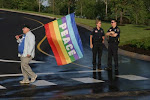

What I Meant To Say by Steve Clemens. July 23, 2009
In all my 35 years of civil disobedience actions, until this week I had never pled “guilty”. Usually I would defend myself if there weren’t a pro bono lawyer representing other defendants. Often the charges have been dismissed prior to trial and three times I’ve been found “not guilty” by a jury. When a Judge or jury finds me guilty, there is an opportunity to make a statement to the Court prior to sentencing. When I accepted a plea bargain arranged by our pro bono, National Lawyers Guild lawyer this week, I didn’t realize I wouldn’t have an opportunity to explain to the Court why I chose to be arrested. So, for the record, here is what I meant to say.
I don’t feel guilty and I am not ashamed of my actions on May 6th, the day 31 of us nonviolently blocked the driveway at the Immigration and Customs Enforcement Deportation Center in Bloomington, MN. Our action was to put political and moral pressure on President Obama to stop the practice of deportation and workplace or community raids on those identified in our society as “undocumented workers”.
Please note that identity. These are not “illegal aliens”. No person should be identified as “illegal” solely based on where he/she was birthed. We are talking about fellow human beings, created in the image of God, not some strange, alien life form of some science fiction imagination. These are people seeking gainful employment so they can support their families in the face of the new economic realities impacted by the corporate domination of local economies often passing as “globalization”.
It has become abundantly evident that the political pronouncements by American Presidents beginning with Ronald Reagan about how NAFTA, CAFTA, and other “free trade” arrangements have not brought the promised economic benefits to average Mexicans, Central Americans, or others in the western hemisphere – with the notable exception of the elites within each of the affected societies. When new economic realities forced small farmers off their lands, there has not been readily-available options for those displaced to support their families outside the booming trade in illegal drugs.
For citizens of the United States to “hunker down” behind national boundaries, pretending that we don’t bear responsibility, is disingenuous at best and criminal at worst. Some of us are deliberately uninformed about the economic dystopia being created in our name while others are struggling themselves to keep their own little financial ship afloat while frantically bailing it out by working second and third jobs. Our political system tries to scapegoat and blame the victims, whether they are born here or “immigrants”.
I’m under no illusion that our collective act of resistance to our present cruel, broken immigration system will bring significant political change. Maybe the greatest effect will be on ourselves - the 31 who sat, kneeled, or stood in the driveway until the police hauled us off. I spent 7 ½ hours in police custody. Some spent up to 9 hours. It gave us some time to reflect, prisoners of our own design. Maybe if our Members of Congress or in the Administration sat on hard concrete benches with each other, with no other distractions, maybe they would come up with a more humane policy than one which divides families and criminalizes ingenuity.
I was first offered (through our attorney) the possibility of accepting an offer from the Bloomington prosecutor called a CWOP, an acronym for Continuation Without Prosecution. The CWOP is a legal maneuver to hold a charge over one’s head for a period of time (often 6 months or a year) with the promise to erase the record of your arrest if you aren’t arrested for “the same or similar” during that probation period. It is also usually accompanied with a fine that they claim is for “court costs”. I told the attorney to inform the prosecutor that I couldn’t accept any such agreement unless the government also agreed to forgo any “same or similar” behavior –i.e. meaning a halt to all deportations and ICE raids during that same period. Needless to say, that condition wasn’t not acceptable.
So, the next offer was a plea bargain to accept a reduction in charge from a misdemeanor to a petty misdemeanor (equivalent to a traffic ticket) coupled with a fine of $100 and court costs of $78. In lieu of the fine and court costs, I could agree to one day (8 hours) of STS, “Sentenced To Service”. Our attorney thought this offer was likely to be the “best” offered as a plea bargain and it was being offered to all of us appearing that day, including those with prior arrests and convictions. Often the courts make distinctions between “first-time offenders” and those with some or many “priors”. Our prosecutor couldn’t guarantee that other codefendants from our group would get the same offer if they had a different prosecutor and it was the consensus of the defendants from the previous trial group meeting to try to have all of us treated equally.
Our lawyer told us that if someone with numerous prior convictions were to accept the plea bargain offered, it would put pressure on the other prosecutors to offer the same deal to all the other defendants, most of who had no previous records. It was my original intention to go to trial, seeking to defend myself. However, with the change of the charge from trespass to presence at an unlawful assembly, I would have less ability to argue a “claim of right” defense based on the copy of The Universal Declaration of Human Rights that I carried with me when arrested. We also faced the probability that the city would lower the charge to a petty misdemeanor before trial to save the costs and time of a jury trial. While there is still some satisfaction in speaking in court, even if only to a Judge, it is always preferable to have your political case argued before a “jury of one’s peers”.
So why did I accept the plea bargain? If we went to trial, it would be about the 7th of October. I have a tacit agreement with my wife to try to have only one court case at a time (although this was already an exception since the Vets for Peace/RNC trial still hasn’t happened and has been postponed until Sept. 14th). By resolving this case, (and the RNC cse will be “resolved” with that trial), I am now free to chose to act on conscience again in early October when our AlliantACTION group has its annual Gandhi’s Birthday Action at the local war manufacturer’s headquarters.
I’m not under any illusion that STS has anything to do with “service”. It is designed to punish and to identify a punishment as “service” is to bastardize a glorious community-building concept. However, STS or court-ordered “Community Service”, while misnamed, is certainly better than locking folk up in our jails and prisons that are already shamefully over-crowded with nonviolent offenders.
So, on August 21st I report to the parking lot at Ridgedale Service Center for my STS “adventure”. If you pass a group of people wearing orange vests picking up trash alongside the highway - or doing some other task (for which we could pay someone a livable wage!), honk and waive – and then think about a creative way you can work with me to change our immigration policy in a way that promotes human dignity, protects workers, and helps feed the victims of international economic systems which crush the poor.
Showing posts with label immigration. Show all posts
Showing posts with label immigration. Show all posts

Migrant Trail Walk #9


Sunday May 31st. The Last Day
Even though we are allowed to sleep in until 6AM because of the shorter distance today, I awaken at 4:30 AM, clean off with baby wipes and use the Porta-Potty before the anticipated long lines at 6. Actually, the lines start to form at 5:45 as many people are up and about as the noises increase: the distinct sound of people walking on gravel or the “clunk” of the porta-potty door if someone lets it close too quickly. The food crew, efficient as ever, has the requisite bagels, cream cheese, peanut butter out as well as coffee on by 5:30.
We, the weeklong walkers, are scheduled to have a ceremony with Maria up on a nearby mountainside at 7AM where we’ll have a vista overlooking the Altar Valley where we’ve walked this past week. Then we’ll pose for a group picture. Maria asked us to call out the names on the crosses we carried this week. She told us our carrying their names helped them “finish their journeys” that they had started. After calling their spirits to be present with us, she sang a song to welcome those spirits and we were again “smudged” with the smoke from burning sage in the Native tradition. We then sang together a healing song as she prayed that Baboquivari would look over the people traveling this desert valley and prevent any more deaths there this summer. [Derechos Humanos keeps a count on their website of confirmed deaths each year.]
After the ceremony, we had our last group circle before walking for the day. There were new people who needed introduction and Erin again led us in some stretching exercises. We had announcements from the teams and Tom told us that he was reminded that every day there are 3,000 people walking this area, hoping they can survive to feed their families and better their own lives. [Others in our group say there really is no way anyone knows how many people are walking the migrant trails each day but we do know the numbers are significant.] We again close the circle time by reciting the Prayer for the Migrant as we have done every day.
Today is a very different experience walking along a busy highway leading into Tucson. The traffic zips by at 55-65 mph. Much of the walk is on the highway shoulder; in other sections there is a path further off the road. There are about 85-90 walking today so the water and rest stops take longer, especially with lines by the porta-potties.
 The walk culminates in Kennedy Park, just behind the old headquarters building for the Border Patrol. (With all the monies recently poured into “enforcement”, they’ve moved into new, bigger, fancier offices in another location.)
There is a modest crowd of local well-wishers and friends to greet us as we walk in. Kat and the other organizers have scheduled a press conference and some musicians share their music and encourage the crowd to join them. Fr. Bob has asked a representative 12 of us to sit on chairs as he and Fr. Jerry Zawada perform a ceremonial foot washing.
 Derechos Humanos has arranged for a very tasty meal for everyone and after a couple hours of mingling in the park, those walkers who remain travel back to Southside Presbyterian to unpack all the trailers, clean the equipment, and say our goodbyes. A number of folk are from Phoenix and we send them off. Some of us are staying locally, awaiting rides to the airport to return to our homes tonight or tomorrow. Kat and Chris open their home to fellow walkers for a party that evening that last past my 10PM bedtime.
It has been a memorable week and experience. Immigration is no longer just an “issue” and I have a deep appreciation for the many people working in “the trenches” to make our nation once again a place that “welcomes the stranger”.
_________________________________________________
For some, this walk is a political statement in opposition to a structured injustice created by politicians willing to negotiate policies that they know will create deaths. How many deaths -where and under what conditions? What is a tolerable amount to begin the compromises? Those who claim we need “comprehensive immigration reform” are often caught in the political compromises.
Others are walking primarily out of religious conviction. Although Derechos Hermanos is clear that this Migrant Trail Walk is inter-religious (and certainly welcoming of those who come who do not embrace organized religion or reject religion altogether), it is obvious that many of the walkers are strongly motivated by their faith. For some, the symbol of the names of the dead on the crosses we carry as we walk reflect back to the image of Jesus on his cross. The “presente!” on the large cross carried at the front of the march hearkens back to the years of the thousands of martyrs in Central America in the 80’s, especially evocative of Archbishop Oscar Romero. It is clear that Maria’s embrace of Native American spirituality is clearly a part of her journey this week.
But what is becoming apparent to me is that for some walkers, this is primarily personal. It isn’t that they don’t hold political views or religious conviction. It isn’t even primarily about social change, as essential as that is. It is walking in solidarity with the people victimized by a system which doesn’t recognize their worth or even existence. It is walking to help heal the pain of broken hearts, shattered dreams. Several times organizers request that we walk this next stretch between our water or snack breaks in silence. It gives us time to reflect as we take each step. The blisters, the aching muscles, the parched throats, and the sun beating down mercilessly –all of it fades to the background when you reflect on “completing the journey” as Maria so movingly put it this morning.
The gratitude one receives from the welcoming at Kennedy Park at the end of the Walk is shown on the faces. There is a deeper appreciation than one usually receives for an act of political or social courage. You can sense in some of those gathered the intense personal connection they have and that appreciation that others would undertake this symbolic journey with their loved ones is too deep to convey with mere words. The spiritual, political, and personal have all come together to work for our own healing, the healing of our nation, and the healing of our world. All of us are complicit in the deaths happening here in the Sonoran Desert. All of us must decide to engage in the healing as well.

Maybe next year, beginning on Memorial Day, you, too, might be able to walk The Migrant Trail.
for information contact:
http://www.derechoshumanosaz.net/
Migrant Trail Walk #8

Saturday 5/30/09
My best night of rest in a week! Thank God for a couch and a swamp cooler. I woke up at 4:30 AM and beat the rush to use the (indoor) bathroom. After hooking up the gear trailer and getting it ready to be loaded by the logistics team, we discovered one of the walk organizers has a bad eye infection/irritation from getting sunscreen and/or dirt under her contacts. We unhook the Porta-Potty trailer so she can be taken to Tucson for proper medical care. Since we can’t be without toilets on the busy Ajo Way highway, we consider switching trailers but the Highlander van arrives just in time to solve the problem.
Mel and I (once again) take the gear trailer to our last (!) campsite and then return to the walk. It seems that each day has gotten hotter than the last although after our cool space last night, maybe it is all relative. We don’t carry a thermometer with us; I think it’d make us feel hotter- if that is possible.
We go ahead at the last water stop to set up the shade canopies and make side walls on them with tarps to screen out the blistering sun. This “campsite” belongs to the Bureau of Land Management – there seems to be little “management” as this site is the least pleasant for the entire week. We are set up by 11AM and the van and porta-potties arrive by 11:20 with the walkers about 10-15 minutes behind them. We are certainly ready for lunch today.
The hot sun beckons one to a siesta time. It feels too hot to exert oneself so we might as well adopt the south-of-the-border tradition. When the Humane Borders water truck arrives, Mark fills all our water containers and still has enough water left to allow some of our walkers to wash their hair.

A much larger group has joined us by suppertime. A group of students and professors from Duke University are in the area for the next two months for a “Duke Engage” program to learn about border/immigration issues. A Witness for Peace group from Portland, OR is here as well. Others who are part of the No More Deaths and Borderlinks have joined us as well. We have a great sing-along with a banjo and 3 or 4 guitars that ends just before our extended quiet time begins at 9PM.
 The song session closes with “Goodnight Irene” but before that there has been an eclectic combination of new and old songs - labor and marginalized groups getting the lion’s share.
I’m scheduled for the first shift (9-11PM) of night security watch but Tom, ever mindful of wanting his drivers to be fully alert for the next day asks my night watch partner, Dan, if I can leave early to be sure I get enough sleep. He readily agrees and I turn in after the first hour of the shift –leaving him to the swarms of a myriad variety of bugs which have swarmed to our lantern.
I’ve finally connected with a few folk I’ve met before: John Heid, the Christian Peacemaker Team/Catholic Worker I’ve known for years has rejoined us after walking the first day. Sister Lil and Betsy Lamb, two former Prisoners of Conscience from the School of the Americas vigils are also present. The energy is high with all these new (or returning) folk but you can see the difference between them and the 45+ of us who have been together all week – we are the ones saying, “One more day to go!”.
Migrant Trail Walk #7
Friday 5/29/09
Another hot one!
Last night we discovered about 7PM that the key to the rented 15-passenger van got mistakenly taken with one of the drivers when she had to return to her home in Denver. So this morning was a time of shuttling walkers and the supply trailers back down the 8.3 miles (each way) from the campground to the place on the highway where we left off yesterday.
Fortunately Pat stayed with us overnight so he was able to help pull a trailer and shuttle people in his pick-up truck. I made a trip down with the food team and their trailer while most of the others were still packing up their tents and gear. I unhooked the trailer by the highway and returned up the hill to give others a ride down. Each round trip takes 30-40 minutes. I had to return a third time to get a large drink cooler left in our (now keyless) van so we can give the walkers a choice of Gatorade or water on this extremely (again) hot day.
Although yesterday was longer, because we started so early in the darkness, it didn’t seem as difficult a today’s heat. I was able to walk some as Mel and I swapped driving responsibilities again today.
We ended at “Serenity Baptist Church” near Robles Junction (3 Points) a little after noon. The church graciously welcomed us to sleep and rest in their main sanctuary, their library, and/or their Sunday School/child care building. Some buildings are air conditioned while the sanctuary is cooled with a swamp cellar system that adds moisture to the air to cool it. It was very comfortable!
After a wonderful Thai food lunch supplied by a local Buddhist group (with watermelon provided by the Baptists), most of us just stretch out and enjoy the cool rest – with serenity! It is so serene; most of us doze off.
A couple more walkers have to leave today after lunch. It is sad to say goodbye to someone you’ve just shared these past 50+ miles with under these conditions – but the group will go on.
The jackrabbits and red-tailed hawks are a sight to see. Tom spied a horned toad at one of our water stops. I spotted a colorful beetle or ant that had a bright yellow thorax with an equally bright red head –all on a chassis that was black. I also saw a lizard that was black with orange markings and a black snake with yellow markings on this walk or at the campsites. Another roadrunner scooted across the road today. I wish they and the jackrabbits would sit still long enough for me to snap their picture.
After another good meal, this time it is vegetarian lasagna, the leaders announce that this evening will be the annual Migrant Trail Walk talent share. There is some significant talent to go around but I need to drive Jill back to the Caballo Loco Ranch first to retrieve the van so we can use it tomorrow – so we miss the first half of the show. We return in time to hear some great songs and it appears that everyone had a good time.
Migrant Trail Walk #6

Thursday 5/28/09
Today is “hump day”. Once we are finished with the scheduled 15.9 miles(!), our longest day, we are over the hump and more than half way finished. We got up at 3 AM, packed all the gear and started the walk just a few minutes before 4. We will wait to do our morning “circle-up” at our first full stop when it is finally daylight. We are promised a treat at the end today –showers with hot running water!
We are camping tonight at Caballo Loco Ranch, a campsite/RV park that is 8.3 miles off highway 286, just to the north of the BANWR.
 Our first 4.6 miles today took us out of the refuge area and the balance of our walk will now be along two state highways, 286 and Ajo Way. That means single file and stepping off the road shoulder when a car approaches. The speed limits are 55 and 65 along these stretches and it seems that almost every other vehicle that passes us is from the Border Patrol.
Mel and I are once again asked to drop off the gear trailer at the destination ranch. We need to stop en route by a trailer with Porta-Potties to get the padlock for our trailer hitch. The trailer is to be parked close to the road but at 4AM it is hard to spot among the mesquite, cactus, and other wilderness growth that makes mile after mile appear the same to me.
At the morning circle, Kat reminds us that we are not trying to mimic the migrant experience. Those who cross here do not often travel on the gravel roads or the paved highway but instead look for openings in the underbrush – just like we do in trying to find our eco-toilets. And now, because we are walking on the shoulder of a paved highway with fences alongside the right-of-way, we will be using two Porta-Potties for the remainder of the trip. We walk not to mimic the experience but rather in solidarity with the migrants and in remembrance of those who didn’t survive it.
Our campsite is at 4,000 feet and the vista of the mountains behind us and across the Altar Valley where we walk is spectacular- especially at sunrise today.
 But today is relative luxury – flush toilets and showers – our first since leaving Monday morning. Overheard in the men’s bathroom: “I don’t really need to “go” right now; I just want to hear the sound of flushing!”
It is amazing how much we take for granted in our lives. We don’t often recognize our privilege until it is taken away or surrendered voluntarily. This experience, like that of prison, helps me recognize more areas I need to be willing to surrender to be in solidarity with others in our world.
In the midst of the heat and the dust (compounded by no showers …), small graces become important stepping stones. April came up to me and asked if she could wash my long-sleeved shirt that I wear for protection from the intense sun. Then she asked if there was anything else I needed washed at the camp laundry and my pants made filthy from changing the flat tire and hauling 5-gallon water jugs came to mind. While I had changed my pants after my shower, I now had nothing clean to wear after the walk for my flight back to the Twin Cities. Problem solved!
Tom graciously gave me a repaired camping chair he had brought along, saying I could use it until it broke again. It did well the first day I had it but collapsed right in the middle of our logistics team meeting the next day!
During supper, someone asked Margo, a public defender lawyer for Pima County who also has a growing (mostly pro-bono) private immigration practice on the side, what her take was on getting a comprehensive immigration reform bill through Congress this year. About 20 or more of us sat around listening to her stories and perspectives from her many years as both an activist and an attorney. She volunteers for No More Deaths as well as other groups but her advocacy as a lawyer is something few of us are able to emulate. Her work is so important in trying to keep families together who are threatened by deportation of one or more members. It is critical to retain a vestige of hope as well as an attitude of resistance for this work. I’d like to get her perspective on the role civil disobedience by Anglo/US citizens might play in support of immigrant rights, wishing to stand and act in solidarity with those threatened by our policies. Maybe we can talk as we walk tomorrow or in the afternoon after we rest.

Migrant Trail Walk #5

Wednesday 5/27/09
I had a better night of rest and woke about 4:20 AM. I cleaned off with baby wipes (we are promised our “shower for the week” in Thursday!) and got to the eco-toilets before the 5AM wake-up call rush. We loaded the gear trailer at 5:30 and I helped Tom latch down the pop-up shelters and water jugs on his trailer.
The walkers hit the trail at 6:10 after our morning circle with exercises and the prayer:
Prayer for the Migrant
[Creator], full of love and mercy, I want to ask you for my Migrant brothers and sisters. Have pity on them and protect them, as they suffer mistreatments and humiliations on their journeys, are labeled as dangerous, and marginalized for being foreigners. Make them be respected and valued for their dignity. Touch with Your goodness the many that see them pass. Care for their families until they return to their homes, not with broken hearts but rather with hopes fulfilled. Let it be.
The original version of the prayer begins “Heart of Jesus …” but to make it more inter-faith and inclusive it is suggested we begin with “Creator”. Mel and I are once again tasked with leaving the gear trailer at the next campsite and then rejoin the walkers. It is challenging enough to drive on these roads in the BANWR with or without a trailer. We encounter numerous areas called “washes” where the water rushes through during heavy rainstorms that I’m told often come through here in late July. Locals call it the monsoon season. With the ground so parched and baked hard, the water often runs off quickly to those lower dry creek bed areas. If the rains came more frequently, some of the washes might be more properly called arroyos. In any case, the loose gravel and sand along with the potholes would challenge any driver.
Today, the heat seems even more intense than the past three but at least the humidity remains low. Last night about sunset there was a big storm cloud in the distance with thunder; we saw a beautiful rainbow – but we got nary a drop at our campsite.

Special kudos need to be given to Chandra and her sanitation team. They are responsible for finding spots that provide some screening from the road or campsite for a minimum of privacy – often behind a mesquite “tree” or shrub. They dig a hole next to the eco-toilet, leaving some dirt nearby for users to sprinkle on top of their excrement to keep the smell to a tolerable minimum. These “toilets” are carried on Tom’s trailer in 5-gallon buckets in the “unsanitary” zone. The black toolbox separates the trailer between the sanitary zone where the water jugs and medical gear is stored and the unsanitary area where the toilets and shovels are places.
 Once the toilets are sited (the women's usually to the left of the campsite and the men's to the right), the area is marked with an orange security vest or bright cone and a bottle of hand sanitizer and an extra roll of toilet paper.
Tom spots one of many red-tailed hawks flying close to the road. We’ve also spotted quail that often run along the road in front of the vehicles - occasionally flying in short stretches to keep ahead of us. We are often driving only 10-15 mph on the road surfaces in the BANWR, ready to brake on a moment’s notice for big ruts, potholes, or washes alongside or across the road surface.
Brother David, our brown-robed Franciscan needs to leave at the end of today’s walk to spend time with his mother. Father Bob, another local priest arrives to pick him up after the day’s walk is completed (a relatively easier 10.8 miles after yesterday’s 13.7 miles plus an additional mile and a half or so for the missed turn). Fr. Bob makes the transition of losing Brother David easier by bringing us some candy and two chests of ice to cool our drinks. Blessings abound! The Mennonites left their Igloo cooler/jug for us to use the rest of the week so we are able to make Gatorade for our rest stops.
Several walkers have developed blisters and/or heat rash. Many of the walkers wear “camelback” devices that include a bladder to fill with water that can be worn on the back as a backpack. A tube passes through the harness to the front so one can rehydrate as you walk. It certainly is easier than trying to drink from my Nalgene bottle while I’m walking.

Mel has brought along her guitar and several walkers sing along with her at the campsite as we await lunch or supper. With our relatively “easy” distance today, there is some “down time” before lunch. We arrived at the campsite on time, just before 11AM. Tomorrow promises to be a much more grueling trek and we need to leave much earlier in the morning to try to beat the hottest part of the day.
Each of the drivers carry a walkie-talkie while the walk is in process. Here is a typical exchange:
Kat (with the walkers): Steve, I see the Rodeo ahead. We turn right at the spot where you are?
Steve: correct.
Kat: Thanks. You can go ahead; do it now so we aren’t eating your dust.
Steve: OK. I’m heading out. There is a water no-stop just ahead.
We have two types of “stops” en route during the walking phase: a “water no-stop” means the walkers pass the vehicles on the right side and fill their water bottles (if needed) and continue walking. These are scheduled every 1-1/2 to 2 miles. The “full stop” (between the water only stops, again after another 1-1/2 to 2 miles) lasts 10-20 minutes and people go to the bathroom and get snacks to replace lost salt or sugar for energy. We have fruit, both fresh and dried, pretzels, salted peanuts, cookies or crackers, and Gatorade or water. It is time for some to re-apply their sunscreen; others use the opportunity to sit on the ground and rest. Several members of the food team ride ahead with the drivers to set up the tables and snacks so everything is ready as the walkers arrive. This walk is well organized! It is during these “breaks” that drivers and walkers can switch out if someone wishes and others can get into the van and ride for a stretch if they need a break. The organizers make it clear that peoples’ health and safety remain a priority.
We also use the walkie-talkies to make sure the walkers know when the support vehicles are coming up behind them so they can get into a single-file for us to pass. Later, when we are walking on the main paved highways, we must walk single-file all the time but while in the BANWR we can walk two-by-two and have some conversation easier.
It has become apparent that I am more useful to the success of the Migrant Trail Walk as a driver/support person than as a walker. I’m happy to contribute whatever way is best. While it may seem to be more “heroic” to be walking the 75 miles in the extreme heat, unless the walkers have reliable support in setting up the stops and hauling the gear and supplies, nothing would work as smoothly as we’ve functioned so far.
Our medical team is ready to advise and help –blisters, heat rash, aching muscles, removing cactus’ thorns. They remind us to have food in our stomachs before taking ibuprofen. Taking it in the morning sometimes certainly makes the walking easier for me. The food team sets up our breakfasts, making coffee as well as setting out the bagels that are our morning staple. Their mantra always is: “Sanitize! Sanitize!” Don’t touch any food without sanitizing first and don’t reach into any food container – use the tongs or scoops provided. We have a lawyer who walks with us and she will take charge with any potential contacts we have with the Border Patrol or migrants we encounter.
Each evening close to our suppertime a truck operated by Humane Borders comes to the campsite to replenish our supply. They often have ice as well. What a crucial role water plays in our lives this week!
Today the group decided to walk in silence for a mile and a half to take time to reflect on those who have died in this area. Also, today, during one of the stretches, names written on the crosses we carry are read aloud with the group responding with “Presente!” as a symbolic gesture of carrying that person’s spirit with us, or recognizing his/her presence among us.
Rain? In southern Arizona? Yesterday a cloud came over and I felt about 12 big drops. Then it stopped. About sunset there was another huge threatening cloud but it never came over the campsite. There are no clouds when I awoke close to 3 AM and the stars in the dark sky were incredible! Since our wake up time tomorrow is scheduled for 3AM with the walk starting at 4, hopefully we’ll get to enjoy them again. Meanwhile, threatening clouds moved in about 3PM today and people scrambled to attach rain flies to their tents or to get under the canopies but all we got was thunder and a few sprinkles again – not even worthy enough to settle the abundant dust. With the early departure in the dark tomorrow, we need to load and secure Tom’s trailer before 8PM tonight after we take down the canopy shelters and the water truck has completed filling all our containers.
Migrant Trail Walk #4
Tuesday 5/26/09 Getting Lost in the Sonoran Desert.
Wake up call was at 5AM just as it was getting light outside. Thank God for our sanitation team that had placed the eco-toilets for us to use near the campsite. Just before grabbing some breakfast (usually bagels with peanut butter or cream cheese), I discovered that the rear tire of the Rodeo appeared low. Tom gave me his air gauge (is there any tool he doesn’t carry?) and when it doesn’t register at all, we know we have a flat that needs repair. Although Kat has 195,000 miles on this vehicle, she is prepared with a full-sized spare tire which I am able to change with help from others – just in time for our morning “circle-up” where Erin leads us in some stretching exercises and we recite the Migrant Prayer again, this time in Spanish, led by a retired policeman from Phoenix who has walked this trail before. The rest of the logistics team had reloaded the trailer with all the camping and personal gear while I concentrated on the flat tire.
Mel, an immigration lawyer from Phoenix and I were asked to haul the gear trailer ahead to the next campsite for tonight and then rejoin the group with the Isuzu Rodeo which will serve as our emergency vehicle. Then I will remain as the driver for the day so Mel can walk with the others. (I had volunteered to help out with driving when needed.) Even with detailed instructions with odometer readings of when to turn and a map, we missed a turn and got lost on the BANWR. It turned out that the walkers also missed a turn and got lost and were about an hour behind schedule. We finally connected with the others thanks to the walkie-talkies which helped the three drivers coordinate with the security team members walking with the group. We are communicating on two different channels so a couple of people (Tom and Kat) are carrying two radios.
If we get lost in this desert/wilderness with maps and directions keyed to our odometer readings, can you imagine how hard it is to navigate on foot without these tools? Is it any wonder more migrants don’t die out here amidst the heat and the cacti? It got me thinking about the Hebrew slaves who escaped Egypt only to wander 40 years (!) in the desert/wilderness of the Sinai? No wonder they were a cranky group for Moses, Miriam, and Aaron to lead. I have much more appreciation for their plight after just hours in this wilderness.

And yet … the cacti blooms are marvelous! Also, this morning we spotted about 5-6 deer and almost a dozen large jackrabbits, some as big as a good-sized dog. I also saw a roadrunner scamper across the road but didn’t see a coyote chasing him. (We did hear the coyotes “singing” at night, however.) We haven’t seen any Pronghorn antelope yet but Kat tells us there are some in this area. I hope they enjoy eating mesquite and cacti since there isn’t much else beside some dried grasses. This wilderness is off-limits to the local ranches where the cattle seem to have eaten all the grass.
After we arrive at the campsite and get ready for lunch, I am told to try to get the flat tire repaired at a local town about 10-12 miles away after a quick lunch while the walkers are resting. We will also need to pick up more water as we had run low by lunchtime. Because of the wrong turn, we don’t get lunch until about 2 PM and it is refreshing to get under one of the pop-up canopies to lessen the effects of the mid-day sun. Since the sun is so intense, we’ve set up all five of them so people can sit or lie in the shade.
Not knowing where I was going, one of the volunteers who brought us our lunch offers to ride with me to give me directions for the tire repair place. Isabella, an older volunteer with Derechos Humanos tells me as we’re driving about meeting migrants at a center in Nogales who arrive with feet rubbed so raw there is almost no skin to protect them after blisters burst and peel off. One woman told her that her whole extended family saved up money for her to “go north” to try and find work to get money for her family. Even though her feet were raw, she couldn’t turn back to go home because of how shamed she would feel in failing her family.
Isabella has been part of this struggle for a long time. Her parents migrated to the US from central Mexico to better their lives. Isabella worked with Caesar Chavez in organizing farm workers. She told me she still doesn’t eat grapes in honor of him and the struggle for justice. In going to get the tire repaired, I heard a scraping sound at a stop sign. When I got out to inspect it, I noticed the front bumper which had been fastened on with a bungee cord had slipped loose from the rough roads we travelled and now held on with only one fastener. After trying to re-secure it without success, I removed it and put it in the back seat. After getting the tire repaired, the detached bumper was fastened to the roof rack on top of the spare tire for the gear trailer.
What trees there are are short scrub mesquite that are so low one can’t get decent shade and what shade they might provide is intermittent because they are not very leafy. There is no other shade for miles so you pray for some passing cloud cover to provide a respite from the broiling sun which bakes everything around here.
Almost Thou Persuadest Me to Become a Mennonite [Again].
Although I was raised in a church which called itself Mennonite until I was 14 (when the congregation dropped the “Mennonite” identity and reverted to the independent/fundamentalist/evangelical church it, in practice, had always been), the supper brought to the Migrant Trail walkers on Tuesday night made me want to renew my Anabaptist heritage!
Shalom Mennonite Fellowship provided the supper and the first thing I (and others) noticed was the incredibility colorful and even more tasty fruit salad. Not only did it include fresh mango, pineapple, watermelon, cantalope, grapes, and strawberries, but also fresh raspberries, blackberries, blueberries and topped off with fresh pomegranate seeds! There were tossed salads, tuna fish salad, several pasta salads, an apple/broccoli salad. Homemade cookies plus other desert-like treats wrapped in cellophane so they could be squirreled away until needed tonight or after the first few miles tomorrow.
It was evangelism through hospitality. People often referred to as “the quiet in the land” spoke eloquently through their service and generosity. You could physically see spirits lifted during and after the meal. Now, if only that hospitality was contagious – and metastasized exponentially to include our Mexican brothers and sisters and all other “strangers within the land”.
Wake up call was at 5AM just as it was getting light outside. Thank God for our sanitation team that had placed the eco-toilets for us to use near the campsite.
 Just before grabbing some breakfast (usually bagels with peanut butter or cream cheese), I discovered that the rear tire of the Rodeo appeared low. Tom gave me his air gauge (is there any tool he doesn’t carry?) and when it doesn’t register at all, we know we have a flat that needs repair. Although Kat has 195,000 miles on this vehicle, she is prepared with a full-sized spare tire which I am able to change with help from others – just in time for our morning “circle-up” where Erin leads us in some stretching exercises and we recite the Migrant Prayer again, this time in Spanish, led by a retired policeman from Phoenix who has walked this trail before. The rest of the logistics team had reloaded the trailer with all the camping and personal gear while I concentrated on the flat tire.
Mel, an immigration lawyer from Phoenix and I were asked to haul the gear trailer ahead to the next campsite for tonight and then rejoin the group with the Isuzu Rodeo which will serve as our emergency vehicle. Then I will remain as the driver for the day so Mel can walk with the others. (I had volunteered to help out with driving when needed.) Even with detailed instructions with odometer readings of when to turn and a map, we missed a turn and got lost on the BANWR. It turned out that the walkers also missed a turn and got lost and were about an hour behind schedule. We finally connected with the others thanks to the walkie-talkies which helped the three drivers coordinate with the security team members walking with the group. We are communicating on two different channels so a couple of people (Tom and Kat) are carrying two radios.
If we get lost in this desert/wilderness with maps and directions keyed to our odometer readings, can you imagine how hard it is to navigate on foot without these tools? Is it any wonder more migrants don’t die out here amidst the heat and the cacti? It got me thinking about the Hebrew slaves who escaped Egypt only to wander 40 years (!) in the desert/wilderness of the Sinai? No wonder they were a cranky group for Moses, Miriam, and Aaron to lead. I have much more appreciation for their plight after just hours in this wilderness.

And yet … the cacti blooms are marvelous! Also, this morning we spotted about 5-6 deer and almost a dozen large jackrabbits, some as big as a good-sized dog. I also saw a roadrunner scamper across the road but didn’t see a coyote chasing him. (We did hear the coyotes “singing” at night, however.) We haven’t seen any Pronghorn antelope yet but Kat tells us there are some in this area. I hope they enjoy eating mesquite and cacti since there isn’t much else beside some dried grasses. This wilderness is off-limits to the local ranches where the cattle seem to have eaten all the grass.
After we arrive at the campsite and get ready for lunch, I am told to try to get the flat tire repaired at a local town about 10-12 miles away after a quick lunch while the walkers are resting. We will also need to pick up more water as we had run low by lunchtime. Because of the wrong turn, we don’t get lunch until about 2 PM and it is refreshing to get under one of the pop-up canopies to lessen the effects of the mid-day sun. Since the sun is so intense, we’ve set up all five of them so people can sit or lie in the shade.
Not knowing where I was going, one of the volunteers who brought us our lunch offers to ride with me to give me directions for the tire repair place. Isabella, an older volunteer with Derechos Humanos tells me as we’re driving about meeting migrants at a center in Nogales who arrive with feet rubbed so raw there is almost no skin to protect them after blisters burst and peel off. One woman told her that her whole extended family saved up money for her to “go north” to try and find work to get money for her family. Even though her feet were raw, she couldn’t turn back to go home because of how shamed she would feel in failing her family.
Isabella has been part of this struggle for a long time. Her parents migrated to the US from central Mexico to better their lives. Isabella worked with Caesar Chavez in organizing farm workers. She told me she still doesn’t eat grapes in honor of him and the struggle for justice. In going to get the tire repaired, I heard a scraping sound at a stop sign. When I got out to inspect it, I noticed the front bumper which had been fastened on with a bungee cord had slipped loose from the rough roads we travelled and now held on with only one fastener. After trying to re-secure it without success, I removed it and put it in the back seat. After getting the tire repaired, the detached bumper was fastened to the roof rack on top of the spare tire for the gear trailer.

What trees there are are short scrub mesquite that are so low one can’t get decent shade and what shade they might provide is intermittent because they are not very leafy. There is no other shade for miles so you pray for some passing cloud cover to provide a respite from the broiling sun which bakes everything around here.
Almost Thou Persuadest Me to Become a Mennonite [Again].
Although I was raised in a church which called itself Mennonite until I was 14 (when the congregation dropped the “Mennonite” identity and reverted to the independent/fundamentalist/evangelical church it, in practice, had always been), the supper brought to the Migrant Trail walkers on Tuesday night made me want to renew my Anabaptist heritage!
Shalom Mennonite Fellowship provided the supper and the first thing I (and others) noticed was the incredibility colorful and even more tasty fruit salad. Not only did it include fresh mango, pineapple, watermelon, cantalope, grapes, and strawberries, but also fresh raspberries, blackberries, blueberries and topped off with fresh pomegranate seeds! There were tossed salads, tuna fish salad, several pasta salads, an apple/broccoli salad. Homemade cookies plus other desert-like treats wrapped in cellophane so they could be squirreled away until needed tonight or after the first few miles tomorrow.
It was evangelism through hospitality. People often referred to as “the quiet in the land” spoke eloquently through their service and generosity. You could physically see spirits lifted during and after the meal. Now, if only that hospitality was contagious – and metastasized exponentially to include our Mexican brothers and sisters and all other “strangers within the land”.

Migrant Trail Walk #3
Monday 5/25/09
Some additional walkers will join us for the first day. Many have purchased this year’s bright yellow Migrant Trail Walk T-shirt . On the back it reads:
Our Vision
The precarious reality of our borderlands calls us to walk. We are a spiritually diverse, multi-cultural group who walk together on a journey of peace to remember people, friends and family who have died, others who have crossed, and people who continue to come. We bear witness to the tragedy of death and of the inhumanity in our midst. Lastly, we walk as a community, in defiance of the borders that attempt to divide us, committed to working together for the human dignity of all peoples.
We also wore our name badges for our identification and on the back of it there is the following statement: To Whom It May Concern: I am a participant of the Migrant Trail, a peaceful event by citizens and immigrants in support of justice on our borders. I wish to exercise my right to remain silent. I will not speak to anyone, answer questions, respond to accusations, waive any of my legal rights, or consent to any search of my person, papers, or property until I have first obtained the advice of an attorney. If I am detained, I wish to contact the following person in order to obtain legal advice: Margo Cowan: 520-850-0058.
We have introductions and some logistical announcements in a circle in the Fellowship Hall of the church after the three trailers are loaded. I’m on the logistics team and our gear trailer carries the tents, sleeping bags and pads, camp chairs, and duffle bags or backpacks of those who will walk all week. We also carry an additional three 5-gallon water jugs on our trailer; it is packed tight! The food trailer is self-explanatory. The third trailer is hauling our water for our rest stops, eco-toilets [in a separate “unsanitary” area], our medical supplies, and our “pop-up canopies” we will use for shade when we finish each day.
Today is the only scheduled day when we walk in the afternoon. We drive about 1 ½ hours to the US/Mexico border at Sasabe, walk across the border and then are shuttled to a local Catholic church in this small Mexican border town. The road is unpaved, with deep potholes, and the driver has to avoid the occasional cow “grazing” in the middle of the main street or along the shoulder.

The women of the church have prepared a meal of rice, refried beans, tamales, and salad. We eat with some of the local residents under a canopy/tent that provides shade for about half of us. Others try to sit alongside the church building where there is little shade. Afterwards we enter the church for a brief service before we process, walking with three coffins the 1 ½ miles back to the border. We past a group of predominately young men, about 30 in all who wait in the shade and we are told will try to cross the border later in the day.
At the border, we gather in a circle for a moving ceremony remembering the migrants who take the costly risks in crossing nearby. Maria talks about the indigenous peoples of this area and calls us to pray for all involved in this on-going tragedy. She burns sage and “smudges” each of us before we cross over to the US side.


As we cross the border to re-enter the US, each of the walkers hands their passport or other ID to one of the walk organizers. We will travel as “undocumented” for the rest of the week in solidarity with our migrant brothers and sisters. It is only a symbolic gesture; we are such people of privilege, knowing that we travel with our own attorney this week.

It is a hot, dusty trek today. We walked single-file along highway 286 for close to 3 miles before we turn off into the Buenos Aires National Wildlife Refuge (BANWR). We walk a little more than 6 miles and don’t arrive at the campsite until 6:15 PM. Supper wasn’t ready until about 7:30 and we are scheduled for quiet time from 8PM until 5AM. It gets dark quickly and I will sleep in one of the vehicles tonight hoping it will feel better on my back.
A packet of 3 burritos and a slice of watermelon is our supper. It is getting close to sunset and I’m tired enough not to want to read before I sleep. The moon rises over Baboquivari, the distinct mountain peak to our west that dominates the landscape. We’ve had her in our sight all day. My friend, John Heid, told me a little of the story of this sacred mountain as we walked today. I’itoi, the Creator/God of the Tohono O’odham Nation dwells on this mountain. It is this people’s Garden of Eden/Creation story myth. There is a cave in the mountain where native people leave gifts or sacred objects for I’itoi. Some people say the mountain is shaped like a breast to nourish the people in this parched land. Others say the people complained to I’itoi that they wanted more cultivatable land but God split the mountain (thus the sharp face on one side) and the rocks from that face fell into the area coveted by the people. God felt the people were being too greedy in desiring more land and so made some of it uncultivatable. Whichever story is correct, the mountain and the surrounding area remain a sacred site for the indigenous people on both sides of the border between nations because the native people historically lie on both sides of the US/Mexico divide.

Some additional walkers will join us for the first day. Many have purchased this year’s bright yellow Migrant Trail Walk T-shirt . On the back it reads:
Our Vision
The precarious reality of our borderlands calls us to walk. We are a spiritually diverse, multi-cultural group who walk together on a journey of peace to remember people, friends and family who have died, others who have crossed, and people who continue to come. We bear witness to the tragedy of death and of the inhumanity in our midst. Lastly, we walk as a community, in defiance of the borders that attempt to divide us, committed to working together for the human dignity of all peoples.
We also wore our name badges for our identification and on the back of it there is the following statement: To Whom It May Concern: I am a participant of the Migrant Trail, a peaceful event by citizens and immigrants in support of justice on our borders. I wish to exercise my right to remain silent. I will not speak to anyone, answer questions, respond to accusations, waive any of my legal rights, or consent to any search of my person, papers, or property until I have first obtained the advice of an attorney. If I am detained, I wish to contact the following person in order to obtain legal advice: Margo Cowan: 520-850-0058.
We have introductions and some logistical announcements in a circle in the Fellowship Hall of the church after the three trailers are loaded. I’m on the logistics team and our gear trailer carries the tents, sleeping bags and pads, camp chairs, and duffle bags or backpacks of those who will walk all week. We also carry an additional three 5-gallon water jugs on our trailer; it is packed tight! The food trailer is self-explanatory. The third trailer is hauling our water for our rest stops, eco-toilets [in a separate “unsanitary” area], our medical supplies, and our “pop-up canopies” we will use for shade when we finish each day.
Today is the only scheduled day when we walk in the afternoon. We drive about 1 ½ hours to the US/Mexico border at Sasabe, walk across the border and then are shuttled to a local Catholic church in this small Mexican border town. The road is unpaved, with deep potholes, and the driver has to avoid the occasional cow “grazing” in the middle of the main street or along the shoulder.

The women of the church have prepared a meal of rice, refried beans, tamales, and salad. We eat with some of the local residents under a canopy/tent that provides shade for about half of us. Others try to sit alongside the church building where there is little shade.
 Afterwards we enter the church for a brief service before we process, walking with three coffins the 1 ½ miles back to the border. We past a group of predominately young men, about 30 in all who wait in the shade and we are told will try to cross the border later in the day.
At the border, we gather in a circle for a moving ceremony remembering the migrants who take the costly risks in crossing nearby. Maria talks about the indigenous peoples of this area and calls us to pray for all involved in this on-going tragedy. She burns sage and “smudges” each of us before we cross over to the US side.


As we cross the border to re-enter the US, each of the walkers hands their passport or other ID to one of the walk organizers. We will travel as “undocumented” for the rest of the week in solidarity with our migrant brothers and sisters. It is only a symbolic gesture; we are such people of privilege, knowing that we travel with our own attorney this week.

It is a hot, dusty trek today. We walked single-file along highway 286 for close to 3 miles before we turn off into the Buenos Aires National Wildlife Refuge (BANWR). We walk a little more than 6 miles and don’t arrive at the campsite until 6:15 PM. Supper wasn’t ready until about 7:30 and we are scheduled for quiet time from 8PM until 5AM. It gets dark quickly and I will sleep in one of the vehicles tonight hoping it will feel better on my back.
A packet of 3 burritos and a slice of watermelon is our supper. It is getting close to sunset and I’m tired enough not to want to read before I sleep. The moon rises over Baboquivari, the distinct mountain peak to our west that dominates the landscape. We’ve had her in our sight all day. My friend, John Heid, told me a little of the story of this sacred mountain as we walked today. I’itoi, the Creator/God of the Tohono O’odham Nation dwells on this mountain. It is this people’s Garden of Eden/Creation story myth. There is a cave in the mountain where native people leave gifts or sacred objects for I’itoi. Some people say the mountain is shaped like a breast to nourish the people in this parched land. Others say the people complained to I’itoi that they wanted more cultivatable land but God split the mountain (thus the sharp face on one side) and the rocks from that face fell into the area coveted by the people. God felt the people were being too greedy in desiring more land and so made some of it uncultivatable.
 Whichever story is correct, the mountain and the surrounding area remain a sacred site for the indigenous people on both sides of the border between nations because the native people historically lie on both sides of the US/Mexico divide.

Migrant Trail Walk #2
Sunday, May 24, 2009
It is 85 degrees at 10:30 AM when I land at the Tucson airport. I take the city bus (with a transfer) to Southside Presbyterian Church, our place of orientation. The countryside is stark and barren as our plane approached Tucson from the north and east. I don’t expect much different from the south and the west, the area where we’ll walk. I’ve started reading Dan Berrigan’s Exodus: Let My People Go on the flight down. Moses and his people spent some time in the wilderness, too so it might serve as a helpful companion on this journey.
My first sight of Southside Presbyterian Church is the group of homeless folk who partially obscure the sign. Without the sign, one might not suspect the building behind it serves as a church. When I arrive at the back door just before noon, I am told that they are showing a documentary about immigrant issues in the church library. It is a movie about organizing sweatshop workers in the clothing industry in LA. After the movie, I have 5 hours before orientation so I ask where I can get something to eat nearby. I’m told a good Mexican restaurant is “about 5 blocks away”; in reality it is closer to 10 blocks and the noonday sun is intense. After walking to and from the restaurant, I discover the church is locked so I try to find a spot in the shade and sit on an empty milk crate for a little more than an hour before the students from the Newman Center of U of AZ arrive to prepare our supper.
What a relief to sit in a metal folding chair in the moderately air conditioned Fellowship Hall. When one of the Walk organizers arrives, I’m told I can sleep in the library tonight. There I discover a recliner/rocker in the corner and I camp out there. After reading and napping, it is suppertime and many of the fellow walkers have arrived.
After a supper of beans, rice, enchiladas, salad and fruit, we are directed next door to the “Kiva”, the worship space/sanctuary – a rustic but esthetically beautiful building with an impressive open beam ceiling. The benches (in place of pews) are attractive but hard and no one knows how to turn on the air conditioning. At orientation we are introduced to the sponsoring groups and some of their members. They include Mennonite Central Committee, Pax Christi, American Friends Service Committee, Border Links, No More Deaths, and a Franciscan Peace and Justice group. The main sponsor, Derechos Hermanos (a Human Rights Coalition) shows a brief PowerPoint about the militarization of the US/Mexico border. Kat Rodriguez says it is best described as “when the military acts like police and the police act like the military”. She goes on to describe the “Southern Boarder strategy” where the plan is to shut down all urban crossing points (through the construction of walls and fences) which channel migrants attempting to cross the border (without documents) into remote and physically challenging desert areas. The official sanctioning of “death in the desert” is seen by proponents as one of the “deterrents” promoted by this policy – hoping it will discourage others from undergoing the risky crossing.
Kat shows us a photo she took a couple of years ago of pallet upon pallet of metal sections of military runway which was left over from the Vietnam War. So much of this metal has been used to create this border wall that it is reported that after all the Vietnam era runway was used, some of the wall now being built is from the detritus of the Gulf War. Talk about militarizing the border! We are told some of the same corporations who are building this wall are also some of the same corporate contractors doing the separation barrier installation between Israel and the Occupied West Bank of Palestine.
The Border Patrol has become a law unto itself. Unlike local or state law enforcement, there isn’t an accountability structure in place for them. When Border Patrol officers are accused of inappropriate deadly force, sexual harassment and racial profiling, there is little recourse – and those committing such human rights violations are often just transferred to another section.
Under the Real ID Act, passed in the fearful years following 9-11, the new Secretary of Homeland Affairs is authorized to waive any laws he/she feels necessary to “protect our borders”. Michael Chertoff, Bush’s Secretary of Homeland Security, waived Clean Air, EPA, and other environmental laws (32 in all) ostensibly to “protect us” from our neighbor and #2 trading partner, Mexico.
We were educated about present practices that undocumented immigrants face here in the US. Many who are caught and detained presently agree to “VR”, voluntary return, which serves like a “catch and release” program where one is returned to Mexico (even if they might be from another Latin American country) without draconian legal penalties. We are told the numbers are so great and the legal system so overburdened, between 1,000 and 1,500 persons are “voluntary returnees” every day in Tucson alone.
Because of the border walls and the funneling of undocumented people into the remote areas, it’s estimated that 52% of those crossing now come through the desert and wilderness areas of Arizona. Local hospitals have become overwhelmed and are not reimbursed by the federal government who has created the crisis.
The latest plan designed to try to squelch this “illegal migration” is called Operation Streamline”. It is a pernicious and draconian attempt to harshly criminalize any undocumented person crossing by permanently labeling anyone caught and processed under this provision as being forever banned from entering the US under any circumstances. It doesn’t matter if your children (or spouse) are US citizens. Under this process one will be refused any legal visas or other legal papers anytime in the future. Many of these proceeding are occurring en masse where 50-70 undocumented people are processed at one time and then permanently deported. Of course, when people are desperate, they will still attempt to return but must always live in the shadows. As one man told a Derechos Humanos worker, “If I could get a job and feed my family in Mexico, I would never risk this [life-threatening] crossing.”
We talked about the logistics and expectations for the Walk. We are told to select a “pee buddy” to make sure no one is left behind “when nature calls” but also to monitor that one’s partner is drinking enough to pee regularly –because if you aren’t peeing, you aren’t hydrated enough.
The air mattress I borrowed from my neighbor wasn’t terribly helpful for sleep on Sunday night at the church. After two hours of tossing and turning, I get up and sleep in the reclining chair until 5AM when one of the church volunteers burst in to inform us that he is our wake-up call. We were aware that the church hosts a breakfast for the homeless at 7:30 AM and set up begins about 6 but this guy thought he’d start our day off on his schedule!
Walking the Migrant Trail #1
Walking the Migrant Trial 2009: Being Present With Desconocida in the Shadow of Baboquivari by Steve Clemens.
Last week was the start of the 6th annual Migrant Trail Walk coordinated by Coalicion de Derechos Humanos based in Tucson, AZ. They state, “The walk is not intended to simulate the experience migrants face as they cross the gauntlet of death. Walkers are accompanied by support vehicles, unlimited food and water, and medical attention: things that the migrants themselves desperately lack. However by walking 75 miles in the hot summer sun we try to make a small contribution that will some day lead to change on the border. No one should be forced to risk their life in order to provide for their family.”
I walked part of the time and served as a logistics driver for the rest of the time to enable others to receive the support they needed to complete the arduous task. When I was driving, Mel, another driver/walker had me play a song over and over again on Kat’s cd player in the Isuzu Rodeo I drove. On it was a song written by Jake _____, a participant walker several years before on the Migrant Trail. He wrote a very moving song, Desconocida (the term used for “unknown [female]”) and it framed and contextualized the week for me. As best as I could transcribe the lyrics:
Desconocida
Desconocida,
Are you wearing your favorite dress?
Is it woven with wedding thread?
When you look over your shoulder
Does it cry colors?
Desconocida,
Does your hair fall over your eyes?
Does it seem so to a dragonfly?
They know the way they lose themselves
In the breeze
No one heard the sound of our body
On a grain of sand
Or the Creator had your name engraved
On the palm of His hand.
Desconocida.
Desconocida,
Do you dance ‘til the sun wakes up?
Slightly moving through the windows of your love
How you barely weave your finger-
Prints on the sill?
Desconocida,
Do you gaze into a jealous moon?
With the stellar of old surround your youth?
And when you are leaving
Do they ask you to stay?
No one heard the sound of our body
On a grain of sand
Or the Creator had your name engraved
On the palm of His hand.
Desconocida.
Oh, oh, oh …
Desconocida,
Are you breathing the freshest air?
Does your garden grow
With every prayer?
I feel the bees
They hum their sweet pollen.
Desconocida,
Have you the arms of a loving man?
Do you own the lines upon his hands?
Your family, does he build the table strong?
When no one heard the sound of our body
On a grain of sand
Or the Creator had your name spelled out
On the palm of His hands.
Oh, no one heard the song
Of you dying on the desert floor
But now you’ve got your favorite dress
Oh put on your favorite dress
Put on your favorite dress
‘Cause you don’t have to hurt anymore ….
Desconocida.
Remarks at Interfaith Vigil on Anniversary of Postville, IA Immigration Raid
Remarks for Postville Vigil. By Steve Clemens. May 12, 2009
I was asked to share a few remarks about why I chose to join the act of Civil Disobedience last Wednesday at the Immigration and Custom Enforcement Office (ICE) in Bloomington. Most of the 30 who were arrested for blocking the entrances and (hopefully) preventing or delaying the deportation of individuals from this country that day were close to half my age.
I came to political consciousness about the plight of immigrants in the U.S. during the early 1980’s as many families and individuals were fleeing U.S. sponsored or supported wars in Central America. At the time, I lived in southwest Georgia and was part of a sister community to Jubilee Partners, an intentional Christian Community in northeast Georgia who ran a program called Ano de Jubileo. This program attempted to help Central Americans seeking safety and political asylum from those wars to come to Georgia for 6 weeks of language study and orientation to North American customs before driving them to political asylum in Canada. [The US denied political asylum to 95-98% of those who applied from El Salvador or Guatemala.]
Besides helping to drive their bus loaded with 30 refugees at a time, our community also hosted a couple of families during this period as well. In learning of their stories and needs, it was natural to act on my values of Christian compassion and seek to work in solidarity for their needs. In so doing, I was driven to learn more of the Biblical tradition of “welcoming the stranger or sojourner in the land” – for, as the Bible says, “in so doing, we have often entertained angels or the divine.”
The call from my own faith tradition comes primarily from Matthew’s Gospel, the 25th chapter where Jesus reminds us “what we do to the least of those who are marginalized in our society, we do to him.”
Some fellow citizens would argue today that many immigrants are not true “political refugees” but rather migrating here for economic reasons. That may be true but does that make their suffering and needs significantly different? Does that mean we are excused from the Biblical call to compassion? Economic refugees are not just created by drought or other natural forces. Many are created as the result of a globalized economic system that allows capital and material resources to cross borders but not people. When profits come before people, our faith and values must take precedence over our greed and our demands for “low prices”.
In the Christian scriptures, the faithful are called to live as “strangers in a strange land”. For a Christian to identify with a nation-state over the fictive kinships we have with one another is to confuse our own identities.
My friend, Ched Myers observes: All social groups establish boundaries—whether physical impediments, such as fences or borders, or symbolic and cultural lines, such as language or dietary laws. Such boundaries can be a good thing, especially when they help protect weaker people from domination by stronger people. More often, however, boundaries function in the opposite manner: to shore up the privileges of the strong against the needs of the weak. It is this latter kind of boundary that characterizes the current U.S. immigration debate and that the Bible consistently challenges. …
To be sure, issues related to the continuing and often involuntary migration of peoples, and to the geopolitical definition of human communities, are complex in the modern world and deserve our careful reflection and deliberation. But these are finally theological and pastoral issues for Christians, and we must seek to know immigrants and refugees not as statistics but as human beings who endure extraordinary hardship and trauma in their struggle to survive.
And for U.S. citizens, these are issues of national identity. Israel’s ethic of compassion toward outsiders was shaped by its own history of pain: “You shall not wrong or oppress a resident alien, for you were aliens in the land of Egypt” (Exodus 22:21). We, too, are a nation of immigrants. Amidst the current culture wars that marginalize immigrants and refugees, then, our churches must choose which America we embrace.
Taking It To the Courts
Taking It To The Courts by Steve Clemens. May 12, 2009
The immigration system in the U.S. is broken. Partisan political bickering compounds this political hot potato. Maybe the only branch of our tripartite government that can look at this issue dispassionately is the judiciary. It seems both the legislative and executive branches are bombarded by both interest groups and fear-mongering and remain immobilized to doing something.
But do we really want a dispassionate look? Yes and no.
Yes, because in a democracy, one needs a clear analysis of the situation, making sure that the majority doesn’t trample the rights of minorities. Fears, xenophobia, racial and ethnic stereotyping need to be set aside when determining correct public policy.
No, because I also want a passionate look at immigration. There is genuine suffering that presently occurs on both sides. Arizona cattle ranchers on the border with Mexico find their fences cut, cattle being killed outright or poisoned from eating the detritus left behind by migrants traveling through their lands. On the migrant side, families are being torn asunder. People are desperate to feed and provide for their families amidst Mexico’s economy which has been shattered in some sectors (agriculture, manufacturing, …) by globalization pressures. And that desperation drives them north, trying to find ways to survive and thrive. I want compassion – literally “with passion”.
The U.S. is not an island. Our economic and political policies drastically affect the lives of millions around the globe. Some Americans are truly fearful of being overrun by “outsiders” – maybe in similar ways to what our Native American ancestors experienced. By global standards, most of us have more than enough, certainly more than our fair share.
So, how does one bring it to the courts?
One way is through civil disobedience. It becomes a way to protest unjust laws and unjust situations and creates a public crisis by forcing the judicial branch to look at it. Granted, for the most part in U.S. history, the courts have done a pathetic job. We only have to view the “guilty” verdicts of abolitionists, suffragettes, civil rights agitators, and anti-war activists to see the failure of the judiciary in retrospect. But there have been a few victories; some judges find a defendant technically guilty but refuse to sentence them to any penalty.
Witness the recent case of a member of “No More Deaths” who was arrested and charged with “littering” for leaving bottles of water in the desert for migrant workers trying to get a better life for their families. He was found “guilty” but the judge refused to sentence him. In an ideal world, the Judge would refuse to pronounce the guilty verdict and instead fall back on the Universal Declaration of Human Rights that the U.S. has signed in 1948 as a justification for the humanitarian action.
Or remember the Federal Judge in Minneapolis who refused to find guilty demonstrators against the Vietnam War or nuclear weapons. Some prosecutors have chose to dismiss charges, not because they don’t have enough “evidence”, but because it is not in the public interest to criminalize some behavior. It may appear to outsiders that some of these decisions are made for other reasons (cost of a trial, difficulty to prove intent, busy court docket) but I hope it is due to the conscience and political sensibility of some prosecutors. Maybe some prosecutors are sensitive to world opinion and International Law that often gets short shrift in the U.S.
Some courts and some judges have done a better job on death penalty issues than the political process. It has been the courts that have led the way for some initial movement on the rights of GLBT people to marry – and now some legislators are trying to catch up. Maybe the courts can provide an opening for a just and compassionate resolution to our immigrant policy impasse.
My friend and retired trial attorney, Peter Thompson, reminded me that the best vehicle for getting the courts to address the immigration issue is not via civil disobedience where the court is left to only decide guilt or innocence -so conviction or acquittal doesn't really get to the issues, except indirectly. Civil disobedience cases really don't develop the law; civil disobedience can help build public opinion -it is rather through finding compassionate and determined lawyers to take up the thousands of cases of those caught up in this broken system. To get to the social and justice issues a judge needs to have a case before her that raises those issues. The way to reach these issues is through litigation of the deportation or exclusion cases of immigrants. The big problem here is that most lawyers won't take these cases.
Until or unless we can find and fund the lawyers who will, we’re left with artificially creating the crisis for the courts: by filling their dockets with those of us willing to sit or stand in the way, hoping to protect our brother and sister immigrants who are in danger. Sometimes it seems that civil disobedience is all we can do in the interim while we wait for (and create space for) the political process to catch up. I remember Dan Berrigan said after one of his many courageous and insightful protests, “I could not NOT do it”. That’s one reason for my civil disobedience last Wednesday at the ICE/deportation center in Bloomington, MN.
Demonizing Dissent [Again]


Demonizing Dissent [Again] by Steve Clemens May 8, 2009
At first, I was neither surprised or shocked to be met by helmeted Bloomington Police at the demonstration/civil disobedience action at the ICE/immigration deportation office on Wednesday. I had confronted the police in all their riot-gear fantasy outfits at the Republican National Convention when I was part of the Minnesota Peace Team. The equipment was the same. Some even had the squad numbers from the RNC on the sides of their helmets. The only thing lacking was the silly Ninja Turtle-like armored body suits.
With gas masks in their carrying cases strapped to their thighs, one of the more than 30 police present carried an M-16 rifle with a scope and clip of ammo in place. At least two police officers carried tear gas guns. Two others carried huge pepper spray canisters – much larger than the ones I saw used on the streets of St. Paul in September – with two additional canisters across the back just in case the 30 nonviolent protesters couldn’t be subdued with an initial application. Those officers not carrying that offensive gear all had the long batons and all carried Tasers as well as the traditional Police sidearms.
What were they expecting?
At the training prior to the demonstration, the Minnesota Immigration Rights Action Coalition (MIRAC) leaders were explicitly clear to all potential participants: our tactics and attitude would be nonviolent. Our protest was directed toward the victimization of immigrants who came to our country in an attempt to feed and support their families; families which have be devastated by NAFTA, CAFTA, and other “free trade/globalization deals which allows capital and consumer goods to freely cross borders but not people. Anyone paying attention would be aware of the devastating consequences this has had on the small family farmers and other working class families in Central America, especially Mexico.
Oh, we’ll pay a little attention to Mexico when we are frightened by stories of a swine flu pandemic but otherwise we can remain blithely ignorant about the daily realities of our neighbors to the south. Folks along the borders in the desert regions of Arizona and New Mexico may feel inundated and overwhelmed as the walls and fences we’ve constructed on the border callously funnel those desperate enough to cross to risk their lives walking through the desert – hoping to stay on the migrant trails, not getting sick, running out of water, or being caught by “la migra” before reaching Tucson or Phoenix.
So when American citizens want to nonviolently protest our government’s inhumane policy of deporting agricultural, domestic, food-processing and serving, and construction workers for lack of proper documentation, we are met with police in costume designed to intimidate. Although the police who did the actual arrests of the civil disobedients were courteous, a few of the police who handled the booking process at the jail could barely disguise their contempt for us.
In a nation founded on dissent that is celebrated every July 4th, we quickly relegate the responsibilities of citizenship and instead demand to be entertained and distracted, relying on the police to dispatch anything that might “disturb” our oblivion.
The demonstrators I joined on Wednesday are not merely “sunshine patriots” but are engaged, concerned, and dedicated citizens who are demanding a more just, equitable, and caring society. They/we don’t want our compassion and calls for solidarity to stop at artificial national boundaries but realize that our abundance often comes at the expense of others and it is time we recognize it.
Busted at ICE and then "put on ice”


Busted at ICE and then "put on ice”. By Steve Clemens. May 6, 2009
The five of us blocking the west entrance/exit from the Immigration and Custom Enforcement (ICE) office in Bloomington, MN were chanting with our arms linked together. “2-4-6-8, Stop the raids, Stop the hate! 3-5-7-9, Destroying families is a crime!”
We were one of four teams of activists who planned an action of civil disobedience unless President Obama announced an end to the ICE immigration raids and subsequent deportations that have increasingly taken place over the past several years despite the obvious brokenness of the present immigration system and policies.
There were two reasons for selecting Wednesday May 6th. It closely follows the 100th day of the Obama administration and it coincides with the normal deportation schedule from this ICE office. On many Wednesday mornings, undocumented people are driven from this building within eyesight of the Mall of America to the nearby MSP airport for deportation. Our goal was to try to physically block any deportations from happening that day as well as to put Obama on notice that a new policy must be forthcoming.
One of the reasons I chose to join the action was I had noticed the obvious lack of “gray hairs” in the planning and training sessions. I felt some of my 40+ years of experience with direct action and public protest might be helpful among a group that appeared primarily in their 20s and 30s. But I was pleasantly surprised at the discipline and commitment I saw evidenced by my fellow activists. The level of energy and enthusiasm was inspiring and I was proud to be included in their midst. They did the “heavy lifting” (the planning and coordination of the action) and I was happy to join these “young people” whom I’ve too often dismissed in the past.
Most of the teams had 7-8 members and after inter-locking arms they stretched a clothesline on which hung children's clothing to symbolize the age of some of the victims of this policy which has routinely separated a parent from their children under the guise of “enforcing the law”. As a push-back of my own, I carried with me a copy of the Universal Declaration of Human Rights which many nations around the world adopted at the UN 61 years ago. Its language reminds we signatory nations of the basic rights of all people – no matter their nationality, race, or status.
After we were informed we were under arrest for “unlawful assembly” and would be charged with trespass, we were handcuffed and carried to an awaiting bus for transport to the Bloomington jail. That’s when we were “put on ice”. I was in custody for seven hours before being released with my citation and order to report to criminal court in mid-June. Although more than 2/3s of the 30 arrestees were released before me, 5 or 6 still languished in the holding or solitary cells after more than 8 hours had past and I had to leave. Fortunately, a spirited group of “jail solidarity” folk remained behind to greet and thank the rest when they walked out.
What we were told was holding up the process was the claim by the police that we had to give our Social Security numbers as part of the booking process – this despite that many of the others who had already been processed and released had failed to disclose such! The Bloomington Police involved in the booking process had become a law unto themselves, deciding what to require before writing the citation for the misdemeanor charge which many other police departments like Edina and Eden Prairie have learned to do right on the scene of the arrest. Most of my previous arrests for similar civil disobedience involve processing in as little as 15 minutes!
We wanted to focus our attention on the immigration policy rather than the police but I came to realize both come down to the same issue: is priority given to paper over people? ICE officials hide behind policy that says, “if only their documentation was in order”. The Bloomington police had the driver’s license/ID of all the arrestees but that wasn’t enough for them – they wanted fingerprints, photos, place of birth, and other info besides the mysterious demand for a Social Security number – all for a misdemeanor!
But lest it sound like the lengthy processing time was all drudgery, I should mention two things. Our inconvenience and discomfort are a small price to pay in comparison to the fear and anger caused by the dismantling of families our deportation policies engender. And our time in the holding cells allowed for a lot of bonding and camaraderie. We discovered we could hear some of what was said from the women’s holding cell if we listened carefully from the vents in the ceiling. So the men and women traded songs and chants back and forth. Not only were the women more creative than we men, but both groups managed to keep the focus predominately on the immigration issue rather than the growing awareness that we hadn’t been fed at all while in custody - well in excess of normal eating hours. But again, our jail solidarity friends came to the rescue once we were finally released, greeting us with peanut butter and jelly sandwiches, oranges, and cold water. What a blessing!
While sitting in the jail, the thought came to mind: what if all law enforcement personnel treated civil disobedients with the same respect that they would treat Dr. Martin Luther King today if they had him in their cells instead of us. Who knows how history will judge those who today challenge the status quo in the same way he, Rosa Parks, Susan B. Anthony, Thoreau, and others did in their time.
Today, it was “no business as usual” at the ICE office in Bloomington – at least for three hours this morning. Now we all have to continue to keep our elected officials accountable for addressing the grievous wrongs these policies have wrought. Much of this is the result of NAFTA and other global economic polices which allow capital but not people to freely cross the border. We must put people before profits as well as people before paperwork!
Subscribe to:
Posts (Atom)