


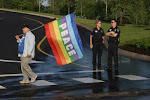

“No Same or Similar” by Steve Clemens. November 2, 2009
Judge Edward Wilson looked down from on high. The Judge’s perch in the Ramsey County Courthouse is designed to give the impression that the one who occupies the “high ground” in this legal battlefield has the superior position. So that September afternoon when he was about to pass his sentence on me after the jury dutifully found me guilty for my nonviolent protest at the Republican National Convention, he looked down on me as he followed exactly what the prosecutor had recommended: “The City of St. Paul sees no purpose served at this time in jailing [the defendant]… The State is asking the Court to stay the imposition of sentence of this misdemeanor conviction for the period of one year – on the condition that [the defendant] pay a $100. fine, plus the other fees and assessments required by law [$81], and the Court orders [the defendant] to have no same or similar violations of the law in the next year.” Judge Wilson added “and remain law-abiding in all respects” as he issued his edict from on high.
I had tried to be law-abiding – recognizing that there is a hierarchy of laws and in my estimation, International Law and Treaties need to be weighed in the balance when one is considering how to behave in a responsible manner as a citizen as well as as a follower of Jesus of Nazareth - a responsibility I see as more important than even my civic responsibility. There was an illegal war in progress then – and two wars continue today. I continue to remain willing to accept the consequences when those loyalties conflict.
But my question is: does “no same or similar” also apply to our Presidents who continue to claim one can succeed with military solutions to “counterinsurgency” situations – despite all evidence to the contrary? Vietnam was our “Vietnam”; Afghanistan was the Soviet Union’s “Vietnam”. “Vietnam” has become a pejorative term which is short-hand for an unwinnable situation. Historians tell us you can’t “win hearts and minds” with military firepower. But first Bush, now Obama, seem determined to commit a “same or similar” act. I would call it a mistake if it were just an innocent error of judgment. But when the President surrounds himself with “the best and the brightest” who continue to get foreign policy wrong, one has to wonder if it is not deliberate. I would like to believe President Obama is sincere when he tells the troops he addresses that he doesn’t want to send them into “harm’s way” unless it is “absolutely necessary”. I try to believe him but I have my doubts. Is it “absolutely necessary” for us to continue the economically and environmentally unsustainable “American style of life”?
So why do I continue to do “the same or similar” in defiance of the Judge or even in the face of disappointment from the apparent lack of change in our national policy? Is it worth risking three months in jail or prison just to participate in a symbolic action that few are likely to see and the media will likely dismiss as unworthy of notice on the evening news? [When the Judge “stayed” sentencing back in September, it means if I violate the “no same or similar” edict, I am liable for the maximum sentence on the first offense (trespass at the RNC), up to 3 months – plus any additional sentence the current Judge might impose when arrested.]
Actually, the real question is: what do I risk by not acting? What part of my life-spirit shrinks when I respond out of fear of the consequences rather than following the clarity of conscience? Is taking a risk for peace and justice only worthwhile when one has a larger audience or a greater likelihood of “success”? The action in question is being part of “die in” this week in front of an Arms Bazaar in Omaha – the shopping mall where the merchants of death hawk their latest ways to facilitate killing to the world’s most-addicted military.
Besides, risking arrest gives me the potential opportunity to spend several days with the legendary Franciscan activist, Father Louie Vitale who has been arrested more than 200 times in his quest for peace with justice; and Frank Cordaro as well, the ex-priest and Catholic Worker activist from Des Moines. Others pay good money to hear these seasoned activists tell inspiring stories at conferences; going to jail with them is like auditing their courses in nonviolent action at no tuition – and you get room and board to boot! Granted, one never knows what to expect when locked up by the authorities. Sometimes the noise and commotion allows little energy for those discussions. Sometimes “co-defendants” are deliberately split up from one another in different parts of the jail. But knowing that for even a short time one was not complicit with the Empire can embolden one to continue on the journey toward peace.

Remarks for MN FOR Peacemaker Award 2009

Remarks for MN Fellowship Of Reconciliation Peacemaker of the Year Award – Steve Clemens. Nov. 1, 2009
Peacemaking is a journey, not a point of arrival. I never thought my up bringing would lead me to this event. My Evangelical background dismissed anything labeled “inter-faith” - and its stark “saved/lost” dichotomy almost relished the idea of leaving some behind. My “peacemaking” got off to a rocky start in the late 1960s and was characterized more with disgust and hatred of President Nixon rather than out of compassion for the Vietnamese civilians or US soldiers killed in that war.
When I chose to become a conscientious objector during the height of the Vietnam War in 1968 in response to the military draft, it was a purely personal decision. I couldn’t reconcile my desire to follow a Jesus who called me to “love my enemies” with the uniform and rifle I was issued for my compulsory Army ROTC class and drill at my college.
Becoming a conscientious objector was a personal decision initially and it didn’t impact my politics or career choices. It was only during the following summer of 1969, after having my life threatened by a Black Panther on the streets of Philadelphia and then watching the landing on the moon in a tenement slum apartment as a rat ran across the room that it began to dawn on me that my conscientious objection had to become a commitment to peacemaking - to become “political” in the sense that it had to go beyond whether I was willing to take up a gun or not but had to impact all the choices I made.
What was personal had to become social and political. It was a Catholic priest from the Maryknoll seminary down the road from my Wheaton College campus that helped me move from a personal stand to public protest.
It was another Catholic, a former nun, Elizabeth Macalister and her husband, Phil Berrigan, who a few years later helped me transition from public protest to nonviolent direct action and civil disobedience. It was a long journey from a childhood where I was coached to avoid Catholics because they weren’t “born-again Christians” like my family was - to being inspired by their commitment to a God of Peace.
The genius of the Fellowship of Reconciliation (FOR) is that it draws from the strength and insight of many streams of religious thought and practice, refusing to attempt to contain “truth” within the confines of one religion or set of doctrinal beliefs.
I had first heard of the FOR during my years of street protest against the Vietnam War and my attempts as a draft counselor where groups with acronyms like the FOR and CCCO (The Central Committee for Conscientious Objectors) and NISBCO (National Inter-religious Service Board for Conscientious Objectors) became helpful sources of information for young men wrestling with issues of war and peace and the draft.
But the power and witness of FOR really hit home when I moved to south Georgia and met an 80-year old man at Koinonia in 1975. Will Wittkamper was raised as a member of the Disciples of Christ or Christian Church. He didn’t know what a pacifist was, he just knew that the Jesus he followed wouldn’t allow him to carry a gun. When he was drafted for World War I, he refused to take up a gun and was thrown into prison for his conscience. He told me how a few years later he wept when he heard of a group of others who were also morally opposed to war and how eagerly he signed on to become one of the early members of the FOR. Christine and I named our first son, Micah Will, after this man of conscience and we hope our lives, too, will serve to inspire others like Will did for us.
One other FOR experience had a major effect on my own journey: I attended a national FOR Conference in Berea, KY in 1980 where I encountered presentations from Dan Berrigan and the radical Southern Baptist preacher, Will Campbell. Will insisted that Jesus had very few direct commands to his followers – but one of them was that we must visit those in prison. As a result, and with the mentoring of Murphy Davis of The Open Door Community in Atlanta, I ended up visiting a man on Death Row in Georgia over the next 10 years. Meeting Bob Redd, and eventually trusting him to hold and play with my infant sons during our prison visits taught me a lot about peacemaking and the need for justice to be tempered with mercy.
I’d like to share a few things I’ve learned on this journey.
· Peacemaking, while it often appears to be a solitary witness, is more often the result of partnerships and community. I’ve been blessed with a life-partner and spouse who has supported and encouraged me even though our styles are quite different! Thank you, Christine. And, being surrounded by a community which shares my convictions has been an essential part of my peacemaking efforts - first at Koinonia Partners where I lived from 1975 to 1990, and now The Community of St. Martin since then. This award must be shared with them – as well as the “communities” of Pax Christi, Alliant ACTION, WAMM, IARP, SOA Watch, MN Peace Team, Vets for Peace and many other groups.
· There is always new learning and deeper commitments to explore: After my first arrest in 1975 at the White House during the final days of the Vietnam War, I was shocked to learn that a few of my fellow arrestees remained in jail rather than accept “release on their own recognizance” -they had understood the “White Privilege” implicit in that offer. Constantly I’ve been challenged with the question, “How deep do you want to go?” and as I witness the courage and conviction which leads others to take their first step or go deeper I am humbled and grateful for their commitments. Some have paid a heavy price for their risks for peace.
· I’ve learned when I allow myself to act on my faith rather than my fears, my faith is strengthened and new possibilities emerge. When I chose to climb the fence outside the Pantex Nuclear Weapons Assembly Plant in 1981, or sit on the train tracks in southern Georgia to block the shipment of nuclear warheads to the Trident submarines in 1985, or traveled to Iraq with war threatening with the Iraq Peace Team, I had to wrestle with the possibility of my own death before acting. It has been my experience that acting after considering the potential costs has been a very liberating and empowering thing.
Clarence Jordan, one of the founders of the Koinonia Community, used to say that “Fear is the polio of the soul which keeps us from walking by faith”. He went on to say that faith is not believing in spite of the evidence but rather acting in scorn of the consequences.
· I’ve learned that time spent in jail or prison need not be “unproductive”. My experience of reading the scriptures while in prison gives one a very different perspective than reading it on the “outside”. It is amazing how much of the Christian and Jewish scriptures were written either in exile, prison, or on the run from “the authorities”, political or religious. Prison time forces you to draw on your inner resources.
Like Dr. Martin Luther King, I’ve found writing from prison lends one a different sense of credibility or authority than when on the “outside”. I’ve been inspired by King, Daniel Berrigan, Kathy Kelly, Rita Steinhagen and others who have written about their experiences while “guests of the state”.
More importantly, as a white male, time incarcerated can help one experience powerlessness and not being in “control”. This is a critical learning for anyone striving to be a peacemaker. Jail is not the only place to learn this but it is hard to escape learning it when one is imprisoned.
· I’ve also learned that I need “decompression” time after time in jail or prison –almost equal to the same amount of time one has spent locked-up. Time for reflection and renewal is often neglected in the life of activists and I’ve found it essential if I am to be equipped for “the long haul”. Reading and writing are helpful disciplines for me.
· I’ve struggled over the years with the continuum within peacemaking efforts between faithfulness and effectiveness. There are many different styles of peacemaking and we need to appreciate all of them rather than giving special recognition to one style (like civil disobedience) over the others. Some of us would rather risk going to jail than to sit through interminable strategy/planning meetings! All our gifts will need to be implemented for peace to prevail.
I ask myself as bad knees or an aching back make it more difficult for me to participate in a “die-in” or to get into the top bunk in my prison cell: Am I getting too old for this? I am so grateful to have so many “fellow travelers” to accompany me – many of whom are here today. I am learning the importance of mentors and mentoring the next generation. I’ve been blessed to have learned from Phil and Liz and others from the Catholic Worker movement, and from Ladon Sheats and Kathy Jennings, two peacemakers almost no one in this room has ever heard of. Now I find myself joining “young people” in protest at immigration deportation centers and foreclosed houses, meeting with SDS activists from Macalester, and talking with RNC arrestees – hopefully sharing some of what I’ve learned in my own journey.
I am humbled by your recognition and accept this award on behalf of the communities with which I act and receive my support. Thanks to all of you for the important peacemaking work you have done and continue to do. Hopefully our paths will continue to cross as we encourage, challenge, and nurture one another as we together strive to make this a world worthy of the next generations. Thank you.
The Face of "The Enemy"

The Face of “The Enemy” by Steve Clemens. October 6, 2009
I was their designated driver; thirteen Iraqis from Najaf, a holy city to the Shi’a Muslims, had come to the Twin Cities. They were accompanied by my friend, the founder of the Iraqi-led Muslim Peacemaker Team (MPT), Sami Rasouli.
Sami, the former owner of Sinbad’s, a popular restaurant on Minneapolis’ “Eat Street”, Nicolette Avenue, chose to return to his native country five years ago, after the war was launched by the Bush regime. As a one-man peace team, he worked at rebuilding bridges and healing the psychic wounds that are always the byproduct of war. Speaking both English and Arabic fluently, Sami told us he was like a “salmon swimming upstream”, returning to his place of birth – but unlike the salmon, he did not plan to return to spawn and die but hopefully return to help us, his American friends, get an accurate description of this war from the inside.
Although this committed peacemaker did not return to die, there were several close calls in encountering trigger-happy and nervous US troops at check points. Rasouli’s hearty sense of humor, coupled with quick thinking, came to his aid on more than one occasion. But it is not only the occupying force that presents a threat to this erstwhile reconciler – he also faced threats and suspicions from Iraqis eager to throw off the yoke of an oppressive occupation, viewing someone who is willing to talk to the “enemy” as a possible collaborator.
Sami Rasouli told me how inspired he was when he encountered members of the Christian Peacemaker Team in Iraq – especially his new-found friend and mentor, Tom Fox, a gentle Quaker pacifist who was later martyred after being held captive by insurgent forces for many months. It is difficult these days to use the pejorative term “martyr” because it has been bandied about by so many as an honorific title for those who use their bodies in an attempt to kill others. Tom Fox only armed himself with love and compassion and the desire to see the end of all violence. His death shook Sami Rasouli to the core – but also had the effect of steeling his resolve to carry on his friend’s work for peace and reconciliation.
In founding the Muslim Peacemaker Team, Rasouli hoped to remind his fellow Muslims about their own tradition of commitment to peacemaking and salaam. Where better to model this commitment to reconciliation than within his own war-torn homeland? To support his work and to help others struggling to feed their families, Sami decided to bring original Iraqi art work back when he returned to the U.S. When the art was sold, half of the proceeds would help to fund the work of MPT, the other half would be given to the artist in Iraq.
But peacemaking can’t happen in a vacuum. There must be other life-sustaining programs to give people hope. So Rasouli initiated two additional programs: Water For Peace and Letters For Peace. For life and health, there needs to be clean drinking water and the MPT, which now included others committed to peacemaking besides Sami Rasouli, decided to ask groups and individuals outside of Iraq to help fund water filters to be placed in schools and hospitals in Najaf, the area where MPT was active. This idea built on the work of the U.S.-based Veterans For Peace effort that had begun under the economic sanctions in the late 1990s to help rebuild and equip water treatment plants in southern Iraq. Under the sanctions, Iraq could not purchase certain replacement parts so Vets for Peace chose to commit civil disobedience in the name of compassion and justice.
But Rasouli and his MPT colleagues couldn’t tackle large water treatment facilities so they concentrated on finding small water filter units which could be placed directly on sites where needed. After finding someone who could supply small and medium sized units for schools and hospitals, MPT discovered that they wouldn’t work without a reliable source of power. Since much of Iraq still has only intermittent electricity since the war began, they decided that they would also need to purchase small generators to power the water filter equipment.
Also, to help foster hope and reconciliation, Rasouli decided to ask school children in both the U.S. and Iraq to write to each other about their lives, hopes, dreams, and realities. Thus, Letters For Peace was born. School kids who now had clean drinking water could write and thank their American counterparts who donated money to purchase the filters. Art for Peace, Water for Peace, Letters for Peace – why not cities for peace?
Sami Rasouli, ever eager to continue building bridges between the two countries he called “home”, asked the U.S.-based Iraqi and American Reconciliation Project (IARP) to explore a more formal relationship between his two home towns, Minneapolis and Najaf. The Sister City program initiated by President Eisenhower in the 1950s as a vehicle for people-to-people “diplomacy” was just the right fit. It encourages citizens of both cities to break down barriers and stereotypes through social, cultural, and economic exchanges. Minneapolis already has 9 other Sister City relationships with cities around the global but none with a city in the Middle East or which is predominately Muslim. After a year of planning and collaboration with other civic, religious, political, and economic groups, the City Council of Minneapolis unanimously voted to become a Sister City with Najaf, Iraq at the end of July.
IARP and the MPT didn’t wait for the resolution to pass before deciding to plan for a visit from representatives from Najaf. Planning began before the start of 2009 and by Spring a planning committee included representatives from the University of Minnesota, Women Against Military Madness, St. Joan of Arc Church, and Friends For a Nonviolent World among others.
The University of MN helped overcome the biggest hurdle – securing visas – by making their visit to campus a central part of the trip and helping with the paperwork for “J visas”. Even though we may want to foster better relations with Iraqi citizens, the process in place for Iraqis to travel to the U.S. is extremely difficult unless one lives in the Green Zone and collaborates with the Occupation Forces. It was only the day before the delegation left Najaf that the final visas were issued to several delegates after the helpful intervention of Minneapolis’ Congressman Keith Ellison’s office. Transport to the Twin Cities was further complicated by the delegation being held by Homeland Security in Washington, DC’s airport for four hours -causing them to miss a connecting flight.
The Najaf delegation included doctors, University deans and professors, city council members, engineers, and members of Najaf’s Chamber of Commerce. Several spoke English well enough to have a conversation, including one who often corrected the interpreters during the two-week stay. Delegates were hosted in pairs in the homes of local volunteers who were recruited by local peace activist Marie Braun. Also included in the schedule was a three night stay at Hospitality Place, a retreat house in Circle Pines generously donated for a short respite in the middle of the trip so all the delegates could be in one place for a few evenings.
The schedule planned was ambitious and diverse. Meetings were scheduled with the Minneapolis Mayor and City Council, two days at different locations on the University of MN campus – both St. Paul and both banks of the Minneapolis campus, a boat trip on Lake Minnetonka, a cook-out/barbeque, the Mall of America, a tour of the State Capitol, some went to a battered woman’s shelter, others to The Loft literary center, a private and a public school, an alternative lifestyle community in Wisconsin as well as a tour of an Amish farm in Lanesboro. Some went to the Como Zoo, others appeared on Almanac and Belahdan, two locally produced TV shows. There was an Arab Cultural Night at a local church as well as the dedication of a new peace bridge at a Minneapolis park. A Tour of the Walker Art Center and Sculpture Garden was included as well as a tour of Native American artifacts at the Minneapolis Institute of Arts led by curator Joe Horse Capture. The folks at Meet Minneapolis, a group promoting visits and tourism in the Twin Cities sponsored and led a bus tour of both cities where I saw sights I’d never seen in my 20 years here.
Augsburg College, the Eastside Food Coop, the Chamber of Commerce, and MN Advocates for Human Rights were also on the schedule. But the stop which seemed most important on the agenda was the meeting with Congressman Keith Ellison. Spending an hour and a half with them, the 5th District Congressman not only listened and took notes but also asked one of his staff members to take video of the dialog so their message could get wider exposure. Delegates explained their concern about Chapter 7 of the United Nations which has placed restrictions on what ultimate control Iraqis can assume in their own nation while under American occupation. They spoke passionately about their need and desire for Iraqi control over the rebuilding of their infrastructure and control over their resources, especially oil and water.
Because of the weakness of the Iraqi government under the sanctions and now the occupation, the neighboring countries of Turkey, Syria, and Iran have diverted water from the Tigris and Euphrates Rivers which are essential for both drinking water and agriculture in Iraq. Although Iraq should have abundant wealth due to their oil reserves, delegates complained they have little say over rebuilding projects under the occupation and decried the “brain drain” which has occurred during the past 19 years under sanctions and war. Many of the highly trained people needed to run hospitals, schools and universities, repair infrastructure like roads, bridges, electrical plants, and water treatment facilities have been killed, uprooted as refugees, or fled the country during this period. Some expressed they felt the brain drain was a deliberate strategy to keep Iraq politically and economically weak.
One of the delegates was forthright about the more recent repression of women in Iraq who had enjoyed many more freedoms and status than they experience now. I could see the discomfort of some of the other delegates, especially those aligned with the dominate political party in power today in Iraq, at hearing this delegate expound on the plight of women today. It gave me a brief insight (despite my lack of Arabic) into some of the diversity included in this delegation.
It was evident that Congressman Ellison was engaged and energized by this meeting. He responded positively to the invitation for him to visit Najaf on his next visit to Iraq and he said he’d work with the State Department to facilitate that. The greatest spoken desire of the delegates during the two weeks was for concrete, specific, tangible commitments to partnership and help in rebuilding their city and country. Now that we are “sisters”, they would say, you need to help us while we are in need.
But their visit was not one of demands but one of pleading. Over and over we were reminded that this war had destroyed and devastated their nation and we had a moral and legal obligation to restore it – but the message was conveyed not out of anger but of expectation. They knew Americans to be a generous and compassionate people, distinct from its government; hoping that the military tanks and weapons could be quickly replaced with skilled professionals with resources under the direction of and with the cooperation of Iraqi leadership.
I’d like to share a few other observations. My only previous exposure to Iraq was a two week presence in Baghdad and Basra just three months before the war at the end of 2002. Baghdad, even under Saddam was more culturally diverse (dare one say more “liberal” in some respects?) than Najaf which has been a cultural center and Holy City for the Shi’a branch of Islam. In Baghdad, on the streets, there were many women who walked around without head coverings or at least less modest dress than you would have found in Shi’a dominated areas. Because Saddam Hussein’s regime gave preference and power to minority Sunni Muslims under his Baathist rule, most Shi’a were glad to see the U.S. intervention to topple his government.
But that replacement of a dictator came at a fearful price with the breakdown of the society and structures in its aftermath coupled with the incompetence of the occupation to either provide order or any quality reconstruction. These Iraqis witnessed the incredible waste of U.S. tax dollars in bribes, corruption, and incompetence – leaving them physically much worse off than under Saddam’s repression. At least before they had reliable electricity and somewhat potable drinking water. Now without working sewer systems, the water contamination issues are huge. A delegate told me she routinely has only 6 hours of electricity today – and it has been that way for going on six years now! So the welcome toppling of Saddam has been bittersweet with one type of oppression replacing the other. Even so, some delegates expressed reluctance to the idea of U.S. troops pulling out – fearing that in its present weak state (militarily), other nations might take advantage of them. It was a perspective I hadn’t considered.
One of the delegates with his PhD in nuclear physics told us he was one of only 16 left in the whole country, down from 350 before the war. The others have been “assassinated”, killed, or fled the country. He talked numerous times when he had the chance to educate others about the use of depleted uranium in Iraq during both the 1991 war as well as the present war. He explained about both the heavy metal toxicity as well as the radioactive contamination caused when the pyrophoric shells release the water-soluble uranium trioxides which pollute the ground water and the non-soluble uranium dioxide particles which lay on the ground and get distributed during the frequent dust storms, scattering these microscopic radioactive particles far and wide. I couldn’t help but think of the Biblical passage of “reaping the whirlwind” when he talked about the problems caused by depleted uranium use. He described the frightening rise in cancers and birth defects in Iraq since these weapons were used and the medical doctors along on the delegation confirmed the scientist’s conclusion about the causal effect likely between these and exposure to the depleted uranium.
We faced cultural and religious differences we hadn’t anticipated. We knew that most of the delegates would prefer halal meat and asked our host families to provide it if they were including meat in any of their meals. But we assumed that many of the restaurants we planned to go to which served Middle Eastern foods would also have halal meat – some did, others didn’t. We knew use of alcohol was also forbidden for them and sought to avoid eating places that promoted it but, again, didn’t realize the strong feelings of some in the group that if a restaurant served any alcohol, it “contaminated” the rest of the food. Fortunately, in the process we found some excellent restaurants that served both halal dishes and no alcohol. I would have loved to listen in on the conversations which must have ensued by the trip to the Mall of America – to both the culture of excess as well as the marketing of sexuality at places like Victorias Secret or Fredricks of Hollywood. I have my doubts about how soon one might find such stores in Najaf.
In selecting host families, we requested that there be no dogs and no pork products in the homes. Special plastic pitchers were purchased for sanitary reasons in the home bathrooms. Our over-booked schedules frequently did not provide adequate time or places for delegates to have for their prayers but we adjusted on the fly. I’m sure some guests at the Como Zoo might have been surprised to see two men in suits, barefooted, bowing and kneeling in prayer near the sea lion exhibit! Others seemed content to pray in less conspicuous fashion. I’m sure we’ll hear stories of cultural faux pas over the coming weeks from our host families.
There were times when the Iraqis talked rapidly among themselves, their voices raising and seemingly the conversations heated up. But not knowing what they were discussing, I couldn’t tell if there were sharp disagreements or whether it was merely a culturally different way of communicating than I’m used to in this country.
We had two “farewell” dinners, the original scheduled in advance when we thought the return flight to Najaf would be on Friday, October 2 and the second when we discovered the travel agent in Najaf had booked the return flights for the 3rd. At the first farewell, we were joined by host families and planning team members, packed into a cozy space at St. Martin’s Table. It was wonderful to see the bonds that had developed between Twin Citians and our guests. Appreciations flowed, hugs and hand shakes were exchanged, bridges were crossed and barriers were dismantled. It was in incarnational event for The Iraqi and American Reconciliation Project. It is only a beginning. There is much hard work that must continue.
But a few of us were blessed with a second farewell dinner the following evening, this time at the Hamdi Restaurant in Midtown. I took the opportunity to tell the delegates that they had told us they wanted to return to Iraq with tangible commitments. My “gift” to them, I explained with the help of Sami Rasouli translating, was my arrest that very morning at Alliant Techsystems for trespass when I refused to leave after asking to meet with the weapons maker CEO, wanting to ask him to stop making and selling depleted uranium munitions. I told my new friends that my arrest was a tangible sign to them that I will continue to work, nonviolently, on their behalf (and on behalf of the whole world) to stop the use of these deadly weapons.
One of the doctors in the group pulled me aside and told me how sad he was that I was risking going to jail. I’m sure he knew some who had been jailed under Saddam’s regime. I tried to explain to him a little of the history of civil disobedience and how going to jail can help build the movement. While as a doctor he desperately wants the scourge of depleted uranium contamination to end, he also does not want to see his new friend suffer. We need each other to create a world that is better for both of us. The visit from our new “sisters” is a first step on that journey. Some may remember Najaf several years ago was home to one of the fiercest insurgent groups, the Madhi Army, led by Muqtada al-Sadr. When we see the face of one who may have been an “enemy”, when we sit down and break bread together and listen to one another, we can recognize our common humanity and strive to become friends. I give thanks for their courage to visit the nation that attacked them.
[More on The Iraqi & American Reconciliation Project can be found at: www.reconciliationproject.org ]
RNC 8 Press Conference Remarks by Steve Clemens. Oct. 8, 2009
Our political system is broken. Both the legislative and the executive branches of government have been thoroughly corrupted by vested interests fueled by corporate money. In our system of “checks and balances”, that leaves only the judicial branch.
However, as I found out last month, even the courts have turned a deaf ear to protests against the on-going wars of aggression in Afghanistan and Iraq. The Ramsey County assistant prosecutor and the Ramsey County judge told 8 defendants on trial for protest at the Republican National Convention that “International Law, Treaties, the US Constitution, and the MN State Constitution” were irrelevant to our charge of trespass at the RNC.
When I told our judge that three other judges in Hennepin County allowed me to not only freely testify but also to submit the text of International Law and Treaties to the jury, his response was, “Well, I’m not as liberal as those judges over in Hennepin County!”
Human rights and civil liberties should not be grist for “liberal vs. conservative” labels. When our US Constitution states that “Treaties signed by our government shall be the supreme law of the land” yet our court system won’t allow that “supreme law” to be cited in court, the whole system is exposed as a fraud.
Where are the checks and balances to stop these wars?
The real conspiracy is the conspiracy to continue an unpopular war which continues adding to the loss of life and the emptying of our treasury. If anything, these young people have had the courage to say no to this madness.
I stand here with the RNC 8, this generation’s “Chicago 8” - young people who call for these wars to end, for these corrupted systems to be exposed, calling on the judicial system to reign in the excesses of governmental repression under the guise of “national security”. Our national security comes only with justice and equality – not selective prosecutions of people working and planning for change.
However, as I found out last month, even the courts have turned a deaf ear to protests against the on-going wars of aggression in Afghanistan and Iraq. The Ramsey County assistant prosecutor and the Ramsey County judge told 8 defendants on trial for protest at the Republican National Convention that “International Law, Treaties, the US Constitution, and the MN State Constitution” were irrelevant to our charge of trespass at the RNC.
When I told our judge that three other judges in Hennepin County allowed me to not only freely testify but also to submit the text of International Law and Treaties to the jury, his response was, “Well, I’m not as liberal as those judges over in Hennepin County!”
Human rights and civil liberties should not be grist for “liberal vs. conservative” labels. When our US Constitution states that “Treaties signed by our government shall be the supreme law of the land” yet our court system won’t allow that “supreme law” to be cited in court, the whole system is exposed as a fraud.
Where are the checks and balances to stop these wars?
The real conspiracy is the conspiracy to continue an unpopular war which continues adding to the loss of life and the emptying of our treasury. If anything, these young people have had the courage to say no to this madness.
I stand here with the RNC 8, this generation’s “Chicago 8” - young people who call for these wars to end, for these corrupted systems to be exposed, calling on the judicial system to reign in the excesses of governmental repression under the guise of “national security”. Our national security comes only with justice and equality – not selective prosecutions of people working and planning for change.
The Things I Carried


On Friday, October 2nd, the AlliantACTION vigil group celebrated Gandhi's birthday again by a nonviolent presence at the entrance to Alliant Techsystems, Minnesota's largest "defense"[sic] contractor and Merchant of Death. Bret Hesla led us in song,we read excerpts of passages from Gandhi's writings, and talked about the choice which confronts our nation: will we choose health-care or warfare?
As the gong was struck 141 times for the years since the Mahatma's birth, four of us chose to carry the message to the building's entrance, asking to meet with the CEO, retired Admiral Dan Murphy. We carried with us a notebook entitled, Employee Liabilities of Weapons Manufacturers Under International Law which included a letter signed by the four of us to the CEO. With me were Roger Cuthbertson, Geri Eikaas, and Sister Kate McDonald - making me the youngest of the quartet!
Because I had spent the previous two weeks with visiting delegates from Minneapolis' new Sister City, Najaf, Iraq, I also carried a more personal letter to explain why I was risking arrest (again). Here is what I carried:
October 2, 2009
Admiral Daniel Murphy, CEO
Alliant Techsystems
Eden Prairie, MN
Dear Admiral Murphy,
I come today to Alliant Techsystems at the behest of my new Iraqi friends, members of the Sister City delegation from Najaf. They have told me of the plague of disease and death wrought on their nation from the US military use of depleted uranium weapons, both in the 1991 war as well as the present war. Because ATK manufacturers, sells, and profits from making these toxic and illegal weapons, it is incumbent upon me to remind you of the illegality of indiscriminate weapons under treaties signed by our government as well as reminding you of the human cost of the use of these weapons.
Dr Najim Askouri, one of the members of the Sister City delegation, is a nuclear physicist and he has helped further educate me in the effects of this weapon on both humans and the environment. Doctors Al Janabi and Al Radhi, also distinguished members of the delegation have told me of the increase of cancers and birth defects in their country which they believe is related to exposure to your radioactive and toxic depleted uranium munitions. Other members of the delegation share the sense of urgency in the need to stop producing these weapons and the need for your company and the US government to pay for the clean-up of the contaminated areas and to set up medical treatment facilities to deal with the civilian casualties caused by DU. Members are especially concerned about contamination of the water systems in Iraq, including contamination from the particles of uranium tri-oxide from DU munitions used in the wars.
I bring with me today a notebook, Employee Liabilities of Weapons Manufacturers Under International Law in hopes that you will understand the legal obligations your company faces in manufacturing and selling these illegal and immoral weapons. I ask you to sit down with members of the AlliantACTION group which vigils every Wednesday in front of your headquarters to discuss our concerns. We remain nonviolent in our words and actions on this, the anniversary of Gandhi’s birthday.
In hope for peace conversion with no loss of jobs,
Steve Clemens
2912 E. 24th St.
Minneapolis, MN 55406-1322
steveclemens@gmail.com
With the above letter, I also carried highlighted excerpts of Treaties and laws documenting the illegality of depleted uranium and other "weapons of indiscriminate mass destruction" made by ATK. Included were:
1) Constitution of the United States, Article VI (Supremacy Clause).
2) Excerpts from Hague Convention (1907), Section II
3) Excerpts from Protocol Additional to the Geneva Conventions of 12 August 1949 …, Parts III and IV
4) Convention on Prohibitions or Restrictions on the Use of Certain Conventional Weapons (CCW)
5) Agreement For the Establishment of an International Military Tribunal For War Criminals in Europe. (Nuremberg Tribunal) and Principles of International Law Recognized in the Charter of Nuremberg Tribunal and in the Judgment of the Tribunal. (Nuremberg Principles)
6) Excerpts from International Committee of the Red Cross publication International Humanitarian Law: Answers to Your Questions 31-10-2002.
7) UN Commission on Human Rights Resolution 1996/16: International Peace and Security …
We were met at the front entrance to the building by ATK security and we asked permission to enter to deliver our documents to the CEO or other corporate officers. The security officer refused, stating he would not accept any documents from us and were told we were trespassing and should leave.
After being notified a second time that we were trespassing, the police asked us if we would voluntarily leave to which we politely refused. We were told we were under arrest and treated respectfully by the Eden Prairie Police who were present. As we walked back to the squad car to be processed for our arrest, Lt. Tracy Luke, asked me if I wished to have the documents we carried placed into the case file for this arrest. It showed a profound respect for the relationship we have developed since ATK moved from Edina to Eden Prairie a couple of years ago. While she is willing to enforce property laws, she also has listened carefully to our vigil group and clearly understands our commitment to nonviolence even if it leads to what is considered civil disobedience.
We, in turn, believe we have a "claim of right" under International Law and Treaties, and thus are innocent of the charge of trespass. It will be up to a jury to decide in the coming months. For me, this act of resistance was a parting gift to my new Iraqi friends. Over the past two weeks they've asked those they met for tangible, specific commitments of what we will do to help rebuild Iraq. I told them I will continue to nonviolently struggle to stop the use of DU and work to insist that those who have profited from this illegal and immoral weapon pay for the clean-up of the radioactive debris and fund a cancer research and treatment center to help heal the victims.
Please friends, add your voice and body to ending this scourge of war and inhumanity.
[photos courtesy of Tom Bottolene]. For link to photos from the event go to: http://alliantaction.org/archives/a1go/2009/action/100209gandhi/100209.html
Pre-sentencing statement

Pre-Sentencing Statement of Steve Clemens for the “Other RNC 8” Trial. Sept. 17, 2009
I stand convicted of a crime. Everyone here knows that this case was not about simple trespass. There would have been not arrest had this not been about war, torture, and other gross violations of human and civil rights.
Our real crime is in challenging the dying empire, pointing out that the “emperor has no clothes”. I have chosen to say “No!” with my body and spirit - to all the war-making, the domineering swagger of greed, the priorities so out of whack that we spend $50 million on “security” for the RNC - to protect what Dorothy Day has called “this filthy, rotten system.”
I do not pride myself as a lawbreaker but rather one who has chosen to understand that there is a hierarchy of laws –some are clearly more important than others and must be given more weight and consideration.
The Court tells us it is the arbitrator of the law. It decides what can be spoken or not. Ultimately, for me, our laws should be contracts among ourselves, to allow for the human spirit to flourish rather than to squelch conscience and creativity.
I stand before you today as a naive optimist. I always come to trial with the hope that we might turn away from a course of domineering and instead look for a course of mutuality and compassion. Much of our society is caught up in fear. I choose to act in hope –hoping that we can choose a new way.
When I did the crime, I was willing to “do the time”. I still am. I ask you to sentence me to jail for my act of resistance to war. To pay a fine is a tax on my conscience. I’ve done my “community service” by raising my voice and nonviolently acted to stop war and torture. If you feel the need to hide behind an insignificant law when a crime that is described as “the supreme war crime” continues to be committed, then please send me to join those others who have been marginalized by this system.
Martin Luther King reminded us one year before his martyrdom,
“Somehow this madness must cease. We must stop now. I speak as a child of God and brother to the suffering poor of Vietnam. I speak for those whose land is being laid waste, whose homes are being destroyed, whose culture is being subverted. I speak for the poor of America who are paying the double price of smashed hopes at home and death and corruption in Vietnam. I speak as a citizen of the world, for the world as it stands aghast at the path we have taken. I speak as an American to the leaders of my own nation. The great initiative in this war is ours. The initiative to stop it must be ours. “ …
“A nation that continues year after year to spend more money on military defense than on programs of social uplift is approaching spiritual death.”
Claiming Their Rights

Claiming Their Rights: When Nuns, Social Workers, and Librarians Confront The Military Industrial Complex by Steve Clemens. September 11, 2009
It wasn’t the usual group of criminal defendants in Hennepin County’s Courtroom 14D this week where Judge Lloyd Zimmerman presided. Minnesota judges are used to facing defendants who have been charged with drunk driving, burglary, assault, and even murder. And it is a rare occurrence when defendants who face up to three months in jail agree to “stipulate to the facts” of the charges against them before any evidence is presented by the prosecutor. In fact, after the stipulation was entered into the court record, the prosecutor for the City of Eden Prairie rested her case.
After all, the stipulation said both the defense and the prosecution agreed to the “facts”: The nine defendants went on the property at 7480 Flying Cloud Drive on March 4, 2009; they had not been invited and, in fact, were asked to leave; they refused; and the police were summoned and arrested them on the charge of criminal trespass. Only one element of the case was disputed: did the defendants have a reasonable belief that they had a “claim of right” to be on that property despite the wishes of the owner?
The youngest defendant is 52. Three were nuns in their seventies. An elementary school librarian. A retired social worker. An environmental engineer. At least four defendants are grandparents. And not a lawyer among them – they chose to go “Pro-Se”, to defend themselves. An old saying is often heard in the halls of most law schools: “He who defends himself has a fool as a client”. But these defendants thought this was no laughing matter. They sat before their jurors facing fines and jail because of conscience and conviction.
It was where the alleged trespass occurred that holds the key to understanding their determined and principled resistance – the headquarters of the largest Minnesota-based military contractor, Alliant Techsystems. Some of the defendants in the courtroom had begun their protest of the manufacture of illegal, indiscriminate weapons (especially cluster bombs) in the 1960s when Honeywell made them. After nearly twenty years of protest, vigils, and arrests, Honeywell chose to spin off their weapons products into another company, Alliant Techsystems – which is often referred to as ATK, their abbreviation on the stock exchange. That is significant. There is a lot of money to be made in selling both bullets and high tech weapons to a nation whose military budget grossly outpaces the rest of the world. But ATK doesn’t stop there. It markets its deadly products to more than 40 other nations.
Besides the deadly cluster bombs that one defendant told the jury “kills more children” when the “duds” are picked up by them thinking they might be toys, this war profiteer also makes depleted uranium munitions and land mines. Defendants testified about the effects of some of these weapons and cited International Treaties that ban their manufacture, sale, and use.
This is the lynchpin of the defendant’s case: did they have a “claim of right” to be on the property? The testimony from the stand connected the dots. The US Constitution states that treaties signed by our government become the “supreme” law of the land. The Hague and Geneva Conventions and the Nuremberg Tribunals signed by the U.S. declare weapons which are indiscriminate and kill civilians, damage the environment, and keep killing years after a conflict has ended are illegal. The Nuremberg Principles declare that “complicity” with war crimes and crimes against the peace or crimes against humanity is itself a crime. The defendants spoke about therefore having a solemn responsibility to take nonviolent action to try to prevent the manufacture, sale, and use of these illegal weapons.
What the defendants readily admit is on March 4th, they marched forth – right into the lobby of ATK carrying with them a notebook with the title: Employee Liability of Weapons Manufacturers Under International Law. They intended to hand this loose-leaf notebook to CEO Daniel Murphy or one of several other corporate officers and it contained a letter to him, sections of relevant International Treaties, and some case studies of weapons manufacturers who were prosecuted as war criminals under the Nuremberg Tribunals at the end of World War II. They requested to schedule a meeting with one of the corporate officials but were denied that as well. It was at that point they refused to leave.
Rita Foster, one of three nuns from the Sisters of St. Joseph of Carondolet, gave the opening statement for all the defendants. She described the actions and intent of the defendants on that morning in March.
Marie Braun was the first defendant to take the stand in her own defense. An indefatigable leader and organizer of the local anti-war movement and member of Women Against Military Madness, she told about meeting a German woman about her own age in the 1970s at a conference. When they were talking about their experiences growing up, the German woman told Marie that she had asked her parents why they hadn’t done anything to stop the Holocaust. Her parents told their daughter they “didn’t know” what was going on. Marie’s new friend told her, “I think they did know something.” They were afraid to act and now their daughter experienced the shame and guilt many Germans still feel today. Marie told the jurors she is now a grandmother and doesn’t want them to feel ashamed because of her failure to act – she knows what ATK makes.
Char Madigan, a nun who has worked with thousands of mothers and children who have suffered domestic violence, took the stand next. She talked about commonwealth versus corporate wealth and greed. She talked about taking responsibility rather than “hiding behind private property or trespass laws”. She said, “Just as property rights don’t protect from domestic abusers, nor should property rights protect weapons makers who violate international law. [Speaking] as a nun, property rights should not protect church officials from covering up pedophilia.” Char was clear that there should be some property rights but they have to be balanced and weighed with other important values, in her case with the value of international law to protect people during war.
John Hynes used to work at Honeywell until quitting in 1971. He was on the inside when Sister Char was vigilling outside! He told the jurors, “I wish someone had given me a copy of ‘Employee Liabilities’ when I worked at Honeywell.”
Kathleen Ruona only testified briefly and reminded the jurors that these weapons endanger all species, not just humans. John Braun, described the design and effects of cluster bombs. When he declared that civilians, especially children, were often victims of “dud” cluster bombs, the prosecutor objected, saying his statement was inflammatory.
Betty McKenzie, the third nun to address the Court testified about the effects of depleted uranium. She told the jury she was not a doctor or scientist but she had read plenty and heard experts talk about the horrendous effects the heavy metal poisoning and toxic radiation released from this newer super-weapon favored by the military. The judge instructed the jury, as he did for most of the witnesses, that her testimony was allowed not as “fact” but rather as to her “state of mind” when the defendant was arrested. It was up to the jury to determine if her beliefs and intent were “reasonable”.
The school librarian told a story about a children's picture book where the main character observes various children in her school being picked on or bullied. When none of her friends come to her aid after being poked fun of, her older brother reminded her that she also didn't " say something." Pepperwolf told the jurors, “I couldn't go back to school and face my students if I had this knowledge, this common knowledge of what these weapons do, and not ‘say something’. That is the title of the book: Say Something. “
Tom Bottolene gave the closing statement for all the defendants. He stated that the US Constitution was written for all the people not “we the corporations” or “we the government”. Since the case hung on whether the defendants had a reasonable belief they had a claim of right, Bottolene asked, “Is it reasonable to believe that this document has any meaning?” He went on to discuss the basis of international law and the rules of war. These were ratified by our government. And again he asked, “Do these documents have any meaning?”
He reminded the jurors that the Nuremberg Tribunals ruled that corporations were liable for their acts; that being told to or asked by the government doesn't excuse those actions. He explained how the Nuremberg rulings became part of the United Nations Charter, another Treaty signed by the United States government. “Is it reasonable to believe that document has any meaning?” he asked again. Then he told the jurors about his friend, the late Sister Rita Steinhagen. When she was on her way to prison for a nonviolent protest, she said, “I have the burden of knowing.”
For Tom, for the other eight defendants, and now the Judge and the Jury –all have the burden of knowing. We can’t tell our children like some German parents did after the Holocaust, “We didn’t know.”
[Just after I finished this article, the jury found all 9 guilty of trespass. The Judge sentenced them to a $300. fine or 24 hours of community service. In my opinion, they have already performed a service to the community with their acts of conscience.]
Subscribe to:
Posts (Atom)