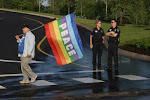
Migrant Trail Walk #5


Wednesday 5/27/09

I had a better night of rest and woke about 4:20 AM. I cleaned off with baby wipes (we are promised our “shower for the week” in Thursday!) and got to the eco-toilets before the 5AM wake-up call rush. We loaded the gear trailer at 5:30 and I helped Tom latch down the pop-up shelters and water jugs on his trailer.

The walkers hit the trail at 6:10 after our morning circle with exercises and the prayer:

Prayer for the Migrant
[Creator], full of love and mercy, I want to ask you for my Migrant brothers and sisters. Have pity on them and protect them, as they suffer mistreatments and humiliations on their journeys, are labeled as dangerous, and marginalized for being foreigners. Make them be respected and valued for their dignity. Touch with Your goodness the many that see them pass. Care for their families until they return to their homes, not with broken hearts but rather with hopes fulfilled. Let it be.

The original version of the prayer begins “Heart of Jesus …” but to make it more inter-faith and inclusive it is suggested we begin with “Creator”. Mel and I are once again tasked with leaving the gear trailer at the next campsite and then rejoin the walkers. It is challenging enough to drive on these roads in the BANWR with or without a trailer. We encounter numerous areas called “washes” where the water rushes through during heavy rainstorms that I’m told often come through here in late July. Locals call it the monsoon season. With the ground so parched and baked hard, the water often runs off quickly to those lower dry creek bed areas. If the rains came more frequently, some of the washes might be more properly called arroyos. In any case, the loose gravel and sand along with the potholes would challenge any driver.

Today, the heat seems even more intense than the past three but at least the humidity remains low. Last night about sunset there was a big storm cloud in the distance with thunder; we saw a beautiful rainbow – but we got nary a drop at our campsite.

Special kudos need to be given to Chandra and her sanitation team. They are responsible for finding spots that provide some screening from the road or campsite for a minimum of privacy – often behind a mesquite “tree” or shrub. They dig a hole next to the eco-toilet, leaving some dirt nearby for users to sprinkle on top of their excrement to keep the smell to a tolerable minimum. These “toilets” are carried on Tom’s trailer in 5-gallon buckets in the “unsanitary” zone. The black toolbox separates the trailer between the sanitary zone where the water jugs and medical gear is stored and the unsanitary area where the toilets and shovels are places. Once the toilets are sited (the women's usually to the left of the campsite and the men's to the right), the area is marked with an orange security vest or bright cone and a bottle of hand sanitizer and an extra roll of toilet paper.

Tom spots one of many red-tailed hawks flying close to the road. We’ve also spotted quail that often run along the road in front of the vehicles - occasionally flying in short stretches to keep ahead of us. We are often driving only 10-15 mph on the road surfaces in the BANWR, ready to brake on a moment’s notice for big ruts, potholes, or washes alongside or across the road surface.

Brother David, our brown-robed Franciscan needs to leave at the end of today’s walk to spend time with his mother. Father Bob, another local priest arrives to pick him up after the day’s walk is completed (a relatively easier 10.8 miles after yesterday’s 13.7 miles plus an additional mile and a half or so for the missed turn). Fr. Bob makes the transition of losing Brother David easier by bringing us some candy and two chests of ice to cool our drinks. Blessings abound! The Mennonites left their Igloo cooler/jug for us to use the rest of the week so we are able to make Gatorade for our rest stops.

Several walkers have developed blisters and/or heat rash. Many of the walkers wear “camelback” devices that include a bladder to fill with water that can be worn on the back as a backpack. A tube passes through the harness to the front so one can rehydrate as you walk. It certainly is easier than trying to drink from my Nalgene bottle while I’m walking.


Mel has brought along her guitar and several walkers sing along with her at the campsite as we await lunch or supper. With our relatively “easy” distance today, there is some “down time” before lunch. We arrived at the campsite on time, just before 11AM. Tomorrow promises to be a much more grueling trek and we need to leave much earlier in the morning to try to beat the hottest part of the day.

Each of the drivers carry a walkie-talkie while the walk is in process. Here is a typical exchange:
Kat (with the walkers): Steve, I see the Rodeo ahead. We turn right at the spot where you are?
Steve: correct.
Kat: Thanks. You can go ahead; do it now so we aren’t eating your dust.
Steve: OK. I’m heading out. There is a water no-stop just ahead.

We have two types of “stops” en route during the walking phase: a “water no-stop” means the walkers pass the vehicles on the right side and fill their water bottles (if needed) and continue walking. These are scheduled every 1-1/2 to 2 miles. The “full stop” (between the water only stops, again after another 1-1/2 to 2 miles) lasts 10-20 minutes and people go to the bathroom and get snacks to replace lost salt or sugar for energy. We have fruit, both fresh and dried, pretzels, salted peanuts, cookies or crackers, and Gatorade or water. It is time for some to re-apply their sunscreen; others use the opportunity to sit on the ground and rest. Several members of the food team ride ahead with the drivers to set up the tables and snacks so everything is ready as the walkers arrive. This walk is well organized! It is during these “breaks” that drivers and walkers can switch out if someone wishes and others can get into the van and ride for a stretch if they need a break. The organizers make it clear that peoples’ health and safety remain a priority.

We also use the walkie-talkies to make sure the walkers know when the support vehicles are coming up behind them so they can get into a single-file for us to pass. Later, when we are walking on the main paved highways, we must walk single-file all the time but while in the BANWR we can walk two-by-two and have some conversation easier.

It has become apparent that I am more useful to the success of the Migrant Trail Walk as a driver/support person than as a walker. I’m happy to contribute whatever way is best. While it may seem to be more “heroic” to be walking the 75 miles in the extreme heat, unless the walkers have reliable support in setting up the stops and hauling the gear and supplies, nothing would work as smoothly as we’ve functioned so far.

Our medical team is ready to advise and help –blisters, heat rash, aching muscles, removing cactus’ thorns. They remind us to have food in our stomachs before taking ibuprofen. Taking it in the morning sometimes certainly makes the walking easier for me. The food team sets up our breakfasts, making coffee as well as setting out the bagels that are our morning staple. Their mantra always is: “Sanitize! Sanitize!” Don’t touch any food without sanitizing first and don’t reach into any food container – use the tongs or scoops provided. We have a lawyer who walks with us and she will take charge with any potential contacts we have with the Border Patrol or migrants we encounter.

Each evening close to our suppertime a truck operated by Humane Borders comes to the campsite to replenish our supply. They often have ice as well. What a crucial role water plays in our lives this week!

Today the group decided to walk in silence for a mile and a half to take time to reflect on those who have died in this area. Also, today, during one of the stretches, names written on the crosses we carry are read aloud with the group responding with “Presente!” as a symbolic gesture of carrying that person’s spirit with us, or recognizing his/her presence among us.

Rain? In southern Arizona? Yesterday a cloud came over and I felt about 12 big drops. Then it stopped. About sunset there was another huge threatening cloud but it never came over the campsite. There are no clouds when I awoke close to 3 AM and the stars in the dark sky were incredible! Since our wake up time tomorrow is scheduled for 3AM with the walk starting at 4, hopefully we’ll get to enjoy them again. Meanwhile, threatening clouds moved in about 3PM today and people scrambled to attach rain flies to their tents or to get under the canopies but all we got was thunder and a few sprinkles again – not even worthy enough to settle the abundant dust. With the early departure in the dark tomorrow, we need to load and secure Tom’s trailer before 8PM tonight after we take down the canopy shelters and the water truck has completed filling all our containers.

Migrant Trail Walk #4

Tuesday 5/26/09 Getting Lost in the Sonoran Desert.

Wake up call was at 5AM just as it was getting light outside. Thank God for our sanitation team that had placed the eco-toilets for us to use near the campsite. Just before grabbing some breakfast (usually bagels with peanut butter or cream cheese), I discovered that the rear tire of the Rodeo appeared low. Tom gave me his air gauge (is there any tool he doesn’t carry?) and when it doesn’t register at all, we know we have a flat that needs repair. Although Kat has 195,000 miles on this vehicle, she is prepared with a full-sized spare tire which I am able to change with help from others – just in time for our morning “circle-up” where Erin leads us in some stretching exercises and we recite the Migrant Prayer again, this time in Spanish, led by a retired policeman from Phoenix who has walked this trail before. The rest of the logistics team had reloaded the trailer with all the camping and personal gear while I concentrated on the flat tire.

Mel, an immigration lawyer from Phoenix and I were asked to haul the gear trailer ahead to the next campsite for tonight and then rejoin the group with the Isuzu Rodeo which will serve as our emergency vehicle. Then I will remain as the driver for the day so Mel can walk with the others. (I had volunteered to help out with driving when needed.) Even with detailed instructions with odometer readings of when to turn and a map, we missed a turn and got lost on the BANWR. It turned out that the walkers also missed a turn and got lost and were about an hour behind schedule. We finally connected with the others thanks to the walkie-talkies which helped the three drivers coordinate with the security team members walking with the group. We are communicating on two different channels so a couple of people (Tom and Kat) are carrying two radios.

If we get lost in this desert/wilderness with maps and directions keyed to our odometer readings, can you imagine how hard it is to navigate on foot without these tools? Is it any wonder more migrants don’t die out here amidst the heat and the cacti? It got me thinking about the Hebrew slaves who escaped Egypt only to wander 40 years (!) in the desert/wilderness of the Sinai? No wonder they were a cranky group for Moses, Miriam, and Aaron to lead. I have much more appreciation for their plight after just hours in this wilderness.

And yet … the cacti blooms are marvelous! Also, this morning we spotted about 5-6 deer and almost a dozen large jackrabbits, some as big as a good-sized dog. I also saw a roadrunner scamper across the road but didn’t see a coyote chasing him. (We did hear the coyotes “singing” at night, however.) We haven’t seen any Pronghorn antelope yet but Kat tells us there are some in this area. I hope they enjoy eating mesquite and cacti since there isn’t much else beside some dried grasses. This wilderness is off-limits to the local ranches where the cattle seem to have eaten all the grass.

After we arrive at the campsite and get ready for lunch, I am told to try to get the flat tire repaired at a local town about 10-12 miles away after a quick lunch while the walkers are resting. We will also need to pick up more water as we had run low by lunchtime. Because of the wrong turn, we don’t get lunch until about 2 PM and it is refreshing to get under one of the pop-up canopies to lessen the effects of the mid-day sun. Since the sun is so intense, we’ve set up all five of them so people can sit or lie in the shade.

Not knowing where I was going, one of the volunteers who brought us our lunch offers to ride with me to give me directions for the tire repair place. Isabella, an older volunteer with Derechos Humanos tells me as we’re driving about meeting migrants at a center in Nogales who arrive with feet rubbed so raw there is almost no skin to protect them after blisters burst and peel off. One woman told her that her whole extended family saved up money for her to “go north” to try and find work to get money for her family. Even though her feet were raw, she couldn’t turn back to go home because of how shamed she would feel in failing her family.

Isabella has been part of this struggle for a long time. Her parents migrated to the US from central Mexico to better their lives. Isabella worked with Caesar Chavez in organizing farm workers. She told me she still doesn’t eat grapes in honor of him and the struggle for justice. In going to get the tire repaired, I heard a scraping sound at a stop sign. When I got out to inspect it, I noticed the front bumper which had been fastened on with a bungee cord had slipped loose from the rough roads we travelled and now held on with only one fastener. After trying to re-secure it without success, I removed it and put it in the back seat. After getting the tire repaired, the detached bumper was fastened to the roof rack on top of the spare tire for the gear trailer.

What trees there are are short scrub mesquite that are so low one can’t get decent shade and what shade they might provide is intermittent because they are not very leafy. There is no other shade for miles so you pray for some passing cloud cover to provide a respite from the broiling sun which bakes everything around here.

Almost Thou Persuadest Me to Become a Mennonite [Again].


Although I was raised in a church which called itself Mennonite until I was 14 (when the congregation dropped the “Mennonite” identity and reverted to the independent/fundamentalist/evangelical church it, in practice, had always been), the supper brought to the Migrant Trail walkers on Tuesday night made me want to renew my Anabaptist heritage!

Shalom Mennonite Fellowship provided the supper and the first thing I (and others) noticed was the incredibility colorful and even more tasty fruit salad. Not only did it include fresh mango, pineapple, watermelon, cantalope, grapes, and strawberries, but also fresh raspberries, blackberries, blueberries and topped off with fresh pomegranate seeds! There were tossed salads, tuna fish salad, several pasta salads, an apple/broccoli salad. Homemade cookies plus other desert-like treats wrapped in cellophane so they could be squirreled away until needed tonight or after the first few miles tomorrow.

It was evangelism through hospitality. People often referred to as “the quiet in the land” spoke eloquently through their service and generosity. You could physically see spirits lifted during and after the meal. Now, if only that hospitality was contagious – and metastasized exponentially to include our Mexican brothers and sisters and all other “strangers within the land”.

Migrant Trail Walk #3

Monday 5/25/09

Some additional walkers will join us for the first day. Many have purchased this year’s bright yellow Migrant Trail Walk T-shirt . On the back it reads:

Our Vision
The precarious reality of our borderlands calls us to walk. We are a spiritually diverse, multi-cultural group who walk together on a journey of peace to remember people, friends and family who have died, others who have crossed, and people who continue to come. We bear witness to the tragedy of death and of the inhumanity in our midst. Lastly, we walk as a community, in defiance of the borders that attempt to divide us, committed to working together for the human dignity of all peoples.

We also wore our name badges for our identification and on the back of it there is the following statement: To Whom It May Concern: I am a participant of the Migrant Trail, a peaceful event by citizens and immigrants in support of justice on our borders. I wish to exercise my right to remain silent. I will not speak to anyone, answer questions, respond to accusations, waive any of my legal rights, or consent to any search of my person, papers, or property until I have first obtained the advice of an attorney. If I am detained, I wish to contact the following person in order to obtain legal advice: Margo Cowan: 520-850-0058.

We have introductions and some logistical announcements in a circle in the Fellowship Hall of the church after the three trailers are loaded. I’m on the logistics team and our gear trailer carries the tents, sleeping bags and pads, camp chairs, and duffle bags or backpacks of those who will walk all week. We also carry an additional three 5-gallon water jugs on our trailer; it is packed tight! The food trailer is self-explanatory. The third trailer is hauling our water for our rest stops, eco-toilets [in a separate “unsanitary” area], our medical supplies, and our “pop-up canopies” we will use for shade when we finish each day.

Today is the only scheduled day when we walk in the afternoon. We drive about 1 ½ hours to the US/Mexico border at Sasabe, walk across the border and then are shuttled to a local Catholic church in this small Mexican border town. The road is unpaved, with deep potholes, and the driver has to avoid the occasional cow “grazing” in the middle of the main street or along the shoulder.


The women of the church have prepared a meal of rice, refried beans, tamales, and salad. We eat with some of the local residents under a canopy/tent that provides shade for about half of us. Others try to sit alongside the church building where there is little shade. Afterwards we enter the church for a brief service before we process, walking with three coffins the 1 ½ miles back to the border. We past a group of predominately young men, about 30 in all who wait in the shade and we are told will try to cross the border later in the day.

At the border, we gather in a circle for a moving ceremony remembering the migrants who take the costly risks in crossing nearby. Maria talks about the indigenous peoples of this area and calls us to pray for all involved in this on-going tragedy. She burns sage and “smudges” each of us before we cross over to the US side.


As we cross the border to re-enter the US, each of the walkers hands their passport or other ID to one of the walk organizers. We will travel as “undocumented” for the rest of the week in solidarity with our migrant brothers and sisters. It is only a symbolic gesture; we are such people of privilege, knowing that we travel with our own attorney this week.


It is a hot, dusty trek today. We walked single-file along highway 286 for close to 3 miles before we turn off into the Buenos Aires National Wildlife Refuge (BANWR). We walk a little more than 6 miles and don’t arrive at the campsite until 6:15 PM. Supper wasn’t ready until about 7:30 and we are scheduled for quiet time from 8PM until 5AM. It gets dark quickly and I will sleep in one of the vehicles tonight hoping it will feel better on my back.

A packet of 3 burritos and a slice of watermelon is our supper. It is getting close to sunset and I’m tired enough not to want to read before I sleep. The moon rises over Baboquivari, the distinct mountain peak to our west that dominates the landscape. We’ve had her in our sight all day. My friend, John Heid, told me a little of the story of this sacred mountain as we walked today. I’itoi, the Creator/God of the Tohono O’odham Nation dwells on this mountain. It is this people’s Garden of Eden/Creation story myth. There is a cave in the mountain where native people leave gifts or sacred objects for I’itoi. Some people say the mountain is shaped like a breast to nourish the people in this parched land. Others say the people complained to I’itoi that they wanted more cultivatable land but God split the mountain (thus the sharp face on one side) and the rocks from that face fell into the area coveted by the people. God felt the people were being too greedy in desiring more land and so made some of it uncultivatable. Whichever story is correct, the mountain and the surrounding area remain a sacred site for the indigenous people on both sides of the border between nations because the native people historically lie on both sides of the US/Mexico divide.

Migrant Trail Walk #2

Sunday, May 24, 2009

It is 85 degrees at 10:30 AM when I land at the Tucson airport. I take the city bus (with a transfer) to Southside Presbyterian Church, our place of orientation. The countryside is stark and barren as our plane approached Tucson from the north and east. I don’t expect much different from the south and the west, the area where we’ll walk. I’ve started reading Dan Berrigan’s Exodus: Let My People Go on the flight down. Moses and his people spent some time in the wilderness, too so it might serve as a helpful companion on this journey.

My first sight of Southside Presbyterian Church is the group of homeless folk who partially obscure the sign. Without the sign, one might not suspect the building behind it serves as a church. When I arrive at the back door just before noon, I am told that they are showing a documentary about immigrant issues in the church library. It is a movie about organizing sweatshop workers in the clothing industry in LA. After the movie, I have 5 hours before orientation so I ask where I can get something to eat nearby. I’m told a good Mexican restaurant is “about 5 blocks away”; in reality it is closer to 10 blocks and the noonday sun is intense. After walking to and from the restaurant, I discover the church is locked so I try to find a spot in the shade and sit on an empty milk crate for a little more than an hour before the students from the Newman Center of U of AZ arrive to prepare our supper.

What a relief to sit in a metal folding chair in the moderately air conditioned Fellowship Hall. When one of the Walk organizers arrives, I’m told I can sleep in the library tonight. There I discover a recliner/rocker in the corner and I camp out there. After reading and napping, it is suppertime and many of the fellow walkers have arrived.

After a supper of beans, rice, enchiladas, salad and fruit, we are directed next door to the “Kiva”, the worship space/sanctuary – a rustic but esthetically beautiful building with an impressive open beam ceiling. The benches (in place of pews) are attractive but hard and no one knows how to turn on the air conditioning. At orientation we are introduced to the sponsoring groups and some of their members. They include Mennonite Central Committee, Pax Christi, American Friends Service Committee, Border Links, No More Deaths, and a Franciscan Peace and Justice group. The main sponsor, Derechos Hermanos (a Human Rights Coalition) shows a brief PowerPoint about the militarization of the US/Mexico border. Kat Rodriguez says it is best described as “when the military acts like police and the police act like the military”. She goes on to describe the “Southern Boarder strategy” where the plan is to shut down all urban crossing points (through the construction of walls and fences) which channel migrants attempting to cross the border (without documents) into remote and physically challenging desert areas. The official sanctioning of “death in the desert” is seen by proponents as one of the “deterrents” promoted by this policy – hoping it will discourage others from undergoing the risky crossing.

Kat shows us a photo she took a couple of years ago of pallet upon pallet of metal sections of military runway which was left over from the Vietnam War. So much of this metal has been used to create this border wall that it is reported that after all the Vietnam era runway was used, some of the wall now being built is from the detritus of the Gulf War. Talk about militarizing the border! We are told some of the same corporations who are building this wall are also some of the same corporate contractors doing the separation barrier installation between Israel and the Occupied West Bank of Palestine.

The Border Patrol has become a law unto itself. Unlike local or state law enforcement, there isn’t an accountability structure in place for them. When Border Patrol officers are accused of inappropriate deadly force, sexual harassment and racial profiling, there is little recourse – and those committing such human rights violations are often just transferred to another section.

Under the Real ID Act, passed in the fearful years following 9-11, the new Secretary of Homeland Affairs is authorized to waive any laws he/she feels necessary to “protect our borders”. Michael Chertoff, Bush’s Secretary of Homeland Security, waived Clean Air, EPA, and other environmental laws (32 in all) ostensibly to “protect us” from our neighbor and #2 trading partner, Mexico.

We were educated about present practices that undocumented immigrants face here in the US. Many who are caught and detained presently agree to “VR”, voluntary return, which serves like a “catch and release” program where one is returned to Mexico (even if they might be from another Latin American country) without draconian legal penalties. We are told the numbers are so great and the legal system so overburdened, between 1,000 and 1,500 persons are “voluntary returnees” every day in Tucson alone.

Because of the border walls and the funneling of undocumented people into the remote areas, it’s estimated that 52% of those crossing now come through the desert and wilderness areas of Arizona. Local hospitals have become overwhelmed and are not reimbursed by the federal government who has created the crisis.

The latest plan designed to try to squelch this “illegal migration” is called Operation Streamline”. It is a pernicious and draconian attempt to harshly criminalize any undocumented person crossing by permanently labeling anyone caught and processed under this provision as being forever banned from entering the US under any circumstances. It doesn’t matter if your children (or spouse) are US citizens. Under this process one will be refused any legal visas or other legal papers anytime in the future. Many of these proceeding are occurring en masse where 50-70 undocumented people are processed at one time and then permanently deported. Of course, when people are desperate, they will still attempt to return but must always live in the shadows. As one man told a Derechos Humanos worker, “If I could get a job and feed my family in Mexico, I would never risk this [life-threatening] crossing.”

We talked about the logistics and expectations for the Walk. We are told to select a “pee buddy” to make sure no one is left behind “when nature calls” but also to monitor that one’s partner is drinking enough to pee regularly –because if you aren’t peeing, you aren’t hydrated enough.

The air mattress I borrowed from my neighbor wasn’t terribly helpful for sleep on Sunday night at the church. After two hours of tossing and turning, I get up and sleep in the reclining chair until 5AM when one of the church volunteers burst in to inform us that he is our wake-up call. We were aware that the church hosts a breakfast for the homeless at 7:30 AM and set up begins about 6 but this guy thought he’d start our day off on his schedule!

Walking the Migrant Trail #1

Walking the Migrant Trial 2009: Being Present With Desconocida in the Shadow of Baboquivari by Steve Clemens.

Last week was the start of the 6th annual Migrant Trail Walk coordinated by Coalicion de Derechos Humanos based in Tucson, AZ. They state, “The walk is not intended to simulate the experience migrants face as they cross the gauntlet of death. Walkers are accompanied by support vehicles, unlimited food and water, and medical attention: things that the migrants themselves desperately lack. However by walking 75 miles in the hot summer sun we try to make a small contribution that will some day lead to change on the border. No one should be forced to risk their life in order to provide for their family.”

I walked part of the time and served as a logistics driver for the rest of the time to enable others to receive the support they needed to complete the arduous task. When I was driving, Mel, another driver/walker had me play a song over and over again on Kat’s cd player in the Isuzu Rodeo I drove. On it was a song written by Jake _____, a participant walker several years before on the Migrant Trail. He wrote a very moving song, Desconocida (the term used for “unknown [female]”) and it framed and contextualized the week for me. As best as I could transcribe the lyrics:

Desconocida

Desconocida,
Are you wearing your favorite dress?
Is it woven with wedding thread?
When you look over your shoulder
Does it cry colors?

Desconocida,
Does your hair fall over your eyes?
Does it seem so to a dragonfly?
They know the way they lose themselves
In the breeze

No one heard the sound of our body
On a grain of sand
Or the Creator had your name engraved
On the palm of His hand.
Desconocida.

Desconocida,
Do you dance ‘til the sun wakes up?
Slightly moving through the windows of your love
How you barely weave your finger-
Prints on the sill?

Desconocida,
Do you gaze into a jealous moon?
With the stellar of old surround your youth?
And when you are leaving
Do they ask you to stay?

No one heard the sound of our body
On a grain of sand
Or the Creator had your name engraved
On the palm of His hand.
Desconocida.

Oh, oh, oh …
Desconocida,
Are you breathing the freshest air?
Does your garden grow
With every prayer?
I feel the bees
They hum their sweet pollen.

Desconocida,
Have you the arms of a loving man?
Do you own the lines upon his hands?
Your family, does he build the table strong?

When no one heard the sound of our body
On a grain of sand
Or the Creator had your name spelled out
On the palm of His hands.
Oh, no one heard the song
Of you dying on the desert floor
But now you’ve got your favorite dress
Oh put on your favorite dress
Put on your favorite dress

‘Cause you don’t have to hurt anymore ….
Desconocida.

Losing a Mentor and Friend: Larry Rosebaugh


Losing a Mentor and Friend, Fr. Larry Rosebaugh, OMI by Steve Clemens. May 20, 2009
[Note: I received word last evening that an American Catholic priest had been murdered during a robbery in Guatemala on May 18th.]

Fr. Larry was a gentle person, one with few possessions or needs. I remember his joy at being moved to solitary confinement at the Potter County Jail in Amarillo, TX one week after our arrest for praying at the assembly plant for all U.S. nuclear weapons (Pantex) in 1981. When we saw each other at the arraignment, he beamed and said, "They gave me my own little prayer cell".

What I didn’t know at the time was that Larry had joined the other five of us because someone else who had planned on taking part of this witness against nuclear weapons was sick so Larry decided to take his place. Prior to the six of us being booked into that jail, we were held together in a cell while the FBI attempted to interrogate us. It was at that point that Larry told us about his imprisonment and torture in Brazil while serving the poor under the inspiration of Dom Helder Camera. After describing what he went through there, I knew I could survive this, my first long-term stretch in the slammer.

Because we were locked in different cellblocks for all but the first week together, I didn’t get to spend much time with Larry – but what time we shared was precious. I learned about his previous experience in prison as the result of his participation in burning Vietnam-era draft files as part of the Milwaukee 14. But what really made an impression on me was his statement on why he scaled the 12’ fence at Pantex that cold February morning in 1981. He said when he worked with the “street people” in Recife, those young, homeless kids had no idea what an atomic bomb was –or what it was capable of doing to its victims. Larry said, “I don’t know too much about these bombs myself, but I know enough that I have to speak out on their behalf.”

It had been less than a year since Archbishop Oscar Romero had been martyred in El Salvador but Larry must have picked up the mantle that dropped when Romero fell about being “a voice for the voiceless”. Larry tried to tell the jury at our trial about his experiences in the slums of Recife and why it propelled him to go to the Pantex plant but Judge Robinson cut him off and stated it was irrelevant to our “crime” of trespass. Larry was sentenced to a year in prison for praying for peace at the “wrong” place. But while still in the county jail, before being transferred to federal prison, the local Catholic bishop came to pay this renegade priest a visit. It was after Bishop Leroy Matthiessen visited Larry in jail that he made his own act of conscience and courage: the bishop publicly asked all those of conscience to stop working for that bomb factory. And what a firestorm that caused!

If Fr. Larry and the other 5 of us had tried to devise an action to compel the local Texas bishop to denounce nuclear weapons, I’m sure our efforts would have failed. But Larry did a simple act of faith and conscience and, as a result, his “sowing of the seed bore much fruit”. Because the newspaper mentioned in the story that a Catholic priest was among the 6 arrested and held in the jail, one of the Pantex workers had a crisis of conscience. Why would a priest be willing to go to prison to protest at the place where he worked? When that worker talked to the bishop, the bishop had to find out for himself.

I joined Fr. Larry once again a couple of years later when he, Fr. Roy Bourgeois, and Linda Ventimiglia came to Koinonia Partners and told us about their intended campaign at Ft. Benning where Salvadoran troops were being trained. (This was just prior to the School of the Americas being moved there.) They invited some of us who were vigiling by the base gate every Thursday to join them in what turned out to be their final action in a very busy week. Several of us joined the 3 of them and we planted our crosses on the Base Commander's front lawn before we were arrested and hauled off. My last time seeing Larry was at their trial in 1983.

I'm grateful for his life and witness. Rest in Peace, my friend and brother.

Remarks at Interfaith Vigil on Anniversary of Postville, IA Immigration Raid

Remarks for Postville Vigil. By Steve Clemens. May 12, 2009

I was asked to share a few remarks about why I chose to join the act of Civil Disobedience last Wednesday at the Immigration and Custom Enforcement Office (ICE) in Bloomington. Most of the 30 who were arrested for blocking the entrances and (hopefully) preventing or delaying the deportation of individuals from this country that day were close to half my age.

I came to political consciousness about the plight of immigrants in the U.S. during the early 1980’s as many families and individuals were fleeing U.S. sponsored or supported wars in Central America. At the time, I lived in southwest Georgia and was part of a sister community to Jubilee Partners, an intentional Christian Community in northeast Georgia who ran a program called Ano de Jubileo. This program attempted to help Central Americans seeking safety and political asylum from those wars to come to Georgia for 6 weeks of language study and orientation to North American customs before driving them to political asylum in Canada. [The US denied political asylum to 95-98% of those who applied from El Salvador or Guatemala.]

Besides helping to drive their bus loaded with 30 refugees at a time, our community also hosted a couple of families during this period as well. In learning of their stories and needs, it was natural to act on my values of Christian compassion and seek to work in solidarity for their needs. In so doing, I was driven to learn more of the Biblical tradition of “welcoming the stranger or sojourner in the land” – for, as the Bible says, “in so doing, we have often entertained angels or the divine.”

The call from my own faith tradition comes primarily from Matthew’s Gospel, the 25th chapter where Jesus reminds us “what we do to the least of those who are marginalized in our society, we do to him.”

Some fellow citizens would argue today that many immigrants are not true “political refugees” but rather migrating here for economic reasons. That may be true but does that make their suffering and needs significantly different? Does that mean we are excused from the Biblical call to compassion? Economic refugees are not just created by drought or other natural forces. Many are created as the result of a globalized economic system that allows capital and material resources to cross borders but not people. When profits come before people, our faith and values must take precedence over our greed and our demands for “low prices”.

In the Christian scriptures, the faithful are called to live as “strangers in a strange land”. For a Christian to identify with a nation-state over the fictive kinships we have with one another is to confuse our own identities.

My friend, Ched Myers observes: All social groups establish boundaries—whether physical impediments, such as fences or borders, or symbolic and cultural lines, such as language or dietary laws. Such boundaries can be a good thing, especially when they help protect weaker people from domination by stronger people. More often, however, boundaries function in the opposite manner: to shore up the privileges of the strong against the needs of the weak. It is this latter kind of boundary that characterizes the current U.S. immigration debate and that the Bible consistently challenges. …
To be sure, issues related to the continuing and often involuntary migration of peoples, and to the geopolitical definition of human communities, are complex in the modern world and deserve our careful reflection and deliberation. But these are finally theological and pastoral issues for Christians, and we must seek to know immigrants and refugees not as statistics but as human beings who endure extraordinary hardship and trauma in their struggle to survive.
And for U.S. citizens, these are issues of national identity. Israel’s ethic of compassion toward outsiders was shaped by its own history of pain: “You shall not wrong or oppress a resident alien, for you were aliens in the land of Egypt” (Exodus 22:21). We, too, are a nation of immigrants. Amidst the current culture wars that marginalize immigrants and refugees, then, our churches must choose which America we embrace.