The Things I Carried To My Arrest


The Accoutrements of Arrest by Steve Clemens. September 28, 2011
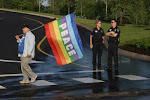
Usually when I risk arrest in an action of nonviolent civil disobedience I try to only carry the bare essentials: my drivers license/ID and possibly some cash if I will try to make bail. I even remove my wedding ring if I’m expecting to end up in jail. Today, however, for our last arrest witness at Alliant Techsystems, Minnesota’s largest war profiteer, I carried a Civil Arrest Warrant for ATK’s CEO, Mark DeYoung. I also wore my blue scarf brought home from Afghanistan this Spring as a symbol of solidarity with nonviolent peacemakers in Kabul and Bamiyan Province.
I wore my Blue T-shirt with the bold lettering of “No War” coupled with “Love your enemies” and “our God is Love, our Gospel is Peace” statements.
I also carried excerpts of International Law provisions from the Hague and Geneva Treaties, resolutions from the United Nations, statements from the International Committee of the Red Cross, and statements from experts about the illegality of depleted uranium weapons. I carried a copy of my personal letter to CEO DeYoung as well.
Alliant Techsystems, also well known by their stock-ticker abbreviation as ATK, just recently announced that they are moving their corporate headquarters from Eden Prairie, MN to Arlington, VA so they can be close to their preferred customer, the five-sided Department of War headquarters also known as the Pentagon. Here in Minnesota they are a big fish in a small pond when it comes to corporate sales; in the Washington, DC area, close to the center of pork barrel politics and military contracts, they will just be one of many trying to sidle up to the hog trough.
Our AlliantACTION vigil group, usually about 20-30 stalwart peacemakers, have come every Wednesday morning for more than 15 years running from 7-8 AM to hold signs, sing songs, and gather together to call for ATK to cease production of illegal and indiscriminate weapons and instead use their inventive engineering genius to create products that are life-giving and useful. “Peace conversion with no loss of jobs” is one of our on-going mantras. It is coupled with another, a query: “Who profits? Who dies?”
We carry few illusions that our act of nonviolent civil disobedience today will result in a radical change in policy for a corporation which has profited from weapons of death and threats of annihilation. This spin-off of Honeywell’s weapons division (after years of nonviolent protest at their south Minneapolis corporate headquarters organized by The Honeywell Project), ATK has the notorious distinction of being one of our nation’s largest manufacturer of landmines, cluster bombs, and depleted uranium weapons.
To further add to this pantheon of what the United Nations lists as “weapons of mass or indiscriminate destruction” (and, as such are illegal to manufacture, sell, or use), ATK also makes components for nuclear weapons, including the nuclear missile for the Trident Submarine. As if that were not enough, they have developed a gun that purports to “shoot around corners”, the XM-25 which is now being field-tested in Afghanistan. There are also reports that Alliant is also providing components for the Pentagon’s latest obsession, the un-manned aerial vehicle, aka the drone. While ostensibly targeted at Taliban leaders, scores of reports of innocent civilians being killed in Afghanistan and Pakistan has led hundreds if not thousands to join the insurgency to seek revenge for the attacks on family members.
Our act of civil disobedience comes just four days before the birthday of the premier disciple of nonviolence, Mahatma Gandhi. On October 2, the AlliantACTION vigil group will return to the front doors of the newly vacated corporate headquarters. The move of the corporate officers is to take place on October 1 but Gandhi’s birthday comes only once a year so we will gather to celebrate his life and witness as well as the power and the blessing our vigil circle has provided to us over the past 15 years. It was not our goal to “chase” ATK out of Minnesota; our state can use good paying jobs. We just want those jobs to affirm life rather than find ever more creative ways to destroy it.
__________________________
My letter to Mark DeYoung:

September 28, 2011
 Mr. Mark DeYoung, CEO
Alliant Techsystems
7480 Flying Cloud Drive
Eden Prairie, MN 55344-3720

Dear Mr. DeYoung,
I come to ATK Headquarters today with a heavy heart. The last time I approached this front door, just a few weeks shy of one year ago, it was in response to your gracious agreement to meet with a small group of us from the weekly Alliant ACTION vigil. As you may recall, during that meeting you told us “We are not in that business” in reference to depleted uranium weapons and went on to say that ATK always “pick and choose what contracts we will go after” – or words to that effect since you requested that I hand over all my written notes as we left the meeting so these quotes are my best recollection of what was said last October 11th.
Although I am not a shareholder of ATK stock, several members of our vigil group are and they reported back to those of us vigiling outside or the morning of your annual shareholders meeting in August that you admitted in that meeting that ATK is assembling munitions containing depleted uranium provided for you by the U.S. Government.
You might recall during our meeting with you we gave you (and your legal counsel who was also present) a lengthy document identified as “Employee Liabilities of Weapons Manufacturers Under International Law”. Included in that document was a resolution passed by the United Nations Commission on Human Rights in 1996 which stated categorically that weapons containing depleted uranium are “weapons of mass or indiscriminate destruction” and “the production, sale and use of such weapons are incompatible with international human rights and humanitarian law”.
Therefore, we come with the intent of serving you with a Citizens Arrest Warrant, charging you with both the production and sale of illegal weapons according to Treaties signed by the U.S. Government. It has always been the intent of our vigil group to advocate “peace conversion with no loss of jobs” for the company you lead but since you have decided to move the corporate headquarters to the Washington, DC area at the end of this week, we felt we needed to take this nonviolent action.
 Sincerely, in Peace,
 Stephen D. Clemens
Member, Alliant ACTION Vigil

The Rest of the Story - Climate Change Arrest at the White House

The Rest of the Story: Tar Sands Action at the White House by Steve Clemens. August 30, 2011

When I first signed up to come to Washington and return to the White House, I thought to myself: wasn’t it just a year and a half ago that I told Christine that I’m getting too old to spend another night in jail? My experience protesting President Obama’s continuation of the Afghan and Iraq Wars had left me physically very sore (but spiritually content) after 28 hours in the four different DC jails we occupied after our “die in” at the White House the day before the 2010 State of the Union address.

This time it was an email from my friend, Rabbi Arthur Waskow of the Shalom Center in Philadelphia that got the juices flowing again. He sent me a letter signed by Bill McKibben, Jim Hansen, Naomi Klein, and Wendell Berry (among others) asking us to come to DC at the end of August to nonviolently pressure President Obama to declare that allowing the Trans-Canada project to build the Keystone XL pipeline linking the Alberta Tar Sands oil fields to Houston, TX refineries and Gulf Coast shipping would not be in “the national interest”. Since the proposed 1,700 mile pipeline would cross the international border, Obama can unilaterally declare it is or isn’t in our national interest without Congressional interference. Come to Washington, the letter said, and risk arrest in a two-week civil disobedience campaign. The letter especially encouraged we older folk who have made a very large carbon footprint over our lives to share some of the burden of risking arrest to change our policies.

I first tried to see if several of my friends from the Community of St. Martin might be interested and willing to travel with me and join the action. Unfortunately Jack, Dave, and Peter, although very interested and supportive, couldn’t go. Neither could Scott, my friend with a new baby – I’m sure Tara would be uneasy with him getting busted as school is about to begin and he has primary care for the new family member! It’s not the easiest thing to approach people asking them if they want to go to jail with you.

Although the organizers were telling us as well signed up that they were trying to negotiate a “fine and forfeit” arrangement with the DC authorities (as is often the case with group arrests for nonviolent protest at the White House), I knew from past experience that one needs to be prepared: “If you can’t do the time, don’t do the crime”. I read Dr. Jim Hansen’s statement that if this pipeline is built, it will be like a carbon bomb being set off and it is essentially “game over” for our attempts to avoid (or at least mitigate) some of the nasty results from human-induced climate change. Here was (another) cause worth risking arrest over.

I was anxious to join the group early on in the two week planned action because I knew many of the participants had never been arrested before and felt it would to helpful to lend them some of my experience. However, before committing to the day I would risk arrest, my friend Rose Berger, an editor and writer at Sojourners, told me that they would like to plan for one of the days to be an inter-faith action day and encourage religious leaders and faith-based activists to join together for worship before arrest. That’s my style: acting with others with similar values and beliefs is always an empowering experience for me ever since my first arrest more than 36 years ago at this same seat of imperial power. The cause then was Vietnam; last January, our latest imperial wars; now, our war on the environment and the planet’s climate. I jumped at Rose’s invitation and signed up on-line for August 29th, not knowing a hurricane would try to intervene.

As I was about to fly to DC (yes, I’m aware of the hypocrisy of taking an airplane to protest our dependence on fossil fuels – I’m working on that), I was aware of the monster Hurricane Irene was headed straight up the East Coast and the airlines informed me that I might want to reschedule my trip so I wouldn’t arrive the same day as the projection for Irene. So I flew into DC on Friday and joined the daily gathering at the White House Saturday morning as the dark storm clouds began to roll in. The Tar Sands Action coordinators had discussions with the police about the emergency conditions anticipated if the hurricane came nearby and already decided to call off any civil disobedience for Sunday in order to free up the law enforcement personnel for the hurricane.

Friday evening, those planning to risk arrest discussed the same issue and made the same choice for Saturday’s action –so we just had a public presence, sang some songs, listened to some inspiring words from Bill McKibben and then posted for group photos as the rain and wind gusts started. Many of those who had originally planned to risk arrest on Saturday or Sunday tried to rearrange their schedules in order to take action with our Monday group. On Sunday afternoon, the folk planning on participating as the inter-faith religious group met to outline the plans for a worship gathering in Lafayette Park prior to the arrival of the rest of the Tar Sands activists. Rabbis (and other Jews), Buddhists, and Christians of all stripes were there– from a large Unitarian contingent to mainline and evangelical Protestants, Roman Catholics, and at least one Anabaptist. Others represented Native American spirituality as well as other traditions. Since some folk arrived after introductions, it’s hard to include all the perspectives represented.

After the hour for inter-faith planning, more than 100 others jammed the room at the local Methodist church for the pre-arrest nonviolence training and legal team briefings. Our trainers were three energetic young people from the Ruckus Society and another woman activist. They were engaging and helpful, especially to the many for whom this would be their first arrest. At least ½ to 2/3s of the potential arrestees were planning on taking this step for the first time – some of whom appeared to be in their 60s and 70s! As in any new and potentially threatening experience, there were multitudes of questions and the lawyers and trainers did a great job of fielding them. We were asked to pose for individual photos so the Tar Sands Action team could later post “pins” on an online map to show where we all came from to be part of this action. A caravan from California arrived shortly before we began so I’m sure our group represented close to half the States and we also welcomed the couple in their 60s who had come from Alberta because they had witnessed the reality of the destructiveness of the tar sands “development” first-hand.

By 9 PM I was tired and hungry (even though they served us a modest vegan supper as we selected “arrest buddies” during the training. Since we were likely to be arrested and transported by perceived gender, we were asked to select a same-gender partner to look out for one another during the action component the following day. Since Dr. David Hilfiker and I had spent several weeks together in Baghdad as part of the Iraq Peace Team just prior to the start of the present war, we agreed to be arrest partners. (His wife was also risking arrest, both of them had never been arrested – even though David and I were threated with up to 12 years in federal prison for traveling to Iraq during the economic sanctions but fortunately were never prosecuted.)

Our trainers were explicitly clear: we were to carry as little as possible on our persons when we went up to the White House fence to risk arrest. Carry a photo ID, $100 in cash to pay the “fine and forfeit” charge if we were offered it (and we were strongly encouraged to do so to facilitate others later in the week being able to receive the same “offer” rather than going to jail overnight and face a Judge the following day), $5-10 additional cash to purchase a bus or Metro ticket once you were released, and a disposable bottle of water. Anything else could be confiscated by the police or would certainly delay the processing time – and with such large numbers, it would already take a long time without making it much longer.

We were told to remove wedding rings, watches, other jewelry including piercings, and one of the trainers recommended wearing adult diapers just in case you weren’t permitted access to a bathroom for hours on end. Put your ID and money in a zip-lock bag and put it in your pocket or bra. The Buddhist religious leader helpfully pointed out she didn’t wear one but maybe she had a pocket in the robes she wore the next day. Trainers recommended women not wear skirts as the pat-downs upon arrest were often quite aggressive. (And they were – especially for the women as we watched them as we waited for our own arrests the next morning.)

At the end of the training, Rose Berger rose to address all of us. She explained how she and several others had wanted to encourage religious faith leaders from many traditions to be part of this action and that Monday the 29th had been designated for that day. But she told the group of us that she was very cognizant of the fact that many of us had (and have) been deeply wounded by both religious traditions and proponents. Religion has often divided us and has marginalized others. She asked us if instead we could see our presence tomorrow as a group of religious folk trying to act on the best within our traditions – a striving for compassion, justice, and inclusion, especially for the marginalized. And then she welcomed any of the group who wanted to be included in the “religious contingent” of the activities the next day. As someone who often shuns the moniker “religious” and often cringes at what is often labeled “Christian” in our culture and world, I was relieved to hear my friend’s confession and welcome.

Arriving back at my son’s apartment about 10 PM, I needed some time to decompress and then headed off to bed. I awoke, restless, as is often the case prior to an anticipated arrest, about 3 AM and since I was alone in the apartment, I put some music on my iPod and the shuffle feature must have figured out just what I needed – the song that came on was a South African freedom song that I first learned in 1983 when I was arrested for praying in the US Capitol Rotunda during a Sojourners-led Peace Pentecost witness. The words are “We shall not give up the fight, we have only started, we have only started (repeats). Never ever put to flight we are bound to win, we are bound to win (repeats) Together we’ll have victory, hand holding hand, hand holding hand (repeats).” Warm memories of singing in the DC jail with 400 others that night, followed by about 50 of us who chose to spend a week in the DC Jail rather than pay the $50 fine. We sang those South African movement songs all week to one another. It was a time of spiritual enlivening for which I remain grateful 30 years later.  

I arrived at the park early the following morning, ready to put my prayers for climate justice and environmental protection into action – what Abraham Heschel used to say was “putting legs on our prayers”. We gathered in a circle as we were led in some Jewish prayers and songs, a brief Buddhist meditation, some reflections from several Christian pastors, priests, and lay leaders, a young Muslim man who described the inspiration and encouragement he had received from the Quran to join us and then a Rabbi blew his Shofar, a ram’s horn “trumpet” as a fellow Rabbi interpreted the tradition.

Following the worship time, many others joined a circle in the park facilitated by our training team. We checked in with the legal team to confirm who was going to risk arrest that day. Bill McKibben addressed the group and reflected about the destruction happening in his home state of Vermont from the hurricane and how the intensity of the storm was likely related to climate change. Dr. Jim Hansen, the NASA scientist and climatologist, also spoke to the crowd gathered but I had a hard time hearing him over the muted bullhorn and with such a large crowd. One thing I did hear him say was how he had tears (of joy) in his eyes the evening Obama won the election because he believed the campaign statements about addressing climate and environmental issues.

After last minute instructions, we lined up in two lines to process to the White House fence and sidewalk area known as the “postcard spot” because many tourists want their photos taken there with the White House neatly framed in the background. This is the same area the US Park Police has designated as a “no protest zone” and if one remains there for any period of time and choses not to leave when approached by a police officer, one will be arrested. In a way it fosters a less controversial method for nonviolent civil disobedience because one is “guaranteed” to be arrested if one doesn’t leave and allows activists of all stripes to risk arrest if they so choose.
We were told in the training that we would be given 3 verbal warnings by the police before we were arrested and that is how it played out.

Since there were more than 140 of us, the arrest process took quite a long time, close to two hours. I took some ibuprofen for my aching back and muscles after the first warning. I knew I’d be sore after standing in one place on the sidewalk for an extended period of time. Each of the women were individually handcuffed, banded with an arrest number, and aggressively patted-down. It took a long time so some members of the to-be-arrested group stated singing. Then some of the support people on the other side of the police barricades about 30 yards away also started singing.

As more and more women were arrested and escorted away, it gradually morphed into a men’s choir or glee club. I joined in and when some of the songs lagged, I tried to teach folk a couple of the South African songs including “We Shall Not Give Up the Fight” and “It Doesn’t Matter If You Should Jail Us (we are free and kept alive by hope)” I’m not a song leader so I sang them as much for my own benefit as well as the edification of others, knowing that we stand in a long tradition of witness and protest to governments and political leaders. Indeed, as Rose Berger reminded us in our circle, this weekend was to be the dedication of the memorial built to honor Dr. Martin Luther King and Rose observed the irony of honoring someone who was frequently vilified by political leaders while alive only to be honored when he was safely in his grave. She said King’s spirit was better honored in a “living memorial” of people today committing civil disobedience, recognizing that climate change more drastically affects the poor, those for whom Martin gave his life.

As I awaited my own set of plastic flexi-cuffs (which don’t actually feel that “flexible” when one is cuffed with hands behind one’s back), I had the honor of having Dr. Hansen sitting at my feet. It was not the time or the place to have a conversation with him; I was just very grateful to have him join us. After the handcuffs and the pat-down, we were photographed with a police officer holding up our arrest number (mine was 119) and then placed into the police transport van, squeezed in 6 to a side on a narrow metal bench with very little between our knees and the aluminum dividing wall between us and the six on the other side.

Rabbi Fred from a congregation across the river in suburban Virginia was closest to the van’s front so I asked him to describe where we were headed as the van took off, headed for the police station in Anacostia in SE Washington. It was a great tour although we had to use our imaginations a lot since we further back could see very little. As we pulled up to the Park Police Headquarters building I was relieved that it had only taken about 15 minutes. Little did I know that we would wait locked in that little box for another hour and ten minutes before being let out. We used the time to get to know each other a little better.
Finally, we were let out, a couple at a time, and then asked to line up according to our arrest numbers. Once we go into the garage area of the building, our handcuffs were cut off and I felt great relief in my hands and shoulders. After another pat down, we were then processed and we confirmed that we were choosing to “pay the fine and forfeit”, paid the $100 and then waited on a ramp to be released. Dr. Hansen had been in the van ahead of us so we were released together and were greeted by a group of supporters and our training team. We were grateful for the cups of water and snacks we were offered. We checked in with the legal team and then walked the little more than 1-mile distance to the Metro station. I was exhausted when I got on the train and was glad to sit down and put my feet up after walking to my son’s apartment. I’m glad I did this and had a great group of dedicated folk to share in it.

(For updates, photos, and more details, visit www.tarsandsaction.org ) Photo credits: tarsandsaction.org, Josh Lopez and Milan Ilnyckyj.

Acting on Climate Change


Carrying the Living King Back to the White House by Steve Clemens. August 29, 2011

Rose Berger from Sojourners Magazine spoke to the hundreds of us gathered in Lafayette Park just before we processed to the fence surrounding the White House. She mentioned the irony of building a monument to Dr. Martin Luther King, Jr. by the powerful political forces who disregarded or dismissed his message during his lifetime – we only honor him after he is safely dead. How ironic also that the dedication of the monument was postponed by the most recent example of significant climate change. Will evidence of climate change begin to also signal political change?

Rose called on us to take up the banner of the Living Spirit of Dr. King within ourselves and allow it to inspire us as we risked arrest by calling on President Obama to take a clear stand to help protect our environment and begin to make a U-turn from the climate change path we are traveling as a nation and culture. We are part of a two-week vigil and civil disobedience action calling the President to deny permission for building the proposed Keystone XL Pipeline from the environmentally devastating tar sands/oil shale development in Alberta, Canada to refineries in Texas.

Dr. James Hansen, the NASA scientist who has done yeoman’s work on the issue of climate change for years (and original proponent of the 350 parts per million threshold), joined us saying he “wanted to get arrested with the religious folk.” Certainly not all (or most?) of the 138 persons arrested for their nonviolent presence at the White House today identify themselves as “religious”. During our nonviolence training the evening before our arrests, Rose Berger admitted that many of us carry scars and deep wounds that have been inflicted on us by religious leaders over the decades and she asked the others joining the action at the White House to be patient with us as we try to model what is best in our religious traditions – compassion and care for the weak and marginalized.

The blasts from the shofar, the ram’s horn used by Jews in worship for centuries was loud and clear as we moved from a time of worship and reflection to a period of action. One of the rabbis leading us told we non-Jews that tonight marks a month-long period of reflection before the Jewish high holy days – and then those two rabbis walked across Pennsylvania Avenue with us to spend part of that reflection time in the custody of the police - nonviolently, of course.

Before we left the park, Bill McKibben, the primary organizer and instigator of this two-week presence in front of the White House told us he had just talked to his wife in Vermont, hearing her reports of the tremendous devastation from Hurricane Irene from his home state. He told us that while we are paying attention to the floods and droughts which affect those we know, these climate change related wake-up calls are happening every day around our planet. NOW is the time to act.

I don’t pretend to be an expert on climate science or environmental justice; I’ll leave that heavy lifting to McKibben, Hansen, and others. I do know we all need to pay attention and take seriously the changes in our lifestyles we will need to embrace. We can’t expect our President to take political risks unless we are willing to model changes in our own lives. [http://www.democracynow.org/2011/8/29/bill_mckibben_will_hurricane_irene_be]

But what is the connection to ML King other than the commitment to be nonviolent? As several speakers noted this weekend and today: climate change disproportionately affects the poor. No only do they have less “cushion” to ameliorate the extreme swings between hot and cold, drought and flood, they also find the recent budget cuts fall more heavily on them while at the same time the military budget continues to rise – something Dr. King spoke about frequently the year before he was martyred. I plan to visit the new memorial while here in DC while remembering to celebrate all the living memorials breaking out in nonviolent witness around our world.

[note photo credit www.tarsandsaction.org and Josh Lopez]

We Don't All Need To Be Leaders


When Peacemaking is Derivative: Playing the Piccolo in a Marching Band. By Steve Clemens
Over the past 40+ years, most of my attempts at peacemaking, my efforts for justice, my acts of conscience have been derivative; I’ve followed the lead and inspiration of others, content to be a “ [nonviolent] foot soldier for justice”.
The massive Wall Street fraud scandal which destroyed the retirement savings of millions and brought about the total collapse of huge banks, corporations, and even countries has given the term “derivatives” a bad name. In finance, a derivative is the process of gambling on the future value of something and the practice in the 1990s and 2000s where fraudulent and/or toxic mortgages were sliced and diced into small pieces and then bundled together to be sold to other financial firms remains a scandal of herculean proportions and largely ignored by prosecutors by either the Bush or Obama Administration. But it made a tiny percent of hedge fund managers and assorted financial buccaneers obscenely wealthy. 
Our society and culture seems to be obsessed with heroes, role models, leaders, and “movers-and-shakers”. We love to point out “who is in charge” and awards, honors, and occasionally wealth are showered on those designated as special or “not like us”. It seems to be a facet of our capitalist culture where we often aspire to bask in the limelight, to be patted on the back, to bolster our reputations, … as a way to rise above others and be noticed – while at the same time lamenting “we have too many chiefs and not enough Indians” or “too many cooks spoil the broth”.
Not everyone has to think the great thoughts, make the strategic plans, direct the operation; there needs to be someone to carry out the orders, to follow the instructions, to do the physical lifting that must be done to accomplish the task or bring the vision to fruition. Martin Luther King said he’d like to be remembered as “a drum major for justice” but even drum majors can’t do their task if there is no one in the band following the directions of that drum major. Too often our society lauds only the drum majors while ignoring the piccolo player because her instrument is so much smaller than the sousaphone or bass drum.
Most of my arrests for acts of civil disobedience and nonviolent resistance have been the result of following the lead and ideas of others. At the White House during the final days of the Vietnam War, my first arrest was precipitated and encouraged by Liz Macalister, a veteran of the anti-war struggle from the Jonah House resistance community that has inspired and provoked many of us over the decades. Sitting beside her in the courtroom for my first trial gave me a wonderful mentor and role model for the path ahead. It was her brother-in-law, Dan Berrigan, whose prophetic witness at Catonsville, MD gave me the courage to burn my draft card and mail the ashes back to my Selective Service office during the years of struggle to end the carnage in Vietnam.
It was Ladon Sheats, a peacemaker extraordinaire who died from cancer nearly 10 years ago, who came up with the idea of taking our prayers for peace to the center of the nuclear madness – the Pantex Plant outside of Amarillo, TX, the final assembly point for all US nuclear weapons – back in 1981. This former IBM executive-on-the-rise became one of the gentlest yet determined peacemakers I’ve ever encountered.

I’ve followed the lead of Jim, Joyce, Bob, Jim and others from the Sojourners Community during the Peace Pentecost days of witness at the US Capitol, embassies, and alongside railroad tracks and military bases during the 1980s. It was the prophetic leadership of Jim and Shelly Douglass and the Ground Zero community that gave me the courage to sit on the railroad tracks to block the nuclear bomb-laden White Train as it passed through my home state of Georgia during that decade of nuclear bluster and threat.
It was the inspiration of Murphy Davis that led to my public protests by carrying a model of the electric chair to our county courthouse in southwest Georgia every time the state executed a prisoner when I lived in the South. Her husband and co-agitator, Eduard Loring, asked me to join him in protest on behalf of Atlanta’s homeless that led to a week in jail during my final year living below the Mason-Dixon line.
While living in Georgia, I had the blessing of meeting a veteran-turned-priest who welcomed me to join his weeklong acts of witness against the training of Salvadoran troops at Ft. Benning, leading me to my first “ban-and-bar letter” from the base which would become the home of the notorious School of the Americas the following year. Roy Bourgeois continued to provoke and inspire me to “cross the line” numerous times since then. We were already vigiling at the military base on a weekly basis when he came to Columbus, GA but it was at his instigation that several of us took the next step of resistance in planting the crosses on the base commander’s lawn back in 1983.
When our family moved from the Koinonia community to Minneapolis in 1990, I found myself in the presence of another large pool of inspiring, committed peace activists to walk alongside me on this path for justice. Marie and John Braun were the prime movers in getting me involved with the weekly vigil on the Lake Street-Marshall Ave. Bridge. The decades of inspired rabble-rousing of Marv Davidov coupled with the gentle spirit of Char Madigan and other nuns from the Sisters of St. Joseph of Carondolet led to my first involvement with the Alliant ACTION vigil group and the insight and ideas of Tom Bottolene deepened my acts of resistance and hope in front of Minnesota’s largest war profiteer over more than a decade.
Not all my actions of resistance and hope result in arrest. Kathy Kelly was the one who urged me to join her in sharing the risks with Iraqi civilians in Baghdad as war loomed at the end of 2002. Although we were threatened by our government with fines and long imprisonment for just traveling to Iraq during the period of economic sanctions, no arrest resulted but it had a huge impact on my life and work. Again, it was Kathy’s compassion and determined commitment to peace that reached out to me to meet with young peacemakers in the war zone of Afghanistan this Spring to plant trees for peace.
Walking the Migrant Trail to learn more about the plight of immigrants was the idea of Kat Rodriguez. My previous risky adventures with the over-ground and underground railroad transporting refugees fleeing from the US-sponsored wars in Central America during the 1980s was initiated by Don Mosley and other friends from the Jubilee Partners community. Picking up the vulnerable in south Texas and transporting them to a welcoming Canadian city was work that probably blessed me more than it helped them. Again, this wasn’t my idea; I just followed the lead and vision of others.
Most of my peacemaking has been derivative, following the lead, in the footsteps and trails walked by others. We don’t necessarily need more leaders and visionaries in the peace and justice movements. What is needed are more folk who are willing and able to swell the ranks, hand out the leaflets designed by others, and fill the jails. Thank God for the Gandhis, the Martin Kings, the Dorothy Days – but also for those Freedom Riders whose names we never learned, for those who joined Rosa Parks in the bus boycott, for the hundreds, thousands, who “crossed the line”, “sat down” and refused to move until arrested, insisted on the right to vote, refused to pick up the rifle and instead filed their conscientious objector claim. Those who are present and answer the call week after week vigiling in the cold and the dark. Baking in the heat of the Omaha summer to answer the call from Frank Cordaro to be present at Strategic Air Command headquarters at Offutt Airbase. Or walking in the sweltering temperatures with the Nevada Desert Experience leaders to be present at the nuclear test site.


Maybe it is joining local Native American leaders like Professor Chris Mato Nunpa in being present when they assert Treaty rights to fish and hunt. You could join me as I follow the leadership of Chuck, Sonja, Roger, and Coleen witnessing against torture at the Minneapolis Federal Building– or you can join Frida, Matt, Kathy and a score of others when they march on Guantanamo or the Supreme Court or the Senate Office Building as they Witness Against Torture in Cuba or Washington, D.C. Stand alongside Michael Bayly and other LGBT rights activists to lend your voice and support.
You don’t have to be an expert spokesperson about nuclear weapons; Ralph Hutchinson, Jane Stoever, or Ann Suellentrop can provide the leadership but they need others to join them at the Y-12 Plant in Oak Ridge or the new nuke plant in Kansas City. If you want to lend your voice on behalf of those victimized in the foreclosure and mortgage crisis/bank fraud, there will be people at the Welfare Rights group you can follow. The Workers Interfaith Network (WIN) can provide leadership and information if you want to stand for the rights of laborers.
I don’t mind following Martin King as my drum major, I’m content to be a piccolo player in the marching band. Dr. David Harris was my drum major as we marched on the Republican National Convention. It was his idea to go beyond the permitted march to carry our symbolic tombstones with the names of American and Iraqi war dead right into the Xcel Center to present them to President Bush. It was the young organizers of the Minnesota Immigrant Rights Action Coalition who led the way to block the entrances of the ICE deportation center in the Twin Cites. I was proud to join them in the blockade. Kathrine Wojtan and members of the Michigan Peace Team sent out the call for a Minnesota Peace Team. I was happy to follow their lead and directions as I deployed amidst the armored police firing tear gas and chemical weapons. Father Tom, a Maryknoll priest was one of my first drum majors for justice when I hesitantly took to the streets for the first time in Wheaton, IL at the local draft board while I was in college.
The real issue, whether you provide the vision and the leadership or just help by holding the banner and risk arrest, is to be engaged in the struggle to make this world a safer and more just reality. I’ll play the piccolo, will you march beside me with your trumpet or sax?

Listening to the Voices of Afghans

The Afghan Youth Peace Volunteers Have Their Say by Steve Clemens. April 2011

Hakim, the founder and mentor of the Afghan Youth Peace Volunteers (AYPV), lives very simply. He attended a Methodist boarding school in Singapore as a youth but didn’t see the faith put into practice. He has read both Gandhi and Noam Chomsky and their ideas and values permeate much of his life. One would never hear this from Hakim himself but when the AYPV boys were on a Skype conversation in December, they talked to Hakim’s parents who live in Singapore and learned from his mother that Hakim was “sometimes number 1 in his medical class”. He learned English while in school. He worked as a public health doctor and came to work in a refugee camp in Pakistan 8-9 years ago. While there, he met many of the Hazara refugees from the province of Bamiyan, Afghanistan and when they were ready to return to their homeland, Afghans like Hakim’s friend, Mr. Feda (who now works for the Ministry of Education in the Afghanistan government) drew him to accompany them. In the ensuing years he has become fluent in Dari (the local language and one of Afghanistan’s two national languages), an eastern version of Farsi or Persian, based on the Arabic alphabet) and taught at the university in Bamiyan, the capital city of the province located about an 8 hour drive through mountain passes northwest of Kabul.

55 multi-ethnic students signed up for his weekly workshop three years ago but after a semester the students concluded that “peace was impossible” (within their lifetimes) but they wanted to stay engaged. Hakim raised the possibility of “love”. Would any of you be willing to try to live together for one semester? 16 said yes; Pashtuns, Tajiks, Hazaras, Uzbeks, and 2 Turkmen. They dressed in all white and did a walk for the International Day of Peace. They publicized a statement as a multi-ethnic group that “we want peace”. This created talk and questions within the broader community but it also created some concern for religious leaders - Hakim was the foreigner, some of the students were Sunni while most of the Hazaras are Shia. Hakim and some of the youth went to all the youth councils of each village asking that young people come together voluntarily to work for peace. Because they offered no money, there were no takers.

After working with the college students he concluded he would need to work with even younger-aged youth to share his commitment to Gandhian-style nonviolence. We went to various villages in the province to ask elders if they would help select some young boys and girls for him to participate with in the peace programs. (Unfortunately we were not able to meet any of the girls/young women who are peace volunteers in Bamiyan because the conservative cultural mores do not allow them to leave their home areas unescorted by their fathers or other older male family member. Hakim tells us that some women in Bamiyan are allowed to go to the bazaar “only once a year”, a 25 minute drive downhill, but many will never see Kabul, an 8 hour drive from their homes. Once they get married, they usually don't leave the province. They must wear full burkas whenever out of the home.) His “volunteers” came from different valleys and different tribal youth councils. They’ve been together now for about two years. Hakim’s goal is to introduce new thought; working to break a cycle of violence and revenge that is deep in the culture. He claims it is the #2 value. However, the #1 value is hospitality and if people focus on that and broaden the groups one extends hospitality to, the revenge value fades into the background.

He encouraged the AYPV to help build a peace park in Bamiyan despite the skepticism of the adults, most prominently, Bamiyan’s female governor (the only female governor in Afghanistan). They were told they could “apply for a grant from USAID (the State Department’s Agency for International Development) for $10,000; they discovered the application was only available in English. When they told her they could not only do it, but would do it without government funds, she allowed the project to go forward, saying “let it be” (assuming it might not work out but why not let them try.)

After two years, they have planted trees and grass seed. They have created and sold a book (entitled “A Book of Questions” and published by Operation Mercy) to raise the funds needed. They’ve put up signs reading “Why Not Love?” and “Why Not Peace?” and, although vandalized twice, they’ve been re-painted and now there is a beautiful green patch in the city.

The boys embarked on a public 7-day vigil, hoping to get a statement delivered to President Obama when news came that US Ambassador Karl Eikenberry would be coming for a visit. The ambassador told them he would deliver the statement, “Reconciliation of Civil Hearts” (which can be found on their website at: http://ourjourneytosmile.com/blog/) but they have never heard any response back from the US White House. The Bamiyan young people, mostly Hazara but also including some Tajik and mixed-race young adults also made some hand-made gifts (100 cell phone pouches made from scrap leather) and sent them to Pashtun young people in Kandahar in the southern part of the country as a gesture of reconciliation and intentions of peace. (Abdulai and his older brother, Khamad, fled to the mountains 11 years ago after the Taliban killed their father. The Taliban who killed his father were Pashtun.) They followed the gift with a phone call to the Pashtun young people; the response they received back was, “I can’t believe that there can be such love”.

I mentioned to the boys that I met Greg Mortenson of Three Cups of Tea fame at the Kabul airport and our conversation shifted to education. Abdulai, the AYPVer with the best English says, “The one thing we need to be educated in is to stop the killing of other humans; this is even more important than literacy.”

The boys don’t see the use of money as a measure of how “internationals” can help us. [Greg Mortenson is reputed as saying if we had 241 fewer US soldiers as part of this present “surge”, he could “build 241 schools” which would have a much more lasting impact.] But the AYPV boys said, “$241 million in the present system will still end up falling into the hands of corrupt people, the already rich and powerful”.

Hakim tells us this much money and power “will corrupt even an angel”. He told us that Greg Mortenson comes across to him as impersonal. [They were introduced to him via email numerous times but, so far, have only been met with silence.] The boys said, “it is better for an illiterate shepherd boy to learn it is not kind to kill another than to become an engineer. The people who flew their planes into the NY towers were all ‘educated’.”

In illustrating the culture of corruption, Mohamed Jan told us that at a college entrance exam, the teacher administrating the test was accepting bribes, giving students the answers in exchange for money. “The whole system is rotten. Young people must rise up like they have in Egypt.”

Zikrullah told us he learned nothing in school between the 2nd and 7th grades because his teachers were not properly trained. He still couldn’t read, so he dropped out of school and was selling pens and cigarettes as a vendor in the bazaar to support his family. His participation in the 7-day vigil helped convince him to go back to school and so he has returned to the 2nd grade, determined to learn how to read!

Although a lot of money has been poured into schools, Hakim tells us, “USAID has been unable to monitor how (and where) it is being spent.” Abdulai adds, “Money cannot solve this problem.” The average pay for a teacher is $120 US/month but the more important value seems to be learning English so one can get paid as a translator and make much more money than teachers. The translators are hired by the US and ISAF militaries or by the “private contractor teams” for a lot of money because they will be targeted by the Taliban. Other translators are hired for less money (but certainly much more than teachers are paid) by other international NGOs. The boys tell us that many of the teachers are unqualified and have gotten the job by paying bribes.

Several of our new friends tell us that the Hazara ethnic group (the third largest in the country after the Pashtun and Tajik groups) were particularly targeted by the Taliban during their reign of terror from 1996-2001 because the men have little facial hair, tracing their ancestry back to the Mongol invasion of Genghis Khan. The fundamentalist Taliban insisted that all men wear beards and all women be fully covered in burkas or be treated as infidels. Since the Bamiyan province is predominately Hazara in ethnicity, they were often the target of Taliban zealotry and anger.

The boys take turns telling us their stories as Hakim translates. Mohammed Jan, at age 20, is one of the three older young men. He tells us he always wanted to have a group of friends with a shared sense of humanity and found this with AYPV. He wanted a group where he could address “the things that irritate me a lot” and found he could do this with them. A Tajik ethnically, he tells us, “We must try to stand up to fight corruption.”

Abdulai, age 15 is the one most fluent in English. He tells us his father was killed by Taliban 11 years ago and he and his older brother had to run away into the mountains when he was just 4. Khamad, his older brother and also a member of the AYPV is now 20 and tells us, “The killings must stop. Afghans must stop killing.” He says he “lost his mind” after his father was killed and still continues to struggle with trying to regain it. He runs a potato chip factory and hired 14 year-old Zikrullah to work with him when he isn’t back in school learning to read. Abdulai tells us that he was initially doubtful about the AYPV program. He was cynical. He thought, maybe it is a lie. But as he conversed with the various internationals through delegation visits like ours or over Skype conversations, he concedes, “peace may be possible”. Many, many times he “gives up”, he tells us, but the group “drags him back”. The visiting delegations have “sealed his heart” that peace may be possible. He was amazed, saying, “Who would want to come and see a bunch of nobodies in Bamiyan?” But, he says, “Peace must include action, not just words.” Zikrullah adds, “We’ve been fighting for so many years and all it’s gotten us is bloodshed.”

Faiz, at age 22, is the oldest of the AYPV young men who have traveled to Kabul to meet us. His parents died when he was a young boy and told us his brother was dragged out and shot at a close range in front of him during the war. He would like to bring “true justice” as one of the reasons he joined Hakim’s group. He bought 5 sheep with a small business loan, fattened them up, sold them and took out another loan. He now has 12 sheep and 6 new lambs.

Ali, 16 years-old, works as a “donkey water-fetcher”. He has two donkeys and is well known as the boy who fetches water. He charges 25 Afghanis (about 50-55 cents) for 2 containers of water hauled from a spring and can transport 4 containers per donkey on the one hour round trip. His two uncles were killed in war and tells us all the news on the radio is about killing. It is tiring; you hardly hear about peace. With this group he has a chance to hear about peace and less negative things than killing. He recently participated in a “donkey demonstration”: people in his village decided to demand that the local government make clean water available. They had a parade of donkeys marching near the provincial Governor’s office. He leaves at 3 AM to take his donkeys into the mountains and does 6 round trips per day. He also uses his donkeys to haul firewood for fuel from mid-summer until winter.

Ghulamai, at 13 or 14 (many don’t know their exact age as record-keeping is difficult with a largely illiterate population in the rural areas), is the youngest of the group. He tells us that the peace program was a good way for him to make friends. Amer Shah, 15, tells us that Ali was the “preacher” who convinced him to join the group.

Mohammad, the 35 year old van driver for the week was hired by Hakim because he was the only one contacted who did not raise his price when he was told that he would be driving around “a group of international visitors”. (Hakim expresses his disgust at the other drivers who try to take advantage of foreigners. “I challenge them to be true Muslims and only charge the going rate but all but Mohammad wouldn’t comply.”) He first met the AYPV boys when he drove them to the inter-ethnic peace march on Thursday, March 17th and as the boys tell their stories to us six days later, he tells them he wants to join their group. The boys joyfully embraced him and said of course they’d love to have him be part of their movement.

One of the boys observed, “What are the roots of terrorism? Hate, poverty, lack of understanding, discrimination and prejudice, misuse of religion. None of these roots can be stopped by war.” When asked what they think will happen if the US troops leave, one boy says it might mean the Taliban would agree to negotiate and leaves the opportunity for reconciliation. Another tells us yes, civil war may break out. Yes, people may be killed –but people are being killed now! If the US/NATO leaves, it gives the Afghan people the ability to work things out – we must be left alone. Someone says if Americans fear that all Afghans are wild and might become Talibs, this is not true. There is intense hatred and pain toward the Taliban. He wanted to reassure Americans that the people of Afghanistan will not accept the Taliban as leaders again; they may try to take power by force but the people will fight back. (From my own reading of Afghan history, many people accepted the Taliban in 1996 because they were fed up with the corruption and thievery of the warlords, not anticipating the brutal oppression that would follow until too late.)

Our delegation was not able to schedule a meeting with Ramazan Bashardost, a dissident Member of Parliament before I left (he did meet with other delegates the following week) but we were told his position is to ask the US to leave with transitional security being provided by the United Nations. He also advocates a transitional government led by international bureaucrats for 2-3 years, monitored by the UN, after which elections could be held because he feels no Afghans will trust any of the present leaders. As part of this process, warlords will have to be brought to justice and reparations must be sought from them. The AYPVers have also met with Malalia Joya who they said “goes straight to the truth” of the situation. She is very angry but also very committed, telling the boys to “never give up hope” but they should also be prepared “to be killed”. Are you ready to die for nonviolence? - is the question put before all of us. One of our international delegates reminds us that courage is when love takes over reason. Courage is when you control your fear enough to act. Courage is to speak one’s truth by following your heart – it is not naïve, nor is it silly. It was a sobering conversation.

Hakim tried to apply for a US visa to bring a few of the young men to the US but they were denied. He attempted to apply at the US Embassy in Kabul but was told he could “try again in 3 or 4 years from your own country”. Former State Department official Ann Wright has advised Hakim on some avenues for re-application. He desperately wants to amplify the voices of Afghan people around the world but it is extremely challenging as “only 3% of the Afghan people have access to the internet”. And within the country, virtually all the Afghan radio stations have been bought up by USAID, so their voices aren’t heard very often at home as well. They are voices Americans need to hear.

Day 6: Tough Questions Without Easy Answers

A Day of Tough Questions With No Easy Answers: Day 6 in the War Zone by Steve Clemens

The conversation actually began the afternoon before. The seven of us who traveled to the Panjshir Valley had hurried back so we could attend a session on transitional justice followed by a meal at the home of our speaker. I confess I was somewhat drowsy for the PowerPoint presentation by Yonos Akhtar and a younger spokesperson (whose name I failed to record) from Physicians for Human Rights. Talk of amnesty laws vs. prosecution of war crimes made me reflect on our own situation back in the US. How does on balance the need for justice and accountability against the other compelling need to “move forward” and not wallow in the past?

I have joined public vigils at the Federal Courthouse in Minneapolis and at the University of St. Thomas Law School over the past several years demanding prosecution of Americans who paved the way for practicing torture on those detained in the tumultuous years following the September 11th attacks. Certainly part of my passion has aspects of retribution and anger at how the general public was manipulated and abused by the fear-mongering by politicians for political gain - but most of all, I feel that if Cheney, Bush, Yoo, Delahunty, Rumsfeld, Rice, and others aren’t held accountable, it will be easier to cross those illegal and immoral thresholds again and again. Since these perpetrators (or should I say perp-e-traitors?) are now out of office and at least some of the post-9-11 paranoia has subsided, I don’t feel an imminent threat of these policies being re-instituted although Obama’s promise to close Guantanamo still is glaringly unfulfilled.

However, there seems to be a palpable fear among the older and more middle-class Afghans we met with – a real fear of a resurgence of the Taliban and other brutal warlords if the US pulls out too precipitously. After the presentation, Yonos said he would transport us, four or five at a time, to his nearby home for the dinner. En route, he told me he wants the US Military to remain (he didn’t say for how long) because otherwise the Taliban would return and oppress them again. I listened respectfully, allowing him to express his fears and concerns. After a five-minute ride down several streets that were really no more than alleys, we arrived at his home, removed our shoes, and were ushered into a long, narrow room where our dinner was to be served. The long, carpeted room had no furnishings other than art on the walls and a TV set at the one end. He brought in a local musician who played the dauyab, a 3-stringed instrument, and sang while we waited for Yonos to fetch the others. We waited for almost an hour before others arrived and were told we missed a very lively (and at times heated) discussion amongst those who had remained after the meeting. One of the more outspoken Afghans, Liah Ghazanfar Jawed, Director of the Solidarity for Justice Foundation asked if the conversation could continue so we walked over to her offices the next afternoon.

One of the critical concerns raised by the transitional justice coalition surrounds what they feel is a culture impunity throughout the entire country with little to no acknowledgment of the victims’ suffering or of past crimes. Karzai signed an Amnesty Law (for acts committed during the civil war) in secret and the lack of transparency greatly troubles this group. They claim many of the warlords that populate his cabinet should be prosecuted for war crimes. Accountability, not amnesia, for past and present crimes is a prerequisite for genuine reconciliation and peace in Afghanistan, they said. Some in the group appeared to be open to a Truth and Reconciliation process similar to that in South Africa but only if specific crimes are acknowledged as part of the process. There can be no peace without justice. “We don’t want a peace with these (known) criminals walking around”, especially those given powerful positions in the government.

However, the most contentious issue seems to be how, politically, can this process of accountability, reparations, and healing happen with the constant threat and fear of the Taliban regaining control? For many of these middle class Afghans (who, in all likelihood also benefit, at least indirectly, from the billions of US dollars flowing into Afghanistan for both the prosecution of the war and for the supposed re-building under the counter-insurgency strategy), there is grave concern of (another) rapid US pull-out reminiscent of what happened in early 2003 when Afghanistan was dumped for the new center of the war, Iraq. So they voiced a strong support for US troops to remain. [How long and under what conditions was more vague.] The AYPV boys, on the other hand stated clearly they wanted all foreign troops out as quickly as could be done “responsibly”.

Both the US and Australian peace delegates responded with a warning: beware of the fox guarding the hen house. The Afghans, desperate to have a strong counter-force to a possible resurgent Taliban had ascribed all sorts of honorable intentions to the US intervention – women’s rights, democracy, human rights, … The Americans countered that perception by citing US interests in securing a pipeline through Afghanistan for oil and natural gas, regional hegemony (especially to counter threats from Iran), empire-building, and political payback for US weapons manufacturers as less noble reasons. Donna observed that when an Australian soldier is killed in Afghanistan, it is front-page news back home. But, she continued, we hear nothing in our media about Afghan victims. The justice I seek, she said, is to value all the victims. US delegates expressed their pessimism that the US military might never leave.

Hakim pointed out what he thought was the foundational question that must be addressed in this discussion: Is peace and justice brought about with and through military means? Peggy noted that recent studies have reported that when the US increases the number of troops, the number of Taliban also seems to increase which indicates the strategy doesn’t work. A number of analysts have observed that whenever civilians were killed by US or ISAF military action, particularly by Hellfire missiles fired by pilot-less drone aircraft from miles above the intended target, an exponentially larger number joins the resistance or insurgency.

Kathy Kelly was asked by Hakim to respond to the concerns raised. She said, “We do have a great deal of cynicism but we’d like it to be tempered with love – but we know that the people who have been in charge in our country have been ruthless and they have tolerated tremendous bloodshed and starvation and terrible destruction of our environment in war after war after war.

And … we have to have tender hearts but tough minds; when the United States is trying to assure that all its soldiers here get fed – and they are fed – some of them complain that they are too fat now, it means many, many trucks of supplies have to go … and we know that the US has to pay for passage to get these trucks through and this money goes to the pockets of these same warlords that we say we are fighting against. And we know that it is costing $1 million per year for one soldier, $2 BILLION every week – who is getting that money, where is it going? It’s not going to the right hands. Its not going to help assure that the structures you are working hard to preserve will be supported.

Because I was in Iraq 27 times, and I’ve been with mothers, holding their babies, starving – none of those mothers went home with their babies – none of them. 500,000 children. And the United States government does not care. We fasted for 30 days under George Bush every summer; we tried every trick in the book, and they devastated Iraq, they broke it. We have a history of genocide and we don’t want it inflicted on other people. We want to tell the truth – to ourselves. And then we want to ask you to forgive us and hope we can go forward in friendship.”


By the end of our two-hour conversation, we realized we weren’t that far apart. Our Afghan friends wanted to hear their pain about the victims that are too quickly forgotten and their real fears about another civil war occurring if the US pulls out too quickly; the peace delegates wanted to be sure the Afghans didn’t mistakenly ascribe too noble intentions to the military intervention by the US and other international forces. The AYPV young people want the spiral of violence to end. All of us sensed the pain and destructiveness of war and the evils of unchecked and unaccountable power. We had come to Afghanistan to listen and learn. There are no easy answers once the dogs of war have been unleashed.

Day 7 in a War Zone


The Faces of a New Afghanistan: Day 7 in a war zone by Steve Clemens. March 24, 2011

She is an unveiled, defiant young woman. He is a filmmaker still recovering from his kidnapping 6 ½ years ago. She told me this morning, only half in jest, that she plans on becoming the President. He, at only 15, has known the pain of losing his father but is still willing to stand up to the intimidation of much older adults.

What Zahra, Basir, Shahrbanoo, and Abdulai have in common is a commitment to peace, acts of courage, and, yes, they are all tired – tired of living in a nation of fear, corruption, violence, ethnic animosity and gender discrimination. One turns 30 in a few months, another 20 next week. At 23 and 15, the other two belie their ages with hard-won wisdom. All four took the gutsy step of protest in the streets of Kabul on Thursday, March 17th with 35-40 others, draped in bright turquoise blue scarves and holding banners reading “Today we make a resolute stand for a peaceful tomorrow”, “The citizens of Afghanistan say No to war”, “We wish to live without wars”, and “Warmongers, do not turn our houses into war bastions!”

Some are members of the Afghan Youth Peace Volunteers (AYPV); others belong to organizations that have aligned themselves to the AYPV, despite the enormous distrust many Afghans feel for their fellow citizens. These 4 collaborate together hoping to find ways to encourage each other in what is an admittedly lonely struggle – at least for now. While their elders sit in fear of the return of the Taliban, these young, energetic activists want their nation to move forward, not merely crouching in fear or wallowing in corruption.

Each of the four had 25 committed peacemakers from Germany, Australia, and the US travel with them for a week, listening to them, weeping with them, and smiling and hugging one another; peacemakers from four continents sharing stories and food, lighting candles to remember the victims of war. One of the International Peace Delegates, now in his 80s, had marched in the Deep South of the US in the days of the Cold War – a march from Canada to Cuba – and was there for the birthing of the Civil Rights movement. Two other internationals were so young that they couldn’t remember the first Gulf War in 1991, just a year older than my youngest son.

Abdulai laughs easily but he also carries a deep wound. It was the strength and courage of his older brother, Khamed Jan, who carried his younger brother up the mountains to hide from the Taliban who had killed their father. Like any 15 year-old who experienced such a traumatic loss, Abdulai has moments of anger and times of despair but when he was scolded by adults who told him he is naïve and unrealistic for advocating that negotiations to heal Afghanistan’s ethnic rivalries must also include the Taliban – at least lower-level Talibs – he quickly reminds the adults that he has already had a cup full of pain and wants the cycles of hatred, vengeance, and revenge to end.


Knowing a little of how hard it is for any woman – let alone one who openly defies her extremely patriarchal culture – one of the Americans asks Zahra if she’d consider moving to India, Pakistan, Iran, or even the U.S. to give her some breathing room, a safer space, from which to operate. No, this is my country; I am an Afghan woman was her response. I could see in her sad eyes and drooping shoulders as she let down her natural defenses to tell us how tired she was. We listened, our hearts breaking at her pain – yet strangely celebrating the strength of this young woman at the same time. She had invited many people to join her in the peace march in the street last Thursday who said they’d come but then didn’t answer her calls on the day it was happening.

She is trying to bring change to Afghanistan but says she sees little change - she doesn’t witness good results. She tried politics for a couple of years but was disgusted with the fraud and corruption. People accept them just because of money, she observed. Although she likes some of the ideas of Dr. Barshardost, a Member of Parliament, she is not sure about his strategy. But she still sees it as too much talk and not enough action. “He should do, he should Act. People are tired of speaking, they want to see action. Barshardost hands out money (to the needy) but he should help with real development.”

“I’m tired; I don’t know how I can accept this situation. I want to work for peace but I worry that I am alone. I can’t find more people who have the same idea. When people are hungry, how can I say to them that you should work for peace? When they are jobless, how can I ask them to take a political stand? They can only think about food and work.” Then one of the internationals tells her that the recent uprising in Egypt didn’t happen overnight. It was people just like you working behind the scenes for years – even we didn’t see how fast the change came.

Basir, a photojournalist, told me he awoke from a nightmare a few nights ago, fearing he had a hole blown into the back of his skull, waking up with a premonition that it might be best for him to lay low today. It might be a wise decision since he had a similar dream the night before the Taliban kidnapped him in 2004. Although it has been more than 6 years since that event, he told us he is more concerned about his physical safety in the past year than anytime before. He told us that suicide bombers could strike anywhere. Although his beautiful photographs grace many of the walls at the Open Society office, greeting us every morning with his colorful images, most of his work is at the 3rd Eye Photojournalism Center, the place where we held the candle light vigil for victims of war several days ago.

Basir tells us the story somewhat matter-of-factly, as if keeping his emotions at arm’s length, he won’t have to be re-traumatized. He was traveling with two other photojournalists and he doesn’t give us the details of the kidnapping or how long they were held. The female filmmaker was shot by the Taliban and she remained lying on the ground, the Taliban assuming she was dead. I wasn’t clear on where she was shot but in moving away from her, allowed her to escape and survive. Meanwhile, the Talibs held Basir and the other photographer, hoping to exchange them for prisoners held at Baghram’s prison on the sprawling Air Base. During this ordeal, one of his captors became sick and Basir helped him. This captor was sympathetic to them, telling them what was going on, the hope of the prisoner exchange.

However, it became clear that neither the US or Karzai governments were interested in a prisoner swap and so Basir was told by this man that they were to be killed the next day. The man he helped indicated that he was powerless to release them and was sorry it had come to this. As they were on the move to the area where they were to be executed, the Talibs got word that another group of their comrades had just ambushed and killed “an international [soldier] and an Afghan soldier.” His captors, elated with the news lit a fire, and began dancing and celebrating. With the forewarning about their planned execution, Basir and his friend used the distraction of the celebration to escape.

So when Basir tells us seven years later that “things are much more difficult now”, referring to suicide bombing attacks that can happen “anywhere”, it may be a sign of hyper-vigilance as a result of post-traumatic stress or it can be just a realistic evaluation of the depression and fear engendered after decades of war and senseless violence. Basir and my other three friends have not known any extended periods of peace in their lifetimes – yet they are still willing to embrace us, visitors from the country which has armed both sides of this on-going tragedy.


Shahrbanoo is being mentored as a filmmaker by Basir and also acted in one of his films. She and Zahra “escaped” to Kabul – leaving their very conservative, prescribed-roles, rural homes (without their parents’ knowledge or permission. [Their parents have followed them, moving to Kabul.] Basir serves as an “older brother” in picking them up and riding with them to the office. Never knowing who is watching, and with so many rigidly conservative men ready to pounce on any women brazen or foolish enough to travel unaccompanied by a male family member, having Basir or Asif accompany them is a helpful and prudent thing. I’m drawn by their lively spirits and their ready laughter with us but also know the deep well of pain they carry with them. They obviously draw support from each other.

For their future, for the future of their country, this war must end. They are very clear to us: Get the US troops out as quickly as can as be done responsibly. They don’t want to see the Taliban fill the political and military vacuum that could be created with too quick a withdrawal but the present reality must change. Karzai and his cronies may be hopelessly corrupt – but with courage and insight, these young people are getting ready to lead a new Afghanistan. It is a privilege to have listened to them.