Day 4 in the War Zone: Eating Chickpeas in the Cemetery on New Years Day

Eating in the Cemetery on New Year’s Day: Day 4 in the War Zone by Steve Clemens. March 21, 2011

Afghan New Year coincides with the first day of Spring and has incorporated the Zoroastrian tradition of the new birth of Spring making the start of a new year as part of it. It seems to make a lot of sense to me instead of doing it in mid-winter. Who really wants to start a new year when you really are waiting for the next 2 ½ months to be behind you?

Basir, Zahra, Asif, and several other local Kabul friends whose names I couldn’t remember or spell join us by 9 AM to accompany us for the New Year’s celebration ritual at the base of a nearby mountain. The stream of people, many dressed in holiday outfits, is a joyous sight. The parade of families and individuals all headed in the same direction merges into a sea of people. Basir does his best to guide us and try to keep us together as a group. It is a challenge given the size of the crown as well as the number of police/military/security personnel. Jake is stopped and they check his camera and backpack. We are jostled and struggle to keep sight of one another. I’m not concerned as much for my safety as much as getting separated from each other, particularly those who can speak Dari.

We get to a gated, secured area close to the mosque, the center of the ritual. The heavily armed guards are pushing, shoving, grabbing we westerners, sometimes including our Afghan friends, sometimes ignoring them. Several of us are pushed or pulled through the gate and then pointed in the direction of a stairway to an elevated viewing area where we see some photographers, high-ranking military officers, and others which overlooks the courtyard of the mosque where the long green pole lies awaiting the ceremony. We are able to look down on the huge crown gathered in the cemetery; another large crowd is looking down from the homes which rise up the mountainside. People seem joyful, ready to see the green flag unfurl when the pole is raised - good luck for the year if it flies in the wind; prospects for a poor or troubling year if it remains limp on the pole.

After a few speeches, the pole is raised and after some hesitation the flag flutters in the breeze. People cheer wildly, hoping for an end to the three decades of strife, fear, privation, and violence. During the Taliban era, this ceremony was forbidden as well as music and other celebrations. After the flagpole and flag are securely tethered in the upright position, a number of young men, most in their 20s and 30s climb over a fence in order to try to grab the pole and kiss it as a sign of dedication or to get more luck? It is confusing but fascinating to watch as more than 100 men try to grab and kiss this pole while the guards for the mosque, all in outfits with green predominate try to keep them away.

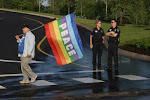
As a group of of westerners, the International Peace delegation stands out, especially the two blond-haired Aussies, Simon and Donna. A number of Afghans want to have their picture taken standing next to us and the local TV station from Kabul interviews Paki and Linda but we have no idea if the footage was ever shown since we don’t have access to a TV. We are told by our Kabul friends that the media is closely controlled by the Karzai government or the US occupation forces which has bought up virtually all the radio stations. (On a ride across Kabul one evening, the taxi driver from Afghan Logistics playing one of the radio stations which obviously caters to the US or other English-speaking troops.)

I’m glad I brought along sunblock because the sun is bright and at 5,000 + feet, the UV exposure was projected to be a very high 7 or 8 for all the days I was scheduled to be in Afghanistan. There was a tent set up for the dignitaries nearby on our elevated viewing area which was the roof of a building which was part of the mosque complex. Today was one of the few days I saw a significant number of women out on the streets, enjoying the holiday. Most other days you find that men and boys outnumber the females visible in public by about 3 to 1 or greater.

We need to head back to the office space where we have most of our educational/listening gatherings because another is scheduled for mid-afternoon but Basir asks some of us if we’d like to get something to eat first. There are dozens of tents or tarp-draped areas in the middle of the cemetery grounds selling soups, kebabs, ice cream, and other foods and treats. Since an number in our delegation are vegetarians or vegans, Basir asks if the place selling chickpeas is OK with us and we agree. It takes a while to find all the delegates but we don’t mind waiting under the tarpaulin canopy because we are out of the sun. We could get it “spicy” or regular but when they brought it to us, it wasn’t clear to me which was which. Mine was spicy enough but others added the spices from a container on the table. Most also had ice cream for dessert but I passed. Ceylon, one of the delegates from Memphis who is game to eat virtually anything, is still hungry so he goes next door and brings back a sandwich which he thought had meat in it but after tasting a small bit of it, I thought it was made with mostly spiced vegetables and grain. It was very tasty but I’m not interested in risking getting sick while staying at a place that only has one toilet for the 8 or 9 of us sleeping at the office. At least the toilet is one you can sit on rather than the traditional squat-style that I tried to use at the internet café the day before but reeked so badly I decided I could wait until I had access to a toilet. I hadn’t realized our lunch “café” was just part of the cemetery until I tripped on an upturned rock which served as a “headstone” as I was leave the “restaurant”. As we began our walk back to the office, it became very clear that the sea of people who had gathered for the New Year celebration hid most of the grave markers during the celebration. Now that it was over (although many families stayed around to picnic together), it was much more evident.

While walking back from the new year’s celebration ritual, about a 20 minute walk, you before aware of how dirty and destroyed much of the public infrastructure is in this part of Kabul. We learn later that the area near where we are staying housed much of the Soviet-dominated offices and housing during their occupation in the 1980s but destroyed in the ensuing battles among various warlords and the Taliban during the early 1990s, much of it not rebuilt. We walk past a few fortified compounds and occasionally see new vehicles sporting UN signage or logos from other international NGOs. I’m sure some of these compounds host this other face of the on-going occupation of this ancient city.

After our discussion about safety/security concerns some of us had the previous afternoon, a number of the delegates staying at the Mustafa Hotel chose to move several blocks away to a guest house where Martin and Donna had been staying. (They had arrived several days before the rest of us, Martin having previously worked for the International Red Cross in Afghanistan and fluent in Dari was much abler in getting around without being escorted by other Afghans and had a lot of experience in this war zone.) While slightly more expensive than the other hotel if we put 2 to a room, and with breakfast and dinner provided as well as 24 hour internet access, it was a stark contrast to our “office” space but provided a greater appearance of security. I, personally, prefer our more rustic setting in keeping with the economic realities most Afghans face but do envy their ready internet access to stay in touch with family and friends on a more regular basis. Much of the “work” of our delegation is to hear the stories and see the reality of our new Afghan friends and then “report” that back to our home networks to increase our awareness and renew our collective commitment to work for a just peace.

In one of our smaller group discussions, Kathy notes our delegation is experiencing a “tale of two cities”. Some of us in the second-story office that has only two office type chairs plus about a dozen folding chairs with mats on the carpeted floor where most of us sit. As in Afghan homes, we take off our shoes before entering the office space and must put on slippers to enter the kitchen or bathroom or risk getting your socks wet. There is no shower curtain – and the shower doesn’t work anyway. You fill a small bucket while standing in the shower basin and pour water over your head and body as you soap up.

Although we’ve purchased toilet paper, we have a discussion amongst those sleeping at the office about the advisability of using it. Those with a lot more international experience than me (virtually all of those staying in our office space) point out that any toilet paper with fecal matter can serve as a ready source for cholera if not disposed correctly. Many toilets in developing countries are not designed to have toilet paper flushed with the bowel movements but rather be placed in a waste basket by the toilet. In many cultures, Afghan included, a washing pitcher with a pour spout is provided to be used to wash one’s (left) hand afterward. As best we can discover, all of our trash is placed out on the street curb by (or in) a trash container but we’ve seen much of that blown about our area of the city and some poor people are routinely picking through the trash to find anything of value. So, we decide to try to forgo use of toilet paper when possible and flushing down just small amounts when necessary.

We also have no vacuum cleaner and must sweep the carpet with a broom or pick up crumbs by hand so we encourage each other to use plates when eating our daily staple of fresh bread from the bread bakery two doors down from our office. We also discourage “double-dipping” when we have a common bowl of soup or cream into which to dip the bread. Instead, the preferred technique is to break off small pieces of bread, then dip it and put the whole piece in your mouth instead of putting the read you just bit back into the common bowl. Having lived in intentional community, I was aware of this but some of us didn’t have this at the top of our consciousness and needed to be gently reminded. It is all part of building community together this week.

Although it makes logical sense for our delegation to be split into 2 or 3 different lodging places so we don’t provide too great a target for those who may wish us harm, it does feel like we are too separated, especially since the balance of the group is a 20 minute ride away and we only have on van (and driver, Mohamed –who doesn’t speak English) at our disposal. A cab ride is the equivalent of $5. in the daytime and $7. at night but any ride seems to be very anxiety-producing for me because of the nature of kamikaze-style driving here. I can’t tell you how many hundreds of times in my week in Afghanistan that we were inches away from hitting another car, bike, pedestrian, or dog in the vehicle I was in – yet I only witnessed one accident and saw the evidence of two others in my week there.

This tale of two cities, one where some of the delegates live have people hired to pick up after you, make the beds, make and serve the food, a pool table, a work-out facility. It is not a five-star hotel by any means but compared to the common Afghan whose life expectancy is only 44 years, one of the three worst in the world, it certainly seems luxurious. Those corrupt politicians and warlords living off the bounty skimmed off the “reconstruction” or “security contracts” or living in “poppy palaces” funded by the production of poppies and the refinement into heroin and opium would find the relative comforts of the guest house insulting. Those of us eating the leftover lentil soup and bread from last night’s supper for our breakfast are still living in luxury for the millions of Afghans waking up to dire poverty. As Kathy Kelly so often reminds us, “What you see depends on where you stand.”

Day 3 in the War Zone: Creating Peace Via Skype

Day 3: Creating Peace Via Skype by Steve Clemens. March 20, 2011

We were told to expect the AYPV boys at our office lodgings at 4:30 AM because the Global Day of Listening was scheduled to begin by 5:30. They arrived a little late because they had been on the phone to others around the world since 10 PM last night. The plan for today was to continue the conversations over Skype connections on the internet. We rented a local internet café for the day but it wasn’t schedued to open until 8 AM so the conversation across the ocean(s) began with just telephone conversations.

Scott Shaeffer-Duffy from a Catholic Worker Community in Massachusetts helped begin the dialog as his wife, son, and daughter all joined in to talk with Hakim and the youth seated around our table in our office /“hotel”. We had a few technical glitches but everyone was engaged despite the long night and the early morning. Different members of the International Peace Delegation were asked to send greetings to their friends at home as part of the listening project. I signed up for 7 AM and actually joined the conversation at 7:30, sending greetings to the peace community in the Twin Cities where it was 10 PM on the day before. The young people asked me to tell them about groups I was part of in Minnesota so I described our weekly Wednesday vigil at Alliant Techsystems (ATK).

The connection is relevant for our friends in Afghanistan since this Minnesota-based war profiteer has made landmines and cluster munitions, two of the scourges of war which continue to plague civilians long after the conflict ended in certain regions of the country. I also mentioned the new weapon used by the US Army in Afghanistan, a combat gun that “shoots around corners”. Hakim asked if this was the XM-25 and I said that was - its new name and it’s “roll-out” was happening now in Afghanistan.

Abdulai asked me about whether I was hopeful about change coming after vigiling for so many years at ATK. This 15 year old boy is wise beyond his years. He had previously said that he feels tired of trying but said we need patience – and, if it doesn’t happen in his lifetime, the struggle is still worth it. I told him I shared his sentiment: if ATK doesn’t end it’s production and sale of indiscriminate weapons, it is still important for my own integrity to continue our protest at the corporate entrance because I have to act on my values. Even if change doesn’t come to ATK, change does come in my life and my heart.

The boys were very engaged in the conversation even though they had been doing this conversation across the table and around the world via cell phone and Skype for more than 9 hours before I sat down with them. After our conversation lasting 30 minutes, the whole group of us took a ½ hour break to move down to the internet café to continue the conversations around the world over Skype.

They talked with Sami Rasouli in Iraq (about his and other Iraqis experience with the US war machine) and Media Benjamin and Ann Wright in Washington, DC before both of them left for a trip to Quantico to protest the inhumane treatment of whistle-blower Bradley Manning. They talked with people in Australia, a guy in Laos (who told the boys of the legacy of unexploded bombs from the Indochina War), someone in Poland, and many other groups from the US. I listened to their conversations but also used the time to send a few emails to my friends and family to reassure them I was safe while engaged in this important work of peacemaking.

Patrick suggested we use part of the afternoon to go shopping with our new friends Zahra and Asif (to help translate/negotiate and to show us where to go). As if to show that even shopping in Afghanistan can be an adventure, our van driver was stopped by the police for driving the wrong way on a certain street since the other street was closed. (There were no signs indicating it was one way.) Patrick and I sat quietly in the van as both Zahra and Asif got out to engage the police as more and more surrounded our vehicle. While the other two negotiated, our driver was instructed to turn around in an impossibly small space. Driving conditions are a complete nightmare without the police stopping you.

After about 15-20 minutes, our two defenders came back to the van and said, “We’ll walk from here.” As we got to the sidewalk, Zahra assured us the driver wasn’t in serious trouble. She told me later that the policeman wanted a cash bribe. She told him she was a journalist and if he demanded money, she would print his name to expose his corruption in her newspaper. He withdrew his request. For a country where women have been marginalized, it is so refreshing to see a determined feminist here. She was no slouch in negotiating a fair price for the rug Patrick bought but she hesitated and was puzzled when I told her I wanted to buy a scarf for my wife. Here is a woman who is determined to be “unveiled” whenever possible, why would her new friend want his wife to cover her head? I laughed and told her Christine would only be wearing it around her neck! Besides, she’s the breadwinner in our family – while I’m out trapesing around the world in search of peace and justice.

After we returned, she shared her concerns with a couple of us about our safety here in Afghanistan. (I hadn’t known she had just received threats a week ago and I’m sure that added to her caution for us. She was concerned about the security of the area where the hotel some of the other delegates were staying at – noting that the main entrance was neither guarded nor locked. Anyone could walk into the building. She also expressed concern about a group of us traveling to Panjshir, a province north of Kabul, past Baghram Air Base and site of the notorious prison where the US had detained so many earlier in the war. Apparently they’ve just built a new detention center a few hundred yards away so they can claim not to being holding people in that shameful place.

After returning to re-join the young peace volunteer and their indefatigable mentor, Hakim, for several more hours, most of we westerners left to go to bed at 10 PM, leaving Kathy Kelly and a few others to finish the international dialog at midnight – 26 hours after they started! As is the custom this week, we walk back to our home-base in small groups, always accompanied by one of the Afghan youth. And here I thought that some of my work was to accompany them! They are such a blessing and inspiration to us.

Day Two in the War Zone

Day Two in the War Zone: Planting Trees, Burning Candles by Steve Clemens. March 19, 2011

In the morning we walked in groups of five for about 30-45 minutes through our area of Kabul en route to our morning activity. I awoke at 4 AM to use the bathroom and when the call to prayer was broadcast from the nearby mosque about 40 minutes later, I knew it was time to get up because the dogs on the street also joined the chorus. The city is fairly dirty (what does one expect in one of the poorest countries in the world which is at war with the world’s largest military machines?) and the traffic has no street lights or road striping so the cars switch invisible lanes as the pedestrians dodge and move between them.

Vendors crowd the sidewalk selling fruit, live chickens, freshly butchered meat, nuts, beans, and a multitude of other items. We travel in groups of 4 or 5 – always escorted by one of the Afghan Youth Peace Volunteers. I know I shouldn’t have favorites - they are all so wonderful and helpful – but I can’t help but respond most to 13 year-old Gholami, the youngest and smallest of the 8 who have joined us for several days. We walk in small groups so we blend in a little more than if we all walk together. About half of the International Peace Delegation is staying at a hotel, others of us are sleeping on the floor in the office building of a non-profit organization that has joined with AYPV in inviting us. After walking down two main streets, we branch off into what seems to be a side street which more resembles an alley with an open sewer/gutter on one side. As cars or trucks pass us they blow their horns so we can step aside.

Vans come by with other delegates from the hotel and we are offered rides but Simon and I prefer to walk with several of the boys, enjoying the sunshine and “fresh air”. Actually, the air is often quite polluted with fumes from older, untuned vehicles. We walk purposefully and deliberately so as to not draw undue attention, despite our pale complexions. (Simon, from Australia, is fairer-skinned than me.) Since most of the others arrived before us, we missed part of the presentation at the private school which was our destination.

Lena, the teacher who addressed our group at the school, was a young woman who described the school and answered our questions. We had “one cup of tea” (we could have had more if we wished – even 3 Cups of Tea) but were told what Afghanistan needs is not more money to build schools but rather to have teachers properly trained. Having school buildings does no good without trained teachers. And teachers have to be paid a wage they can live with. The public school teachers are not paid enough and often have class sizes of 50-70 students – an impossible situation to help students learn at the grade school level. This private school had 20-25 students per class and it appeared to me at the recess time that the predominance was girls at this school.

When asked about whether the US military is needed for security, both the school’s principal and the teacher quickly said they wanted the US troops to leave. Lena added that “we need to make peace by ourselves” – it is not something that can be imposed from the outside. She continued, “Instead of waging war [here], the US could concentrate on education instead”, using the incredible amounts of money to train teachers.

The AYPV had picked this school for the tree-planting opportunity as a way to symbolically celebrate the New Year which would begin two days hence on the first day of Spring. Afghans are about to begin Year 1390 – their calendar, like that it many other Muslim-dominated nations, is dated from the time of their Prophet Mohammad. Students at the school drew or painted pictures of trees as an art project to celebrate the tree-planting event in their schoolyard.

Before we moved to the schoolyard to plant the trees, Hakim and the AYPV boys recited a poem they wrote the night before, “We Need a Different Tree” – a moving statement of choosing peace over war. It lamented how “power and privilege oppress the people – it is perfected in war. … Why would an Afghan mother want a tree that kills? … War is not a tree we want to plant – so, if we wish to live without war, we need to plant a different tree.”
Then 55 trees, almond, poplar, plum, apricot, and apple, were placed in the already-dug holes provided. A local man pruned them after they were planted and watered. As we finished, the children were let out of the classrooms for recess/exercise and they were enamored at the visitors to their school; some loved posing for photos, other avoided our cameras.

The school principal announced that the garden/schoolyard would be re-named “The Friendship Garden.”

The van ride back to our office space –like all rides in the Kabul traffic – was another adventure. Just when you think the driver will hit a bike rider or pedestrian, scrape an on-coming car or one that you are passing, the brakes are applied or the steering wheel turned to prevent the accident. Any insurance agency would have to be crazy to cover someone for collision –although I don’t seem much beyond very close calls. It makes rush hour in the Twin Cities look positively relaxing.

Next on the day’s list (after a light lunch) was to drive to the Emergency Medical Hospital for civilian war casualties operated by an Italian NGO to donate our blood. (Ironically, I was told in Minneapolis before I left that I will not be able to donate platelets for a full year if I travel to Afghanistan due to threat of malaria – even though the threat doesn’t arrive until May, long after I’ve left.) My group had some difficulty getting a taxi to the hospital so we missed most of the tour and discovered that they only needed O negative blood that day. Two of us met that requirement but Kathy, who was one of the two, was asked to wait a couple of weeks since she gave at that hospital only several weeks before. She will donate again before she returns to Chicago in a couple of weeks.

Returning to the office, we had a convoy of 5 huge armored tan vehicles of the International Security Assistance Forces (ISAF) pass us. Even though there were no US markings, it is clear to everyone who is in sight that these behemoths are the dinosaurs of the crumbling American empire – unfortunately still very deadly in its decline.

Later in the afternoon, we walked to the 3rd Eye Photojournalism Center, the host organization for the candlelight vigil in remembrance of the victims of war. A stunning gallery of wonderful photos taken from all over Afghanistan graced the walls of the four rooms and a table with candles encircling a banner reading “For the War’s Victims” in both English and Dari. After a few moving talks and the reading of the names of the 7 boys who were killed earlier this month in one of the northern provinces, the AYPV boys lit candles and passed them to all of us and we observed 2 minutes of silence in memory of all of war’s victims. Many of us felt tears welling up knowing that two of the boys present had lost their father to the Taliban several years ago. I am amazed at their courage and commitment.

At dinner afterward, I had a great conversation with Zahra, yesterday’s moving speaker from the Open Society, deeply moved by this 23 year old women who refuses to wear the veil except when she is outdoors. She has many questions for me – why I came here, what do I think about Afghanistan, what other Americans think about the war, … . I’m sure we will have several more conversations before our week’s end.

Having gotten up before dawn, I was very grateful for the air mattress and sleeping bag at 9 PM. I am so grateful for so many friends who have supported me/us on this pilgrimage/journey for peace.

Report from Day One in Afghanistan


Three Powerful Perspectives on Afghanistan by Steve Clemens. March 18, 2011

I couldn’t afford to give in to jet lag after my arrival in Afghanistan this morning after 3 flights and layovers totaling 40 hours before reaching my floor space in a Kabul office of a small nonprofit human rights organization formed by some very dedicated Afghan women eight months ago. I did nap for about an hour before Hakim showed us a new five minute video he had just created from yesterday’s historic peace walk through the streets of Kabul.

It was a group of more than 20 international nonviolent peace activists and at least a dozen Afghan counterparts that crowded into the 12’ x 16’ office room and overflowed into the adjoining space. After a few minutes for introductions and several more for logistics and a look at the proposed schedule for our week here, Hakim, the mentor, translator, and prime mover of the Afghan Youth Peace Volunteers (AYPV) begins to share about yesterday’s historic event.

About 40 Afghan young people, primarily in their teens and early 20s donned bright blue scarfs and carried banners as the inter-ethnic group marched from the Iranian Embassy to the Embassy for the United Nations in the busy area of central Kabul.
http://www.youtube.com/watch?v=uedQzWck7xc
Hakim shows us the video before explaining that “ ‘Peace’ is a dirty word to Afghans”. President Obama won the ‘Peace Prize’ in 2009, the same political leader who has increased the level of foreign military occupiers (both uniformed armed forces as well as ‘contractors’ and other mercenaries under the pay and control of the Pentagon or US State Department). “Peace” is the term used (or more accurately, abused) by everyone to excuse or justify anything. Many, many Afghans have been killed in the name of “peace”.

“We have had non-stop occupation and war; Afghans can’t trust each other because of decades of war”, Hakim tells us. We get a lot of ‘lip-service’ to the causes of peace by others – but then they ‘don’t show up’, he continues. “How do we restore hope; how do we begin to build up trust?” He observes there is not a culture of questioning here in Afghanistan (at least out loud, not in public). “War mongers have misused the word of peace” – to the point there is no trust. It is left to us, foreigners, who must encourage Afghans to find their own voice, this trained Public Health medical doctor from Singapore tells us. He started working in public health with refugees first in Pakistan and then accompanied them back to the Bamiyan area of central Afghanistan 8 years ago when he decided his role to encourage and nurture the ideals of the local young people was more pressing and in line with his deep commitment to Gandhian nonviolence then his medical practice.

“It is easy for politicians to talk about peace – but nothing is working here. Violence is a failing strategy. Every family here has someone who has been killed [in these wars]” – if not in the immediate family, then certainly in the extended one. There is no clear plan by any leader that is nonviolent he laments but goes on to say that there are only two leaders that these young people trust: Malalia Joya, an out-spoken woman activist, and Dr. Ramazon Barshardost, a humanist Member of Parliament who states categorically “It is wrong to kill” but is readily dismissed by many of his compatriots as “the mad (crazy) one.” Joya tells these young people, “If you truly walk this path [of peace and nonviolence], you will be killed one day.” We are told that the US government has just refused to give her a visa to come to the US for a planned speaking trip that was to begin next week.

Three years ago at a college in Bamiyan, Hakim led a 3 month workshop with students and their conclusion was “Peace is not possible in Afghanistan” – so, what do we do? He helped organize an effort to get an inter-ethnic group to live together for a semester and 16 students did. However controversy arose near the end of the time and Hakim started receiving death threats. He spoke to the “authorities”, he traveled from village to village, meeting people and listening. A group of boys coalesced and he helped supervise them in building a peace park in Bamiyan. The boys did a 7 day vigil to try to deliver a peace message to Obama. They recently sent gifts of some things they made to Pashtun people in Kandahar. A gift from some Hazaras and other ethnic tribes to Pashtuns stunned the recipients. “I can’t believe that there can be such love” was one of the responses Hakim heard. [Please go to the AYPV website to learn more about them.]


Zahra Mobtaker, an amazingly strong, 23 year old Afghan woman who spoke out during the peace march shared with us next. As the director of Open Society, a nonprofit working to empower Afghans –“helping ordinary people overcome their fears to give voice to their experiences”, she is focusing on human rights and democracy. She said they quickly found themselves very much alone. They sponsored a festival to help their fellow citizens overcome their fear and speak the truth. She has displayed photos of victims of the wars in gatherings to facilitate conversation about the reality of today’s Afghanistan.

This tiny (25 members) but bold non-profit has helped form a singing group with the intention of bringing a message of peace through song– especially to the many illiterate in the rural villages. They support their work primarily through their own personal funds – recognizing that their “aims might be sidetracked” by outside donors. This is often the reality of many NGOs here in Afghanistan – especially those getting the predominance of their funds from US AID, the UN, or other funding mechanisms tied to governmental agencies or large bureaucracies. (Note: this Open Society has no connection to the George Soros organizations which also take the Open Society moniker.) This group just operates in Kabul and Afghanistan. Open Society has also used film-making as a vehicle for peace and change. “The Night of the Cartoon-makers” used cartoons drawn on walls of public places, including mosques, as an educational tool. They were pleased that many of the cartoons have been “protected” by the people from defacement- a sign of the growing empowerment the group strives for.

They are also using web blogs (www.opensociety.af@blogspot.com) and yesterday’s march was their first public partnership/ joint venture with the AYPV. “Thank you for coming to this exceptionally frightening country”, she told us. We felt her warmth and welcome and we are so grateful for her courage and eloquence.


Our heads and our hearts were already full before the country director from an [unnamed] NGO (non-Governmental Organization) dropped in to meet with us. He was pleasantly surprised to discover one of the international peace delegates he was to address included a Maryknoll priest who he had worked with in Cambodia many years before! The speaker had just joined this work in Afghanistan two months ago and is responsible for their program in 3 of Afghanistan’s northern provinces, Bamiyan, Herat, and Ghor. This organization has a long history in this country and focuses on 4 main program areas: an agriculture-based program in Herat which primarily works with girls and women developing sustainable methods; community-based education with a focus on girls; watershed management featuring gravity-flow spring management and work to prevent run-off and erosion; and emergency work with an aim to transition to sustainable development. This last program entails road construction and road snow clearance, especially the mountain passes which are cleared by shovel under a cash-for-work plan. One critical pass on the national highway between Herat- Bamiyan – Kabul must be cleared in a timely fashion to allow any traffic to flow, getting supplies to remote areas.

This NGO maintains a strict policy and reputation for not proselytizing and they don’t use any armed guards. Their director talked with dismay about the almost complete failure of the US/NATO military forces and privatized “contractors” (he said we call them ‘Beltway Bandits’ referring to the corruption in Washington, DC) to rebuild needed infrastructure. He said the saying among NGOs is “where progress begins, the Taliban ends”, referring to the on-going struggle against forces of fear and repression. However, what this group has observed is with every contract with US AID (Agency for International Development, the “foreign aid” arm of the US State Department), funds are siphoned off in kick-back style payments, even in the written agreement itself. He recommended we read Descent Into Chaos by Hamad Rashad about this practice and lamented that he sees a “perfect storm of US AID, “contractors”, and local corruption” as a spiral leading to frustration, despair, and a culture of corruption which infects most things happening in Afghanistan.

A lot to think about on my first day in the war zone.

Have Visa, Will Travel [For Peace]

Have Visa, Will Travel [To Afghanistan]. March 11, 2011 by Steve Clemens

“Praise the Lord and pass the tree-seedlings [or other nonviolent equivalents of ammunition].” Finally, after a nerve-racking 2-week wait, I received my visa (and Passport back) from the Afghan Embassy in Washington, DC. Although I paid extra to have the visa request processed “within 24 hours”, I had not even received confirmation from the Embassy (despite 6 phone calls and an email over 4 days) that they had even received my application. Other friends from Chicago who are also part of our peace delegation received their visas a week ago.

Now I can concentrate my energies toward our intended mission: to stand in solidarity with the youth of Afghanistan and to plant trees with them in Kabul as a symbol of our desire for peace. If you are on Facebook, you can “friend” that group (search for Afghan Youth Peace Volunteers). They are hoping to have an International Day of Listening on March 19-21st (depending on your time zone) where young people from Afghanistan and Iraq will talk via Skype with other people around the globe. http://globaldayoflistening.org/Home.html and http://www.livewithoutwars.org/ are sites that have the details about this.

We will also participate in the candlelight vigil they have planned for the evening of March 21st which is both the first day of Spring and also the Afghan New Year. Our candles will be in remembrance of all the young people who have lost their lives in not only the wars in Afghanistan and Iraq but also the revolutions in Egypt, Tunisia, Libya, and Palestine/Israel. Why don’t you get some of your friends together in your area and have your own candlelight vigil in solidarity with these young people and then send them a photo of you doing that?

Jim Haber, one of our delegation members and part of the Nevada Desert Experience suggests some of the reasons why we take the risks in traveling to a war zone:

Delegation members are responding to an invitation to support Afghan peace-making efforts by the Afghan Youth Peace Volunteers and the Open Society Organization (of Afghanistan, not to be confused with the Open Society Institute started by George Soros; there is no connection between the two similarly-named groups). Afghans need to see, meet and know westerners other than those in military roles or who are protected by armed contractors. There are partners for peace everywhere, including in Afghanistan. These groups are courageously standing up, saying, “No!” to all the armed actors there, be they Taliban, War Lords, North Atlantic Treaty Organization (NATO), International Security Assistance Force (ISAF), or private security contractors.

This delegation is one in a long history of citizen-citizen diplomatic efforts, whereby we meet with other people from civil society to foster peace. As President Eisenhower said, “I think that people want peace so much that one of these days government had better get out of their way and let them have it.” It is popular in this country to dismiss the people of Afghanistan and other war-torn countries as full of unloving people (or why would there be so much fighting there), very different from ourselves, and to portray them as motivated by promises of riches in the afterlife for violence committed here, now. The presence of violent extremists is not unique to Afghanistan nor to Islam as history amply, and sadly, bears out. No Eastern or Western religion is devoid of supremist adherents. I expect to meet people who have lost loved ones to violence and who do not wish a similar grief on anyone else. There are people who come through violent situations everywhere who don't want retaliation, who want to end the cycle of violence.

To better understand a situation, it is generally good to have some first-hand experience of it, to put someone else's shoes on and walk in them for a day. Our stay in Afghanistan is necessarily brief, but I am sure it will lead us to correct some perceptions and reinforce others that we have from this vantage point. I want to put faces and names to people who too often are treated as pawns in geo-political fights. The various invasions of Afghanistan have never been out of concern for the people of Afghanistan. Rather, they have unleashed violent forces, both foreign and domestic, that have no regard for the lives of the Afghan peoples.

Some of folk who will be part of the delegation: Mary Lou Anderson, George Capaccio, Patricia Chaffee, Mary Dean, Elizabeth Deligio, Chris Doucot, Detlef Enge-Bastien, Christine Gaunt, Peggy Gish, Phil Glendenning, Clare Grady, Jim Haber, Martha Hennessey, Judith Kelly, Kathy Kelly, Patrick Kennelly, Ceylon Mooney, Simon Moyle, Donna Mulhearn, James P. Noonan, Jake Olzen, Martin Reusch, Scott Schaeffer-Duffy, David Swanson, John Volkening, and Paki Wieland. Some are Catholic Workers, others have been part of Christian Peacemaker Teams, Iraq Peace Team, or other nonviolent campaigns.

I will fly Wednesday evening (3/16) from Minneapolis to Amsterdam, then to Dubai, and finally to Kabul, arriving Friday morning. (There is a 10 ½ hour time difference from Central Daylight Savings time.) Besides the tree planting and candlelight vigil, we hope to observe the AYPV inter-ethnic peace walk on March 19th and meet with various NGOs (Non-governmental organizations) working in Afghanistan. We also hope to meet with Dr. Ramazan Bashardost, a Member of Parliament and former Presidential candidate. Because of security concerns, we won’t be staying in the hotels where westerners usually stay but will rather “camp out” with sleeping bags in the office rooms of two organizations in Kabul. It is our hope to create durable relationships and deepening hope with the Afghan youth, NGO reps, and their friends.

Kathy Kelly, one of the founders of Voices for Creative Nonviolence (www.vcnv.org) and organizer of our delegation has shared with us 3 goals for our journey: To learn more about Afghanistan and what Afghan people want; to build solidarity with indigenous movements working for peace, human rights, and a just end to the conflicts; and to use first-hand reports to catalyze opposition to US military intervention in the region. I will be available to speak to local groups after I return on March 25th.

Please pray for us –and especially the brave youthful peacemakers we will meet. And then, get out in the streets, contact your political representatives, and work for an end to this war!

May I Go With Your Blessing?

May I Go With Your Blessing? My Upcoming Trip to Afghanistan

Last week I received an invitation from my friend Kathy Kelly to join her and other international peacemakers in a trip to Afghanistan to stand in solidarity with the Afghan Youth Peace Volunteers in actions of hope and resistance around the first day of Spring which also coincides with the Persian New Year (March 21).

The plan is to fly to Kabul in order to arrive by March 18th and return after being in Afghanistan for about 6 days. While there are obvious risks involved in traveling to a war zone, the risks we take for peace and reconciliation are very small compared to that of the Afghan youth that we will support. Voices For Creative Nonviolence (VCNV) members have made 3 previous visits (the last being in December 2010) to meet with these youth and their leaders.

Kathy writes: “We're working hard, over the next several days, to determine whether we could muster the skills and wherewithal to bring 100 peace activists to Afghanistan in March to undertake a tree-planting project, seeking nonviolent options for Afghanistan's future.

Would you by chance have any time and inclination to consider being part of such a delegation? It would be risky. We're thinking of a short delegation, perhaps only six or seven days in Afghanistan. Dr. Ramazon Bashardost is willing to lead the tree-planting and would welcome international accompaniment.

Gandhi's quote comes to mind regarding the inviolable connection between nonviolent means and ends, akin to the relationship between a seed and a tree. I'm especially appreciative of the willingness shown by several of the youngsters to eschew retaliatory violence, even though they lost their uncles and cousins and, in Abdulai's case, a beloved father. …

We also grew to know, through three visits, Dr. Ramazon Bashardost, whom a majority of Afghans hold in high regard as a populist leader with Gandhian values. He meets people in a vacant lot where his office is a "pup tent;" he travels around in an old "Mr. Bean" car. And he has no armed guards and bunks in with relatives, a far cry from many elected and appointed Afghan officials who flaunt convoys of armed guards, live in "poppy palaces," and often seem impervious to charges of corruption. Dr. Bahsardost came in third in the last presidential elections. He is a former Minister of Planning who resigned because of corruption. He also resigned from a Parliamentary seat, after a previous election, again because of corruption. Now he is again a Member of Parliament who advocates tirelessly on behalf of sharing Afghanistan's resources fairly, bringing criminal warlords to justice, and practicing basic principles of nonviolence.

The AYPVs are coordinated by a Hakim, a Singaporean M.D. who has lived in Afghanistan for the last eight years and who has been welcomed to make his home in the mountain village where several of the AYPV live. We have come to trust him deeply. Hakim, several of the AYPVs, and Dr. Bashardost will be visiting various provinces in Afghanistan during the month of February to learn more from people in various villages about their views of non-violent future options.

Hakim regards such options as the answer to every Afghan mother’s prayer. He has met many ordinary family members in his work as a teacher, organizer and healer. Trained in Singapore as a medical doctor, he moved to the border between Afghanistan and Pakistan after completing his residency. For two years, he lived among Afghan refugees, learning their language and living under the same circumstances of poverty and violence that they endured. For the past six years, he has lived in the Bamiyan province, having decided to accompany the Afghan refugees back to their homes. Hakim speaks fluent Dari, English, Mandarin, Urdu and various dialects. He is both highly skilled and deeply humble. It's exciting to think of how he and Dr. Ramazon Bashardost might work, together with the youngsters, to help promote nonviolent options for Afghanistan's future.

Action in Afghanistan
The AYPVs seek our support as they launch a tree-planting event to communicate their rooted commitment to nonviolent, life-giving options. Voices for Creative Nonviolence has agreed to help “get the ball rolling” in formation of an international peace team to briefly visit Kabul. Upon return, participants would promote nonviolent options, globally, and help end the war in Afghanistan.

Why tree-planting? As members of a global movement, and as U.S. people with a grave responsibility for destroying Afghanistan, we are hoping to provide support for ordinary Afghans who are proposing nonviolent options for their future. Alfred McCoy states, in a March 2010 article, that it would take $33 billion to replace the rural infrastructure of Afghanistan – a sum that equals roughly one round of U.S. supplemental spending for the war. …

The Afghan Youth Peace Volunteers have assured us of “an ample welcome for internationals” to take part in their week of peacemaking including the March 19th tree planting and a March 21st candlelight vigil. They will also hold an inter-ethnic walk on March 19, but they ask that participation in the walk be limited to Afghans who will have had an opportunity to prepare well in advance of the event.

All activities will be part of one (ongoing) campaign pursuing nonviolent options for Afghanistan. The tree-planting will allow us to share in a very small way the courageous and patient toil with which Afghans begin, every spring, to restore a land of beauty and peace in a country where so many lives have been cruelly cut down. The candlelight vigil will commemorate lives lost in Afghanistan and other war zones.”


So, with Christine’s blessing, I am submitting my application for a visa to the Afghani Embassy and hope to fly to Kabul (via Dubai) arriving March 17th and returning on March 24th so I’ll be home to help celebrate Christine’s 65th birthday a few days later on the 28th.

How you can support me:

I’d appreciate your thoughts and prayers as I travel and while in Afghanistan. (And prayers for Christine as I travel into a war zone.)

I am asking for support especially from 4 groups that I would intend to represent : The Community of St. Martin, Pax Christi Twin Cities Area, The Iraqi & American Reconciliation Project, and AlliantACTION.

I have enough financial resources to cover my expenses but would encourage each of you to consider making a donation of $10 to Voices For Creative Nonviolence (1249 W Argyle Street #2, Chicago, IL 60640 www.vcnv.org ) to cover some of their organizing/coordinating work and/or give me a donation of $10 to take and share with the Afghan Youth Peace Volunteers organization.

After I return, I’d like to show my photos and talk about the trip to a variety of local groups. Contact me about possible speaking venues like adult ed sessions at your local congregation, a civic group, or a classroom.

In peace and solidarity,
Steve Clemens

30 Years Ago I Climbed A Fence and Went To Prison

30 Years Ago I Climbed A Fence and Went To Prison by Steve Clemens. February 2011

At the dawn of the Reagan Presidency, just after the death of my father-in-law, I was sentenced to 6 months in Federal Prison because I climbed a fence. Five months earlier 8 peacemakers committed what was to become the first of many “Plowshares” actions, a nonviolent attempt to “beat [nuclear] swords into plowshares”. The where and why of the story explains the consequence.

After the end of American involvement in Vietnam ended with the fall of Saigon [later renamed Ho Chi Minh City] in 1975, Phil Berrigan and Liz Macalister turned their peacemaking focus toward nuclear weapons. As part of the Bible Study group they facilitated at the Community for Creative Nonviolence in Washington, DC in 1974-75, I was inspired and challenged to consider nonviolent direct action in my own peacemaking efforts. We carried full-scale models of “Little Boy” and “Fat Man”, the atomic bombs dropped on Hiroshima and Nagasaki in August of 1945, to the steps of the US Capitol to mark the week of the 30th anniversary of those war crimes. Shortly after that, I moved to southwestern Georgia to join an intentional Christian community outside Americus called Koinonia Partners.

The genesis for the prayer witness at Pantex began for me with a conversation with Ladon Sheats in Washington, DC in September of 1980. I had just participated in a week-long group of peace actions at the Pentagon as part of Jonah House’s call for “The Year of the Election”. Peacemakers were urged to “take their vote to the Pentagon” for a week of actions since neither President Jimmy Carter nor Republican nominee Ronald Reagan were advocating movement toward disarmament or peaceful solutions to the world problems confronting us. Ladon Sheats was a former Resident Partner and Director of Koinonia Partners, living at the that Christian community from 1968-1975. From there, he joined the Jonah House Community in Baltimore and remained active in a life of resistance to the power of the war machine until his death in August of 2002.

Ladon discussed with several friends and me the possibility of conducting a prayer vigil at the heart of the nuclear weapons empire - the Pantex Plant in Amarillo, TX, the final assembly point for all nuclear weapons produced by the US government. He envisioned a small group of committed Christians who would travel to Texas, meet to pray and reflect for several days, and then attempt to enter the plant to pray in or around the buildings where the bombs were assembled. Participants would covenant together ahead of time to be committed to nonviolence and the group would agree not to notify the press ahead of time nor to cooperate with providing any defense of our action other than to state clearly why we were there. We would not defend ourselves with legal arguments but only statements about our faith and convictions.

When I returned to south Georgia and my community at Koinonia, I first discussed the proposed witness with my wife, Christine, and then with a smaller group of Partners who were committed to nonviolent direct action. As we were discerning my participation, we received word of the first Plowshares witness at King of Prussia, PA. While in support of that creative witness, it was clear that our planned witness would not involve any attempts to disarm or damage weapons we might encounter but rely solely on the power of prayer. As I continued in the discernment process, I had conversations with my parents and my wife’s parents. It was a very difficult time as my father-in-law, Benton Haas, was dying of leukemia and my wife spent most of her fall helping to care for him at his home in western Pennsylvania. While neither set of parents was enthusiastic about this proposed witness, I tried to communicate to them my sense of “call” to take this action of faith and witness.

In early February 1981, the Koinonia Resident Partners had a time of prayer during our weekly Partner’s meeting as a blessing and send-off. My wife, Christine, and Gail and Edwin Steiner and I drove the 20 + hours to Amarillo, Texas where we gathered with about a dozen others for a time of reflection, prayer, and sharing before the witness at the plant. The times of Bible study and prayer were very uplifting, helping to calm some of my fears and anxieties. Especially difficult was taking the time to write letters to my parents and to our community in the event we did not return. We tried to face the fact that this facility was one of the most heavily guarded facilities in the nation and that the guards confronting us would be armed with deadly weapons. Facing one’s own death and still choosing to act is the most liberating feeling in the world!

Yet not all the preparations were so serious. We had a “trial-run” of the two ladders we built to scale the 12’ chain link fence topped with barbed wire that we would encounter. When we set it up to scale a local baseball field backstop, the ladder collapsed under our weight and had to be rebuilt with heavier wood. We ended up in a heap, laughing at ourselves and the “folly” of our witness.

On the morning of Feb. 10, 1981, the six of us who covenanted together for this witness drove to the Pantex Plant to arrive in conjunction with the morning employee traffic, hopefully to allow us to get close to the area protected by 2 rows of chain link fence, separated by a 50’ “no man’s land” area between them. The radio station announced that visibility was “almost zero” as the blowing snow made it almost impossible for us to be seen as we briskly walked toward the fences with our two ladders.

After the first 3 scaled the fence and I threw their ladder over it so we could scale the second fence, all types of bells and whistles and lights were activated by sensory mines placed in the inner area between the fences. After all of us were inside the first fence, we noted that the second fence was electrified and security personnel had their automatic rifles pointed at us. We decided that it was as far as we were meant to go and so we gathered in a circle, read the passage from Ephesians about bringing light into darkness, and prayed for forgiveness for our complicity and trust in these weapons which threatened all of creation.

It took about 45 minutes for the security personnel to bring a van inside the fences to arrest us. Then they took us to the heart of that area of the plant (where we hoped to go anyway to pray) to question and process us. The Manager of the plant asked to meet with a couple of us to inquire why we were there. In the ensuing conversation, we discovered he was Jewish and one of us asked him how he would have felt if a group of people had sat on the railroad tracks leading into Auschwitz, challenging the Nazi plans for extermination. While he didn’t agree with our actions, he said he could understand [somewhat] our motivations.

After transfer to the local county jail, Federal Agents then transferred us again to the FBI building in Amarillo. After being questioned [and threatened] by the FBI, we were then taken to the Potter County Jail, our new home for the next 3 months. The two women in our group, Kathy Jennings and Mary Sprunger-Froese were sent to the women’s facility. Ladon, Father Larry Rosebaugh, Vince Scotti Eirene, and I were sent to maximum security in the men’s jail. After one week, Ladon and Larry were transferred to the minimum-security facility while Vince and I remained in the maximum lock-up. Vince and I only saw the other 4 when we went to court for arraignment, then our one-day trial, and then our sentencing. We also convinced two court-appointed lawyers assigned to our case to schedule two “pre-trial meetings” so we were able to see each other for a couple of hours before our trial.

Just before our trial began, the lawyers notified us that the US Attorney had filed several “Motions in Limine” aimed at preventing us from testifying about certain “irrelevant” issues. They asked the Court to disallow any testimony about “nuclear weapons or nuclear energy, US foreign policy, or our religious convictions” because they were not relevant to a simple criminal trespass charge we faced. This being only my second trial, I was nervous, wondering if the Judge would charge me with contempt if I attempted to talk about my motivation for our act of witness. Federal Judge Mary Lou Robinson had stopped both Ladon and Fr. Larry in the middle of their testimony stating that they could not testify about growing up in west Texas (Ladon) or his work on the streets of Recife, Brazil (Fr. Larry). While they were not charged with contempt, it was clear she had little patience with the prospect that the jury would hear any of this “irrelevant” testimony.

30 years later, I don’t remember what I said on the stand that day. I do remember talking about my faith and belief that Jesus called me to a life of nonviolence and that I had gone over that fence “to pray for peace”. I expected to be cut-off by the Judge at any minute but my testimony was short and to the point. The judge’s instructions to the jury left no doubt in my mind that our conviction was a forgone conclusion. She instructed the jury to disregard everything the defendants had said since our “motivation” was not important – only our intent: did we intend to enter the property and did we have permission to do so? It was all so neat and antiseptic. No need to “confuse” the jurors with complicated notions such as International Law and indiscriminate weapons. Did they trespass? If so, find them guilty. They did their duty and 45 minutes later returned to the Courtroom with their six guilty verdicts, one for each of us. Judge Robinson thanked them and announced she would sentence us in several weeks after court officers had a chance to research our prior records and come up with their recommendations.

Because of our decision to refuse to give our Social Security numbers or other irrelevant information at the time of booking, neither Vince nor I were permitted any visits in the Potter County Jail for the three months we were incarcerated there. But that decision, coupled with the incompetence of federal bureaucrats who failed to find prior arrest records for Vince and me, even though they had our names, addresses, fingerprints, and photos, that led us to be sentenced as “first-time offenders” and only get 6 month sentences, half the maximum allowed. Kathy and Mary, who had previously been arrested at Rocky Flats, another Department of Energy facility in Colorado that made the triggers for nuclear weapons, got 9 months. Ladon and Fr. Larry both were given the maximum one-year in prison because of their prior acts of conscience that led to convictions.

Several more weeks after sentencing, we were transferred to the Federal Prison in El Reno, OK to finish our sentences in federal prison. Federal Prison guidelines called for us to be sent to low-security prisons close to our homes because we had been convicted of nonviolent offences with relatively short sentences. However, since the prison camps at Maxwell Air Base in Alabama and at Eglin Air Base in Florida both had nuclear weapons located there, the prison authorities decided to ship me to Texarkana, TX for the remained of my 6 months. When I arrived, the minimum-security camp was not yet opened so I was housed in the “big house” (a medium security, level 3 prison) for several weeks until the camp opened. I finally was able to get a visit from my wife, Christine, over the Memorial Day weekend, after she had a grueling 20+-hour bus ride to see me.

In early August, nearly 6 months later, I was given a new set of clothes, about $25 and a bus ticket to Americus, GA and released, just two months shy of my 31st birthday.

Reflection on the past

Before we were transferred to federal prison, we heard a rumor about a Pantex worker quitting his job for reasons of conscience. We also learned that the local Roman Catholic Bishop, Leroy Matthiesen, visited Larry in his Amarillo cell and then later called for all persons of conscience to quit their jobs at Pantex and started a transition fund for workers who quit for reasons of conscience.

If we had strategized about how to get religious leaders to denounce nuclear weapons or had concocted a scheme to get the Roman Catholic Bishop to make a public statement about the morality of Pantex, we wouldn’t have come up with what we did. In retrospect, I feel that God used the faithfulness of our witness to help move the conscience and courage of the Bishop. And while the Bishop’s statement caused a shock wave throughout the Amarillo community, in the long run I believe the witness had more of an affect on me than on others.

What I took from the Prayer Witness At Pantex was the conviction that when we choose to act on our faith rather than our fears, our faith increases. Clarence Jordan, co-founder of the Koinonia community used to say, “Faith is acting not in spite of the evidence but in scorn of the consequences” and “faith is betting your life on the unseen realities”. When we chose to place our lives into the hands of God’s grace over against the fear of the weapons of the Pantex security guards, it was a statement of faith and hope rather than a resignation to despair in the presence of “The Bomb”.

The time in jail and prison was grace-filled. There were moments when I was scared; times when I was “concerned”; a lot of the time was filled with boredom, loud noises, and way too much cigarette smoke from fellow inmates. I learned to sleep with a towel over my eyes since the 100-watt light bulb in our 6-person, 8’ x 14’ cell was on 24/7. I read through my Bible twice. Wrote scores of letters, one every day to my wife while in the county jail, less frequently when I hit the federal prison. Listened to the stories of my cellmates and grew to understand the powerlessness that an inmate experiences. Having survived it, I feel I am stronger for it. I had a vibrant, loving community praying and supporting me that goes a long way when one is locked up!

It gave me a new appreciation for what it can mean to be on the “receiving end” of the American Empire. Those nuclear weapons, protected by the barbed-wire-topped fences and the plant security guards, are metaphors for the length to which our nation is willing to go to “protect our way of life”. As such, they are idols to our god of National Security, Mars, the god of war, and Mammon, the god of greed. February 10, 1981 was a day to reject those idols, those false gods; the rest of my life is one of nonviolent resistance to them while at the same time an embracing the alternative reality my faith calls me to: what Jesus referred to as the Kingdom or Reign of God. I am thankful to have friends who continue on this journey with me.