Report from Day One in Afghanistan


Three Powerful Perspectives on Afghanistan by Steve Clemens. March 18, 2011

I couldn’t afford to give in to jet lag after my arrival in Afghanistan this morning after 3 flights and layovers totaling 40 hours before reaching my floor space in a Kabul office of a small nonprofit human rights organization formed by some very dedicated Afghan women eight months ago. I did nap for about an hour before Hakim showed us a new five minute video he had just created from yesterday’s historic peace walk through the streets of Kabul.

It was a group of more than 20 international nonviolent peace activists and at least a dozen Afghan counterparts that crowded into the 12’ x 16’ office room and overflowed into the adjoining space. After a few minutes for introductions and several more for logistics and a look at the proposed schedule for our week here, Hakim, the mentor, translator, and prime mover of the Afghan Youth Peace Volunteers (AYPV) begins to share about yesterday’s historic event.

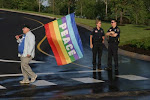
About 40 Afghan young people, primarily in their teens and early 20s donned bright blue scarfs and carried banners as the inter-ethnic group marched from the Iranian Embassy to the Embassy for the United Nations in the busy area of central Kabul.
http://www.youtube.com/watch?v=uedQzWck7xc
Hakim shows us the video before explaining that “ ‘Peace’ is a dirty word to Afghans”. President Obama won the ‘Peace Prize’ in 2009, the same political leader who has increased the level of foreign military occupiers (both uniformed armed forces as well as ‘contractors’ and other mercenaries under the pay and control of the Pentagon or US State Department). “Peace” is the term used (or more accurately, abused) by everyone to excuse or justify anything. Many, many Afghans have been killed in the name of “peace”.

“We have had non-stop occupation and war; Afghans can’t trust each other because of decades of war”, Hakim tells us. We get a lot of ‘lip-service’ to the causes of peace by others – but then they ‘don’t show up’, he continues. “How do we restore hope; how do we begin to build up trust?” He observes there is not a culture of questioning here in Afghanistan (at least out loud, not in public). “War mongers have misused the word of peace” – to the point there is no trust. It is left to us, foreigners, who must encourage Afghans to find their own voice, this trained Public Health medical doctor from Singapore tells us. He started working in public health with refugees first in Pakistan and then accompanied them back to the Bamiyan area of central Afghanistan 8 years ago when he decided his role to encourage and nurture the ideals of the local young people was more pressing and in line with his deep commitment to Gandhian nonviolence then his medical practice.

“It is easy for politicians to talk about peace – but nothing is working here. Violence is a failing strategy. Every family here has someone who has been killed [in these wars]” – if not in the immediate family, then certainly in the extended one. There is no clear plan by any leader that is nonviolent he laments but goes on to say that there are only two leaders that these young people trust: Malalia Joya, an out-spoken woman activist, and Dr. Ramazon Barshardost, a humanist Member of Parliament who states categorically “It is wrong to kill” but is readily dismissed by many of his compatriots as “the mad (crazy) one.” Joya tells these young people, “If you truly walk this path [of peace and nonviolence], you will be killed one day.” We are told that the US government has just refused to give her a visa to come to the US for a planned speaking trip that was to begin next week.

Three years ago at a college in Bamiyan, Hakim led a 3 month workshop with students and their conclusion was “Peace is not possible in Afghanistan” – so, what do we do? He helped organize an effort to get an inter-ethnic group to live together for a semester and 16 students did. However controversy arose near the end of the time and Hakim started receiving death threats. He spoke to the “authorities”, he traveled from village to village, meeting people and listening. A group of boys coalesced and he helped supervise them in building a peace park in Bamiyan. The boys did a 7 day vigil to try to deliver a peace message to Obama. They recently sent gifts of some things they made to Pashtun people in Kandahar. A gift from some Hazaras and other ethnic tribes to Pashtuns stunned the recipients. “I can’t believe that there can be such love” was one of the responses Hakim heard. [Please go to the AYPV website to learn more about them.]


Zahra Mobtaker, an amazingly strong, 23 year old Afghan woman who spoke out during the peace march shared with us next. As the director of Open Society, a nonprofit working to empower Afghans –“helping ordinary people overcome their fears to give voice to their experiences”, she is focusing on human rights and democracy. She said they quickly found themselves very much alone. They sponsored a festival to help their fellow citizens overcome their fear and speak the truth. She has displayed photos of victims of the wars in gatherings to facilitate conversation about the reality of today’s Afghanistan.

This tiny (25 members) but bold non-profit has helped form a singing group with the intention of bringing a message of peace through song– especially to the many illiterate in the rural villages. They support their work primarily through their own personal funds – recognizing that their “aims might be sidetracked” by outside donors. This is often the reality of many NGOs here in Afghanistan – especially those getting the predominance of their funds from US AID, the UN, or other funding mechanisms tied to governmental agencies or large bureaucracies. (Note: this Open Society has no connection to the George Soros organizations which also take the Open Society moniker.) This group just operates in Kabul and Afghanistan. Open Society has also used film-making as a vehicle for peace and change. “The Night of the Cartoon-makers” used cartoons drawn on walls of public places, including mosques, as an educational tool. They were pleased that many of the cartoons have been “protected” by the people from defacement- a sign of the growing empowerment the group strives for.

They are also using web blogs (www.opensociety.af@blogspot.com) and yesterday’s march was their first public partnership/ joint venture with the AYPV. “Thank you for coming to this exceptionally frightening country”, she told us. We felt her warmth and welcome and we are so grateful for her courage and eloquence.


Our heads and our hearts were already full before the country director from an [unnamed] NGO (non-Governmental Organization) dropped in to meet with us. He was pleasantly surprised to discover one of the international peace delegates he was to address included a Maryknoll priest who he had worked with in Cambodia many years before! The speaker had just joined this work in Afghanistan two months ago and is responsible for their program in 3 of Afghanistan’s northern provinces, Bamiyan, Herat, and Ghor. This organization has a long history in this country and focuses on 4 main program areas: an agriculture-based program in Herat which primarily works with girls and women developing sustainable methods; community-based education with a focus on girls; watershed management featuring gravity-flow spring management and work to prevent run-off and erosion; and emergency work with an aim to transition to sustainable development. This last program entails road construction and road snow clearance, especially the mountain passes which are cleared by shovel under a cash-for-work plan. One critical pass on the national highway between Herat- Bamiyan – Kabul must be cleared in a timely fashion to allow any traffic to flow, getting supplies to remote areas.

This NGO maintains a strict policy and reputation for not proselytizing and they don’t use any armed guards. Their director talked with dismay about the almost complete failure of the US/NATO military forces and privatized “contractors” (he said we call them ‘Beltway Bandits’ referring to the corruption in Washington, DC) to rebuild needed infrastructure. He said the saying among NGOs is “where progress begins, the Taliban ends”, referring to the on-going struggle against forces of fear and repression. However, what this group has observed is with every contract with US AID (Agency for International Development, the “foreign aid” arm of the US State Department), funds are siphoned off in kick-back style payments, even in the written agreement itself. He recommended we read Descent Into Chaos by Hamad Rashad about this practice and lamented that he sees a “perfect storm of US AID, “contractors”, and local corruption” as a spiral leading to frustration, despair, and a culture of corruption which infects most things happening in Afghanistan.

A lot to think about on my first day in the war zone.

Have Visa, Will Travel [For Peace]

Have Visa, Will Travel [To Afghanistan]. March 11, 2011 by Steve Clemens

“Praise the Lord and pass the tree-seedlings [or other nonviolent equivalents of ammunition].” Finally, after a nerve-racking 2-week wait, I received my visa (and Passport back) from the Afghan Embassy in Washington, DC. Although I paid extra to have the visa request processed “within 24 hours”, I had not even received confirmation from the Embassy (despite 6 phone calls and an email over 4 days) that they had even received my application. Other friends from Chicago who are also part of our peace delegation received their visas a week ago.

Now I can concentrate my energies toward our intended mission: to stand in solidarity with the youth of Afghanistan and to plant trees with them in Kabul as a symbol of our desire for peace. If you are on Facebook, you can “friend” that group (search for Afghan Youth Peace Volunteers). They are hoping to have an International Day of Listening on March 19-21st (depending on your time zone) where young people from Afghanistan and Iraq will talk via Skype with other people around the globe. http://globaldayoflistening.org/Home.html and http://www.livewithoutwars.org/ are sites that have the details about this.

We will also participate in the candlelight vigil they have planned for the evening of March 21st which is both the first day of Spring and also the Afghan New Year. Our candles will be in remembrance of all the young people who have lost their lives in not only the wars in Afghanistan and Iraq but also the revolutions in Egypt, Tunisia, Libya, and Palestine/Israel. Why don’t you get some of your friends together in your area and have your own candlelight vigil in solidarity with these young people and then send them a photo of you doing that?

Jim Haber, one of our delegation members and part of the Nevada Desert Experience suggests some of the reasons why we take the risks in traveling to a war zone:

Delegation members are responding to an invitation to support Afghan peace-making efforts by the Afghan Youth Peace Volunteers and the Open Society Organization (of Afghanistan, not to be confused with the Open Society Institute started by George Soros; there is no connection between the two similarly-named groups). Afghans need to see, meet and know westerners other than those in military roles or who are protected by armed contractors. There are partners for peace everywhere, including in Afghanistan. These groups are courageously standing up, saying, “No!” to all the armed actors there, be they Taliban, War Lords, North Atlantic Treaty Organization (NATO), International Security Assistance Force (ISAF), or private security contractors.

This delegation is one in a long history of citizen-citizen diplomatic efforts, whereby we meet with other people from civil society to foster peace. As President Eisenhower said, “I think that people want peace so much that one of these days government had better get out of their way and let them have it.” It is popular in this country to dismiss the people of Afghanistan and other war-torn countries as full of unloving people (or why would there be so much fighting there), very different from ourselves, and to portray them as motivated by promises of riches in the afterlife for violence committed here, now. The presence of violent extremists is not unique to Afghanistan nor to Islam as history amply, and sadly, bears out. No Eastern or Western religion is devoid of supremist adherents. I expect to meet people who have lost loved ones to violence and who do not wish a similar grief on anyone else. There are people who come through violent situations everywhere who don't want retaliation, who want to end the cycle of violence.

To better understand a situation, it is generally good to have some first-hand experience of it, to put someone else's shoes on and walk in them for a day. Our stay in Afghanistan is necessarily brief, but I am sure it will lead us to correct some perceptions and reinforce others that we have from this vantage point. I want to put faces and names to people who too often are treated as pawns in geo-political fights. The various invasions of Afghanistan have never been out of concern for the people of Afghanistan. Rather, they have unleashed violent forces, both foreign and domestic, that have no regard for the lives of the Afghan peoples.

Some of folk who will be part of the delegation: Mary Lou Anderson, George Capaccio, Patricia Chaffee, Mary Dean, Elizabeth Deligio, Chris Doucot, Detlef Enge-Bastien, Christine Gaunt, Peggy Gish, Phil Glendenning, Clare Grady, Jim Haber, Martha Hennessey, Judith Kelly, Kathy Kelly, Patrick Kennelly, Ceylon Mooney, Simon Moyle, Donna Mulhearn, James P. Noonan, Jake Olzen, Martin Reusch, Scott Schaeffer-Duffy, David Swanson, John Volkening, and Paki Wieland. Some are Catholic Workers, others have been part of Christian Peacemaker Teams, Iraq Peace Team, or other nonviolent campaigns.

I will fly Wednesday evening (3/16) from Minneapolis to Amsterdam, then to Dubai, and finally to Kabul, arriving Friday morning. (There is a 10 ½ hour time difference from Central Daylight Savings time.) Besides the tree planting and candlelight vigil, we hope to observe the AYPV inter-ethnic peace walk on March 19th and meet with various NGOs (Non-governmental organizations) working in Afghanistan. We also hope to meet with Dr. Ramazan Bashardost, a Member of Parliament and former Presidential candidate. Because of security concerns, we won’t be staying in the hotels where westerners usually stay but will rather “camp out” with sleeping bags in the office rooms of two organizations in Kabul. It is our hope to create durable relationships and deepening hope with the Afghan youth, NGO reps, and their friends.

Kathy Kelly, one of the founders of Voices for Creative Nonviolence (www.vcnv.org) and organizer of our delegation has shared with us 3 goals for our journey: To learn more about Afghanistan and what Afghan people want; to build solidarity with indigenous movements working for peace, human rights, and a just end to the conflicts; and to use first-hand reports to catalyze opposition to US military intervention in the region. I will be available to speak to local groups after I return on March 25th.

Please pray for us –and especially the brave youthful peacemakers we will meet. And then, get out in the streets, contact your political representatives, and work for an end to this war!

May I Go With Your Blessing?

May I Go With Your Blessing? My Upcoming Trip to Afghanistan

Last week I received an invitation from my friend Kathy Kelly to join her and other international peacemakers in a trip to Afghanistan to stand in solidarity with the Afghan Youth Peace Volunteers in actions of hope and resistance around the first day of Spring which also coincides with the Persian New Year (March 21).

The plan is to fly to Kabul in order to arrive by March 18th and return after being in Afghanistan for about 6 days. While there are obvious risks involved in traveling to a war zone, the risks we take for peace and reconciliation are very small compared to that of the Afghan youth that we will support. Voices For Creative Nonviolence (VCNV) members have made 3 previous visits (the last being in December 2010) to meet with these youth and their leaders.

Kathy writes: “We're working hard, over the next several days, to determine whether we could muster the skills and wherewithal to bring 100 peace activists to Afghanistan in March to undertake a tree-planting project, seeking nonviolent options for Afghanistan's future.

Would you by chance have any time and inclination to consider being part of such a delegation? It would be risky. We're thinking of a short delegation, perhaps only six or seven days in Afghanistan. Dr. Ramazon Bashardost is willing to lead the tree-planting and would welcome international accompaniment.

Gandhi's quote comes to mind regarding the inviolable connection between nonviolent means and ends, akin to the relationship between a seed and a tree. I'm especially appreciative of the willingness shown by several of the youngsters to eschew retaliatory violence, even though they lost their uncles and cousins and, in Abdulai's case, a beloved father. …

We also grew to know, through three visits, Dr. Ramazon Bashardost, whom a majority of Afghans hold in high regard as a populist leader with Gandhian values. He meets people in a vacant lot where his office is a "pup tent;" he travels around in an old "Mr. Bean" car. And he has no armed guards and bunks in with relatives, a far cry from many elected and appointed Afghan officials who flaunt convoys of armed guards, live in "poppy palaces," and often seem impervious to charges of corruption. Dr. Bahsardost came in third in the last presidential elections. He is a former Minister of Planning who resigned because of corruption. He also resigned from a Parliamentary seat, after a previous election, again because of corruption. Now he is again a Member of Parliament who advocates tirelessly on behalf of sharing Afghanistan's resources fairly, bringing criminal warlords to justice, and practicing basic principles of nonviolence.

The AYPVs are coordinated by a Hakim, a Singaporean M.D. who has lived in Afghanistan for the last eight years and who has been welcomed to make his home in the mountain village where several of the AYPV live. We have come to trust him deeply. Hakim, several of the AYPVs, and Dr. Bashardost will be visiting various provinces in Afghanistan during the month of February to learn more from people in various villages about their views of non-violent future options.

Hakim regards such options as the answer to every Afghan mother’s prayer. He has met many ordinary family members in his work as a teacher, organizer and healer. Trained in Singapore as a medical doctor, he moved to the border between Afghanistan and Pakistan after completing his residency. For two years, he lived among Afghan refugees, learning their language and living under the same circumstances of poverty and violence that they endured. For the past six years, he has lived in the Bamiyan province, having decided to accompany the Afghan refugees back to their homes. Hakim speaks fluent Dari, English, Mandarin, Urdu and various dialects. He is both highly skilled and deeply humble. It's exciting to think of how he and Dr. Ramazon Bashardost might work, together with the youngsters, to help promote nonviolent options for Afghanistan's future.

Action in Afghanistan
The AYPVs seek our support as they launch a tree-planting event to communicate their rooted commitment to nonviolent, life-giving options. Voices for Creative Nonviolence has agreed to help “get the ball rolling” in formation of an international peace team to briefly visit Kabul. Upon return, participants would promote nonviolent options, globally, and help end the war in Afghanistan.

Why tree-planting? As members of a global movement, and as U.S. people with a grave responsibility for destroying Afghanistan, we are hoping to provide support for ordinary Afghans who are proposing nonviolent options for their future. Alfred McCoy states, in a March 2010 article, that it would take $33 billion to replace the rural infrastructure of Afghanistan – a sum that equals roughly one round of U.S. supplemental spending for the war. …

The Afghan Youth Peace Volunteers have assured us of “an ample welcome for internationals” to take part in their week of peacemaking including the March 19th tree planting and a March 21st candlelight vigil. They will also hold an inter-ethnic walk on March 19, but they ask that participation in the walk be limited to Afghans who will have had an opportunity to prepare well in advance of the event.

All activities will be part of one (ongoing) campaign pursuing nonviolent options for Afghanistan. The tree-planting will allow us to share in a very small way the courageous and patient toil with which Afghans begin, every spring, to restore a land of beauty and peace in a country where so many lives have been cruelly cut down. The candlelight vigil will commemorate lives lost in Afghanistan and other war zones.”


So, with Christine’s blessing, I am submitting my application for a visa to the Afghani Embassy and hope to fly to Kabul (via Dubai) arriving March 17th and returning on March 24th so I’ll be home to help celebrate Christine’s 65th birthday a few days later on the 28th.

How you can support me:

I’d appreciate your thoughts and prayers as I travel and while in Afghanistan. (And prayers for Christine as I travel into a war zone.)

I am asking for support especially from 4 groups that I would intend to represent : The Community of St. Martin, Pax Christi Twin Cities Area, The Iraqi & American Reconciliation Project, and AlliantACTION.

I have enough financial resources to cover my expenses but would encourage each of you to consider making a donation of $10 to Voices For Creative Nonviolence (1249 W Argyle Street #2, Chicago, IL 60640 www.vcnv.org ) to cover some of their organizing/coordinating work and/or give me a donation of $10 to take and share with the Afghan Youth Peace Volunteers organization.

After I return, I’d like to show my photos and talk about the trip to a variety of local groups. Contact me about possible speaking venues like adult ed sessions at your local congregation, a civic group, or a classroom.

In peace and solidarity,
Steve Clemens

30 Years Ago I Climbed A Fence and Went To Prison

30 Years Ago I Climbed A Fence and Went To Prison by Steve Clemens. February 2011

At the dawn of the Reagan Presidency, just after the death of my father-in-law, I was sentenced to 6 months in Federal Prison because I climbed a fence. Five months earlier 8 peacemakers committed what was to become the first of many “Plowshares” actions, a nonviolent attempt to “beat [nuclear] swords into plowshares”. The where and why of the story explains the consequence.

After the end of American involvement in Vietnam ended with the fall of Saigon [later renamed Ho Chi Minh City] in 1975, Phil Berrigan and Liz Macalister turned their peacemaking focus toward nuclear weapons. As part of the Bible Study group they facilitated at the Community for Creative Nonviolence in Washington, DC in 1974-75, I was inspired and challenged to consider nonviolent direct action in my own peacemaking efforts. We carried full-scale models of “Little Boy” and “Fat Man”, the atomic bombs dropped on Hiroshima and Nagasaki in August of 1945, to the steps of the US Capitol to mark the week of the 30th anniversary of those war crimes. Shortly after that, I moved to southwestern Georgia to join an intentional Christian community outside Americus called Koinonia Partners.

The genesis for the prayer witness at Pantex began for me with a conversation with Ladon Sheats in Washington, DC in September of 1980. I had just participated in a week-long group of peace actions at the Pentagon as part of Jonah House’s call for “The Year of the Election”. Peacemakers were urged to “take their vote to the Pentagon” for a week of actions since neither President Jimmy Carter nor Republican nominee Ronald Reagan were advocating movement toward disarmament or peaceful solutions to the world problems confronting us. Ladon Sheats was a former Resident Partner and Director of Koinonia Partners, living at the that Christian community from 1968-1975. From there, he joined the Jonah House Community in Baltimore and remained active in a life of resistance to the power of the war machine until his death in August of 2002.

Ladon discussed with several friends and me the possibility of conducting a prayer vigil at the heart of the nuclear weapons empire - the Pantex Plant in Amarillo, TX, the final assembly point for all nuclear weapons produced by the US government. He envisioned a small group of committed Christians who would travel to Texas, meet to pray and reflect for several days, and then attempt to enter the plant to pray in or around the buildings where the bombs were assembled. Participants would covenant together ahead of time to be committed to nonviolence and the group would agree not to notify the press ahead of time nor to cooperate with providing any defense of our action other than to state clearly why we were there. We would not defend ourselves with legal arguments but only statements about our faith and convictions.

When I returned to south Georgia and my community at Koinonia, I first discussed the proposed witness with my wife, Christine, and then with a smaller group of Partners who were committed to nonviolent direct action. As we were discerning my participation, we received word of the first Plowshares witness at King of Prussia, PA. While in support of that creative witness, it was clear that our planned witness would not involve any attempts to disarm or damage weapons we might encounter but rely solely on the power of prayer. As I continued in the discernment process, I had conversations with my parents and my wife’s parents. It was a very difficult time as my father-in-law, Benton Haas, was dying of leukemia and my wife spent most of her fall helping to care for him at his home in western Pennsylvania. While neither set of parents was enthusiastic about this proposed witness, I tried to communicate to them my sense of “call” to take this action of faith and witness.

In early February 1981, the Koinonia Resident Partners had a time of prayer during our weekly Partner’s meeting as a blessing and send-off. My wife, Christine, and Gail and Edwin Steiner and I drove the 20 + hours to Amarillo, Texas where we gathered with about a dozen others for a time of reflection, prayer, and sharing before the witness at the plant. The times of Bible study and prayer were very uplifting, helping to calm some of my fears and anxieties. Especially difficult was taking the time to write letters to my parents and to our community in the event we did not return. We tried to face the fact that this facility was one of the most heavily guarded facilities in the nation and that the guards confronting us would be armed with deadly weapons. Facing one’s own death and still choosing to act is the most liberating feeling in the world!

Yet not all the preparations were so serious. We had a “trial-run” of the two ladders we built to scale the 12’ chain link fence topped with barbed wire that we would encounter. When we set it up to scale a local baseball field backstop, the ladder collapsed under our weight and had to be rebuilt with heavier wood. We ended up in a heap, laughing at ourselves and the “folly” of our witness.

On the morning of Feb. 10, 1981, the six of us who covenanted together for this witness drove to the Pantex Plant to arrive in conjunction with the morning employee traffic, hopefully to allow us to get close to the area protected by 2 rows of chain link fence, separated by a 50’ “no man’s land” area between them. The radio station announced that visibility was “almost zero” as the blowing snow made it almost impossible for us to be seen as we briskly walked toward the fences with our two ladders.

After the first 3 scaled the fence and I threw their ladder over it so we could scale the second fence, all types of bells and whistles and lights were activated by sensory mines placed in the inner area between the fences. After all of us were inside the first fence, we noted that the second fence was electrified and security personnel had their automatic rifles pointed at us. We decided that it was as far as we were meant to go and so we gathered in a circle, read the passage from Ephesians about bringing light into darkness, and prayed for forgiveness for our complicity and trust in these weapons which threatened all of creation.

It took about 45 minutes for the security personnel to bring a van inside the fences to arrest us. Then they took us to the heart of that area of the plant (where we hoped to go anyway to pray) to question and process us. The Manager of the plant asked to meet with a couple of us to inquire why we were there. In the ensuing conversation, we discovered he was Jewish and one of us asked him how he would have felt if a group of people had sat on the railroad tracks leading into Auschwitz, challenging the Nazi plans for extermination. While he didn’t agree with our actions, he said he could understand [somewhat] our motivations.

After transfer to the local county jail, Federal Agents then transferred us again to the FBI building in Amarillo. After being questioned [and threatened] by the FBI, we were then taken to the Potter County Jail, our new home for the next 3 months. The two women in our group, Kathy Jennings and Mary Sprunger-Froese were sent to the women’s facility. Ladon, Father Larry Rosebaugh, Vince Scotti Eirene, and I were sent to maximum security in the men’s jail. After one week, Ladon and Larry were transferred to the minimum-security facility while Vince and I remained in the maximum lock-up. Vince and I only saw the other 4 when we went to court for arraignment, then our one-day trial, and then our sentencing. We also convinced two court-appointed lawyers assigned to our case to schedule two “pre-trial meetings” so we were able to see each other for a couple of hours before our trial.

Just before our trial began, the lawyers notified us that the US Attorney had filed several “Motions in Limine” aimed at preventing us from testifying about certain “irrelevant” issues. They asked the Court to disallow any testimony about “nuclear weapons or nuclear energy, US foreign policy, or our religious convictions” because they were not relevant to a simple criminal trespass charge we faced. This being only my second trial, I was nervous, wondering if the Judge would charge me with contempt if I attempted to talk about my motivation for our act of witness. Federal Judge Mary Lou Robinson had stopped both Ladon and Fr. Larry in the middle of their testimony stating that they could not testify about growing up in west Texas (Ladon) or his work on the streets of Recife, Brazil (Fr. Larry). While they were not charged with contempt, it was clear she had little patience with the prospect that the jury would hear any of this “irrelevant” testimony.

30 years later, I don’t remember what I said on the stand that day. I do remember talking about my faith and belief that Jesus called me to a life of nonviolence and that I had gone over that fence “to pray for peace”. I expected to be cut-off by the Judge at any minute but my testimony was short and to the point. The judge’s instructions to the jury left no doubt in my mind that our conviction was a forgone conclusion. She instructed the jury to disregard everything the defendants had said since our “motivation” was not important – only our intent: did we intend to enter the property and did we have permission to do so? It was all so neat and antiseptic. No need to “confuse” the jurors with complicated notions such as International Law and indiscriminate weapons. Did they trespass? If so, find them guilty. They did their duty and 45 minutes later returned to the Courtroom with their six guilty verdicts, one for each of us. Judge Robinson thanked them and announced she would sentence us in several weeks after court officers had a chance to research our prior records and come up with their recommendations.

Because of our decision to refuse to give our Social Security numbers or other irrelevant information at the time of booking, neither Vince nor I were permitted any visits in the Potter County Jail for the three months we were incarcerated there. But that decision, coupled with the incompetence of federal bureaucrats who failed to find prior arrest records for Vince and me, even though they had our names, addresses, fingerprints, and photos, that led us to be sentenced as “first-time offenders” and only get 6 month sentences, half the maximum allowed. Kathy and Mary, who had previously been arrested at Rocky Flats, another Department of Energy facility in Colorado that made the triggers for nuclear weapons, got 9 months. Ladon and Fr. Larry both were given the maximum one-year in prison because of their prior acts of conscience that led to convictions.

Several more weeks after sentencing, we were transferred to the Federal Prison in El Reno, OK to finish our sentences in federal prison. Federal Prison guidelines called for us to be sent to low-security prisons close to our homes because we had been convicted of nonviolent offences with relatively short sentences. However, since the prison camps at Maxwell Air Base in Alabama and at Eglin Air Base in Florida both had nuclear weapons located there, the prison authorities decided to ship me to Texarkana, TX for the remained of my 6 months. When I arrived, the minimum-security camp was not yet opened so I was housed in the “big house” (a medium security, level 3 prison) for several weeks until the camp opened. I finally was able to get a visit from my wife, Christine, over the Memorial Day weekend, after she had a grueling 20+-hour bus ride to see me.

In early August, nearly 6 months later, I was given a new set of clothes, about $25 and a bus ticket to Americus, GA and released, just two months shy of my 31st birthday.

Reflection on the past

Before we were transferred to federal prison, we heard a rumor about a Pantex worker quitting his job for reasons of conscience. We also learned that the local Roman Catholic Bishop, Leroy Matthiesen, visited Larry in his Amarillo cell and then later called for all persons of conscience to quit their jobs at Pantex and started a transition fund for workers who quit for reasons of conscience.

If we had strategized about how to get religious leaders to denounce nuclear weapons or had concocted a scheme to get the Roman Catholic Bishop to make a public statement about the morality of Pantex, we wouldn’t have come up with what we did. In retrospect, I feel that God used the faithfulness of our witness to help move the conscience and courage of the Bishop. And while the Bishop’s statement caused a shock wave throughout the Amarillo community, in the long run I believe the witness had more of an affect on me than on others.

What I took from the Prayer Witness At Pantex was the conviction that when we choose to act on our faith rather than our fears, our faith increases. Clarence Jordan, co-founder of the Koinonia community used to say, “Faith is acting not in spite of the evidence but in scorn of the consequences” and “faith is betting your life on the unseen realities”. When we chose to place our lives into the hands of God’s grace over against the fear of the weapons of the Pantex security guards, it was a statement of faith and hope rather than a resignation to despair in the presence of “The Bomb”.

The time in jail and prison was grace-filled. There were moments when I was scared; times when I was “concerned”; a lot of the time was filled with boredom, loud noises, and way too much cigarette smoke from fellow inmates. I learned to sleep with a towel over my eyes since the 100-watt light bulb in our 6-person, 8’ x 14’ cell was on 24/7. I read through my Bible twice. Wrote scores of letters, one every day to my wife while in the county jail, less frequently when I hit the federal prison. Listened to the stories of my cellmates and grew to understand the powerlessness that an inmate experiences. Having survived it, I feel I am stronger for it. I had a vibrant, loving community praying and supporting me that goes a long way when one is locked up!

It gave me a new appreciation for what it can mean to be on the “receiving end” of the American Empire. Those nuclear weapons, protected by the barbed-wire-topped fences and the plant security guards, are metaphors for the length to which our nation is willing to go to “protect our way of life”. As such, they are idols to our god of National Security, Mars, the god of war, and Mammon, the god of greed. February 10, 1981 was a day to reject those idols, those false gods; the rest of my life is one of nonviolent resistance to them while at the same time an embracing the alternative reality my faith calls me to: what Jesus referred to as the Kingdom or Reign of God. I am thankful to have friends who continue on this journey with me.

When Being a Member of an Historic Peace Church is Not Enough

When Being a Member of an Historic Peace Church is Not Enough by Steve Clemens. [Every Church A Peace Church Presentation – Jan 10, 2011]

At the age of 14, I was baptized into the Mennonite Church of my parents in SE Pennsylvania. I have come to treasure that Mennonite background although I also look at it critically. The Mennonites were part of a broader movement called Anabaptists – the generic name given to “re-baptizers” – including the Mennonites, Czech Brethern, Hutterites, and the Amish.

This movement split with Protestant reformers and the Roman Catholics in the early 1500s over the issue of baptism and membership in a “State Church” – saying that one must choose the faith as an adult and then be baptized – and being a “citizen” within the local form of government had nothing to do with one’s religious beliefs – although one’s religion had a lot to say about what one might do as a “citizen”. The nickname, Anabaptist, was a slur meaning “rebaptizers” – which was a capital offense because it was not only theological heresy but also political treason since one’s baptism as an infant was also one’s political identity – to reject it was tantamount to political betrayal.

The Anabaptists insisted that the Protestant Reformation movement should more closely to resemble that of the early church after Jesus. Some practiced a community of goods. Virtually all embraced an ethic of nonviolence – citing Jesus’ injunction to love one’s enemies and a rejection of the strategy of domination. It is sometimes called the Radical Reformation. They saw themselves as taking the concept of discipleship seriously. Nachfolge, the word in German which most of them spoke, meant “following after” – for them, discipleship meant following Jesus. Faithfulness to the way of Jesus is given priority over effectiveness.

Many of the early Anabaptists were martyred for their faith by both Protestant and Catholic leaders – depending where – in whose jurisdiction - they were caught. Many were drowned – a fitting punishment for those who sought “another baptism”. The expectation of persecution because of their faith and their refusal to take up arms in defense of the state led the Anabaptists to embrace their minority status. “Straight is the gate and narrow the way” was preached rather than the “broad path that leads to destruction”. Because of this mindset, whenever Mennonites were forced out or immigrated to another area or country, the first book, after the Bible, which was printed for Mennonite families was a thick tome titled The Martyr’s Mirror –replete with the many illustrations of Christian martyrs from the story in the book of Acts of the first deacon, Stephen, who was stoned to death as Saul looked on, to the stories of numerous Anabaptists drowned, burned at the stake, beheaded, or otherwise gruesomely killed during the 1500s and 1600s. Even though my ancestors came to Pennsylvania at the behest of Quaker founder William Penn, Martyr’s Mirror was the book published and distributed amongst them after the Bible shortly after my ancestors arrived from Holland in 1705. It was a book I frequently looked at as an adolescent and in my teenage years.

It is important to note that not all Anabaptists were nonviolent –Thomas Munster and the Munsterites –were caught up in apocalyptic visions and he and his followers insisted their role was to “Bring in the Kingdom now!” In doing so, they took up the sword – and were roundly denounced by fellow Anabaptists and were arrested or slaughtered by the Lutheran Princes. Today, many of the “Mennonite Brethren” living in the Fresno area of California are more staunchly anti-communist than pacifist; their migration out of Russia occurred after the Bolshevik Revolution and they had lost their valuable farmland after the socialist state came to power. (They no more reflect traditional “Mennonite” values than did President Nixon’s reflecting his “Quaker” roots.)

The Sunday School movement heavily influenced some Mennonites as well as the cultural debate raised by the Scopes/Monkey Trial. Mennonites in the US had become suspect during World War I since many continued to speak (and especially sing) in their tradition of “low German”. Because they wouldn’t fight in the Army and most refused to buy War Bonds, they were especially ostracized. Because most Mennonites were not “evangelical” – in the sense of “sharing their faith” and proselytizing, those influenced by the fundamentalist tide ended up marginalizing the distinctive witness of the minority faith (peace witness, distinctive dress, downplaying jewelry and musical instruments, …). They exchanged this for what I’d call the “mess of pottage” of embracing capitalism, American exceptionalism, and rigid fundamentalism stressing verbal infallibility of the Bible and “born again” verbiage. Some were seduced by “the American Dream”; having tired of being considered part of a minority movement, some longed to be considered relevant and powerful.

The traditional Mennonite position was one of “nonresistance”. This was often expressed in a lifestyle of withdrawal from the world – a privatizing of the ethic of refusal to “return evil for evil.” War, Peace and Nonresistance a book by Guy Hershberger was the popular text for Mennonites long before the publishing of The Politics of Jesus by John Howard Yoder in 1972. Hershberger used the text of Jesus statement in the Sermon on the Mount to “resist not evil.” Some texts say, “resist not the evil one.” Taking this statement literally, Mennonites often refused to intervene in matters of conflict – leaving space for “divine intervention” if God so chose to act. Many Mennonites did not vote in elections nor would run for public office that was viewed as part of the “realm of the sword”. Academic scholarship and new forms of Biblical criticism and interpretation were not a high priority for many Mennonites until at least the 1950s since most remained on their farms and often their preachers were selected by lot, with little academic training.

In contrast, John Howard Yoder was the best-known Mennonite intellectual during the last half of the 20th Century and taught at both the Mennonite Seminary in Elkhart, Indiana as well as at the University of Notre Dame. A student of Karl Barth, fluent in at least 4-6 languages, Yoder set out to reevaluate the traditional Mennonite view of the relationship of the Christian to “the State”. An ethicist, Yoder maintained that “nonretaliation” would be a better translation of Jesus’ ethic rather than “nonresistance” since there is no imperative of passivity or pointless suffering in the text. Responding in kind is what Jesus rejects – don’t respond to evil with evil rather than “nonresistance”.

John Howard Yoder died suddenly in 1997 – but not before publishing numerous books and articles on Christian nonviolence and ethics. He was often scorned by critics who claimed that his ethic of “faithfulness” to Jesus call to nonviolence was outdated and “ineffectual”. This criticism was one of the main strong disagreements Yoder had with Reinhold Niebuhr who jettisoned his pacifism to embrace the “necessity” of World War II. In a nutshell, Niebuhr argued that Jesus’ ethic of turning the other cheek was just an “interim ethic” until the establishment of the Kingdom of God that Jesus mistakenly believed was imminent. Since Jesus and Paul were “wrong” about the timing of the Kingdom, Christians had to take on a position of “responsibility” and “effectiveness” which included wielding the “sword” according to Niebuhr. (Interestingly enough, Niebuhr is the theologian quoted by President Obama when he attempted to justify his Nobel Peace Prize in his speech in Oslo two years ago.)

Yoder claimed that although the Kingdom of God was not fully realized yet, it is the responsibility of the believers to live with those values now, as a sign of that ultimate reality. The follower of Jesus was called to be faithful to that ethic described in the Sermon on the Mount without an inordinate emphasis on determining what strategy was most “effective”. We are not responsible for making history turn out right, Yoder would claim – that is God’s responsibility. Our job was to be faithful.

Yoder’s position, clarified in his last book, edited and published posthumously by theologian friends from his manuscripts in 2009 under the title of The War of the Lamb points out: if God is sovereign, then what is faithful is ultimately more likely to be effective. Quoting Martin Luther King, “the arc of the universe is long but bends toward justice,” Yoder, echoing that sentiment writes, “Suffering love is not right because it “works” in any calculable short-run way (although it often does). It is right because it goes with the grain of the universe, and that is why in the long run nothing else will work.” [Yoder, The War of the Lamb. Pg. 8]. Yoder took seriously the early church confession that “Jesus is Lord” and argued that the church was called to follow the way Jesus lived and taught. There are Christians today who claim to “follow Jesus” but the Jesus they proclaim as part of their “prosperity Gospel” or as a projection of power bears little resemblance to the Jesus of Nazareth recorded in the Gospels. Following Jesus has to correspond to the Jesus of history, not just some fanciful projection of a triumphalist Lord that so categorizes the widely popular “Left Behind” book series.

While the notion of “historic peace churches” is a common phrase in some circles, it is important to note that it wasn’t until the 1930s and the rising threat of national mobilization for war that the Quakers (or Society of Friends), the Church of the Brethren, and the Mennonites, ever got together to discuss mutual concerns. This followed a tough period during World War I when 3 Hutterites were killed in prison for refusing to fight in the military. Other Mennonites and Quakers were threatened when they refused to buy war bonds. The Peace Churches met together to urge national recognition of the position of conscientious objection to war in relation to a military draft and also in support of their overseas service activities.

Even though all three denominations agree on conscientious refusal to fight in war, they often have little other in common with each other. Many Quakers feel more at home with non-church peace people than with Mennonites or Brethren who use language and styles of religious services which often leave Quakers uncomfortable. Some Brethren feel more at home with other Protestant mainstream congregations while other Brethren and many Mennonites identify more closely with evangelicals.

Mennonites, [Church of the] Brethren, and Quakers at least raised the default option of Conscientious objection and provided a structure for alternative service instead of military service (I-W work and MVS - Mennonite Voluntary Service). Even without an active draft since the military first went to a lottery system in 1970 and then moved to the voluntary “mercenary” military we have today, Mennonite young people were encouraged to spend a year or two in “VS”, voluntary service, before going to college –or after college – before taking on a job. Service to others continues to be a strong value embraced by Anabaptists today.

A significant number of young evangelicals in the late 1960s and 70s identified with the Anabaptist movement and its theology after reading Yoder’s classic The Politics of Jesus which reaffirmed their opposition to the Vietnam War. Jim Wallis and what became the Sojourners movement, The Other Side Magazine, and other young people labeled as “new left” or “Christian radicals” were often linked to the broader Anabaptist movement. In fact, they appeared to be more excited about the need for a church’s “peace witness” than many of those growing up in Mennonite circles who took it for granted.

The question for me was how to move from “nonresistance” to nonviolent resistance. Many of the Mennonites I knew while growing up were not actively engaged in social change and political activism – even when their nation was at war! Many Mennonites were known as “the quiet in the land” and were content to remain quiet if they could farm and worship freely and be exempt from military service. When one’s “personal stance” of conscientious objection doesn’t engage the larger issue of the politics and policies which lead to war, you are not a peacemaker but a passive-ist. To be a pacifist, one must address the causes of the conflict or problem. A baby is given a “pacifier” for only a temporary stop-gap. What is ultimately is needed is sleep, food, a clean diaper. The “pacifier” only buys a little time before one needs to address the underlying cause. A true pacifist must address the causes of war, not just refuse to fight – it requires action, not being “passive”.

On a more personal note, I was asked to share about the role that my religious faith plays in my activism so I’d like to turn to that.

My Dad rebelled against his Mennonite upbringing and went along with the Draft for WWII and joined the US Army. He never talked to my brothers or me about what he did in the war – he’d say, “it was nothing to be proud of.” He did things “before I became a Christian” – and told the Lord he would go to church and become a better Christian if he made it home alive. I knew he had seen some action because he had two German Mauser rifles and a sidearm- all with the Nazi swastika on them that he had brought back from the battlefield. I used one of the rifles to go deer hunting when I was 14 and distinctly remember his instructions: “Never ever point your gun at another person. Never ever point a gun at something you don’t want to kill. And eat what you kill.”

Having gone off to a college prep school for high school, I was enmeshed in academics and sports, totally oblivious to the dramatic escalation of the US War in Indochina. Since all my graduation class of 1968 was going to college, the war and the draft were not issues on our all-boys campus. This was clearly a reflection of the “privilege” I took for granted as an educated, well-to-do, white male.

When I first registered as a Conscientious Objector as a freshman in college that fall, it was, for me merely a private, personal stance. It had no bearing on how I voted and my opinion about the Vietnam War – except that I could not fight in it due to my personal convictions. Even though Wheaton College had compulsory ROTC, with many male students of the school becoming Second Lieutenants in the US Army upon graduation, I saw no immediate need to “force my views on others”.

It took a summer working with African-American street gang kids before I started to realize that my politics had to be congruent with my faith; if I was morally opposed to war, I had to also address the political ramifications – not just hide behind my personal exemption. It led me to my first demonstration at the Wheaton Draft Board – led by a Maryknoll Catholic priest. Often my protest life at Wheaton College was a lonely, individual affair – only a small group of students embraced Christian nonviolence. Especially after I graduated in 1971, I personally knew very few others in my home area of Southeastern Pennsylvania who shared my faith-based opposition to the war. So when I burned my draft card after one of President Nixon’s speeches, I sent the ashes to my Draft Board without my return address. Only in the months to follow did I have the courage to return their letters asking for up-to-date addresses with the note: “Return to Sender. Refused – Obscene materials”.

While doing my voluntary service, first in the rural Delta area of Mississippi and then in Washington, DC, I learned the importance of being part of a community of resistance and part of a counter-cultural group. I joined a Bible/book Study group led by Phil Berrigan and his partner Liz Macalister. It was Liz who mentored me and gave me the personal challenge to take the next step – that of risking arrest as part of a nonviolent act of resistance.

It has been 35 years since that first arrest at the White House in the spring of 1975, less than a month before the Saigon government fell to the North Vietnamese army. Some times I am fined; other times have meant jail or prison – sometimes for a week, once for 3 months, once for 6 months. I have found it more important to take risks for peace –whether one is arrested or not – rather than notching my belt for each arrest on my résumé.

Even after deciding you are willing to risk arrest and jail, the issue of risking jail time when my kids were young and in school had to be factored into the equation. Being married, living in an intentional community means that others need to be consulted in one’s decisions that would obviously effect others you have made commitments to. When you are in jail, you are not available for the many community duties that are now shared by others left behind.

The “bottom line” for me has become a verse found in Galatians 2:20. I had memorized it in Sunday School: “I have been crucified with Christ, nevertheless I live; and the life I now live in the flesh, I live by faith in the Son of God who loved me and gave himself for me.” Dan Berrigan explains in his book, They Call Us Dead Men that the Christian symbol of baptism reflects that “dying to self”. If we are “crucified with Jesus”, then we no longer need to fear death. Our lives have been given back to us by God as GRACE. The life we now have, as believers, is a gift and can leave us unafraid of what the state authorities can threaten us with. They can threaten you with jail – but you have already voluntarily “died” in following Jesus. State power no longer has credible threats to level at those who have chosen to follow the crucified Lord.

I remember how important that concept has been for me, especially in 1981 when I scaled the 12’ high fence guarding the nuclear weapons assembly plant in Amarillo, TX and again, four years later when I sat on the train tracks in Montezuma, GA attempting to stop the “White Train” loaded with over 200 nuclear warheads headed for the submarine base on the Atlantic coast. Yes, I did write letters to friends and family in the event I was killed while witnessing for peace, but I can honestly say I was not fearful those days. When I traveled to Iraq in December 2002 as part of the Iraq Peace Team, the intent was to be there in solidarity with Iraqi civilians when our bombs were dropped there. We didn’t know when the war would start but we went with the intent to be present with the people. Others might view this as either heroic or naïve or stupid. I saw it as a way to be a disciple, to follow the Jesus, the Prince of Peace, I claim as the one who most clearly reveals to me the nature of God, our true creator and parent.

Once one has experienced a different reality, it is hard to “unlearn” it. You can live in denial but you won’t have a sense of inner peace unless you can act on your knowledge in light of your conscience. Looking back on the past 40+ years of peace activism, virtually all the mentors for me in this journey have been people motivated primarily by their deep, personal faith. For me, it is virtually impossible to separate out my faith from my “politics”, my theology from my “protesting”. Nonviolence, for me, is an essential element of Jesus’ life and teaching so that it is a nonnegotiable aspect of my Christian faith. But it is also my understanding that it is not exclusively “Christian”. Jesus reveals to us that this is the nature of God so other religious faith expressions are not a threat but rather enable a broader perspective for all of us.

It is not enough to adopt a “purist” position – I belong to a historic Peace Church; I won’t fight in your wars. If people are being killed in war, it doesn’t make a whole lot of difference to the victims who is doing the killing on behalf of your own nation. Just because we have a mercenary army today in the absence of a military draft does not excuse us from responsibility for what is done “in our name”. Being a peacemaker is about more than just what one won’t do; there must be a positive edge, a saying “Yes” as well as “No”.

Mennonites and Quakers have enjoyed an enviable reputation in Foreign Service circles because they have often refused to take sides in political conflicts when both sides are using violence to advance their cause. We have to model a “third way”, a way that doesn’t increase the spiral of violence. Many Mennonites have been referred to historically as “the quiet in the land” primarily because they’ve often kept to themselves and were hard workers, productive farmers. Until the mid-20th century, many Mennonites chose to not exercise the right to vote in either local or national elections, often seeing the partisan political sphere as contaminated by the system of domination and “lording it over others”. Especially when it came to Presidential elections, some Mennonites asked the question why they, as pacifists, should vote for a person who, after elected, would serve as “Commander-in-Chief”.

The clear advantage of being from one of the Historic Peace Churches is that one shares with others a clear understanding of the nonviolence of Jesus and the value of a God of peace. It is then up to all of us to put our beliefs into practice – active peacemaking – rather than a passive resignation waiting for a future reality. It is a reality we are called to begin to live into now, trusting in the grace of God, believing that the cosmos, God’s creation, the “arc of the universe” is long –“but it bends or unfolds for justice”.

My Application for Conscientious Objector status during the Vietnam War in 1968

On Conscientious Objection by Stephen D. Clemens. November 1968

[In October 1968, at age 18, I was required to register for the Military Draft under the provisions of the Selective Service Act. I chose to register as a conscientious objector, Classification I-O, and submitted these answers in response to the 4 questions from my Draft Board in Norristown, PA as required.]

1. It is my belief that participation in war of any sort or in any form is wrong, and I am thereby opposed to service in an organization (the Armed Forces) which is actively engaged in such activity. I believe that it is wrong to kill, and this is the basic goal of the Armed Forces in defeating an enemy. I believe there is one God, a Supreme Being, and it is his right alone to decide who should or should not continue living. If I am fighting as a soldier and kill a man, I am essentially playing god, because I have decided that I should live while my enemy must die. Who am I to judge that I deserve to live; yet he doesn’t?

My religious training and beliefs have led me to believe that I am to love my enemy, and I feel that taking up arms against someone is contrary to this. Although the ultimate goal or purpose of war may be honorable, such as the purpose of peace or freedom from tyrannical rule, I believe the goal may be reached through other means than the taking of other men’s lives. In the instance of war, I do not believe that “the end justifies the means.”

I believe that by participating in any way, shape, or form in the Armed Forces, not only am I condoning, but I am actually helping something with which I am religiously opposed. I am commanded, I believe, by God in Exodus 20:13, that I must not kill and therefore participation in war is morally and religiously wrong for me. In the situation of war, one is obviously subjected to the emotions of anger and hate when je sees his buddies killed before his eyes, or after he has been forced to crawl through swamps, trenches, not knowing when he will be killed or have to kill to protect his life. I believe that [the Apostle] John was correct when he claimed that hatred of the other man (in this case the enemy) is essentially the same as murder (I John 4:15), when one realizes that although only one may be a physical act, both are morally alike. The Bible claims that “man only looks on the outward appearance” (murder as a physical act) “while God looks on the heart” (hate as a state of mind), found in I Samuel 16:7.

I believe we are to be “our brother’s keeper” (Genesis 4:9-10). This does not mean that we are “our brother’s keeper” for just our allies but also for our enemies. In taking their lives, this concept is violated. I receive this concept through the parable of the Good Samaritan (Luke 10:30-37). The Good Samaritan was praised because he helped his enemy, not because he took his life or ignored him.

I do not believe in the use of force for revenge or retaliation, which is a purpose of the Armed Forces. I put my trust in God and in the Bible, which I believe is God’s word to men. It claims, “The wrath of man worketh not the righteousness of God.” Jesus Christ commands us to “love one another as I have loved you” (John 15:9), a direct contrast to the idea of war. Christ instructs us to “not return evil with evil, but overcome evil with good” (Romans 12:17) – not armed force. We are commanded to pray for, comfort, and feed our enemies, not destroy them.

We are instructed to “do unto others as you would have them do unto you.” Surely we don’t wish to be killed. Maybe if we take the initiative and love our enemies instead of warring with them, peace might finally be established. It is man’s natural instinct to resist force, but “love conquereth all things.”

I base much of my belief on the exemplary life of Jesus Christ. One relevant example can be seen in Christ’s actions on the night before he was crucified. His enemies came to capture him and one of the disciples, Peter, drew his sword and lopped off the ear of one of the guards. Christ could have helped in the use of force against force but he didn’t. He not only told Peter to put away his weapon of force, but even went to the extent of showing love to his enemy in that he healed the man!

The Bible instructs: “Avenge not yourselves, but rather give place unto wrath: for it is written, Vengeance is mine; I will repay, saith the Lord” (Romans 12:19). In the verse following the former, He also instructs us to feed and give drink to our enemies, not to heap vengeance on them. The prophecy of “beating swords into ploughshares” (Micah 4:3) shows that our efforts should be turned toward a constructive goal (plowing to support life, rather than using the sword to take away life). Christ claimed, “I have come that they may have life, and that they may have it more abundantly” (John 10:10). The Bible instructs to “obey God rather than men” (Acts 5:29). God has said, “A new commandment I give unto you, that ye love one another” (I John 1:5).

2. I was born and raised in Montgomery County, Pennsylvania, and as early as I can recall, I attended Calvary Mennonite Church in Souderton. I was dedicated to God by my parents in March 1951 in that church, and have attended there regularly prior to my sophomore year in high school. Since that time I’ve been away at prep school on Long Island and now I’m attending a religiously based college in Wheaton, Illinois.

It was from my parents, my father being a deacon in the church, and from the church itself along with personal investigation into the Bible, that I have arrived at my beliefs. I’ve attended Sunday school, church, youth fellowship, Sunday evening services, and Wednesday prayer meetings ever since I was a small child. I believe that the Bible is the inspired Word of God. I have been taught that what I believe should not be so much how my church or parents believe, but how I feel God is causing me to believe through the personal relationship which I have established with his Son, Jesus Christ; and through reading the Bible, I found in the majority of cases that I totally agree and believe in what my church and my parents believe in. However, this is from my personal investigation rather than being molded into believing and never questioning that which my parents and the church as a whole believe.

I was baptized and accepted as a member into the Calvary Mennonite Church at age 14. Most of my religious training I received through Sunday School, vacation Bible school, discussion of topics with my parents who supported their beliefs with the Bible, and trough hearing scripturally based messages.

Through daily reading of my Bible, I have my beliefs affirmed so that presently I know that God wants me to serve in some peaceful program, rather than being connected in any way with war and killing. I mentioned in the above paragraph that I feel this is an individual decision concerning one’s beliefs and therefore, I feel my decision must be a personal one. I have no right to condemn others who do not believe the same as I do.

Most of the articles, books, and related material which I have taken in probably do more to affirm my already established belief and strengthen it rather than “instructing” me as such. Most of the influence of such works merely strengthen my conscience toward the subject of nonresistance and opposition to war. I have read several articles in magazines such as Christianity Today and Christian Life on conscientious objection to war. Another work which struck me as a relevant commentary on this idea was Hemmingway’s masterpiece, A Farewell to Arms. Also reading books aimed with another point of view in mind, or at least on the surface, such as The Red Badge of Courage, has convinced me that I thoroughly believe in the position which I am trying to explain.

Many people have caused me to think about my position; many disagree with the viewpoint for themselves but see how it is valid for me. A lot of times I, or someone, will bring up the question of military service in “bull sessions.” Some in the discussions help build up my belief either by saying things which I do believe but never have expressed in their way, or by opposing my beliefs, making me analyze my stand in view of their new ideas.

A special speaker here at college on Veteran’s Day unconsciously helped me see the aspect of me being “my brother’s keeper” in relation to war – in this case a specific war – Vietnam. Colonel Robinson, the speaker, emphasized that the people in South Vietnam are our “brothers”, so we must protect them by helping them militarily. But this point caused me to consider the fact of the enemy too. Just because they live under a different political structure and have a different religion, does that mean they are not are “brothers” too?

I have also talked to several people who have been classified I-O because of similar beliefs and we discussed our position. I have talked to two of my friends from my church, and also two or three friends here at college who are conscientious objectors. These talks have helped to affirm my belief and clarify it in some areas where I didn’t know how to articulate my feelings, while some of the others could understand and verbalize my beliefs.

Another encounter which points me to the stand of conscientious objection to service in the Armed Forces is my present experience in ROTC here at Wheaton. ROTC is mandatory the first two years. In there, I find myself thoroughly disgusted with the pervasive emphasis on killing and bloodshed. I strongly object to the fact that the basic “mission” of the Rifle Infantry is to seek out and “destroy (kill) or capture the enemy.” I all good conscience, I could not support such a mission.

Probably the source which I have used the most to arrive at my position is the Bible. I find that Christ preached a message of love and peace – not destruction and war. Not only have I received ideas from God (the Bible), but also through the songs of contemporary men. Donovan in his song, “Universal Soldier”, proposes that without the soldiers “there is no War. He decides who lives and dies.” I think that decision must rest with God, not the “universal soldier”. Eric Burton informs the listener in “Sky Pilot” that just the “sky pilot praying” won’t “stop the bleeding or ease the hate.” Bob Dylan also reminds us of the serious crimes of war in “Masters of War.” He goes on and adds that the soldier coming back from battle “remembers the words, ‘Thou shalt not kill.’”

3. According to my beliefs, I want no connection whatsoever with the Armed Forces because by being associated with them, I would be condoning something against my conscience. I have nothing against helping those injured or sick, but I could not do so within the confines of an organization with whose mission I am at odds.

I feel that it is my duty and patriotic privilege to serve my country in a program where I know I would be doing good rather than in the Armed Services as a non-combatant where my conscience would not permit me to serve. I am anxious to serve in a capacity similar to the Peace Corps, or work in inner-city problems. I hope to major in sociology, and I feel I could do a positive good serving my country in such a manner.

I have received information and am very interested in an organization called “Christian Service Corps,” which is similar to the Peace Corps but is not supported through the Federal Government, and whose aim, along with loving people by helping them with physical and social problems, is to help people fulfill a basic need of man, a spiritual one. In such a program I feel I can spread goodwill for the United States and also do something I know to be worthwhile.

I am not afraid to die – here, in Vietnam, or elsewhere – but when I do die, I want to die doing something which I consider to be worthwhile and morally acceptable to me. Serving as a medic I would have to face a dilemma which to me presents two distasteful choices. If while serving as a non-combatant, the base would be overrun, I would have a choice of taking up arms or not. If I take up arms and kill, I know it is wrong for me, and if I stand by and refuse to interfere while helpless patients are slaughtered, I feel I am guilty there. My only solution is to avoid such a situation, if possible, by completely cutting myself off from the Armed Forces.

4. Although I have never formally presented the views stated herein, I have discussed them in detail with several individuals. I have discussed my views with my professor of Military Science of the ROTC department. I have discussed them with my [academic] advisor and his assistant here at Wheaton [College] also. In my speech class we have briefly exchanged views. And numerous times I have been glad to explain my views to them.

I feel (as expressed in #2) that the decision of one’s military service should be on an individual basis, and I feel that I have no responsibility to persuade others to adopt this opinion against their will. This is why I have never formally presented my views on war or service in the Armed Forces. However, if someone is not sure of their position, I will explain my position to him so that he may have a clearer idea of what stands he is deciding on. It is up to the individual’s conscience in deciding this matter, and I believe it should be settled with the individual and God alone.

Learning from Cuba, Part 2


What Has Become of the Revolution? By Steve Clemens. December 3, 2010

My friend Colin really liked an oil painting of Che Guevara that he saw in a little shop in the “Old Havana” part of the city. Che was one of the intellectual and military leaders of the revolution to overthrow the corrupt Batista regime in Cuba in the late 1950s. After his death in 1967 in Bolivia where he was trying to organize another revolution against another US-supported dictator, (both Batista and Hugo Banzer were trained at the US Army School of the Americas), he was accorded almost mythological status throughout Latin America but especially Cuba. Some say Che was more useful as a martyr for the movement than when he was alive. Anyway, today his image is a marketable commodity. His face adorns T-shirts, hats, postcards, coins, and posters.

There is no little irony in having two Americans barter with two Cubans over the cost of two paintings of Che. Colin had spotted another painting – larger and more colorful – a more impressionistic image with a hint of a twinkle in Che’s eyes. The artist and his grandfather wouldn’t budge off the $40 CUC price for it but were willing to drop from $20 to $15 for the smaller canvas; if we bought both, we could get them for $50.

As a seminary student, Colin’s budget was tighter than mine so I told him I’d pay $20 for the smaller so he could get the larger one for the $30 he could afford. A deal was struck and the artist and his family should be able to get some extra mileage out of the sale amounting to about $55. US. Viva la revolution – everyone seeks to profit off Che but does anyone still share the reasons for the revolution? As one oppressive system replaces the other, when will a real human liberation movement succeed?

Dependency on Tips

It was suggested to us by our government-hired tour leader that we tip our bus driver $10 CUC for his 4 partial days with us. Some of us suspected that Maggie was hoping for an even bigger “score” when she got her tip from us at the end of our stay. One delegation member observed that at $10 CUC each, given that our group was 18 persons strong, the $180 CUC would be well in excess of a year’s salary for most Cuban residents. Certainly many of us could afford it but is tipping like that a way to move forward or to create a new dependency? With most things being government-run and government-owned, I feel better paying our CUC pesos to the local Episcopalians for meals and staying in the church dorm rooms in Itabo and at the Cathedral.

First the Crowing of the Cock and Then the Clop, Clop, Clop.

[The small town of Itabo is almost 4 hours east of Havana. It is the town where Griselda Delgado served as priest for the small Episcopal Church of the Saint Virgin Mary for the past 20 years. Our visit was brief, just less than 24 hours but it gave us a taste of the community and a hearty appetite to return for more.]

The roosters in Itabo must have started, timidly at first, about 2 AM and then by 4 AM it wasn’t just those few extraverts, it must have been all their cousins as well. By 6 AM they were all in the chorus and I dragged myself out of bed realizing no more sleep was forthcoming. Soon the clopping of horse hooves on the pavement of the street in front of the Iglesia Episcopal de Santa Maria Virgen joined the morning’s music. We slept in the church’s dorm located behind the sanctuary and had a bracing cold water shower to bring me to full consciousness. By 7 AM, the hens and other chickens began clucking, a sound more pleasant than the raucous rooster screeches. I’m surprised the dogs in the neighborhood didn’t join in the singing – or the overly friendly church cat that had sidled up to us at supper.

The wonderful, friendly hospitality makes it quite evident that the parishioners treasure our visit. As a few of us sat around visiting and trying to understand one another (fortunately 4 of the 7 of us on this extended stay portion of our Cuba trip are somewhat proficient in Spanish), someone raises her glass filled with a fruit cocktail and offers a toast in Spanish. Another one follows and then another. So I add (in English) my toast: “End the embargo, ahora!” Everyone smiles and says, “Si, yes!”

This parish had “irregular” services for a period of 20 years and then no priest at all for another 4 years; we were told the church building itself was infested with bats, the roof leaked, and the place was mostly in disrepair when a new priest, a recent graduate from a Protestant seminary in Matanzas, Griselda Delgado, arrived in 1988. After replacing the roof, adding some additional buildings and rooms, and building a wall to enclose the back of the property to protect what is now a verdant garden with fruit trees and a variety of vegetables and herbs, the makeover is simply amazing. But this makeover was not the work of that one priest, now the newly consecrated Episcopal Bishop of Cuba, but of a partnership with several Episcopalian parishes in the US and tremendous work from the Itabo parishioners.

“Sy”, the hospitality coordinator of the Cathedral in Havana and Carlos, our bus driver, accompanied us on the four hour drive east from Havana, skirting the northern coast of Cuba for about half of the trip along with the Bishop and her husband. [What a wonderful sound to hear “and her husband” or “and her partner” added to any phrase describing church leadership today!] We stopped briefly at a rest area at the border between the provinces of Habana and Matanzas, one of the highest spots in Cuba for a wonderful look around. We also stopped briefly en route so the Bishop and her husband could see their grandchildren in two towns we were driving through. The second town/city was Cardenas, hometown of Elian Gonzales, the young boy taken to the US in the 1990’s by one parent and then returned to Cuba after a prolonged political storm of controversy in the US.

Now is the time for those storm clouds to lift. We need to restore diplomatic relations with our neighbors to the south and allow for a free exchange of ideas and goods, carefully – so the giant empire to the north doesn’t overwhelm but rather find ways to learn how to survive –and thrive- in a post-oil world. We have much to learn if we can humble ourselves and act as partners rather than as patrons and beneficiaries.