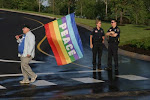
Learning from Cuba: Observations and Reflections of My Pilgrimage

Learning from Cuba: Observations and Reflections of My Pilgrimage by Steve Clemens. December 2010

[From November 27-December 4, 2010 I traveled (legally!) to Cuba as part of a 18 member delegation from St. Mark’s Episcopal Cathedral in Minneapolis. We went to celebrate the installation of Griselda Delgado as the new Episcopalian Bishop of Cuba. As one of two non-Episcopalians on the trip, I felt thoroughly included and welcomed by both my fellow travelers and those we met in Cuba.]

Two weeks before leaving to fly to Havana, many of those traveling together met at the Episcopal Cathedral in Minneapolis to talk about plans for the trip. As part of that gathering, we received our plane tickets and a schedule of our itinerary. Included in that was an essay adapted from material from Paul Strickland entitled “Why Do Pilgrimage?” It encouraged us to travel not as tourists but rather as pilgrims on a transformative journey. Rather than go as observers, we were urged to “become pilgrims who come with searching hearts”.

Our trip gave me much “grist for the mill”, things to think about and ponder for a while. It is not “sound bite”-ready, nor is it likely to be. Our nation has a complicated (and mostly shameful) history with our island neighbor and decisions made by both governments over the years have squandered many opportunities for a healthy reconciliation. The experience was sobering yet celebratory. We have much to share with each other: it should not be a one-way street modeling the colonial past or the domination of empire present.

The Cuban experience since the collapse of the USSR in 1989 has left the island with some harsh economic realities but a resilient population. Like the Iraqis I met in Baghdad three months before our present war, the people I met who were ostensibly my “enemy” greeted me with warm hospitality, curiosity, and much enthusiasm. Both peoples have lived under repressive regimes yet still enjoyed benefits many within our dominant empire lack: access to free healthcare and education for all. Both societies, suffering under economic sanctions imposed by or at the bequest of our government, lacked affordable consumer goods that many of us take for granted. The assumption being that when the people hurt enough, they will rise up and overthrow their governments. It didn’t work in the 13 years before our invasion in Iraq; it has been tried for more than 50 years in Cuba, so far without “success”.

Here are a few stories I wrote during my first few days in country; hopefully more will come as I find time to process the events but I wanted to share some initial impressions soon after returning.

The “Old Man” and the Sea

There is a statute at the end of The Prado, a walkway umbrellaed with trees overhead that proceeds from near the Capitol building in Havana to the wall protecting the city from the ocean to the north. At the end of the walkway, looking out over the expanse of water ahead is a sculpture of marble and bronze. From a distance I assumed it referenced Ernest Hemingway’s novel The Old Man and the Sea but the front it tells me that it is dedicated to a poet/martyr, J.C. Zenea, and dated in 1871 while Cuba remained under colonial rule of Spain. Since Hemingway did much of his writing at a hotel nearby, maybe he was referencing this statute. As I cross the Malecon, the street parallel to the sea wall, I enter the area of the remains of one of the two forts that attempted to protect the entrance to Havana Bay and the harbors within.

After listening to a lone bagpipe player greeting the Sunday morning by playing tunes over the Florida Straits toward Key West, and watching a fisherman cast his line into the sea, a dark-skinned Afro-Cuban man greets me as I take photographs of the forts and surrounding vistas. He inquires, “Que pais?” asking what country am I from. (Many Cubans I encountered on the streets asked me if I were from Spain or Chile because they don’t expect to encounter many Americans because of our country’s travel restrictions.) When I respond that I am from the U.S., he asks what state and proceeds to tell me in English that is better than my Spanish that he once visited Des Moines.

He asked me to sit down with him on a nearby bench by the waterfront sea wall and tells me a slice of his life: he is 58 and helps take care of his 90 year-old father – the only family he has left. He works from 7 PM to 7 AM as a security guard at a local school – paid 2 Cuban pesos (worth about $0.15 U.S.) to guard the computers and other school equipment.

I could see the sadness in his eyes when I told him I was 60 and my own father was 89 – we were almost the same – but he said, “look at my wrinkled face compared to your smooth, young-looking face”. He did appear to be 10 years older than me. Life here is hard.

When I commiserated and denounced my own country’s embargo, he responded, “No, it is also the embargo that my own government sets up”. (Cuba’s government has strict limits on TV stations available and allows no access to the internet other than email. Certain other goods aren’t allowed in and prices are prohibitively expensive for many consumer goods, all blamed on the US embargo.) He shook his head and observed, “I don’t know if I’ll live to see the day of change here.” When I asked who would succeed the aging Castro brothers, Fidel and Raul, when they die, he told me “nobody knows”. They’ve hung on to power without a clear succession plan that the people support.

What hath the revolution wrought? Many Americans rightly praise the Cuban ingenuity of keeping 1950s era automobiles running but much of “Habana” is crumbling from the lack of care for the infrastructure. Although not naming Fidel and Raul, this Cuban man felt the government was hoarding the resources for themselves and stifling other initiatives.

The high blood pressure he suffers from greatly restricts his diet and although he tells me he shouldn’t eat bread and pasta, he says he has only had bread and coffee for breakfast (it being the end of the month and his food ration long used up) and “soon it will be lunchtime”. It felt like it with the hot sun beating down on us although when I looked at my watch it was only 9:30.

Where is the investment in solar collectors? Clearly this “managed economy” has failed; is the rapacious capitalism I so often deplore and denounce the answer here?

He doesn’t ask but I hand this brother a $10. CUC note (worth about $11-12. US) and tell him to get some breakfast and to share it with his father. He had told me he was too old and not inclined to “hold a gun up to someone’s head” to get money to survive. “Besides, that’s not how I treat people”. But he is waiting, hoping that his countrymen and women will rise up and demand a government that can help lift them out of the grinding, urban poverty.

Returning from my walk, a teenage boy approaches me in the area in front of the Museum of the Revolution with his cart, broom, and two waste receptacles. He tells me his job is to clean up the park/walkway in front of the museum for which he is paid one Cuban peso a month. He is the only son of his mother with whom he lives. He asks if I can give him some money for food. I hand his a $3. CUC note and continue my walk.

Tuna For My Baby


I went into the small tienda/store looking to buy some bottled water in larger containers than our hotel carried. After spotting some (everything being behind the counter) and noticing a price sticker of $.70 CUC for the 2 liter bottle, I was approached by a 20-something Cuban young woman who asks me to buy her an ice cream treat from the locked freezer in front of me. After determining the price to be $1.55 CUC, I noticed that I had to get in line and wait my turn to make a purchase.

Waiting for the 4-5 customers ahead of me, my new “friend” points to a can of condensed milk in the display case and then pats her protruding belly and says, “You buy this for my baby”. I make no answer of committal and when the cashier approaches us for our turn to buy, she quickly points to the condensed milk and asks for 3 cans and then points to a huge can of tuna fish and asks the clerk for that. I quickly told her “no” but the clerk removed the price sticker and took one of the cans of milk over to her register and began ringing it up. I had no time to tell her I just wanted to purchase the bottled water.

When the clerk tells me the total price (which I didn’t understand with my limited Spanish), I told her I wanted “dos aguas grande” and she added that to the bill. She handed me her calculator that read “$13.75” so I fortunately had a $20. CUC note with which to pay. As I got my change, an older woman carrying a one-year-old child behind me taps me on the shoulder asking for “leche por mi hijo” – milk for my son – but my shopping adventure was finished for now. I asked for a plastic bag to carry my water, the expectant mother having already disappeared with her milk and tuna, leaving me with the thought that I hoped doctors’ warnings about too much tuna during pregnancy (due to mercury contamination) was less risky than the lack of protein.

An Encounter of a Different Kind

Colin, a third-year student at the Episcopal Seminary in Alexandria, VA asked if he could accompany me on another foray into central Havana, the area near our hotel, a former hotel/casino during the mafia-run days of Cuba under Batista before the success of the revolution was assured with Batista’s fleeing on New Years Day of 1959. I had told him of my earlier walk down The Prado to the sea wall and back while he was studying prior to his ordination exam that will occur later this spring. We walked near the Capitol building and took photos of the 1950s era cars and then continued down a narrow alley/street that was now bustling with people. Right away a couple with their school-aged son approached us asking where we were from, probably overhearing our conversation in English. The father added that he had visited New Jersey. Colin tells him “Washington, DC” and the man recognizes that but looks puzzled when I say Minnesota. Mentioning Minneapolis brings no more recognition but when I add “close to Chicago”, he lights up in recognition.

He tells us “Welcome to Cuba. This is a special festival day – Do you like beisbol?” [Our tour guide on the bus ride from the airport the day before had told us the baseball season officially opened on Sunday as we drove by the stadium for the Havana team.] He wants to tells us about it and shepherds us into a small bar down the alley where only the bar maid is present and tells us to have a seat. He asks Colin in Spanish if we can get some “refreshments” and Colin agrees. The barmaid quickly making 5 drinks and I quickly stop her before she adds rum into my drink.

So Colin’s and our new friend’s mojitos have rum, the other 3 do not. They want to talk to us about our impressions of Cuba, telling us that everything is good for them here – except they don’t get enough food. They blame the US embargo as the source of their troubles unlike my first encounter by the sea where the Cuban “government” was the main culprit.

We got the bill for our “education” – it was $25 CUC (about $30. US). I figure it is the government’s way to gain income since it owns virtually all the restaurants, stores, and bars in the nation. Do “tips” go to the wait staff or does the government take those as well? I paid the bill and started to leave. Although this man told us he worked at the nearby government-run hospital as a radiologist and his wife worked as a schoolteacher, he asked Colin to give him $20. CUC “for food”. Colin was rather surprised and came up with $10. so he turns to me to ask for more. I decline and we both left the bar asking ourselves if all encounters we will have with the locals will be on this basis. I try to avoid eye contact as we leave the area and return to the now-bustling Prado where artists are displaying their wares, hoping for a sale.

Our hotel is nearby and we return to our rooms to change clothes and get ready for the installation ceremony of the new bishop- not knowing then that it would run 3 hours in the very crowded Cathedral – but joyous nevertheless.

The Private-Public Conundrum

Our Cuban guide took us to a “private” family-owned restaurant for our supper on Monday evening. Located on the second floor of a building which was ostensibly their residence, I noticed the fancy woodwork design as we climbed the stairs. Named “La Gardenita” or Little Farmer, the décor of this restaurant and ambiance were noticeably different and the wait staff extremely welcoming and friendly in their cowboy hats and plunging necklines. The menu was impressive and the food presentation and quality was excellent.

Unlike the government-owned and run restaurants, this “palador” was an outgrowth of some limited private enterprise now allowed by the government since the Soviet largess dried up after the collapse of many communist economies and governments in 1989. I am a strong supporter of government programs for education, healthcare, social security, and a safety net for the poor – all of which Cuba seems to do better than the US – but it appears to me that there seems to allow little incentive in their economy for this kind of initiative. It was refreshing but it also caused me to wonder how far to let it progress lest it fester into the incredible gaps between the rich and the poor so evident in the US today. Tonight was a powerful argument in favor of a mixed economy that also allows room for private initiative and resourcefulness.

Jaded as we Americans often are, some of us wondered if “Maggie” our tour guide got a kickback from the restaurant for bringing in 18 customers. We are told “there is very little corruption here in Cuba” but one must wonder about the temptation when government wages are so low and consumer goods are rare and expensive.

Meeting With the “Obispa”

There is no word in proper Spanish for a woman bishop of the church - the language being so traditionally linked to an exclusive male-dominated hierarchy which continues today in the Roman Catholic Church. (A practice, I suspect, which leads many would-be Catholics to become Episcopalians!) Some argue that newly installed Bishop Griselda should be referred to as La Obispo, using the feminine pronoun with the masculine noun. Doug and his Catholic priest friend Gilberto, from the St. Vincent DePaul Order in Mississippi who has been living in Havana for seven years, discussed this back and forth after one of members of Gilberto's parish, a copy editor said it is incorrect. Doug triumphantly pointing out to his friend the Order of Worship program passed out at the service with the title: La Obispa. As old prejudices slowly die (too slowly for some of us), so too must the language change.

I could see the surprise on the taxi driver’s face on the return ride from the Cathedral as Susan explained to him where we had been (installing a woman bishop in the church!) – and then told him that she, too, was a priest – “sacerdote” – and her bishop (this time a male, Brian Prior, Bishop of Minnesota) was seated in the taxi directly behind her! The driver seemed to accept this in stride; after all, being under a secular and, some might say, an anti-religious government since 1959 has already changed many of the attitudes of younger generations. (It is said that more than 70% of today’s Cuban population has only known the government under “the revolution”, having been born after January 1, 1959.)

We met in the Bishop’s residence next to the Cathedral two days after her installation for two hours. With the retired Suffragan Bishop, Ulysses, translating, Bishop Griselda talked about her desire to help her parishes to become self-sustaining. She wants her parishioners to come up with the plans for what they would like to do (agriculture/gardens, cattle or chickens, crafts, …) and then she will work to train the priests to help the congregations implement that dream.

The Minnesotan Episcopalians want to “walk alongside” their Cubano sisters and brothers, assisting where needed. Do they need computers? If so, is there IT help when needed when the computer laptop crashes? Is there enough infrastructure in the far away eastern end of the island for good internet/broadband service? (We learned later that the government doesn’t allow Cubans to surf the net, just get email – and often without any attachments.)

The bishop explains one of her priorities is getting money to pay for transporting priests and key laypersons to a central gathering place to learn from each other. Santiago de Cuba, a parish on the eastern end of the island is a 14-hour bus ride from the capital city although only a one-hour plane ride which costs considerably more.
Should the folks at St. Mark’s in Minneapolis try to raise the $8-15,000 CUCs it would take to buy a car for the bishop to use – if they could find one in Cuba for a fair price? Many of the newer cars on the street are made in China, Korea, or Europe. Most of the buses in Havana are made in China we have been told.

If only there was the political will and courage in the US to lift the damn embargo! The Cuban people we meet are warm and hospitable – they are not our adversaries. Why can’t the political elites left the people enjoy the ability to share with each other across the boundaries of nation and language? This is clearly a peacemaking and justice issue to add to an already long list that our leaders must confront – and soon!

"Shared Word" to Community of St. Martin for Nov. 14

Shared Word for CSM on Vow of Nonviolence Sunday, Nov. 11, 2010 by Steve Clemens

The assigned lectionary readings for today:

Malachi 4
The Day of the LORD
1 "Surely the day is coming; it will burn like a furnace. All the arrogant and every evildoer will be stubble, and that day that is coming will set them on fire," says the LORD Almighty. "Not a root or a branch will be left to them. 2 But for you who revere my name, the sun of righteousness will rise with healing in its wings. And you will go out and leap like calves released from the stall. 3 Then you will trample down the wicked; they will be ashes under the soles of your feet on the day when I do these things," says the LORD Almighty.
4 "Remember the law of my servant Moses, the decrees and laws I gave him at Horeb for all Israel.
5 "See, I will send you the prophet Elijah before that great and dreadful day of the LORD comes. 6 He will turn the hearts of the fathers to their children, and the hearts of the children to their fathers; or else I will come and strike the land with a curse."
-----
2 Thessalonians 3:6-13 (New International Version)
Warning Against Idleness
6In the name of the Lord Jesus Christ, we command you, brothers, to keep away from every brother who is idle and does not live according to the teaching you received from us. 7For you yourselves know how you ought to follow our example. We were not idle when we were with you, 8nor did we eat anyone's food without paying for it. On the contrary, we worked night and day, laboring and toiling so that we would not be a burden to any of you. 9We did this, not because we do not have the right to such help, but in order to make ourselves a model for you to follow. 10For even when we were with you, we gave you this rule: "If a man will not work, he shall not eat."
11We hear that some among you are idle. They are not busy; they are busybodies. 12Such people we command and urge in the Lord Jesus Christ to settle down and earn the bread they eat. 13And as for you, brothers, never tire of doing what is right.
----
Luke 21:5-19 (New International Version)
Signs of the End of the Age
5Some of his disciples were remarking about how the temple was adorned with beautiful stones and with gifts dedicated to God. But Jesus said, 6"As for what you see here, the time will come when not one stone will be left on another; every one of them will be thrown down."
7"Teacher," they asked, "when will these things happen? And what will be the sign that they are about to take place?"
8He replied: "Watch out that you are not deceived. For many will come in my name, claiming, 'I am he,' and, 'The time is near.' Do not follow them. 9When you hear of wars and revolutions, do not be frightened. These things must happen first, but the end will not come right away."
10Then he said to them: "Nation will rise against nation, and kingdom against kingdom. 11There will be great earthquakes, famines and pestilences in various places, and fearful events and great signs from heaven.
12"But before all this, they will lay hands on you and persecute you. They will deliver you to synagogues and prisons, and you will be brought before kings and governors, and all on account of my name. 13This will result in your being witnesses to them. 14But make up your mind not to worry beforehand how you will defend yourselves. 15For I will give you words and wisdom that none of your adversaries will be able to resist or contradict. 16You will be betrayed even by parents, brothers, relatives and friends, and they will put some of you to death. 17All men will hate you because of me. 18But not a hair of your head will perish. 19By standing firm you will gain life.
----

Wow! It is no wonder some of us hesitate to do a “shared word” some Sundays if you have to deal with texts like these. Please note that in the lectionary readings assigned for today, verses 3 thru 6 of the Malachi readings are omitted. I wonder why? Is it because it makes those of us hearing it squirm too much because it is a text used by our own “mullahs”, our own “ayatollahs”? Like Jerry Falwell, Pat Robertson, or Michelle Bachman?

These texts, all of them, would be gladly read and received by our conservative brothers and sisters, especially the Gospel text of “wars and rumors of wars” and the Thessalonians text of “he who doesn’t work, doesn’t eat.” I learned both texts when I grew up in my fundamentalist church. We awaited the “Day of the Lord” with the eagerness of the self-righteous, knowing that “we” were the “wheat”, and “they” were the “chaff” or stubble that will be burned up.

What do we do with these texts on a Sunday when we take a vow of nonviolence? Many churches in the US will use this Sunday to “honor our Veteran’s”, conveniently forgetting that November 11th was originally known as Armistice Day or Remembrance Day rather than Veteran’s Day. The end of the “War to End All Wars” was renamed World War I after the failure to end all wars became readily apparent in 1939 when the German blitzkrieg rolled into Poland. Some military historians now refer “the Cold War” as World War III and claim George Bush’s “Global War on Terror” as World War IV.

We’ve certainly had “wars and rumors of war”. And we look for any excuse we can find to justify and bless them – and as Jack has so often eloquently reminded us – we find texts in the Scripture to bolster our “righteous cause”, our “crusade” against the infidel. It is easy for us to see the fallacies of other religions while readily glossing over our scriptural texts which allow our smug knowledge that “we are on the Lord’s side”.

We could take the time to talk about what Biblical scholars have to say about the problems with the text of the Epistle – whether Paul really wrote this or whether a pseudo-Paul or a monk copying the text added his own comments under the guise of it coming from the Apostle himself. As someone who “retired” from paid employment at age 52, I’m not sure I’d be the best person here to expound on this text on “he who doesn’t work doesn’t eat”!

For us to take a “Vow of Nonviolence”, we must also look at the “shadow” side of our scripture and those brothers and sisters who also claim the same religious tradition as us. In my own case, I can resonate with some of the apocalyptic words ascribed to Jesus when the Luke text says, “You will be betrayed even by parents, brothers, relatives and friends, … All [people] will hate you because of me.”

In my case, “betray” is too strong a word. Disown, discount, or distance from would be more accurate. When I chose the path of becoming a conscientious objector during a war that was fought “to protect our Christian missionaries from being killed by the godless Communists in Vietnam”, I was the one who signaled his own betrayal from my own upbringing. Later, when I went to prison for protesting the weapons “which protect us” and “allow for your ‘freedom to protest’”, it merely confirmed in the minds of many of my relatives that I was “misguided” at best, or “lost” and “on the road to destruction” at worst.

Never mind the eerie parallels with the text warning that those hearing Jesus’ words might land them in prison –or worse. The security guards who rushed at us screaming for the 6 of us to “Stop!” “Don’t go any farther!” had their automatic weapons pointed at us and we didn’t know if a nervous young man would fire at us while guarding the nation’s final assembly plant for all nuclear weapons that cold, snowy February morning 30 years ago in Amarillo, Texas.

After we were ordered at gunpoint to stop, we circled up, and Ladon Sheats pulled out his battered New Testament and read from Ephesians about taking “light into darkness” and we sang and prayed for the 45 minutes it took for the security guards to get inside the fences to arrest us. I think the Apostle Paul’s term of “fools for Christ” was probably more appropriate for us. After that encounter, it made sitting in prison for the following 6 months relatively easy. After all, “Three hots and a cot” as the jail lingo goes is better than getting shot.

I must confess that despite my familiarity with the Luke text, I did worry about what I would say when dragged into court. After all, it was only my second trial (I had veteran protester Elizabeth McAlister sitting aside me at my first trial). Court-assigned lawyers told us the week before the trial that the government had issued a “motion in liminie” to prevent us from testifying about “nuclear power, nuclear weapons, US foreign policy, or our religious beliefs”. Not knowing court procedure as intimately as I do today, I was unsure if the Judge would hold me in contempt of court if I tried to speak about what motivated me to climb that 12’ fence topped with barbed wire in an attempt to “pray” at a place that produced evil incarnate.

I really did trust the Spirit that day in Court because I had planned only to talk about why I did what I did. I nervously talked about scripture and my faith, waiting for the Judge or Prosecutor to cut me off at any minute. The Judge silenced two other fellow defendants because their testimony was “irrelevant” to our criminal trespass charge. Fr. Larry had tried to talk about his work with the poor children of the barrio in Recife, Brazil and Ladon tried to talk about growing up in west Texas and the sense of responsibility he assumed for being raised in that area – that same area where nuclear bombs are now assembled.

What was most helpful for me in getting to that place of taking risks for peace was an explanation of Galatians 2:20 that Daniel Berrigan wrote about in one of his many books. The text, as I had memorized it as a child (in the King James version) in Sunday School goes like this: “I have been crucified with Christ nevertheless I live, yet, not I, but Christ liveth in me. The life I now live in the flesh, I live by faith in the Son of God, who loved me and gave himself for me.”

Berrigan went on to claim that if we take seriously Paul’s idea behind our baptism as “dying to self” and then raised to new life in Christ, there is really nothing State authorities can do to us if we have already “volunteered” our lives to Christ. “They call us dead men,” he said, writing before many of us learned to use inclusive language. If we are already dead, we can’t be killed. What does it matter if you jail us if we are already “dead”? It is a power no State can understand or overcome.


In our Vow of Nonviolence there is a phrase about “persevering in nonviolence of tongue”; When we use “empire-speak”, when we use words like “collateral damage” we do violence against the innocent victims of war. Instead, we should say slaughter of the innocent. Language itself can become a measure of our nonviolence. A few examples:

• Our media talks about Drones/Unmanned Aerial Vehicles – but their real names are Predator and Reaper (as in Grim Reaper). These “extra-judicial assassinations” are conducted with “Hellfire Missiles”. Unmanned assassination airplanes might be a better term for us to use. The term “drone” is too innocuous for what it does- it masks the reality.
• We have been told there is a “covert war” going on in Pakistan, primarily using these “drones”, CIA operatives, and “Special Forces”. Who is the war being hidden from? The people in Pakistan see the results of the bombs and missiles everyday. It is hid only from the American public. Is it really a “covert” war or just another “undeclared” one?
• We often us the term “Defense” Department rather than the more accurate old name: War Department.
• Our military and media constantly refers to “insurgents” when someone fights against US Occupation but uses the name “resistance fighter” when someone opposes a government “we” don’t support.

Tom Engelhardt, the editor of the online site TomDispatch.com says, “such language plays a role in normalizing the running of an empire”. So, when we take the Vow tonight, lets embrace a language which doesn’t do more violence to the victims of war.

I’d like to conclude with what maybe should be considered a “scripture” for the Sunday when we take our Vow of Nonviolence: Martin King’s Letter from the Birmingham Jail. Just listen to a few excerpts of this powerful letter scribbled on a newspaper and smuggled out of the jail to respond to critical white “liberal” clergy who urged King to “wait” or “go slow”:

While confined here in the Birmingham city jail, I came across your recent statement calling my present activities "unwise and untimely."

Several months ago the affiliate here in Birmingham asked us to be on call to engage in a nonviolent direct action program if such were deemed necessary. We readily consented, and when the hour came we lived up to our promise. So I, … am here because I was invited here.

But more basically, I am in Birmingham because injustice is here. … just as the Apostle Paul … so am I compelled to carry the gospel of freedom beyond my own home town.

Injustice anywhere is a threat to justice everywhere. We are caught in an inescapable network of mutuality, tied in a single garment of destiny. Whatever affects one directly, affects all indirectly.

… We had no alternative except to prepare for direct action, whereby we would present our very bodies as a means of laying our case before the conscience of the local and the national community.

You may well ask: "Why direct action? Why sit-ins, marches and so forth? Isn't negotiation a better path?" You are quite right in calling for negotiation. Indeed, this is the very purpose of direct action. Nonviolent direct action seeks to create such a crisis and foster such a tension that a community which has constantly refused to negotiate is forced to confront the issue. It seeks so to dramatize the issue that it can no longer be ignored. … there is a type of constructive, nonviolent tension which is necessary for growth…. The purpose of our direct action program is to create a situation so crisis packed that it will inevitably open the door to negotiation.

… We have not made a single gain in civil rights without determined legal and nonviolent pressure. Lamentably, it is an historical fact that privileged groups seldom give up their privileges voluntarily.

One who breaks an unjust law must do so openly, lovingly, and with a willingness to accept the penalty. I submit that an individual who breaks a law that conscience tells him is unjust, and who willingly accepts the penalty of imprisonment in order to arouse the conscience of the community over its injustice, is in reality expressing the highest respect for law.

… Over the past few years I have been gravely disappointed with the white moderate... who is more devoted to "order" than to justice; who prefers a negative peace which is the absence of tension to a positive peace which is the presence of justice; who constantly says: "I agree with you in the goal you seek, but I cannot agree with your methods of direct action"; who paternalistically believes he can set the timetable for another man's freedom… Shallow understanding from people of good will is more frustrating than absolute misunderstanding from people of ill will. Lukewarm acceptance is much more bewildering than outright rejection.

Actually, we who engage in nonviolent direct action are not the creators of tension. We merely bring to the surface the hidden tension that is already alive. We bring it out in the open, where it can be seen and dealt with. … injustice must be exposed, with all the tension its exposure creates, to the light of human conscience and the air of national opinion before it can be cured.

We will have to repent in this generation not merely for the hateful words and actions of the bad people but for the appalling silence of the good people.

There was a time when the church was very powerful--in the time when the early Christians rejoiced at being deemed worthy to suffer for what they believed. In those days the church was not merely a thermometer that recorded the ideas and principles of popular opinion; it was a thermostat that transformed the mores of society.

… I am thankful to God that some noble souls from the ranks of organized religion have broken loose from the paralyzing chains of conformity and joined us as active partners in the struggle for freedom. They have left their secure congregations and walked the streets of Albany, Georgia, with us. They have gone down the highways of the South on tortuous rides for freedom.

Yes, they have gone to jail with us. Some have been dismissed from their churches, have lost the support of their bishops and fellow ministers. But they have acted in the faith that right defeated is stronger than evil triumphant. Their witness has been the spiritual salt that has preserved the true meaning of the gospel in these troubled times. They have carved a tunnel of hope through the dark mountain of disappointment. I hope the church as a whole will meet the challenge of this decisive hour.


In conclusion, need I remind us, as we gather here tonight preparing to once again take the Vow of Nonviolence that we are still at war in Afghanistan and Iraq; we are actively bombing in Pakistan; and we periodically ratchet up the threats against Iran? And there is talk as well about intervening in Yemen. The military budget, when one includes the supplementary appropriations for the wars, add the costs for mental and physical care of the veterans, the “black budget” for covert operations, secret bases, and special renditions, and the “bribes” we pay for our all-volunteer (mercenary) army, the annual total exceeds $1 TRILLION. Our empire may be in sharp decline –if not outright collapse. Now, as much as ever, we need more peacemakers, people striving to “persevere in nonviolence”. I ask you to join with me in taking the Vow.

Continuing the Story: How the Dominant Story of the Rwanda Genocide Is Unraveling

Continuing the Story: How the Dominant Story of the Rwanda Genocide Is Unraveling by Steve Clemens. October 31, 2010

Who is the real pariah: The Professor or the President of Rwanda?

Peter Erlinder, the William Mitchell Law School Professor and noted human rights attorney addressed a small but attentive group at the law school Thursday afternoon. While attempting to update people about his recent arrest and imprisonment in Rwanda late this spring, he also used the opportunity to describe his role in how the story history will record is changing dramatically in the past year.

He began with a startling announcement: two days before the top prosecutor of Rwanda said he will file charges against Paul Rusesabagina, the real-life hero of Hotel Rwanda. (In the movie Don Cheadle played the role). Erlinder said that the Kagame regime is now lashing out in all directions as a sign of desperation. It also arrested Victoire Ingabire, the Hutu opposition candidate who tried to run against Kagame for President, this month on similar charges of supporting a “terrorist group”. Certainly their relationships with Professor Erlinder didn’t help them, especially since he is the one who has “documented” that the well-known story of the Rwandan genocide is at best a half-truth if not an outright fabrication to hide the real perpetrators.

Of the four year civil war in Rwanda from 1990-1994 most of us, if we know anything at all, know only what the victors claim happened: the Hutus carefully planned to slaughter the Tutsis and only the intervention of Kagame’s Rwandan Patriotic Front (RPF) rebels ended it. Erlinder reminded us of Robert McNamara’s stark admission at the beginning of the documentary The Fog of War where he confesses in one of his last interviews before his death that if the US hadn’t won the war against Japan in 1945, “we would have been prosecuted for war crimes” [for the fire-bombing of Tokyo where 250,000 civilians were killed].

Up until now, there has been very little questioning of the predominate story of the Rwandan genocide. In the past 15 years, the International Criminal Tribunal for Rwanda (ICTR) has prosecuted only those who lost the war. “Either this was the only war in history where the crimes occurred on only one side or this Tribunal is like Nuremberg where there was only ‘victor’s justice’”, Erlinder stated. It was either a strange war or a strange tribunal, he quipped.

Fortunately, Erlinder continued, Carla Del Ponte, the Chief Prosecutor of the ICTR, wrote her memoirs that were published in early 2009. In it, she describes her work for both the Yugoslavia and Rwanda Tribunals and claims that she had enough evidence to prosecute Paul Kagame, the leader of the RPF and now the President of Rwanda, for his central role in the assassination of the Presidents of both Burundi and Rwanda on April 6, 1994, the event everyone considers to be the triggering factor in the ensuing genocide/mass slaughter. (Erlinder is very careful, as a lawyer, to remind his audience that it is not technically genocide if there is no planning or conspiracy. No one doubts there were mass killings throughout the countryside but Erlinder points out it was predominately in the areas where all semblance of law and order had broken down due to the civil war initiated by the RPF. More recent evidence shows that much of the killing occurred in the areas controlled by the RPF.)

Del Ponte also claimed that she had evidence of RPF troops killing “tens of thousands” of civilians during this period but she was ordered not to prosecute those cases by US War Crimes Ambassador Pierre Prosper. When she told him, “I work for the UN, not the US”, Prosper replied according to the memoir, “That’s what you think”. She was replaced within 6 weeks at the insistence of the US by the UN Security Council. “If you want to keep a UN career, you learn from what happened to Carla Del Ponte,” Erlinder continued.

Del Ponte’s firing caused very little media attention even though Kagame called for her resignation because of the timing: all the world was focusing on the search for WMDs in Iraq in 2003. But despite all the attention paid to Iraq, US Secretary of State Colin Powell went out of his way in a press conference to agree that she should be removed. All the outcomes have been manipulated in these cases when only one side is prosecuted. (Does this remind anybody of the aftermath of the Republican National Convention in 2008 when only the demonstrators and not the police were prosecuted?)

Erlinder described how he first got involved in the Rwanda case: while in Kenya in 2003, he was approached and asked to serve as defense counsel for General Bagosora, one of four Hutu military leaders charged with the most serious crimes of conspiring to commit genocide. Seven years later, the three Judges hearing the case against these “leaders of the genocide” rendered their judgment: a unanimous verdict of not guilty of conspiracy to commit genocide. [They were convicted of significantly lesser charges for actions of soldiers under their command for which they might not have even known about.]

With this verdict on February 8, 2009, for the first time in the public record was a significant chink in that wall erected of the dominant story of the genocide. If these 4 military leaders had not planned and conspired to commit the genocide, maybe there were other parts of the Kagame-is-a-hero story that were not true either. The second shoe to drop was the leaking of the draft of the United Nation’s Report from the High Commissioner for Human Rights (otherwise known as the Mapping Report), a 600-page report that had been held in secret for almost a year while Kagame was given a copy allowing him to comment on it before it was officially released. This act of civil disobedience by UN staffers in leaking it is reflective of the disgust and frustration that is growing for allowing Kagame to continue to act with impunity.

Part of that growing awareness of something seriously wrong with the glowing praise of Kagame’s “economic miracle” and his hero-status was his administration’s thuggish arrests of his political opponents – anyone who dared to challenge him. It was one thing to arrest Victoire Ingabire; after all, she is Rwandan. But when Kagame’s government overreached to arrest Peter Erlinder, a westerner with a strong network of legal and activist colleagues, much more attention came to bear on what was going on in Kigali.

The leak of the draft of the Mapping Report forced the hand of the UN officials and the final report was issued this month. Although the focus of the report was on what happened in Zaire/Democratic Republic of the Congo (DRC) from 1993-2003, it showed a clear pattern that completely negated the narrative that Kagame has spun: the killings of civilians in the Congo (and the genocide in Rwanda) were the work of the Hutu. The UN Report states that the RPF, Kagame’s military force, is responsible for many of the 6 million killed to date in the Congo. The primary victims? : Hutu civilians from Rwanda, Burundi, and the Congo.

As Erlinder was preparing his defense in front of the ICTR, he noticed that virtually all the “evidence” against his defendants was “apocryphal”. There didn’t seem to be any documentation, just statements or stories by others claiming, “I saw this” or “I heard that”. When questioning UN peacekeeping force leader, General Dallaire, a Canadian, the ICTR prosecutor asked about his telegram to NY on January 11, 1994, four months before the mass killings. Dallaire said “folks in New York didn’t respond to my warnings.” On cross-examination by Erlinder, he was asked if he had “any documents” and he mentioned statements by informers in his “personal files”.

So Erlinder asked for any documents the UN had relevant to the case. Told he was allowed to “inspect” UN files at the UN headquarters, he was escorted to a room that had a wall of documents arranged like a library. He was told he couldn’t take in his computer, camera, or even a notepad and pen or pencil. But he was instructed that if he put a “Post-It” note on any pages he needed a copy of, it would be given to him and the UN legal department staff would review it to see if it could be released to him. The professor told us he went downstairs “and bought a whole gross of Post-It Note packets” and literally spent a week putting a sticky note on every page. He said the UN staff are good bureaucrats and just followed orders. He received copies of thousands of documents by the end of 2004.

He also stumbled on “the archives”, a warehouse in NJ that also had relevant documents that he could use. Included in them were declassified documents from the Pentagon, US State Department, and the CIA. After arranging all the documents into chronological order, he converted them into PDF format and placed them on a website he created so they would be available to other researchers and the public. At the site, www.rwandadocumentsproject.net, Erlinder has assembled UN documents, US documents, evidence used in the Tribunal trial of his defendants, the Defense brief, articles about Rwanda, documents about Erlinder’s arrest, and a copy of the UN Mapping Report. The documents allowed him to assemble close to a minute-by-minute account of what happened during the 100-days of the genocide. It created a completely different narrative of what happened in Rwanda in 1994. Erlinder claims what he has put together is what historians will ultimately report once the dominant narrative is exposed as fraudulent. The documents are now in the public record –exposure will come.

Erlinder then proceeded to give us a brief outline of the events as they unfolded. Explaining that Rwanda was about the size of the State of Maryland and that historically the richer, minority Tutsi raised cattle and the majority, poorer Hutus grew crops. The Tutsis had the spears, they were the warriors in that society.

Between 1980-1990, Paul Kagame was the Ugandan rebel leader Museveni’s Military Intelligence Chief and then part of the Ugandan Army when Museveni became head of state with US assistance. Kagame himself received training at Ft. Leavenworth in Kansas. In 1990 he took about 25% of the Ugandan Army, renamed them The Rwandan Patriotic Front (RPF) and led a guerilla-style terrorism campaign to destabilize Rwanda.

His forces grew tenfold from 2,500 to 25,000 fully armed troops in those three years, obviously with outside help at a time when the Soviet empire was collapsing and the US was “concerned” about the socialist leanings of the Hutu President in Rwanda. In February 1993 the RFP attacked and advanced close to Kigali, the capital city. One-sixth of the population (1.2 million people) was displaced during this attack. A power-sharing agreement was reached in July that included the RPF because of their military superiority even though the Tutsi were only about 15% of the population. Pressure in the UN led to the removal of French and Belgian UN Peacekeepers who had helped keep the RFP out of Kigali and less-trained UN forces replaced them. An election for President was scheduled for the following August. Meanwhile neighboring Burundi elected a Hutu president by a landslide.

That Burundi president was assassinated by his own army consisting primarily of Tutsis in league with the RPF. The Burundi Army proceeded to kill between 100,000-250,000 predominately Hutus and another 300,000-500,000 refugees fled north to Rwanda. In November of 1993, US Ambassador Bob Flaten (now a resident of Northfield, MN) warned Kagame and the Rwandan president that if either side renewed the civil war there would be massive bloodshed. On April 6, 1994, RPF forces shot down the airplane carrying the Rwandan President and the new Burundi President and within two hours the RPF made a blitzkrieg assault to control much of the country. By July 19 they declared victory.

By September and October some reports of RPF crimes began to surface. Robert Gersony spent six weeks investigating the massive killings and his oral report to the UN claimed “systematic and sustained killing and persecution of the Hutu civilian population by the [RPF]” between April and August. His report was treated as “confidential” and suppressed. To this day (but hopefully not too much longer) the dominant narrative claims virtually all the victims were Tutsi and “moderate Hutu” although none of the statues or memorials today in Rwanda depict Hutu victims. And the “crime of genocide denial” was put into law by the victorious Kagame regime to prevent any other account from being raised.

From Erlinder’s account, it appears to me that most of the Tutsi-on-Hutu killing was done by the RPF military forces in the areas they controlled while the Hutu-on-Tutsi killing happened in the ensuing chaos of a complete breakdown of the society rather than as a military-led strategy. The killings on both sides must be condemned and be a part of the history. There are crimes on both sides in any war. But, in all likelihood, only one of those sides received US military aid and it was not the Hutu government which was overthrown.

For the US government to continue to allow Kagame’s false narrative to be dominant dishonors all the victims of the war. US foreign policy has aligned us with some really reprehensible leaders for political and economic reasons. Our support for Mobutu in Zaire was shameful and embarrassing. A few years from now the world will have a similar perspective about Paul Kagame. Hopefully our foreign policy will prioritize human rights over the resources we covet in the eastern Congo which Kagame has profited from. Time will tell. Meanwhile, the Professor, while a pariah to some in power in Kigali, is a prophetic voice calling us to do the right thing.


For a video of Peter Erlinder’s talk soon after being released from prison: http://ourworldindepth.org/archives/311

To view actual documents from the UN files on Rwanda: http://www.rwandadocumentsproject.net/gsdl/cgi-bin/library

The International Criminal Court and the "Black Hole"

The International Criminal Court and the “Black Hole” by Steve Clemens. October 28, 2010

Professor/Lawyer Peter Erlinder sat in front of us with his eyeglasses perched on his upper forehead very reminiscent of another lawyer of the recent past who also blazed a path for justice in defending the unpopular and marginalized: William Kunstler. While Kunstler actually defended the Chicago 8 after the Democratic National Convention in 1968, Erlinder was not part of the recent RNC 8 case protesting another American war of imperialism – but many of his friends and colleagues were. Instead, Erlinder was sitting in a jail cell in Rwanda as the result of his attempts to defend a candidate for President of that nation from charges of “genocide denial”.

It’s been only four months since his release for “health reasons” (and significant pressure from the U.S. State Department and the world community) and Erlinder’s talk at the Mad Hatter’s Coffeehouse on Tuesday evening was designed to give the 20 or so of us in attendance a broader context to understand what is happening in east-central Africa.

Before addressing the International Criminal Court (ICC), Professor Erlinder gave us a quick update on Rwanda. After his arrest and imprisonment and the attention of the world placed on this small African nation sandwiched between The Congo, Burundi, Tanzania, and Uganda, a Green Party candidate for President was beheaded, a prominent journalist was killed, and there was an assassination attempt on the life of a former Rwandan General who had fled to South Africa. On August 26th, a 600-page report from the United Nations Commission on Human Rights (aka The Mapping Report) very critical of the Kagame regime’s actions in the DRC (Congo) was leaked. This was only weeks after Kagame’s reelection with more than 90% of the vote – often a telltale sign of a rigged election.

With the release of the leaked UN report, Erlinder said, “the story is starting to unravel” – meaning that for the first time the world media is beginning to seriously reexamine the dominant story-line about the Rwandan genocide in the 1990s and the role Kagame and his Tutsi rebel army, the Rwandan Patriotic Front or RPF, may have played in it. The U.S. White House recently issued their first-ever critical statement about the Rwandan administration. Kagame just signed a military agreement with the Chinese. And Victoire Ingabire, Erlinder’s former client and Presidential candidate, was rearrested - this time for “material support of terrorism” and jailed in the same cell where Erlinder had been held. She has just been denied bail and was shipped to one of Rwanda’s notorious prisons.

With the recent FBI raids in Minneapolis, it seems like Rwanda is learning quickly to imitate its imperial masters with phony charges meant to intimidate others.

To understand the role and history of the International Criminal Court, Erlinder told us to look at the Nuremberg and Tokyo Tribunals after World War II if we really want to explore how the ICC reinforces American foreign policy. Both of these post-war Tribunals were designed to condemn the vanquished; they weren’t designed to be even-handed in looking at war crimes, they were legitimated by military victory and provided only “victor’s justice”.

When the United Nations Charter was established, there was no vehicle within it to hold individuals accountable for war crimes or egregious human rights violations, just those of nation-states through the vehicle of the World Court. Erlinder claimed that it was Stalin rather than Churchill or FDR/Truman who pushed for trials of Germans and Japanese in order to delegitimize the vanquished. With the Security Council’s veto power held by the five “permanent members”, the US and the UK held the Soviets at bay – and visa-versa - for much of the next 40 years.

After the collapse of the Soviet Union at the end of the 1980s, the US and UK had much freer rein because the Soviets were too weak and China was just becoming an economic and military power. Within this vacuum, the US and UK initiated an International Criminal Tribunal for Yugoslavia (ICTY) in 1993 and a similar tribunal for Rwanda (ICTR) in 1994. They were justified under Chapter 7 of the UN Charter that allows for peacekeeping forces but Erlinder contended that the US/UK wanted to have “peacemaking” powers as well – thus the Tribunals. However, these tribunals were designed on the adversarial system and clearly limited in scope of which crimes to prosecute – only those by “them”, NOT by NATO or other allies of the US like Kagame.

By the end of the 1990s, the UN sought to establish a more permanent vehicle to prosecute individuals and the Treaty of Rome in 2000 established the International Criminal Court. However, once again with the initiation of the US/UK domination, the ICC severely restricted who could initiate cases: only nation-state signatories or the UN Security Council, NOT non-governmental organizations (NGOs) like Human Rights Watch or Amnesty International. Erlinder claims it was set up to prosecute rebel groups but not state forces.

Although President Clinton signed the Treaty before leaving office, he did not submit it for ratification with the US Senate. After George W. Bush succeeded him, he “unsigned” the Treaty to prevent any Americans from being prosecuted by a world body. Even though the US cannot bring cases before the ICC as a non-signatory, as a powerful permanent member of the Security Council, it carries the ability to initiate cases against those with whom we wish to oppose. So, through the Security Council, the US can refer cases to the ICC without risking any prosecution themselves!

Erlinder described the power of the US in the world community by using the language initiated by physicist Stephen Hawking: a “black hole” which sucks everything within its gravitational pull into its orbit, eventually absorbing it with its power. Like the black cylinder at the Science Museum where kids roll a coin around and around until it is “swallowed up” at the center, The US uses its role as “the world’s only superpower” to dominate anything within its ever-expanding sphere. Everyone is aware of its power and influence even as the empire is collapsing. Still it sucks everything into its gravitational pull. What a great metaphor!

A perfect example of this occurred when Carla Del Ponte, the Chief Prosecutor for ICTY and later ICTR chose to broaden her investigation of war crimes and crimes against humanity to include the actions of Kagame and his rebel forces. She developed evidence that Kagame should be indicted for his role in the assassinations of Rwanda’s and Burundi’s Presidents in April of 1994 which triggered much of the genocide which followed but was summarily dismissed from her position soon after she visited Washington, DC and was told to drop the investigation. She said she “worked for the UN, not the US” but soon found out otherwise when she refused to stop her investigation, mistakenly thinking that the Tribunal was after the “truth” rather than just to persecute political enemies. Erlinder pointed out that “everyone” connected with the Tribunals or the ICC know what happened to Del Ponte - and why - and thus won’t try to challenge the limits the US tries to place against prosecution of those who do our bidding. In fact, the prosecutor who replaced her in 2003 has only prosecuted members of the defeated group of Hutus.

We know about Carla Del Ponte because her memoir, Madame Prosecutor, was published in February 2009. However, she has since been appointed as the Swiss Ambassador to Argentina and her government has ordered her not to talk about what she wrote in her book.

To date, every defendant charged by the ICC is African – and all of them find themselves on the “other side” from US interests. After the US pressured the ICC (through the Security Council) to indict the leader of Sudan (another country that refused to sign or ratify the Treaty), all the African presidents unanimously voted not to cooperate with the ICC.

The struggle to restrain power through law can be traced back to the Magna Carta forced on King John by those he was oppressing. This process has had fits and starts. In war, Erlinder observed, there are always cases of crimes on both sides. When a Tribunal or Court only looks to one side of the ledger, one can’t get justice. There is an imbalance built into the ICC that gives more power to nation-state actors than others.

While leaving much of the detailed story of Rwanda’s genocide for another talk to be given two nights later at William Mitchell Law School where he is a Professor, Erlinder did observe that most Americans know about Rwanda through the camera lens of the movie “Hotel Rwanda”. (Erlinder is friends with Paul Rusesabagina, the real-life hero of the movie that features actor Don Cheadle in that role and he is a member of the nonprofit board Rusesabagina established.) As “good a story” as the movie is, the law professor said, “ ‘Hotel Rwanda’ is as accurate about the Rwandan civil war as ‘Gone With the Wind’ is about the US Civil War.” If you only see the latter movie, you come to think “the damn Yankees” and General Sherman are the real villains and slavery wasn’t all that bad.

Erlinder concluded with the observation: if you ultimate goal is to learn the truth of what happened and to work to heal the nation, going the route of a Tribunal will not get you there. Tribunals are just good for condemnation and retribution. Instead, take the path modeled by South Africa – a Truth and Reconciliation Commission. But there is a trade-off – it will often mean that the perpetrator will not be punished (even though he/she will probably be shamed). But, Erlinder continued, “righteous indignation” will almost never get the whole story right. Erlinder didn’t say it but the thought came to my mind: in order for that to work, one also needs a Mandela-type to order it and a Bishop Tutu-type of leader to run it. Now that they are both retired, the world could use a few more like them.

Punishment To Fit the Crime?

Punishment To Fit The Crime? By Steve Clemens. October 2010

In the past two years, I have been given the “opportunity” to do court-ordered “Community Service”. Often the sentence is to pay a monetary fine (plus “court costs”) and then the Judge allows a substitution of community service to be performed in lieu of paying the fine. Historically, community service was a way for poor people to be “punished” for their conviction in court when they were unable to pay the fine. Today it is sometimes used to assuage the “convictions” of protestors who object to paying money to the government (the fine) as a “tax” on their conscience.

So, how does a Judge determine the amount of community service to equal the fine – or, how much community service should be required to heal the “breach of the peace” which led to the guilty verdict in the courtroom?

Years past my position was clear: don’t pay the fine or agree to community service when convicted of the “offense” of acting on your conscience. Most of my convictions were resulting from “trespass” charges – usually on the property of an activity which should not exist: the plant assembling nuclear bombs, a plant building first-strike submarines, a military base training soldiers in techniques designed to sew terror in the hearts and minds of Latin Americans. The list goes on and on.

Sometimes the arrest comes at a public place in protest of a specific activity or policy advocated by the resident office holder: at the White House against the current war or practice of torture, at the Capitol in protest of taking from the poor to give to the military, at the Immigration Office to protest deportations. Yet other morally legitimate things also happen at those sites: new immigrants are welcomed as citizens, policies are passed to help protect the environment, and decisions are made to end discrimination against marginalized groups and individuals.

One of the things I’ve learned from U.S. history is that a lot of the significant change (for the better) that we’ve seen has been principally brought about politically because of citizens taking to the streets or lunch counters in protest, risking arrest and imprisonment. Women’s suffrage, the 5-day workweek, civil rights, human rights, shortening wars of aggression, even preventing the development or deployment of some weapon systems has been facilitated by acts of conscience and protest, mostly through nonviolent action.

Under our present “justice” system, we’ve evolved theories which primarily see the State (or city or federal government) as the “victim” of the “crime” for which we are arrested. This often leads to the notion in a trespass case that the “owner” of the property (often a war merchant or an elected official who supports the wars or other evil policies) is at most peripheral to the case to the Judge but absolutely central for the defendant.

Therefore Judges often choose not to listen to arguments about intent or motive from the defendant because to do so is too threatening to the established order. The Courts mostly see their role in protecting the establishment, the status quo – that is from where their power emanates. Not many judges are willing to face the fact that the Nuremberg Tribunals also convicted German judges for their roles in the perversion of justice during the reign of the Nazi Party.

At what point do judges ever look back on their own history to see what should have been done differently? Are there any judges alive today who now wish they’d handled Martin Luther King differently when he stood before them in the dock? Plans are underway to erect a monument to him on the Washington Mall yet there are still probably a few of the lifetime-appointed Federal Judges who still defend sending him to jail.

When we finally (and we will) abolish nuclear weapons and give human rights to sexual minorities, society will have a different take on the Berrigan brothers and GLBT/queer activists. But until that day, principled protesters will be cuffed and shackled and hauled before judges for their civil disobedience. Sometimes the result will be jail or prison; more often it will be a fine, probation, and possibly “community service”. What community service is appropriate when the charge is pointing out that the emperor has no clothes?

After blocking the ICE Center to prevent undocumented immigrants from being deported, I was assigned work picking up trash and mowing grass at public boat landings in the wealthy suburbs. The only connection to the “crime committed” is that often those tasks are done by low-wage workers, many of who are new arrivals to this country or those who have been marginalized for decades if not centuries.

The protest against the wars during the Republican National Convention resulted in 24 hours of community service – this time of my own choosing, as long as it was in Ramsey County. I counted my many hours transporting Iraqi visitors around the Twin Cities for that sentence. At least there was a connection for me between opposition to the war and working to heal some of the wounds by acts of reconciliation with those who may have been our “enemy”.

Arrested at the headquarters to the local war profiteer Alliant Techsystems last fall, my judge was very creative: he told the four defendants about his sister who had polio as a child and how local Shriners and Children’s Hospitals gave her great care. He told us after hearing our testimony that we cared deeply for victims of indiscriminate weapons, especially children, so he recommended we do our community service at one of those hospitals – which we did with great joy. This hospital is now providing free treatment to a young Iraqi boy who lost his leg during the war.

Most recently, my judge in Kansas City allowed me to perform my 10 hours of community service (for protesting the use of city funding to build a nuclear weapons plant) at a place of my choosing, adding, and “I hope at least some of it will be here in our city”. I chose to work with a Catholic Worker community that lives, works, and serves with the homeless of Kansas City – the population that should have received the tax monies that were earmarked for blighted neighborhoods but ironically spent on a weapons plant that could wreak blight on the entire planet.

While I like the sense of symmetry that my last three stints of community service engendered, whenever possible I’d prefer a jail sentence over a fine or “sentenced-to-service”. There is something powerfully symbolic about being in jail when one’s society and government are out of whack. Thoreau’s challenge to his friend Emerson – “Why aren’t you in here with me?” – is a testament of marching to the beat of a different drummer. Martin’s call for us to become “drum majors for justice” continues to beckon us to risk jail or community service, even when others say it is “unwise or untimely” like his critics claimed when he was in the Birmingham Jail.

I don’t expect to receive a posthumous Monument on the Capitol Mall – but I do want to be part of those struggling to become the “beloved community” that Martin dreamed of and embodied – that would be a true “community service”!

Blinded By "The Law"

Blinded By “The Law” by Steve Clemens. October 19, 2010

Judge Teresa R. Warner, perched above the packed Courtroom 131 B in Ramsey County Courthouse. A special hearing had been called to allow the 4 remaining defendants in the notorious RNC 8 case to agree to settle their cases with a plea bargain, thus avoiding the 4-6 week jury trial scheduled for beginning next week. She listened as each of the four young men pled “guilty” to either a charge of “conspiracy to commit damage to property in the third degree” or “conspiracy to riot in the 3rd degree”.

She meticulously insisted that each of the defense attorneys go over what rights the defendants were “giving up” in exchange for their pleas: the right to a jury trial, the right to confront the witnesses, the right to testify oneself, … and on and on – as though these “rights” could somehow even the scales of “justice” when the State retained almost unlimited resources in the desire to win a conviction.

The prosecutors and the defendants (and their lawyers) had agreed to a plea bargain over the weekend: in exchange for a guilty plea, the State would ask for no jail time, no restitution, credit for “time served” after arrest, and agree not to force them to testify against other defendants about incidents around the Republican National Convention in September 2008. They recommended that those pleading guilty be given 100 hours of “Community Service” and requested a 2-year probation period be placed on each of the four.

Each of the Defense lawyers asked the Judge to “stay” (suspend) execution of her sentence for a shorter period of probation until the community service could be performed. Noting that each of the defendants had limited income and had all qualified for court-appointed attorneys due to their economic status, they also asked any fines be limited as well.

One-by-one, each of the four defendants came before the Judge, accepted the guilty plea, and was then asked if they had anything further to say before they were sentenced. Nathanael Secor stated that this case was about the criminalization of dissent. He said that while he was guilty of violating the law, local law enforcement personnel did “many acts” which were also illegal and have not been charged. He commented about the police being part of a network of “social control” which allowed the furtherance of “colonial wars”. He reiterated his desire to “abolish institutions of domination”.

Judge Warner, in preferencing her sentence, stated that she was sentencing Mr. Secor for “his acts, not his political beliefs or motivations”. She stressed she was following the law; he pled guilty to violating the law and was being sentenced for his actions, not his beliefs. After giving him “180 days in jail and a $1000 fine” she then said she would stay the execution of that sentence in exchange for one year of supervised probation (remaining law-abiding with no same or similar offenses and abiding by all the rules of the probation), 100 hours of community service, no more than 10 hours per month for 10 months, no restitution, would not be compelled to testify against others in related cases, and fined $200 plus court cost fees of $81.

Max Specktor was the next defendant to stand before Judge Warner. After his guilty plea, he stated that “conspiracy is only part of the story.” He decried the “spectacle of democracy” that we claim is practiced in the U.S., claiming he preferred to live in a more “decentralized world”. He preferred to address real economic needs he sees: “real needs versus conspicuous consumption”. “I refuse to sleep-walk through life”, he continued. He recognized that he and other defendants have had a lot of privileges in life, including being able to speak on their own behalf while “many too others lack those privileges.” He ended by saying he was committed to help “build the world we wish to see.”

Again, Judge Warner went out of her way to claim her sentence “is based on your acts, not your motivation.” It is what she feels is “appropriate, fair, and just.” It is not about “political opinions or ideals”. To quote Shakespeare’s Hamlet, “Methinks the Lady doth protest too much.”

This case is all about politics. From pre-emptive house raids to ridiculous trumped-up felony charges alleging “terrorism”, it has been from start-to-finish about “politics”. It was about politics to dismiss the charges against both the women and another male defendant. The County Attorney who brought the initial charges was running for Governor as a tough law-and-order candidate. And then there is the real reason any charges were brought at all: Sheriff Bob Fletcher. Most of what he does is political – playing to his political base while mired up to his eyeballs in corruption. His press conferences just prior to the Republican National Convention were designed to ramp up fear and hysteria about “anarchists” coming to his city to create mayhem. For me, the biggest tragedy of this plea bargain deal is that we won’t get to see Sheriff Fletcher in the witness chair, facing committed movement lawyers about what he did and why before and during the Convention.

But the most significant reason this case is all about politics is the utter silence in the courtroom about the grossest violation of law: what the Nuremberg Tribunal calls the supreme international crime: “to initiate a war of aggression”. The main reason thousands of citizens came to protest at the RNC centered around two wars initiated by the President of the United States in contravention of the United Nations Charter. For the court to pretend to strictly follow “the law” while ignoring the context of the war is not only disingenuous but absurd. The fact that both these wars continue (and continue to be ignored by both the media and the courts) is an indictment on our entire society.

Spector’s sentence differed only in the fine amount: $500 rather than $1,000 – most likely due to the different sentencing guidelines between conspiracy to riot rather than to commit property damage.

Rob Czernik followed with his statement of “proudly” when asked if he was guilty-as-charged. His answers of “yep” and “nope” to the questions asked him by the Judge and attorneys certainly did nothing to endear him to the Judge. When asked if he wanted to make a pre-sentencing statement, he responded, “Nope. Get on with it.” Judge Warner gave him two years of supervised probation instead of the one year the two prior defendants received. When asked by his attorney, Jordan Kushner, about the discrepancy, Judge Warner responded briskly that she wasn’t about to negotiate. Her decision was the “court’s discretion”. Excuse me, but “politics aside”, is such a statement from the court based “entirely on ‘the law’”? I doubt it.

Finally, Garrett Fitzgerald was the last defendant. He talked about the dedication of “his whole life to community”. He lives a life of voluntary poverty and sobriety. He was not “wanton” in breaking the law; he broke the law on the basis of his principles. He too claimed that he and the other defendants were specifically targeted for their “political beliefs”. After being cut-off by the Judge from reading a passage from Dr. Suess’ book, The Lorax, Fitzgerald concluded, “What we allow and what we don’t allow says a lot about our society.”

He must have struck a nerve: he got the extra year of probation as well.

I left the Courtroom with a conviction reaffirmed: the law is inherently political. These “laws”, especially protecting “property” do not come down from Mount Sinai; members of our legislature whose election is more often than not determined by who has the most money hash them out. Governors or Presidents who are also “elected” by a money-polluted system then appoint judges. Our system of check-and-balances counts on the Judiciary to help “establish justice”. I don’t think I witnessed much “justice” in the St. Paul Courtroom today.

It Doesn't Matter If You Should Jail Us


(photos by Bill Cordaro; National Catholic Reporter staff)


“It Doesn’t Matter If You Should Jail Us”
by Steve Clemens. August 16, 2010

14 of us stood in front of the huge Caterpillar dump truck with our hands outstretched, holding on to one another as we sang, prayed, and read our statement on why we were protesting the building of the first nuclear bomb plant to be constructed in 32 years on the south side of Kansas City, MO.

We sang the South African freedom song: “It doesn’t matter if you shall jail us, we are freed and kept alive by hope …”. We talked with Janice, the dump truck driver after she read a copy of our statement. Neither she nor the nearby bulldozer driver knew that what they were working on was to clear a site for a nuclear weapons plant. She was also unaware of the toxic waste that pollutes the present Kansas City Plant now operated by Honeywell that makes 85% of the non-nuclear components for the US nuclear bomb arsenal.

I hadn’t planned to risk arrest as I traveled down I-35 through Iowa to Kansas City last weekend but what I heard from the locals convinced me that I needed to act as well as speak against this crime. After hearing two retired workers tell about their friends dying of cancers and other diseases after working at the Bendix (and now run by Honeywell) Plant, I was stunned to learn that it was only recently that the EPA was forced to list the site as a source of major toxic pollution. Yet a day-care center remains on the grounds that sit atop this toxic mess. It looks like the federal government (and Honeywell) will walk away from this site once the new plant is built, leaving the local taxpayers stiffed for the clean-up bill.

Speaking of taxpayers, the city government of Kansas City decided to use funds earmarked for urban blight remediation to purchase the soybean fields and trees on the southern edge of the city for this plant with the promise to turn it over to private owners for $10 after 20 years- all under the cynical guise of protecting about 2,000+ jobs.

Presbyterian pastor and local Catholic Worker member (yes, one in the same), Eric Garbison spoke in a loud voice over the dim of the construction equipment this morning to the construction supervisors and the police who had come to arrest us: “I’m a pastor who lives in Northeast Kansas City at 12th and Buford. I heard 4 gunshots last night. There are crack houses and abandoned houses in my neighborhood. The homeless come to our house for food and showers – yet the city government took funds for blighted neighborhoods and use it for this”, as he pointed to the vast expanse of bulldozed land in front and behind us.

“I went to the city council meetings two years ago to try to stop this plant. That is why I’m standing here today, risking arrest, to stay we cannot use this money to build weapons of death.” He, Brian Terrell, and Steve Jacobs had just returned to our group after walking over to two other large construction machines, a power shovel and a bulldozer, to try to talk with those equipment operators while the rest of us tried to engage the dump truck driver we had stopped with our bodies in front of her huge machine.

Garbison told the JE Dunn Construction supervisors and the police, “We want people to have jobs. They could take all of this equipment over to the old Honeywell bomb plant on Bannister and begin to clean that site up.” He went on to inform them that a day-care center remains on that deadly polluted site and asked them if they’d want to have their children to be cared for there. As a father himself, he didn’t want any children exposed to the beryllium, arsenic, and other deadly chemicals being used to make these nuclear weapons.

It is beyond ironic, in fact numbingly stupefying, that our nation can decry Iran’s attempt to enrich uranium for a potential bomb while we continue to modernize our illegal nuclear weapons and extend the life of present bombs for another 40-60 years – all at a time when our President claims a goal of zero nuclear weapons, beginning with the New START Treaty.

Half of the 14 arrested came from outside of the KC metro area: from Des Moines and Malloy in Iowa, from Tuscon, AZ, Columbia, MO and Minneapolis. The other 7 were from Kansas City, primarily from two Catholic Worker communities that live and serve among the poor and marginalized. They see a direct connection between the neglect of human needs and the obscenity of dumping billions into the troughs of arms merchants. Committed to a faith-based nonviolence, these activists chose to risk time in jail rather than to allow this plant to proceed without protest.

Catholic Worker troubadour Steve Jacobs from the St. Francis Catholic Worker in Columbia, MO sang his version of a Bob Dylan classic, changing the title and words to say “I ain’t gonna work on Uncle Sammy’s nuke plant no more. I ain’t gonna work in Kansas City’s nuke plant no more …”

The developer, Jim Cross, pleaded with us to walk away from his earth-moving equipment so his workers could resume, promising us “cold drinks and a place to sit and talk in the shade”. “I don’t want to have you arrested”, he claimed as he returned three times asking us to leave before the police put us in handcuffs and drove us downtown. We were booked on trespass charges and released with a court date on October 7.

__________

Statement carried by the 14 and given to workers:

Statement of Resistance to Nuclear Weapons Production in Kansas City, Mo., Aug. 16


We are gathered today, August 16, 2010, at the site of the future nuclear weapons production plant in Kansas City, Missouri, to protest the continued manufacture of U.S. nuclear weapons.


We also denounce the existence of the current Kansas City facility, where 85% of the non-nuclear components for the U.S. nuclear arsenal are produced, and demand its closure and clean-up.


The current plant and the future plant threaten the health and well-being of workers, our environment and the Kansas City community. The new plant is the recipient of funding by the city government through the explicit misdirection of funds intended for the improvement of urban blight.


The 1970 Nuclear Nonproliferation Treaty requires an end to all planning, preparation, production, threat, or use of nuclear weapons and adherence to the fundamental rules and principles of Humanitarian Law. Further, ratified treaties are enshrined by the U.S. Constitution as supreme laws of the land. Building the first new U.S. nuclear weapons production facility in 32 years is in obvious violation of these laws.


The cardinal rules and principles of humanitarian law require that civilians never be the object of attack and prohibit weapons that are incapable of distinguishing between civilians and military targets.


The International Court of Justice found that the destructive power of nuclear weapons cannot be contained in either space or time, and nuclear weapons have the potential to destroy all civilization and the entire ecosystem of the planet, and thus are illegal. In keeping with the Nuremburg Principles, we choose to act nonviolently rather than be complicit.


The intended use of the new Kansas City Plant is to improve and extend the life of nuclear weapons. Any complicity in planning, preparation, threatening to use or use of these weapons is a crime against peace, war crime and crime against humanity.


Under principles of democracy we exercise the right of every citizen of this republic and this planet to peacefully resist the nuclear threat that attacks every core concept of human rights.


We act to exercise our basic rights to life and freedom from violence and we exercise our duty to protect children and future generations.


We act to ensure that our government fulfills its promise and responsibilities to unequivocally pursue and achieve nuclear disarmament in good faith.


We call on national, state and local Kansas City government to end the use of our tax dollars to wage permanent war and demand clean-up of all chemical and radioactive contamination.