Busted in Front of Nuke Weapons Plant


Two Minnesotans Arrested For Declaring Independence by Steve Clemens. July 5, 2010

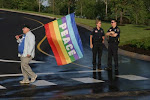
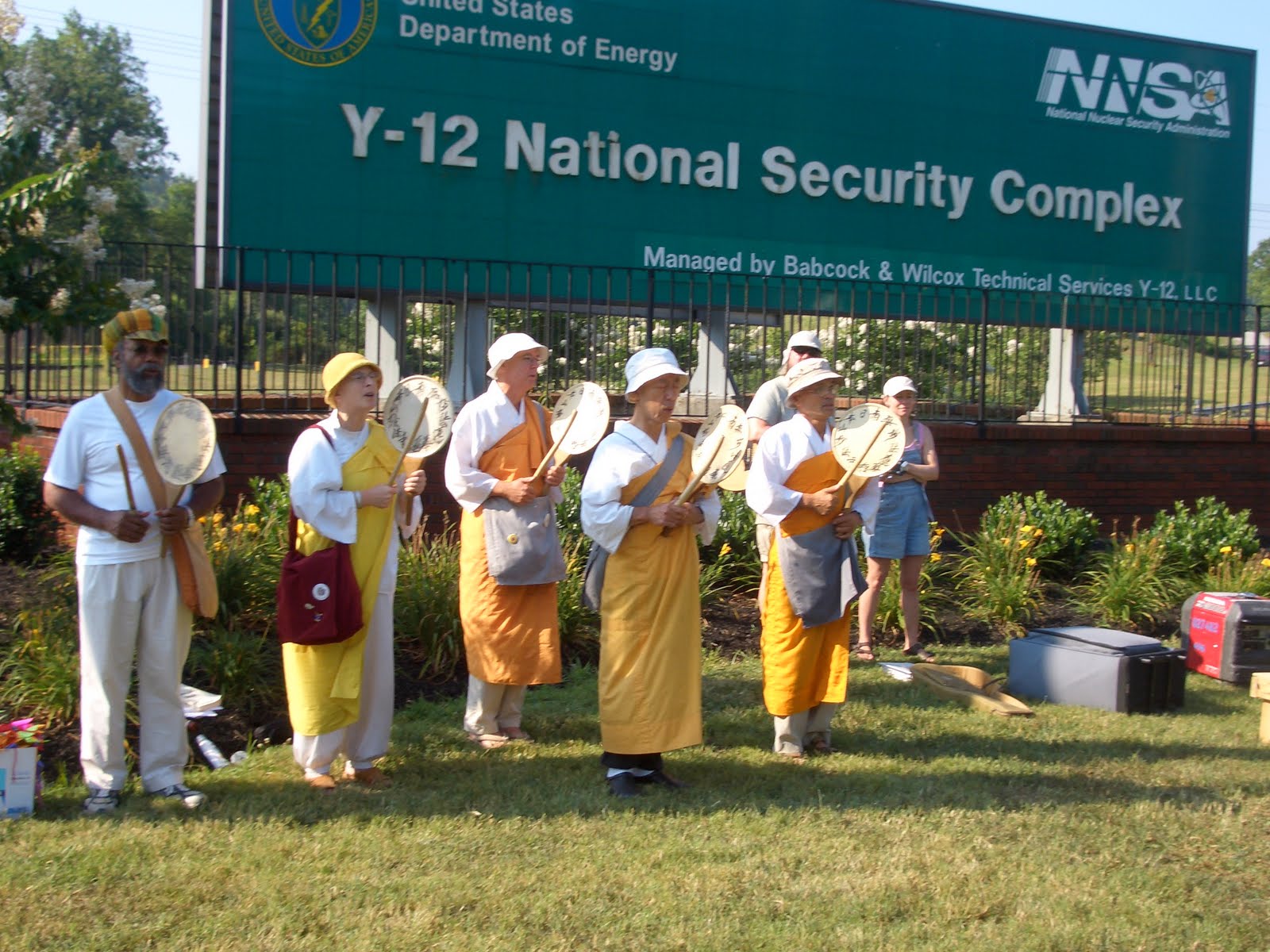
37 anti-nuclear activists were arrested this morning at the entrance to the Y-12 Nuclear Weapons Plant outside Oak Ridge, TN as part of a group under the statement “Declaration of Independence from Nuclear Weapons at Y-12”. Twenty-three people were arrested for blocking the highway entrance to the plant with a banner inscribed with “Independence From Nuclear Terrorism” while 14 others went under the barbed wire fence and nonviolently entered the property. The former group faces state “obstruction of highway” charges, a misdemeanor; the latter group faces federal trespass charges. This more serious charge can result in up to one year in prison and a fine of up to $1,000.

The group arrested included Steve Clemens from Minneapolis and Pepperwolf from Red Wing. Both are members of the local AlliantACTION group which protests radioactive weapons made by Minnesota’s largest war profiteer, Alliant Techsystems in Eden Prairie at a weekly vigil. They attended a weekend conference held in eastern Tennessee along with three others from the Twin Cities area. The conference, “Resistance for a Nuclear Free Future” was scheduled to celebrate the 30th anniversary of Nukewatch, The Nuclear Resister, and the Plowshares 8, the first act of nuclear disarmament by activists at the GE weapons facility in King of Prussia, PA.

Four of the original Plowshares 8 members were present as was the widow of a fifth. They were joined by close to two dozen other Plowshares activists, one of who has served over 18 years in prison for his nonviolent resistance to the bomb. Over two hundred attended the event held at Maryville College, about 25 miles from Oak Ridge, the site of the enrichment of the uranium for the first atomic bomb dropped by the US on Hiroshima, Japan in August 1945.

But the Y-12 Plant, renamed the “Y-12 National Security Complex” after the September 11th attacks, is not just an historical landmark – it remains as a central cog in the nuclear weapons machinery today. OREPA, the Oak Ridge Environmental Peace Alliance, is one of several groups organized in opposition to our present nuclear policy. They informed the conference about the misnamed “Life Extension Program” under which the Y-12 plant is refurbishing all US nuclear weapons so that they can continue to threaten others for another 100-120 years. Under the guise of “modernization”, they are part of a plan to build a whole new generation of nuclear weapons with greater accuracy – now to hit unknown targets with the collapse of the Soviet Union, the excuse used in the past to justify the trillions spent since the 1940s.

The arrested activists carried with them “A Declaration of Independence from Nuclear Weapons at Y-12”. Stating “… Current Law requires an end to all planning, preparation, production, threat, or use of nuclear weapons and adherence to the fundamental rules and principles of Humanitarian Law”, the declaration described the illegal nuclear weapons designed at the Y-12 plant and claimed that “… we exercise our duty to protect children and future generations.”

Ironically, the new START Treaty President Obama is pursuing is being coupled with a promise to spend billion of tax dollars to build newer nuclear weapons to replace some of those being dismantled by the Treaty in order to secure Republican votes in the Senate for it. In fact, Obama’s 2011 budget calls for an increase of 14% for the NNSA nuclear weapons program, the largest increase for any federal agency while at the same time calling for zero increase in education and the environment. As one conference speaker said, “follow the money. Bob Dylan once said, ‘Money doesn’t talk – it swears!’”

Despite the seriousness of the conference topic, there was much laughter and celebration. Guy and Candie Carawan, folk singing troubadours from the bygone labor and civil rights struggles traveled from nearby Highlander Center to lead the conference in songs; several anti-nuclear activists from Australia led a contingent of clowns which greatly enlivened the resistance arrests. Puppetistas and skits both informed and entertained. It was a celebration of continued nonviolent resistance to both nuclear power generation as well as nuclear weapons over the past three decades.

Many of those gathered had been “jailed for justice”, many meeting one another behind jail bars over the years. There were many joyful reunions from people scattered all over the country. Two of the veteran leaders of the movement told jokes or funny stories from their numerous protest actions. A priest in his 70s wept as he listened to a sister arrestee talk about what their action together decades ago did to change her life and inspire her life-long commitment to peace with justice.

Although many Americans associate the “ban the bomb” movement with either the 1950s or the 1980s, a young peoples contingent calling themselves “Think Outside the Bomb” is stepping forth to join the veterans of the anti-nuclear movement. And as politicians look desperately for alternatives to the environmental and climate threats posed by fossil fuels (think of the catastrophe in the Gulf of Mexico and the recent coal mine disaster, not to mention mountain-top removal or threats to wilderness areas), many are jumping on a bandwagon under the illusive promise of nuclear power as a “clean energy”. Nevermind the fact that Wall Street refuses to finance new nuclear facilities, there is no feasible solution to either nuclear waste storage nor any viable plan BP deep water oil rig.

This conference and the act of resistance by the activists are timely reminders that we must be careful of our decisions and directions, choosing peaceful, sustainable technologies for future generations and ourselves. Many of my own personal heroes and mentors were there including Liz McAlister

, Kathy Kelly , and Frank Cordaro. And I met several peace legends for the first time including Brad Lyttle, a Freedom Rider and activist since the 50s , Sr. Anne Montgomery, also in her 80s and continuing to resist. It was a privelege to be arrested with them.

Shades of Gray

Shades of Gray: Listening To the Infamous “Genocide Denier” by Steve Clemens. June 30, 2010

There were only a dozen or so of us gathered at the May Day Bookstore basement at 3PM on Monday afternoon. The hastily-scheduled event left little time to get out the word that the recently returned political prisoner/law professor Peter Erlinder was speaking about his arrest and imprisonment in Rwanda. The professor quickly explained as he began his presentation: he wanted to thank some of his supporters who wrote/called/demonstrated on his behalf during his recent ordeal – and he brought along with him the “real hero”, one of his Kenyan attorneys who risked his own freedom and life to stand up on Erlinder’s behalf.

Erlinder explained: “Before I traveled to Rwanda, an attorney representing [one of the many political prisoners in Rwanda] was safe. After I was arrested and imprisoned, any attorney coming in knew they might also suffer the same fate.” Thus, Gershon Otachi, one of two defense attorneys under the UN International Criminal Tribunal for Rwanda, showed special courage in standing up to represent Erlinder in his time of need.

I had heard Peter Erlinder about three years ago when he spoke at May Day about his work defending one of the Hutu military generals who was charged with genocide and conspiracy to commit genocide. It was my first exposure to hearing any variation on the theme of “what happened in Rwanda?” The dominant (and only story) given coverage by the US media was that of victimization of the Tutsi peoples by the Hutus –almost out of the blue – despite their living side-by-side for years.

In that previous presentation the William Mitchell law professor served as a historian. Erlinder patiently explained about the colonial history of central Africa and described the role of the Belgian, German, French, and English colonizers in the area and the practice of selecting a small group of local people to become the ruling elites under their overall control. He explained the way the Belgian colonizers gave educational and employment benefits to people they defined as Tutsi using artificial designations such as those who owned 10 cows or more rather than traditional tribal identities. What counted was not one’s birth heritage but rather the “tribal” identity given to one on their identification card or by the type of work they did. Understanding the “divide and conquer” strategy behind the colonial history helped me better understand some of underlying reasons behind the bottled-up violence and resentment that was orchestrated by both sides.

The missing piece for me was about President Kagame’s own background in all of this. In Erlinder’s current presentation, complete with maps of Africa and the specific areas of Rwanda, he explained how Kagame’s rebel army, the RPF, invaded Rwanda from Uganda in 1990, failing to capture the capital in Kigali primarily because of the government’s support from several European nations. (The government was headed by a Hutu, the majority group.) After that failure, Kagame retreated back into Uganda, receiving at least three huge shipments of arms and munitions and increasing his armed forces from 2,500 to 25,000 over the next three years.

It is believed that Kagame’s forces shot down the airplane carrying the Presidents of both Burundi and Rwanda in 1993 that, in turn, triggered much of the killing now identified as genocide. Erlinder does not deny the massive killing which occurred – he only says it is not black and white, the “good guys” vs the “bad guys”. The dominant storyline we’ve been told through the media and governmental sources paint the Hutus as perpetrators and the Tutsi as victims. A variation of this story says that some “moderate” Hutus were also killed yet Erlinder claims there are no monuments in the present Kagame-run Rwanda to any Hutu victims. Erlinder says his research shows only shades of gray. There was killing on both sides, depending on which group was dominant within certain areas. It is a complicated story but until or unless the truth comes out about complicity on both sides, there will be no healing there, Erlinder contends.

But, so far, only Hutus have been prosecuted by the International Criminal Tribunal for Rwanda (ICTR). However, Erlinder claims that Carla del Ponte, the chief UN Prosecutor for ICTR, told him that she was in the room when US officials passed on instructions that Kagame was NOT to be prosecuted for his role in the assassinations of the two Heads of State. The clue as to why, Erlinder contends, lies in the geopolitical struggle for regional and resource dominance.

During the post-colonial period between 1960 and 1990 with the rise of a generation of “independent” African leaders, there was an ideological battle reflective of the Cold War between “the West” and the Soviets. Elites jockeyed for power by aligning with one side over the other. The US remained stupefyingly silent to the dictatorial abuses of leaders like Mobutu (Zaire/Congo) and Mugabe (Zimbabwe) because they were steadfast “allies” against “the communists”. With the collapse of the Soviet empire in 1989, some of that competition shifted to between various western powers.

Now, with the rise of Chinese wealth and power, the struggle has resumed – primarily between the US empire (in decline) and the ascendency of that of China’s influence. How else can one explain the inordinate attention paid to the tragic deaths in Darfur (in Sudan) while ignoring the vastly greater numbers of rapes and murders by gangs and military forces in eastern Congo? Erlinder said more are killed “every four months” in the conflicts raging in eastern and central Congo than have died in the past number of years in Darfur.

So we protect Kagame, hoping that he will side with US interests over those of China. If only the need for truth didn’t get in the way – and the desire of human rights lawyers like Peter Erlinder and Gershon Otachi to offer a defense for those facing predominately political charges. According to Erlinder, the US is clearly complicit in the massive killings that occurred in 1994 having learned “the lesson” from the failed intervention in Somalia just prior to these new killing fields not to intervene directly in these “civil war”-type struggles. That didn’t prevent our supplying hundreds of tons of arms to Kagame’s RPF forces just months before all the killings occurred.

It was six years ago when Erlinder, in preparing the defense of one of his Rwandan clients, discovered the collection of UN documents which helped him piece together a narrative quite different than the one put forth by the media and many governments. He has collected them and made them available for others to read at the website www.rwandadocumentsproject.net. It is hard to change the dominate storyline which has been established in our minds for the past 30 years but Erlinder is hopeful in seeing signs that it is beginning to crack and change.

And, as part of a Foundation started by the hero of the Hotel Rwanda story (The Hotel Rwanda Rusesabagina Foundation), Erlinder and others are pushing for a Truth and Reconciliation Process similar to what happened in the post-apartheid period in South Africa. But for Erlinder, no reconciliation will be forthcoming until there is mutual acceptance of responsibility on all sides. Otherwise, each side continues to demonize each other that will lead only toward more violence.

Despite the shock and injustice of his arrest and subsequent jailing, Erlinder told us “I was treated better than Guantanamo prisoners – I wasn’t waterboarded or had a bag over my head. I wasn’t held for six years in solitary waiting for trial like one of my clients here in Minneapolis.” Although conditions in the first jail were brutal for this lawyer in his late 50s, he said the second Rwandan jail he was held in was “better than the conditions some of my clients experience in Hennepin County or other US lockups.”

So lets look and listen for stories that challenge the dominant narrative about genocide and who is responsible as well as who is complicit – but let’s especially focus on what role our own foreign and military policies contribute to these horrors – and then work for change here at home, not just “over there”.

Why I Joined the Picket Line


Why I Joined the Picket Line by Steve Clemens. June 10, 2010

I’ve never been a member of a union. In fact, I was raised in an anti-union family. My father-in-law broke a union picket line as a management-level worker before I was married. My lens was always from the management side of the labor equation.

My family of origin continues in the meat packing industry. From the age of 7 my brothers and I were required to work in the family business before and after school by my parents. My Dad paid me 15 cents/hour at the beginning in 1957 and I was ecstatic when I turned 15 and could get my “working papers” which qualified me for the current minimum wage of $1.15/hour. What could be a tale of the horrors of “child labor abuse” was instead a memory for me of family, teamwork, and pride in being able to contribute in a meaningful way at whatever age I was.

The family business prided itself in caring for its employees. Granted, my perspective (and relationship with the other employees) was necessarily affected by my father’s position as Vice President of the company. The other corporate officers were my uncles and I had other aunts and cousins to work alongside. I saw first-hand the working conditions, made friendships with fellow employees, and worked a variety of jobs within the firm before my last time of employment when I started graduate school in 1973. I took pride in the profit-sharing plan that was established early on for employees and heard recent stories how several workers I worked alongside in my youth have retired with more than a million dollars in their profit-sharing accounts after 40 or 50 year careers in the business.

I’m sure there were times of frustration and disagreement between some of the workers and my dad and my uncles but it seemed to me that their personal religious values and integrity was integral to the way they ran the family business. It appeared to me to be modeled more on compassion and charity than justice. Workers were paid the prevailing (union-established) wage for the meat packing industry and probably a little more – plus the profit-sharing plan which made the lure of union organizing within that company less appealing to those workers. The business saw the value of “giving back” to the community by always donating a minimum of 10% of the profits to charitable organizations before any dividends were paid to shareholders. But, working within the capitalist ethos, justice was skewed in that “management” shared disproportionately in the profits. Those taking “the risks” reaped most of the “rewards”. That may have been true in the early years of the business but after it was fully established, the risks became fewer as the rewards increased disproportionately. But capitalism is seldom concerned with justice and seemingly more concerned with channeling greed.

So what led me on my journey to the striking picket line in 2010?

Part of that answer is my wife’s profession. As a Registered Nurse, one is trained to advocate and care for one’s patients. When Christine switched professions from an elementary public school teacher to return to college for her RN degree, she did so in the context of living in rural southwestern Georgia. Unions were virtually nonexistent in the area in her early jobs as an RN in the local hospital, public health department, or the local primary care clinic in President Jimmy Carter’s hometown of Plains, GA. After some time away from the profession after our sons were born and then we moved “up north” to Minnesota, Christine returned to work again as a nurse.

In the past 19 years, she has watched the hospitals where she works as a post-partum (mother-baby) nurse grow more corporate and less compassionate in its treatment of both the workers and the patients. Cost-cutting measures seem paramount in the struggle with adequate staffing and patient care. LPNs and Nurses Aides are given part of the responsibilities often done by nurses in the past and then those positions are cut or reduced leaving many nurses overworked as they are understaffed. Much of the blame can rightly be shifted to an increasingly dysfunctional heathcare-for-profit-by-insurance model we presently endure. But it is often the nurse and the patient who suffers the brunt of present dysfunction.

When Christine looked at the present concession proposals demanded by the hospitals for the present contract negotiations, her first thought was: “Oh no, this looks a lot like the policies I faced in Georgia 30 years ago!” It wasn’t just the weather climate – but also the political climate – that led us to move to Minnesota.

Lord Acton told us “Power corrupts; absolute power corrupts absolutely”. Yes some unions are corrupt. I was raised with the sordid tales of Jimmy Hoffa and the Teamsters Union. As an anti-war demonstrator I experienced some of the racism and militarism of some powerful union leaders in the 1960s and 70s. And, it seems, the more powerful the unions become, the more danger there is of them being controlled by individuals seeking their own interests above the groups they purport to represent. On the other side, we find hospitals, many of which were started by compassionate religious groups, are now in the hands of large, “non-profit corporations” which act in the marketplace no different than for-profit corporations. Local hospital CEOs are pulling in million dollar a year salaries and their boards are peopled with the “movers and shakers” of the community rather than the pastors, social workers, and other “common folk” of their early years. Remember when the Sisters of St. Joseph of Carondolet ran St. Mary’s Hospital before it merged with the Lutheran Fairview – before it merged again with the University of MN? Sister Kate McDonald is no longer at the admitting desk, she’s now on the picket line!

I admit it: I am biased in this fight. I know Christine to be a committed, conscientious, and compassionate nurse. I am tired of having her return home from her latest shift to tell me how under-staffed her unit is at the hospital. She wants to have time to help new mothers learn the “art” of breastfeeding but is too often pulled away from that teaching and nurturing function by the other demands caused by having too few other support staff or being assigned too many patients. When many of her patients are recent immigrants with language or cultural challenges or young mothers with social or chemical challenges, it is crucial that proper care be rendered – especially when new life is now part of the equation. Even for those who seem to worship the “bottom line” should recognize the need – survey after survey reports that a positive birthing experience in a hospital often results in a positive life-long association for that patient’s family with that hospital. Good care can translate into good future “customer relations”. It should be enough to warm whatever cockles might still reside in that cold capitalist heart. Yet our economy seems to only care about immediate, short-term profits, cynically disregarding the long-term costs.

What we need are hospital administrators who recognize their employees as valuable assets rather than another group to divide and conquer. I think of the words of our late, great U.S. Senator, Paul Wellstone: “When we all do better, we all do better.” This strike is about insuring justice and right treatment for both workers and patients. It is no accident that the whole country is watching what happens to these Twin City nurses. If the hospitals are able to break the back of this union which is comprised of mostly white, middle-class women, are any other workers safe from a predatory capitalism which continues to destroy our natural environment (the Gulf of Mexico is just the most recent, egregious example) and the workers?

I stand (and march) with my wife and her co-workers. I carried the union sign with pride and gratitude.

"Depleted” Sounds Like It is Benign

I plan to join Women Against Military Madness (WAMM) in a fund-raising Walk Against Weapons on Saturday June 5th. We will walk to the entrance to Alliant Techsystems, Minnesota's largest war profiteer. WAMM's Director asked me to write briefly about the scourge of DU, one of ATK's profitable illegal weapons.

“Depleted” Sounds Like It is Benign by Steve Clemens

It is pyrophoric, probably carcinogenic and mutagenic, and when aerosolized, the ceramicized, minute particles can be readily inhaled or ingested. Why so many highfalutin words for something that is already “depleted”?

Uranium-238, aka depleted Uranium or DU, is a waste product remaining from the enrichment process used to process Uranium for use in nuclear weapons and as the fuel for nuclear power plants. While remaining radioactive, it is a less intensive (but longer-lasting) – thus earning the moniker of “depleted”.

As a metal, DU is heavier and denser than lead and has a similar toxicity in humans and animals if ingested. Heavy metal poisoning particularly affects organs like the kidney and liver. But DU’s radioactivity, mostly benign when used as ballast in airplanes and boats or as shielding in tanks and troop carriers, becomes a more potent factor when it is ingested or inhaled.

Military planners are always looking for a super weapon or silver bullet. They discovered that depleted uranium was much more effective in destroying hardened targets than traditional lead or titanium based munitions. As the DU projectile flies through the air, it burns (pyrophoric) and sloughs off tiny, minute particles which take on a hardened, non-soluble character due to the heat (ceramicized). According to military officials, the weapon “self-sharpens” and burns its way into the target. The heat created often ignites or explodes items within the target, further scattering the radioactive dust particles. These particles can enter the body when breathed in (inhaled), swallowed when the dust lands on food or water sources (ingested), or through cuts in the skin.

Doctors in Iraq in the area where DU weapons were used in the 1991 War have been alarmed by the huge increases of cancers and birth defects they have witnessed. While scientific proof of causation demands years of careful study (it took more than 35 years for the Army to admit Agent Orange caused cancer in Vietnam), the circumstantial evidence mounting in Iraq and Afghanistan and other battle areas where it has been used is substantial.

What is really depleted is the morality of designing, manufacturing, and profiting from a weapon which keeps on killing beyond the battlefield (when the sandstorms in Iraq and Afghanistan blow the radioactive dust particles up into the atmosphere where they land who-knows-where); it keeps killing long after a war has ended (with the half-life of 4 ½ billion years –so it will keep killing until it is cleaned up); it is inhumane in how it kills with the likely cancer-causing diseases, birth defects, and heavy-metal poisoning; and it harms the natural environment with its radioactive pollution. Any failure of these four tests make a weapon illegal according to international law experts. The fact that DU fails all four make it an especially heinous “weapon of mass indiscriminate destruction” (according to the UN).

Alliant Techsystems (ATK) profits from the manufacture and sale of these illegal and immoral weapons. This depleted morality must be converted to research for life-giving alternatives. Peace conversion with no loss of jobs.

A Difference Between Night and Day: A Tale of Two Judges


A Difference Between Night and Day: A Tale of Two Judges by Steve Clemens. April 25, 2010

My trials were 7 months apart, almost to the day. One was in neighboring Ramsey County, the other in my home county of Hennepin. Both were for the same charge: criminal trespass and both ended with a somewhat similar sentence: continuance towards dismissal with conditions. In Ramsey County it was “no same or similar for 1 year”; in Hennepin it was “no arrest for trespass at ATK for 6 months.” However, the Ramsey sentence, besides being longer in duration also harbored a more threatening restriction – no arrest [for protest] anywhere in the world, whereas the Hennepin County Court Judge, instead of threatening told us we were welcome to “return to the scene of the crime” (so to speak) by attending the weekly Wednesday morning vigil; we were just to avoid going on Alliant Techsystems property for the next six months. But, if we did, we’d still qualify to get the jury trial we originally planned for –albeit not a speedy one.

I think the differences we experienced in court demonstrate how subjective justice can be with our present system. Much of the experience depends on the judge assigned to one’s case. On the surface, I’d suppose that an African American judge might be somewhat more sympathetic to civil disobedience and principled public protest because without precisely that happening 50-60 years ago during the Civil Rights struggle, we would likely not have many jurists of color on the Bench. That said, one only has to look at the record of Clarence Thomas on the US Supreme Court to disabuse one of stereotyping Black judges as progressive.

But it was an African American District Court Judge I faced in September 2009 for the prior year’s arrest at the Republican National Convention. Judge Edward Wilson, however, had no patience whatsoever with our desire to discuss the US Constitution, International Treaties and Laws, UN Resolutions, or even the MN State Constitution in our “Claim of Right” defense for the trespass charge. Never before had I faced a judge so controlling in this my 5th jury trial on identical charges. In fact, 3 of the prior 4 juries found me “not guilty” after hearing our testimony; the only guilty verdict coming in the wake of 9/11 and the initial popularity of the Afghan War.

So, given Judge Wilson’s hostility, especially evident when I attempted to testify in my own behalf and was interrupted about 30 times by either the Judge or the Prosecutor, it was no surprise that the Ramsey County Judge slapped a $100 fine (or 20 hours of community service), insisting that it also be done in his county, not “anywhere in the world” like his “no arrest” restriction plus $81 in “court costs” which could not be substituted with community service.

The contrast in the Hennepin County Courthouse this week couldn’t have been more pronounced. At first, our trial date was set for April 15th, Income Tax Day. The assigning judge instructed us to go to Courtroom 753 and present our case to Judge Peter Cahill. I’ve written elsewhere about that experience (A Hearing in Lieu of a Trial) which concluded in an official Court Hearing on Friday, April 23rd. Over the weekend I wrote letters to ATK’s new CEO, Mark DeYoung as well as to Eden Prairie Police Lieutenant Tracy Luke inviting them and other arresting officers to attend the Hearing to see what we had to say. Email requests for media coverage were sent to local reporters as well in the days prior to the Hearing.

Promptly at 9 AM, Judge Cahill took the bench and welcomed us. I made a few prefatory remarks about how we wished to proceed and thanking Lt. Luke for her presence in the Courtroom. I made an Opening Statement on behalf of all the four defendants and then Sr. Kate McDonald took the stand. The 80-year old nun began by reading the “Commitment to Practice Nonviolence” statement that is read every Wednesday morning at the beginning of the circle of sharing time during the vigil by the driveway entrance to Alliant Techsystems. She described how she and 20-30 others come every week to call for the end of the production of indiscriminate weapons, calling instead for “peace conversion with no loss of jobs”. She talked about her present literacy teaching work with immigrants and why she felt the need to walk up the driveway on that October morning in an attempt to talk with the CEO of Minnesota’s largest weapons manufacturer.

Geri Eikaas, a 71-year old grandmother who joined the weekly vigil two years ago as the company was moving to Eden Prairie from Edina, took the stand next. She talked about her long involvement with Amnesty International in working to free political prisoners and prisoners of conscience. Recounting how that world-wide movement was sparked by the efforts of one man, Englishman Peter Banenson, who wanted to protest an unjust imprisonment of two students he had never met before who were given a 7-year prison sentence for “toasting freedom” in Portugal, Ms. Eikaas stated that individuals can do great, wonderful things. While she continues to write letters on behalf of political prisoners half a world away, she also wanted to personally address what was happening in her own backyard. On the witness stand she looked at a newspaper photo from 2004 of two Afghanis sitting on a wooden bench at a Red Cross center in Kabul. Both had lost a leg to Soviet landmines that had probably been planted in 1979. Those victims, she said, were part of the Soviet legacy. Noting Alliant’s manufacture of landmines, cluster bombs, and depleted uranium munitions, she said she didn’t want more victims as America’s legacy in that same nation. That is why she felt compelled to act.

Noting ATK’s claim that “If our American men & women are sent in harms way, we want to see them protected and we take that very seriously.” quoting Rod Bitz, one of their public relations staff, Geri went on to describe another spokesman for ATK’s ammunition division announcing their plan to “go after international business to offset any slump in our business with the U.S. Army.” Showing that ATK is now selling AK-47 bullets to Afghanistan, while also noting the estimate that about 1/3 of all material given to the Afghani Government ends up on the black market, she wryly asked, “How long do you think it will be before these same munitions are used on our American soldiers?” She ended with a sad question: “Who profits? Who Dies?”

The Judge was seen taking notes and was obviously engaged with the testimony. He paged through the 32-page document, Employee Liabilities of Weapons Manufacturers Under International Law, which the group had carried with them to give to the CEO; now the Judge had a copy, marked Exhibit 1 after it was put into evidence for the case. As Ms. Eikaas finished, he started to ask a question about some of these weapons but then said he’d wait to hear the rest of the testimony because he felt it might answer some of the questions he had. With that, he called another 71-year old defendant to the witness stand.

Roger Cuthbertson often flies one of his colorful kites on days when the wind is right during the vigil. One of the kites he likes to fly over the parking ramp in front of ATK’s entrance reads “PU DU” referencing his personal disgust and outrage over the manufacture, sale, and use of depleted uranium weapons. Roger described in greater detail how depleted uranium weapons and cluster bombs work in battle and continue to kill, maim, and cause serious health issues, primarily to civilians, long after a war has ended. His description of these weapons confirmed how indiscriminate they are in affecting not just other enemy combatants but also our own soldiers and civilians.

Mr. Cuthbertson told the court he had been a public school teacher for 32 years after serving two years in the Philippines as a Peace Corps Volunteer at its very beginning during President Kennedy’s Administration. He said, “I guess you could say that I have been a person interested in peace and justice and active citizenship, for about 50 years. I have been protesting against weapons production even before Alliant Tech was formed out of its parent company, Honeywell.”

After speaking at length about some of ATK’s indiscriminate weapons, Cuthbertson concluded, referencing the arrest took place during a special vigil honoring Mahatma Gandhi’s 140th birthday, “What was resonating in my mind on Oct 2, 2009 when I tried to visit ATK was Gandhi’s statement, “Whatever you do may seem insignificant to you, but it is most important that you do it.” I read this statement out loud to my friends gathered at ATK before our action. I did do something that day. What I did was not violent or threatening in any way. I did not hurt any one. I am not trying to evade the consequences of my action. I do not feel guilty of any committing any offense. I did not destroy property. I thought long and hard about my action before taking it. I made sure I was reasonably well informed. I thought of my children and my grand children and the kind of world I want for them and for the millions of children like them around the world. Some people were a little bit inconvenienced by my action, but that is all the harm that was done. What I did is to demand a chance to talk to the decision makers at Alliant Tech about their immoral, illegal activities. What ATK is doing is more than inconvenience. It is producing large scale violence and death for profit.”

It was shortly after 10 o’clock when I took the witness chair. I’m always a little nervous or anxious every time I’m called to testify although it seemed easier this time without the awkward position of having the Judge seated on one side of you and the jury on the other side. This time it was only the Judge, Court Reporter, the Court Clerk, and many friends in the audience section of the courtroom. Fortunately my wife had the day off from work and was able to be there in support. Besides a copy of what I had to say, I also carried photos, a letter, and a collection of other documents I carried on the day of my arrest which I hoped could be placed into evidence. Juggling all those things and trying to remember to pour a glass of water for my parched throat added to my own personal drama.

I described a little about myself and how a semester abroad in college sparked my interest in international law. My commitment to peacemaking saw its genesis when I had to register for the Draft during the height of the Vietnam War. Quoting what is known as “the supremacy clause” of the US Constitution, I then read brief excerpts from Treaties signed by our federal government that now are considered (according to the Constitution –if not most US Judges) “the supreme law of the land.” I read from The Hague and Geneva Conventions, the CCW Treaty of 1980, the Treaty establishing the Nuremberg Tribunals and the Nuremberg Principles. All of this to the effect of highlighting the prohibition in international law of “indiscriminate weapons.”

I recounted my journey to Iraq just prior to the start of this present war as part of the Iraq Peace Team. Showing photos of a Pediatric Cancer doctor and two of his patients, I shared what he told me about the dramatic rise of cancers in the area where depleted uranium was used in the 1991 War. I showed photos of myself and Iraqis in the area called “the Highway of Death” to see some of the destruction wrought by depleted uranium weapons in that first war. Showing an additional photo taken the day of the arrest of a new Iraqi friend, I described the Sister City visit of Dr. Najim Askouri, an Iraqi nuclear physicist, to Minneapolis in the two weeks prior to October 2 and how the letter I carried with me that day told ATK’s CEO about the Iraqi delegate’s deep concern and anger at the contamination of their country by dU weapons make by his company.

I concluded my testimony by describing how the International Committee of the Red Cross, charged by the United Nations with promulgation and promotion of the Laws of War, calls us to “sensitize public opinion” and use the national courts and the media to help implement it. That is one reason we think raising these concerns within the Judicial Branch of the government is necessary to help stop the scourge of these already illegal weapons. I ended by reciting the words to the song we sing each week as we gather for the vigil:

Who will speak if we don’t?
Who will speak so their voice will be heard?
Who will speak if we don’t?

We were in court to try to give voice to those thousands victims of war – especially the children who are disproportionately crippled, maimed, sickened, and killed by these indiscriminate weapons.

Our testimony had taken about 90 minutes. The Judge announced a recess so the Court Reporter could have a break and he said it would be a longer recess so he had time to consider written memoranda we gave him which better described the case law basis for our “claim of right” defense. When the Court resumed, Geri Eikaas gave a Closing Argument and then we awaited a response from Judge Peter Cahill.

Judge Cahill told us he was a Public Defender, a private criminal defense lawyer, a city prosecutor, and a county prosecutor before becoming a judge. He said he was curious about what we would have to say in our defense and then remarked, “I found a group of people who were very sincere, very compassionate, and I have to give you credit for one thing I don’t always see among protesters: and that is humility. There is not an arrogance about your message, there is more a plea for, almost a desperation, to hear of the injuries of others as you try to stop the violence you see around the world. That’s refreshing. I think your actions are consistent with the highest standards of the traditions of civil disobedience.”

He went on to say, “With all of you out-ranking me in age, you are the kind of people I want to be like when I grow older. Your message is serious and your message is compelling, as I said. The information you provided was very educational to me and worth my time.” …

“You may be right that depleted uranium munitions may violate international law. Cluster bombs might violate international law. But that’s not why we are here today. And to be honest, I think it is way above my pay grade as a State Trial Court Judge to decide those weighty issues of international law. I’m here because we have a trespass case. And this case demonstrates the tension that exists between property rights and what we hold to be the most sacred rights, the Bill of Rights, the First Amendment rights to freedom of expression.”

The Judge said he couldn’t speculate how a jury might have decided the case. He did admit, “If your claim of right, based on international law, is sincere and in good faith, it would amount to a defense.” Because of the disposition we had already agreed upon in choosing to accept a Hearing in lieu of a jury trial, the Judge did not have to determine our guilt or innocence. It seemed, at least to this defendant, that he was relieved that we had already decided that matter.

Then he told us, “I am imposing $1 in court costs – or, by your conscience, one hour of community service – which can’t include protest activity at Alliant Techsystems. I would encourage you to consider devoting time, maybe your hour, to Gillette Children’s Hospital.” He went on to tell us that his now deceased older sister had suffered from polio all her life and what wonderful care she had received at the local Children’s hospital. He sensed our own compassion and hoped we could channel some of it toward local children like he had received on behalf of his sister. I could tell we had connected on a human level. It was no longer an authority figure looking down at some criminals from the bench but rather fellow citizens wanting to make our community a better place for everyone.

It wasn’t just the sensitivity of the sentence imposed. It was the tone and demeanor of the Judge in the Courtroom that gave me the impression that I really had been heard. What a complete difference between those two Courtroom experiences, one on the east side of the Mississippi, the other on the west. I want a justice tempered by mercy, informed by compassion – calling us to a community that embraces those marginalized and too often victimized in the process. My morning in Courtroom 753 on Friday April 23 was a sign of hope that at least one Judge is ready to listen.

A New Strategy to Be Heard?

A Hearing in Lieu of a Trial by Steve Clemens. April 15, 2010

Four members of the weekly AlliantACTION circle that vigils every week by the entrance to Alliant Techsystems (ATK), Minnesota’s largest weapons manufacturer and war profiteer, were scheduled to have a jury trial today in Hennepin County Court. The four of us, Sister Kate McDonald, Roger Cuthbertson, Geri Eikaas, and myself were charged with trespass on October 2, 2009. It was the 140th anniversary of Gandhi’s birthday and in the spirit of this icon of nonviolence, the four of us attempted to carry documents into ATK’s corporate headquarters in Eden Prairie and ask to meet with their CEO or other corporate official.

The documents we carried were entitled “Employee Liabilities of Weapons Manufacturers Under International Law” and included a letter signed by the four of us, excerpts from International Treaties about indiscriminate weapons, and articles from the media about the use and effects of cluster bombs and depleted uranium munitions. We chose to accept arrest rather than leave without at least an appointment with an ATK official.

We intended to plead our case to a jury this morning, basing our defense on International Treaties signed by our government under the “Claim of Right” provision in Minnesota’s trespass statute. However, when we were assigned Judge Peter Cahill as our trial judge, he asked us if there was any way we could “settle the case” short of a jury trial. The prosecutor from Eden Prairie had already offered a deal of community service with little to no fine and the possibility of waiving court costs but each of us wanted our day in court.

When Judge Cahill asked me why I desired a jury trial instead of settling the case with little or no consequences, I told him that we wanted a public forum to educated the public on the illegal weapons made and sold by Alliant Techsystems. I informed the judge that the International Committee of the Red Cross, the organization charged by the United Nations with promulgating International Humanitarian Law (also referred to as the Laws of War), has said that “using the national courts”, and “pressure from the media and public opinion help insure implementation of IHL”.

The judge listened carefully and paused to consider what I had said. He noted that the four of us planned to go to trial without lawyers representing us and said he would abide by strict court procedures in what testimony or evidence he would allow before the jury. However, he asked if we would be willing to consider an alternative: he would make his courtroom available for half a day for a “hearing –on the record, with a court reporter” for us to present our case to him in a freer format than before a jury. We could call witnesses if we wished. He would allow freer reign in what evidence, including photos that we might wish to present. In exchange, he would issue a “continuance toward dismissal” of our case providing none of the four of us were arrested for trespass at ATK in the next six months. He would assess court costs to us between zero and $100 after he heard our testimony and evidence. We were free to invite the public and especially the media if we wanted to follow the Red Cross mandate to “sensitize public option”.

We requested to possibility of videotaping the testimony but were denied that request because Hennepin County is in the midst of internal discussions about considering adjustments to its present policy prohibiting it, noting that some might feel that this case would appear “too political” to some who already opposed any changes. The judge suggested we could invite local media to video any testimony we wished to give outside of the courtroom if we wished. The real question for us is this: does the local media even care? In the past, even with two consecutive “not guilty” verdicts from Hennepin County juries in December 2004, local media showed no interest in the story. “We’ve already covered those protests in the past” was a typical reply from the local major newspapers and the local TV stations weren’t interested without compelling video footage.

The four of us chose to accept the judge’s proposal as an experiment, a new option we haven’t had before. The judge reminded us that in accepting it, we were only waiving our right to a speedy trial. If, after the hearing, we felt dissatisfied, we could return to ATK and “cross the line” and be arrested again for trespass within the six month window, causing us to return to his courtroom for a jury trial. (Not that our right to a speedy trial had done us much good – it has been more than six months since the arrest for this day in court.)

Will the media be interested? Or will the defendants be merely “preaching to the choir” plus Judge Cahill? How do we best capture the attention of our fellow Minnesotans about the indiscriminate weapons marketed around the world by ATK? How do we give voice to the voiceless victims of what the United Nations has labeled “the weapons of mass indiscriminate destruction”? The Hearing is scheduled for Friday, April 23, 9-noon, in Courtroom 753 of the Hennepin County Government Center in downtown Minneapolis. Come hear a grandmother who just became active in the anti-indiscriminate weapon movement in the past two years tell why she was arrested for the first time. Hear one of the MacDonald sisters, radical nuns who have sung and protested for decades. Listen to a Peace Corp alumnus who taught geography for over 30 years and now flies colorful kites with messages about war, healthcare, and weapons. Come and lend your voice to public opinion calling for “peace conversion with no loss of jobs.”

Spiritual Formation and Civil Disobedience

The Spiritual Roots of Civil Disobedience: Active Peacemaking as Discipleship. by Steve Clemens @ St. Paul Lutheran Church of the Reformation- adult ed 3/28/10

The last time I was here was when Fred Phelps was here protesting out front at the ordination of Pastor Anita. I felt I needed to be here in support of her. And I met a few members from here who travelled to the SOA a couple of years ago. So I’m glad to be back. David [Weiss] asked me to share a few things from my early spiritual formation and my young adult years that have propelled and sustained me over a 40-year “career” of peace and justice activism. Then I hope to recount a couple of stories on that journey of resistance.

Early Formation

1. My Mennonite heritage: Both my parents were raised within the Mennonite Church but they chose to identify with the growing evangelical/fundamentalist movement just before I was born. So although I was baptized at age 12 in a “Mennonite church”, it was not affiliated with any local Mennonite conference. At home we had the requisite copy of The Martyr’s Mirror, a thick book with its gruesome illustrations of early church and Anabaptist martyrs being executed by the Roman state, Calvinists, Lutherans, or Catholics. My brothers and I learned to be comfortable with minority status within both Christian history and American culture. Within my evangelical heritage I was taught to take discipleship seriously with the expectation of “suffering for the sake of the Gospel”. [This was back before evangelicals were seduced by political power.]

It was this quasi-fundamentalist upbringing that made me familiar with the rich Biblical history of nonviolent resistance – from Shipra and Puah, the Hebrew midwives who challenged the edicts of the pharaoh; to Moses, Miriam and Aaron in the Exodus, Queen Esther, Daniel, Shadrach, Meshach, and Abednego; Jeremiah’s call to draft resistance; Ezekial’s street theater. Peter and John’s proclamation, “We must obey God rather than human authority”; and, of course the numerous actions of Jesus in challenging both the religious and civil authorities of his day. The Triumphal Entry and the Cleansing of the Temple were certainly acts of nonviolent resistance.

2. My Dad: My father broke with his Mennonite upbringing with his decision to enter the Army in World War II. However, he refused to talk about that experience when I was growing up. It wasn’t until after his 80th birthday that he first answered some of my questions to him about that experience. However, his experience caused him to instruct my brothers and me before going hunting as a teenager to “never aim your gun at something you don’t intend to kill – and, eat what you kill”. We had no TV in our home before I turned 13 and then we were not allowed to watch any “westerns” either because of all the gun-play.

3. My experience of sexual abuse: However, another significant factor in my formation occurred in elementary school. For a period of more than a year I was sexually abused by my Sixth Grade male teacher. My parents had taught me not to question authority and so I naturally intuited that this abuse was a punishment from a judgmental God for my sins. I now think that early experience of victimization produced a strong longing for social justice and sensitivity to victims in my adult life.

Young Adult Formation

1. ROTC and the Draft: Probably one of the most significant decisions I’ve made on my spiritual journey to peacemaking occurred at the age of 18. In my freshman year of college, I was issued a rifle and a uniform when I registered for classes. Wheaton College in 1968 had compulsory Army ROTC for all male students. I had to drill two mornings a week in my uniform with my spit-shined shoes and rifle and took Military Science classes three days a week. Two months into that experience, I had to register for the military draft with the Selective Service System during the height of the Vietnam War. When I chose to register as a Conscientious Objector, it began a life-long trajectory away from the American Dream and its cultural conformity.

2. Summer in the City: However, it took me a summer of working with black and Latino street gang kids in Philadelphia the next year before I made the shift from peacemaking as a personal stance to a socio-political lifestyle. I began to “connect the dots” in how I began to view social reality from the lens of those “left behind” from the American Dream. I had watched the landing on the moon in a slum tenement apartment as a rat ran across the room. To a person, the black folk in that apartment didn't believe we really put a man on the moon - they thought it was staged somewhere out in the Rocky Mountains - because they didn't want to believe our nation would spend billions of dollars for some fool to walk on the moon while they were living in those conditions.

3. Radical Catholics: When I returned to my conservative evangelical campus for my sophomore year, I decided that my protest against the war had to become a political stance. It was then that I encountered a radical priest from the near-by Maryknoll Seminary who was leading the weekly marches at the Wheaton Draft Board office. Finding common cause with a Catholic –let alone a priest!- was a major shift from what my parents had taught me. [I was told to “never date a Catholic” because the Bible said, “Be ye not unequally yoked with unbelievers”.]

The Road to Peacemaking

Mentors have always played a role in strongly influencing me on the journey that led me from personal stance to public protest to prison for the sake of conscience.

1. Ladon Sheats and Clarence Jordan: After spending a year in graduate school, I chose to drop out of school to do Voluntary Service, a valued experience within the Mennonite and Conscientious Objector tradition. I first met the man who would become a significant peace mentor in my voluntary service orientation. Ladon Sheats was a former IBM executive who quit his job after meeting Clarence Jordan in order to join the intentional Christian Community called Koinonia Partners in southwest Georgia. Ladon gave a “Values Presentation”, a multi-media performance that compared and contrasted the “values” of American culture and the Way of Jesus. Rugged Individualism, materialism, and militarism were set alongside interdependence, community and simple living, and cooperation. Ladon’s call to a radical discipleship was challenging and compelling. We were called to choose which values we would live by. After my year of voluntary service, I moved to southwest Georgia, joined that community, and found both a spiritual and physical home for the next 16 years.

2. Liz Macalester and Phil Berrigan: However, before moving to Koinonia, in my year of voluntary service in Wash, DC, I was invited to join a Bible Study group led by Phil Berrigan and Elizabeth Macalester of the Jonah House resistance community. We read Abraham Heschel’s book The Prophets and wrestled with what the prophetic call was to the followers of Jesus. It was the gentle prodding and pulling of Liz Macalester that led me to my first arrest at the White House in the waning days of the Vietnam War 35 years ago this month.

3. Impact of books and speakers: All along this journey, I was fed, challenged, and nurtured by books and magazines, speakers, and conferences. John Howard Yoder re-introduced me to my Anabaptist heritage; William Stringfellow helped me understand the realities of spiritual powers and principalities. Dick Gregory helped me appreciate the value of humor in social change; Jesse Jackson was inspiring and celebratory as he encouraged me to take the “next step”. Daniel Berrigan, Ched Myers, and Jim Wallis all joined a growing cadre of mentors for me in “the Movement”. All of these, and many others, helped me move from a position of White Male Heterosexual Privilege to one of solidarity – an essential challenge to those who would embrace peacemaking as a vocation. More recently, that journey has included an inter-faith component and a growing desire to broaden my embrace of many other styles and traditions of peacemaking without watering down my own Christian motivation and inspiration.

Clarence Jordan, founder of Koinonia, often talked about fear being “the polio of the soul which keeps us from walking by faith”. He said, “Faith is not believing in spite of the evidence but rather living in scorn of the consequences.” His call to discipleship challenged and inspired me to take actions that stretched me and liberated me. I’d like to briefly share a couple of them with you.

Pantex

In 1981, the first year of Reagan’s presidency and his policy to threaten nuclear destruction on any who would oppose us, I joined a group of six who decided to take our prayers for peace to the center of our nuclear weapons complex: the Pantex Planet, the final assembly point of all US nuclear weapons located just outside Amarillo, Texas. After several days of Bible Study, prayer, and conversation, we planned to scale the 12 foot chain-link fences topped with barbed wire to nonviolently enter the facility to pray.

We knew from the previous “scouting reports” done by others in the group that this was one of the most heavily fortified or protected sites in the country. Along with guard towers, two fences, and rumors of both a tank as well as bazookas and other heavy weapons, the plethora of guards would also be armed with automatic weapons and would probably not take kindly to a motley crew attempting to scale their fortress. It was with a sense of foreboding that I wrote letters to both my parents and my intentional community which I gave to my wife to be delivered in the event of my death.

Yet I was reminded and inspired by the insight of Dan Berrigan who had written about the Apostle Paul’s insistence in his letter to the Galatians that our baptism “into Christ’s death” and our “raising to new life” ought to give us a confidence to act within the grace bestowed upon us. [I had memorized the verse as a kid: I have been crucified with Christ, nevertheless, I live; yet not I, but Christ liveth within me. And the life that I now live, I live by the faith of the Son of God who loved me and gave his life for me. Gal 2:20] Dan reminded his readers that there is nothing the State can do to us that we haven’t already chosen to undergo in our baptism. If we have truly “died with Christ”, the State can imprison us –or even kill us- but we’re already “dead” and the “life we now lead, we have by the grace and power of the Spirit”. There is nothing The Powers can do to us that we haven’t already voluntarily chosen in choosing to follow the way of the nonviolent Jesus. This confidence gives us the power to act in the face of their threats – our faith can overcome our fears.

I clearly remember that cold, blizzardly day in February 1981 as we drove our cars onto the 10-mile square weapons facility, headed for the ultra-secure area ringed by the double fences. I was nervous but I felt the fear lift and I had this amazing feeling of liberation as I chose to act on my convictions rather than my fears. Many times over the next six months in prison I thought about the power of those feelings. I still marvel today over the grace I received to sustain me in climbing that fence and in the County Jail and Federal Prison that followed. Little did we know that as a result of our witness, the Catholic Bishop of Amarillo would call all people of conscience to resign their jobs at Pantex!

Iraq Peace Team

20 years later I decided to update my will before my journey to Iraq just prior to the start of this present war in December 2002. I again drew on the strength of my faith over my fears. Kathy Kelly spoke in August at a rally to end the economic sanctions that were strangling the Iraqi people. But she spent much of her speech telling us that war was definitely “on the horizon”. She shared a vision of creating an “Iraq Peace Team” consisting of people of faith who would travel to Iraq to stand side-by-side Iraqis in an act of solidarity, facing the US bombs alongside them. When I heard her, I immediately thought, “this is something I could do”. But I didn’t dare “sign up” until first discussing it with my wife and kids! [Back in 1981, I didn’t have kids - and my wife and two other close friends travelled to Texas with me.]

I’ve always felt a disconnect about protesting war “over there” from the safety of my home “over here”. The vision of the Iraq Peace Team was to put our bodies where our prayers were directed – to embody peace. That has been one of my goals in doing direct action/civil disobedience over the years. Christian Peacemaker Teams (one of the two co-sponsors of the Iraq Peace Team) uses the motto: “Getting in the Way” – meaning following the Way of the nonviolent Jesus while also interposing oneself between those intending violence and oppression and the intended victims.

What I learned in Iraq was the graciousness and hospitality of people who were supposed to be “the enemy”. Even though my country was publicly threatening to “shock and awe” the Iraqis into submission, they were able to discriminate the difference between me as an American citizen and my government – something many Americans did not seem to be able to do whenever the demonizing name of “Saddam Hussein” was mentioned. I admit there were times when I was nervous and “concerned” in the face of clear oppression exhibited while in Iraq under Saddam –even though I was there only for two weeks. The fear spread by the heavy-handedness of the government was palpable. So I was especially appreciative that there were others who accompanied me as part of the Team. But I was also keenly aware of the prayers and thoughts of my friends and community back home. Even though I returned before the bombs dropped, I felt a deep satisfaction at being willing to be there.


I’d like to read a few brief excerpts from Dan Berrigan’s No Bars to Manhood published in 1969 at the height of the Vietnam War:

We have assumed the name of peacemakers, but we have been, by and large, unwilling to pay any significant price. And because we want the peace with half a heart and half a life and will, the war, of course, continues, because the waging of war, by its nature, is total – but the waging of peace, by our own cowardice, is partial. … But what of the price of peace? …

“Of course let us have the peace”, we cry, “but at the same time let us have normalcy, let us lose nothing, let our lives stand intact, let us know neither prison nor ill repute nor disruption of ties.” …

because of this we cry peace and cry peace, and there is no peace. There is no peace because there are no peacemakers. There are no makers of peace because the making of peace is at least as costly as the making of war – at least as exigent, at least as disruptive, at least as liable to bring disgrace and prison and death in its wake.

I’ve learned over the years to try to never act alone. Even if you might be the only one risking arrest, have a support group present if possible. But, the bottom line is that it has been my experience that acting after considering the potential risks and costs has been a very liberating and empowering thing. Civil disobedience can be a spiritual discipline – declaring who is “Lord”, and who/what is not. It is the unmasking of idolatry. Here in our nation, national security is an idol from the Biblical perspective. Choosing to act despite ones fears allows ones faith to grow. For who or what are you willing to risk arrest or risk going to jail? What values do you hold dear enough to take some risks?