


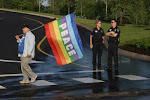

I plan to join Women Against Military Madness (WAMM) in a fund-raising Walk Against Weapons on Saturday June 5th. We will walk to the entrance to Alliant Techsystems, Minnesota's largest war profiteer. WAMM's Director asked me to write briefly about the scourge of DU, one of ATK's profitable illegal weapons.
“Depleted” Sounds Like It is Benign by Steve Clemens
It is pyrophoric, probably carcinogenic and mutagenic, and when aerosolized, the ceramicized, minute particles can be readily inhaled or ingested. Why so many highfalutin words for something that is already “depleted”?
Uranium-238, aka depleted Uranium or DU, is a waste product remaining from the enrichment process used to process Uranium for use in nuclear weapons and as the fuel for nuclear power plants. While remaining radioactive, it is a less intensive (but longer-lasting) – thus earning the moniker of “depleted”.
As a metal, DU is heavier and denser than lead and has a similar toxicity in humans and animals if ingested. Heavy metal poisoning particularly affects organs like the kidney and liver. But DU’s radioactivity, mostly benign when used as ballast in airplanes and boats or as shielding in tanks and troop carriers, becomes a more potent factor when it is ingested or inhaled.
Military planners are always looking for a super weapon or silver bullet. They discovered that depleted uranium was much more effective in destroying hardened targets than traditional lead or titanium based munitions. As the DU projectile flies through the air, it burns (pyrophoric) and sloughs off tiny, minute particles which take on a hardened, non-soluble character due to the heat (ceramicized). According to military officials, the weapon “self-sharpens” and burns its way into the target. The heat created often ignites or explodes items within the target, further scattering the radioactive dust particles. These particles can enter the body when breathed in (inhaled), swallowed when the dust lands on food or water sources (ingested), or through cuts in the skin.
Doctors in Iraq in the area where DU weapons were used in the 1991 War have been alarmed by the huge increases of cancers and birth defects they have witnessed. While scientific proof of causation demands years of careful study (it took more than 35 years for the Army to admit Agent Orange caused cancer in Vietnam), the circumstantial evidence mounting in Iraq and Afghanistan and other battle areas where it has been used is substantial.
What is really depleted is the morality of designing, manufacturing, and profiting from a weapon which keeps on killing beyond the battlefield (when the sandstorms in Iraq and Afghanistan blow the radioactive dust particles up into the atmosphere where they land who-knows-where); it keeps killing long after a war has ended (with the half-life of 4 ½ billion years –so it will keep killing until it is cleaned up); it is inhumane in how it kills with the likely cancer-causing diseases, birth defects, and heavy-metal poisoning; and it harms the natural environment with its radioactive pollution. Any failure of these four tests make a weapon illegal according to international law experts. The fact that DU fails all four make it an especially heinous “weapon of mass indiscriminate destruction” (according to the UN).
Alliant Techsystems (ATK) profits from the manufacture and sale of these illegal and immoral weapons. This depleted morality must be converted to research for life-giving alternatives. Peace conversion with no loss of jobs.

A Difference Between Night and Day: A Tale of Two Judges

A Difference Between Night and Day: A Tale of Two Judges by Steve Clemens. April 25, 2010
My trials were 7 months apart, almost to the day. One was in neighboring Ramsey County, the other in my home county of Hennepin. Both were for the same charge: criminal trespass and both ended with a somewhat similar sentence: continuance towards dismissal with conditions. In Ramsey County it was “no same or similar for 1 year”; in Hennepin it was “no arrest for trespass at ATK for 6 months.” However, the Ramsey sentence, besides being longer in duration also harbored a more threatening restriction – no arrest [for protest] anywhere in the world, whereas the Hennepin County Court Judge, instead of threatening told us we were welcome to “return to the scene of the crime” (so to speak) by attending the weekly Wednesday morning vigil; we were just to avoid going on Alliant Techsystems property for the next six months. But, if we did, we’d still qualify to get the jury trial we originally planned for –albeit not a speedy one.
I think the differences we experienced in court demonstrate how subjective justice can be with our present system. Much of the experience depends on the judge assigned to one’s case. On the surface, I’d suppose that an African American judge might be somewhat more sympathetic to civil disobedience and principled public protest because without precisely that happening 50-60 years ago during the Civil Rights struggle, we would likely not have many jurists of color on the Bench. That said, one only has to look at the record of Clarence Thomas on the US Supreme Court to disabuse one of stereotyping Black judges as progressive.
But it was an African American District Court Judge I faced in September 2009 for the prior year’s arrest at the Republican National Convention. Judge Edward Wilson, however, had no patience whatsoever with our desire to discuss the US Constitution, International Treaties and Laws, UN Resolutions, or even the MN State Constitution in our “Claim of Right” defense for the trespass charge. Never before had I faced a judge so controlling in this my 5th jury trial on identical charges. In fact, 3 of the prior 4 juries found me “not guilty” after hearing our testimony; the only guilty verdict coming in the wake of 9/11 and the initial popularity of the Afghan War.
So, given Judge Wilson’s hostility, especially evident when I attempted to testify in my own behalf and was interrupted about 30 times by either the Judge or the Prosecutor, it was no surprise that the Ramsey County Judge slapped a $100 fine (or 20 hours of community service), insisting that it also be done in his county, not “anywhere in the world” like his “no arrest” restriction plus $81 in “court costs” which could not be substituted with community service.
The contrast in the Hennepin County Courthouse this week couldn’t have been more pronounced. At first, our trial date was set for April 15th, Income Tax Day. The assigning judge instructed us to go to Courtroom 753 and present our case to Judge Peter Cahill. I’ve written elsewhere about that experience (A Hearing in Lieu of a Trial) which concluded in an official Court Hearing on Friday, April 23rd. Over the weekend I wrote letters to ATK’s new CEO, Mark DeYoung as well as to Eden Prairie Police Lieutenant Tracy Luke inviting them and other arresting officers to attend the Hearing to see what we had to say. Email requests for media coverage were sent to local reporters as well in the days prior to the Hearing.
Promptly at 9 AM, Judge Cahill took the bench and welcomed us. I made a few prefatory remarks about how we wished to proceed and thanking Lt. Luke for her presence in the Courtroom. I made an Opening Statement on behalf of all the four defendants and then Sr. Kate McDonald took the stand. The 80-year old nun began by reading the “Commitment to Practice Nonviolence” statement that is read every Wednesday morning at the beginning of the circle of sharing time during the vigil by the driveway entrance to Alliant Techsystems. She described how she and 20-30 others come every week to call for the end of the production of indiscriminate weapons, calling instead for “peace conversion with no loss of jobs”. She talked about her present literacy teaching work with immigrants and why she felt the need to walk up the driveway on that October morning in an attempt to talk with the CEO of Minnesota’s largest weapons manufacturer.
Geri Eikaas, a 71-year old grandmother who joined the weekly vigil two years ago as the company was moving to Eden Prairie from Edina, took the stand next. She talked about her long involvement with Amnesty International in working to free political prisoners and prisoners of conscience. Recounting how that world-wide movement was sparked by the efforts of one man, Englishman Peter Banenson, who wanted to protest an unjust imprisonment of two students he had never met before who were given a 7-year prison sentence for “toasting freedom” in Portugal, Ms. Eikaas stated that individuals can do great, wonderful things. While she continues to write letters on behalf of political prisoners half a world away, she also wanted to personally address what was happening in her own backyard. On the witness stand she looked at a newspaper photo from 2004 of two Afghanis sitting on a wooden bench at a Red Cross center in Kabul. Both had lost a leg to Soviet landmines that had probably been planted in 1979. Those victims, she said, were part of the Soviet legacy. Noting Alliant’s manufacture of landmines, cluster bombs, and depleted uranium munitions, she said she didn’t want more victims as America’s legacy in that same nation. That is why she felt compelled to act.
Noting ATK’s claim that “If our American men & women are sent in harms way, we want to see them protected and we take that very seriously.” quoting Rod Bitz, one of their public relations staff, Geri went on to describe another spokesman for ATK’s ammunition division announcing their plan to “go after international business to offset any slump in our business with the U.S. Army.” Showing that ATK is now selling AK-47 bullets to Afghanistan, while also noting the estimate that about 1/3 of all material given to the Afghani Government ends up on the black market, she wryly asked, “How long do you think it will be before these same munitions are used on our American soldiers?” She ended with a sad question: “Who profits? Who Dies?”
The Judge was seen taking notes and was obviously engaged with the testimony. He paged through the 32-page document, Employee Liabilities of Weapons Manufacturers Under International Law, which the group had carried with them to give to the CEO; now the Judge had a copy, marked Exhibit 1 after it was put into evidence for the case. As Ms. Eikaas finished, he started to ask a question about some of these weapons but then said he’d wait to hear the rest of the testimony because he felt it might answer some of the questions he had. With that, he called another 71-year old defendant to the witness stand.
Roger Cuthbertson often flies one of his colorful kites on days when the wind is right during the vigil. One of the kites he likes to fly over the parking ramp in front of ATK’s entrance reads “PU DU” referencing his personal disgust and outrage over the manufacture, sale, and use of depleted uranium weapons. Roger described in greater detail how depleted uranium weapons and cluster bombs work in battle and continue to kill, maim, and cause serious health issues, primarily to civilians, long after a war has ended. His description of these weapons confirmed how indiscriminate they are in affecting not just other enemy combatants but also our own soldiers and civilians.
Mr. Cuthbertson told the court he had been a public school teacher for 32 years after serving two years in the Philippines as a Peace Corps Volunteer at its very beginning during President Kennedy’s Administration. He said, “I guess you could say that I have been a person interested in peace and justice and active citizenship, for about 50 years. I have been protesting against weapons production even before Alliant Tech was formed out of its parent company, Honeywell.”
After speaking at length about some of ATK’s indiscriminate weapons, Cuthbertson concluded, referencing the arrest took place during a special vigil honoring Mahatma Gandhi’s 140th birthday, “What was resonating in my mind on Oct 2, 2009 when I tried to visit ATK was Gandhi’s statement, “Whatever you do may seem insignificant to you, but it is most important that you do it.” I read this statement out loud to my friends gathered at ATK before our action. I did do something that day. What I did was not violent or threatening in any way. I did not hurt any one. I am not trying to evade the consequences of my action. I do not feel guilty of any committing any offense. I did not destroy property. I thought long and hard about my action before taking it. I made sure I was reasonably well informed. I thought of my children and my grand children and the kind of world I want for them and for the millions of children like them around the world. Some people were a little bit inconvenienced by my action, but that is all the harm that was done. What I did is to demand a chance to talk to the decision makers at Alliant Tech about their immoral, illegal activities. What ATK is doing is more than inconvenience. It is producing large scale violence and death for profit.”
It was shortly after 10 o’clock when I took the witness chair. I’m always a little nervous or anxious every time I’m called to testify although it seemed easier this time without the awkward position of having the Judge seated on one side of you and the jury on the other side. This time it was only the Judge, Court Reporter, the Court Clerk, and many friends in the audience section of the courtroom. Fortunately my wife had the day off from work and was able to be there in support. Besides a copy of what I had to say, I also carried photos, a letter, and a collection of other documents I carried on the day of my arrest which I hoped could be placed into evidence. Juggling all those things and trying to remember to pour a glass of water for my parched throat added to my own personal drama.
I described a little about myself and how a semester abroad in college sparked my interest in international law. My commitment to peacemaking saw its genesis when I had to register for the Draft during the height of the Vietnam War. Quoting what is known as “the supremacy clause” of the US Constitution, I then read brief excerpts from Treaties signed by our federal government that now are considered (according to the Constitution –if not most US Judges) “the supreme law of the land.” I read from The Hague and Geneva Conventions, the CCW Treaty of 1980, the Treaty establishing the Nuremberg Tribunals and the Nuremberg Principles. All of this to the effect of highlighting the prohibition in international law of “indiscriminate weapons.”
I recounted my journey to Iraq just prior to the start of this present war as part of the Iraq Peace Team. Showing photos of a Pediatric Cancer doctor and two of his patients, I shared what he told me about the dramatic rise of cancers in the area where depleted uranium was used in the 1991 War. I showed photos of myself and Iraqis in the area called “the Highway of Death” to see some of the destruction wrought by depleted uranium weapons in that first war. Showing an additional photo taken the day of the arrest of a new Iraqi friend, I described the Sister City visit of Dr. Najim Askouri, an Iraqi nuclear physicist, to Minneapolis in the two weeks prior to October 2 and how the letter I carried with me that day told ATK’s CEO about the Iraqi delegate’s deep concern and anger at the contamination of their country by dU weapons make by his company.
I concluded my testimony by describing how the International Committee of the Red Cross, charged by the United Nations with promulgation and promotion of the Laws of War, calls us to “sensitize public opinion” and use the national courts and the media to help implement it. That is one reason we think raising these concerns within the Judicial Branch of the government is necessary to help stop the scourge of these already illegal weapons. I ended by reciting the words to the song we sing each week as we gather for the vigil:
Who will speak if we don’t?
Who will speak if we don’t?
Who will speak so their voice will be heard?
Who will speak if we don’t?
We were in court to try to give voice to those thousands victims of war – especially the children who are disproportionately crippled, maimed, sickened, and killed by these indiscriminate weapons.
Our testimony had taken about 90 minutes. The Judge announced a recess so the Court Reporter could have a break and he said it would be a longer recess so he had time to consider written memoranda we gave him which better described the case law basis for our “claim of right” defense. When the Court resumed, Geri Eikaas gave a Closing Argument and then we awaited a response from Judge Peter Cahill.
Judge Cahill told us he was a Public Defender, a private criminal defense lawyer, a city prosecutor, and a county prosecutor before becoming a judge. He said he was curious about what we would have to say in our defense and then remarked, “I found a group of people who were very sincere, very compassionate, and I have to give you credit for one thing I don’t always see among protesters: and that is humility. There is not an arrogance about your message, there is more a plea for, almost a desperation, to hear of the injuries of others as you try to stop the violence you see around the world. That’s refreshing. I think your actions are consistent with the highest standards of the traditions of civil disobedience.”
He went on to say, “With all of you out-ranking me in age, you are the kind of people I want to be like when I grow older. Your message is serious and your message is compelling, as I said. The information you provided was very educational to me and worth my time.” …
“You may be right that depleted uranium munitions may violate international law. Cluster bombs might violate international law. But that’s not why we are here today. And to be honest, I think it is way above my pay grade as a State Trial Court Judge to decide those weighty issues of international law. I’m here because we have a trespass case. And this case demonstrates the tension that exists between property rights and what we hold to be the most sacred rights, the Bill of Rights, the First Amendment rights to freedom of expression.”
The Judge said he couldn’t speculate how a jury might have decided the case. He did admit, “If your claim of right, based on international law, is sincere and in good faith, it would amount to a defense.” Because of the disposition we had already agreed upon in choosing to accept a Hearing in lieu of a jury trial, the Judge did not have to determine our guilt or innocence. It seemed, at least to this defendant, that he was relieved that we had already decided that matter.
Then he told us, “I am imposing $1 in court costs – or, by your conscience, one hour of community service – which can’t include protest activity at Alliant Techsystems. I would encourage you to consider devoting time, maybe your hour, to Gillette Children’s Hospital.” He went on to tell us that his now deceased older sister had suffered from polio all her life and what wonderful care she had received at the local Children’s hospital. He sensed our own compassion and hoped we could channel some of it toward local children like he had received on behalf of his sister. I could tell we had connected on a human level. It was no longer an authority figure looking down at some criminals from the bench but rather fellow citizens wanting to make our community a better place for everyone.
It wasn’t just the sensitivity of the sentence imposed. It was the tone and demeanor of the Judge in the Courtroom that gave me the impression that I really had been heard. What a complete difference between those two Courtroom experiences, one on the east side of the Mississippi, the other on the west. I want a justice tempered by mercy, informed by compassion – calling us to a community that embraces those marginalized and too often victimized in the process. My morning in Courtroom 753 on Friday April 23 was a sign of hope that at least one Judge is ready to listen.
A New Strategy to Be Heard?
A Hearing in Lieu of a Trial by Steve Clemens. April 15, 2010
Four members of the weekly AlliantACTION circle that vigils every week by the entrance to Alliant Techsystems (ATK), Minnesota’s largest weapons manufacturer and war profiteer, were scheduled to have a jury trial today in Hennepin County Court. The four of us, Sister Kate McDonald, Roger Cuthbertson, Geri Eikaas, and myself were charged with trespass on October 2, 2009. It was the 140th anniversary of Gandhi’s birthday and in the spirit of this icon of nonviolence, the four of us attempted to carry documents into ATK’s corporate headquarters in Eden Prairie and ask to meet with their CEO or other corporate official.
The documents we carried were entitled “Employee Liabilities of Weapons Manufacturers Under International Law” and included a letter signed by the four of us, excerpts from International Treaties about indiscriminate weapons, and articles from the media about the use and effects of cluster bombs and depleted uranium munitions. We chose to accept arrest rather than leave without at least an appointment with an ATK official.
We intended to plead our case to a jury this morning, basing our defense on International Treaties signed by our government under the “Claim of Right” provision in Minnesota’s trespass statute. However, when we were assigned Judge Peter Cahill as our trial judge, he asked us if there was any way we could “settle the case” short of a jury trial. The prosecutor from Eden Prairie had already offered a deal of community service with little to no fine and the possibility of waiving court costs but each of us wanted our day in court.
When Judge Cahill asked me why I desired a jury trial instead of settling the case with little or no consequences, I told him that we wanted a public forum to educated the public on the illegal weapons made and sold by Alliant Techsystems. I informed the judge that the International Committee of the Red Cross, the organization charged by the United Nations with promulgating International Humanitarian Law (also referred to as the Laws of War), has said that “using the national courts”, and “pressure from the media and public opinion help insure implementation of IHL”.
The judge listened carefully and paused to consider what I had said. He noted that the four of us planned to go to trial without lawyers representing us and said he would abide by strict court procedures in what testimony or evidence he would allow before the jury. However, he asked if we would be willing to consider an alternative: he would make his courtroom available for half a day for a “hearing –on the record, with a court reporter” for us to present our case to him in a freer format than before a jury. We could call witnesses if we wished. He would allow freer reign in what evidence, including photos that we might wish to present. In exchange, he would issue a “continuance toward dismissal” of our case providing none of the four of us were arrested for trespass at ATK in the next six months. He would assess court costs to us between zero and $100 after he heard our testimony and evidence. We were free to invite the public and especially the media if we wanted to follow the Red Cross mandate to “sensitize public option”.
We requested to possibility of videotaping the testimony but were denied that request because Hennepin County is in the midst of internal discussions about considering adjustments to its present policy prohibiting it, noting that some might feel that this case would appear “too political” to some who already opposed any changes. The judge suggested we could invite local media to video any testimony we wished to give outside of the courtroom if we wished. The real question for us is this: does the local media even care? In the past, even with two consecutive “not guilty” verdicts from Hennepin County juries in December 2004, local media showed no interest in the story. “We’ve already covered those protests in the past” was a typical reply from the local major newspapers and the local TV stations weren’t interested without compelling video footage.
The four of us chose to accept the judge’s proposal as an experiment, a new option we haven’t had before. The judge reminded us that in accepting it, we were only waiving our right to a speedy trial. If, after the hearing, we felt dissatisfied, we could return to ATK and “cross the line” and be arrested again for trespass within the six month window, causing us to return to his courtroom for a jury trial. (Not that our right to a speedy trial had done us much good – it has been more than six months since the arrest for this day in court.)
Will the media be interested? Or will the defendants be merely “preaching to the choir” plus Judge Cahill? How do we best capture the attention of our fellow Minnesotans about the indiscriminate weapons marketed around the world by ATK? How do we give voice to the voiceless victims of what the United Nations has labeled “the weapons of mass indiscriminate destruction”? The Hearing is scheduled for Friday, April 23, 9-noon, in Courtroom 753 of the Hennepin County Government Center in downtown Minneapolis. Come hear a grandmother who just became active in the anti-indiscriminate weapon movement in the past two years tell why she was arrested for the first time. Hear one of the MacDonald sisters, radical nuns who have sung and protested for decades. Listen to a Peace Corp alumnus who taught geography for over 30 years and now flies colorful kites with messages about war, healthcare, and weapons. Come and lend your voice to public opinion calling for “peace conversion with no loss of jobs.”
Four members of the weekly AlliantACTION circle that vigils every week by the entrance to Alliant Techsystems (ATK), Minnesota’s largest weapons manufacturer and war profiteer, were scheduled to have a jury trial today in Hennepin County Court. The four of us, Sister Kate McDonald, Roger Cuthbertson, Geri Eikaas, and myself were charged with trespass on October 2, 2009. It was the 140th anniversary of Gandhi’s birthday and in the spirit of this icon of nonviolence, the four of us attempted to carry documents into ATK’s corporate headquarters in Eden Prairie and ask to meet with their CEO or other corporate official.
The documents we carried were entitled “Employee Liabilities of Weapons Manufacturers Under International Law” and included a letter signed by the four of us, excerpts from International Treaties about indiscriminate weapons, and articles from the media about the use and effects of cluster bombs and depleted uranium munitions. We chose to accept arrest rather than leave without at least an appointment with an ATK official.
We intended to plead our case to a jury this morning, basing our defense on International Treaties signed by our government under the “Claim of Right” provision in Minnesota’s trespass statute. However, when we were assigned Judge Peter Cahill as our trial judge, he asked us if there was any way we could “settle the case” short of a jury trial. The prosecutor from Eden Prairie had already offered a deal of community service with little to no fine and the possibility of waiving court costs but each of us wanted our day in court.
When Judge Cahill asked me why I desired a jury trial instead of settling the case with little or no consequences, I told him that we wanted a public forum to educated the public on the illegal weapons made and sold by Alliant Techsystems. I informed the judge that the International Committee of the Red Cross, the organization charged by the United Nations with promulgating International Humanitarian Law (also referred to as the Laws of War), has said that “using the national courts”, and “pressure from the media and public opinion help insure implementation of IHL”.
The judge listened carefully and paused to consider what I had said. He noted that the four of us planned to go to trial without lawyers representing us and said he would abide by strict court procedures in what testimony or evidence he would allow before the jury. However, he asked if we would be willing to consider an alternative: he would make his courtroom available for half a day for a “hearing –on the record, with a court reporter” for us to present our case to him in a freer format than before a jury. We could call witnesses if we wished. He would allow freer reign in what evidence, including photos that we might wish to present. In exchange, he would issue a “continuance toward dismissal” of our case providing none of the four of us were arrested for trespass at ATK in the next six months. He would assess court costs to us between zero and $100 after he heard our testimony and evidence. We were free to invite the public and especially the media if we wanted to follow the Red Cross mandate to “sensitize public option”.
We requested to possibility of videotaping the testimony but were denied that request because Hennepin County is in the midst of internal discussions about considering adjustments to its present policy prohibiting it, noting that some might feel that this case would appear “too political” to some who already opposed any changes. The judge suggested we could invite local media to video any testimony we wished to give outside of the courtroom if we wished. The real question for us is this: does the local media even care? In the past, even with two consecutive “not guilty” verdicts from Hennepin County juries in December 2004, local media showed no interest in the story. “We’ve already covered those protests in the past” was a typical reply from the local major newspapers and the local TV stations weren’t interested without compelling video footage.
The four of us chose to accept the judge’s proposal as an experiment, a new option we haven’t had before. The judge reminded us that in accepting it, we were only waiving our right to a speedy trial. If, after the hearing, we felt dissatisfied, we could return to ATK and “cross the line” and be arrested again for trespass within the six month window, causing us to return to his courtroom for a jury trial. (Not that our right to a speedy trial had done us much good – it has been more than six months since the arrest for this day in court.)
Will the media be interested? Or will the defendants be merely “preaching to the choir” plus Judge Cahill? How do we best capture the attention of our fellow Minnesotans about the indiscriminate weapons marketed around the world by ATK? How do we give voice to the voiceless victims of what the United Nations has labeled “the weapons of mass indiscriminate destruction”? The Hearing is scheduled for Friday, April 23, 9-noon, in Courtroom 753 of the Hennepin County Government Center in downtown Minneapolis. Come hear a grandmother who just became active in the anti-indiscriminate weapon movement in the past two years tell why she was arrested for the first time. Hear one of the MacDonald sisters, radical nuns who have sung and protested for decades. Listen to a Peace Corp alumnus who taught geography for over 30 years and now flies colorful kites with messages about war, healthcare, and weapons. Come and lend your voice to public opinion calling for “peace conversion with no loss of jobs.”
Spiritual Formation and Civil Disobedience
The Spiritual Roots of Civil Disobedience: Active Peacemaking as Discipleship. by Steve Clemens @ St. Paul Lutheran Church of the Reformation- adult ed 3/28/10
The last time I was here was when Fred Phelps was here protesting out front at the ordination of Pastor Anita. I felt I needed to be here in support of her. And I met a few members from here who travelled to the SOA a couple of years ago. So I’m glad to be back. David [Weiss] asked me to share a few things from my early spiritual formation and my young adult years that have propelled and sustained me over a 40-year “career” of peace and justice activism. Then I hope to recount a couple of stories on that journey of resistance.
Early Formation
1. My Mennonite heritage: Both my parents were raised within the Mennonite Church but they chose to identify with the growing evangelical/fundamentalist movement just before I was born. So although I was baptized at age 12 in a “Mennonite church”, it was not affiliated with any local Mennonite conference. At home we had the requisite copy of The Martyr’s Mirror, a thick book with its gruesome illustrations of early church and Anabaptist martyrs being executed by the Roman state, Calvinists, Lutherans, or Catholics. My brothers and I learned to be comfortable with minority status within both Christian history and American culture. Within my evangelical heritage I was taught to take discipleship seriously with the expectation of “suffering for the sake of the Gospel”. [This was back before evangelicals were seduced by political power.]
It was this quasi-fundamentalist upbringing that made me familiar with the rich Biblical history of nonviolent resistance – from Shipra and Puah, the Hebrew midwives who challenged the edicts of the pharaoh; to Moses, Miriam and Aaron in the Exodus, Queen Esther, Daniel, Shadrach, Meshach, and Abednego; Jeremiah’s call to draft resistance; Ezekial’s street theater. Peter and John’s proclamation, “We must obey God rather than human authority”; and, of course the numerous actions of Jesus in challenging both the religious and civil authorities of his day. The Triumphal Entry and the Cleansing of the Temple were certainly acts of nonviolent resistance.
2. My Dad: My father broke with his Mennonite upbringing with his decision to enter the Army in World War II. However, he refused to talk about that experience when I was growing up. It wasn’t until after his 80th birthday that he first answered some of my questions to him about that experience. However, his experience caused him to instruct my brothers and me before going hunting as a teenager to “never aim your gun at something you don’t intend to kill – and, eat what you kill”. We had no TV in our home before I turned 13 and then we were not allowed to watch any “westerns” either because of all the gun-play.
3. My experience of sexual abuse: However, another significant factor in my formation occurred in elementary school. For a period of more than a year I was sexually abused by my Sixth Grade male teacher. My parents had taught me not to question authority and so I naturally intuited that this abuse was a punishment from a judgmental God for my sins. I now think that early experience of victimization produced a strong longing for social justice and sensitivity to victims in my adult life.
Young Adult Formation
1. ROTC and the Draft: Probably one of the most significant decisions I’ve made on my spiritual journey to peacemaking occurred at the age of 18. In my freshman year of college, I was issued a rifle and a uniform when I registered for classes. Wheaton College in 1968 had compulsory Army ROTC for all male students. I had to drill two mornings a week in my uniform with my spit-shined shoes and rifle and took Military Science classes three days a week. Two months into that experience, I had to register for the military draft with the Selective Service System during the height of the Vietnam War. When I chose to register as a Conscientious Objector, it began a life-long trajectory away from the American Dream and its cultural conformity.
2. Summer in the City: However, it took me a summer of working with black and Latino street gang kids in Philadelphia the next year before I made the shift from peacemaking as a personal stance to a socio-political lifestyle. I began to “connect the dots” in how I began to view social reality from the lens of those “left behind” from the American Dream. I had watched the landing on the moon in a slum tenement apartment as a rat ran across the room. To a person, the black folk in that apartment didn't believe we really put a man on the moon - they thought it was staged somewhere out in the Rocky Mountains - because they didn't want to believe our nation would spend billions of dollars for some fool to walk on the moon while they were living in those conditions.
3. Radical Catholics: When I returned to my conservative evangelical campus for my sophomore year, I decided that my protest against the war had to become a political stance. It was then that I encountered a radical priest from the near-by Maryknoll Seminary who was leading the weekly marches at the Wheaton Draft Board office. Finding common cause with a Catholic –let alone a priest!- was a major shift from what my parents had taught me. [I was told to “never date a Catholic” because the Bible said, “Be ye not unequally yoked with unbelievers”.]
The Road to Peacemaking
Mentors have always played a role in strongly influencing me on the journey that led me from personal stance to public protest to prison for the sake of conscience.
1. Ladon Sheats and Clarence Jordan: After spending a year in graduate school, I chose to drop out of school to do Voluntary Service, a valued experience within the Mennonite and Conscientious Objector tradition. I first met the man who would become a significant peace mentor in my voluntary service orientation. Ladon Sheats was a former IBM executive who quit his job after meeting Clarence Jordan in order to join the intentional Christian Community called Koinonia Partners in southwest Georgia. Ladon gave a “Values Presentation”, a multi-media performance that compared and contrasted the “values” of American culture and the Way of Jesus. Rugged Individualism, materialism, and militarism were set alongside interdependence, community and simple living, and cooperation. Ladon’s call to a radical discipleship was challenging and compelling. We were called to choose which values we would live by. After my year of voluntary service, I moved to southwest Georgia, joined that community, and found both a spiritual and physical home for the next 16 years.
2. Liz Macalester and Phil Berrigan: However, before moving to Koinonia, in my year of voluntary service in Wash, DC, I was invited to join a Bible Study group led by Phil Berrigan and Elizabeth Macalester of the Jonah House resistance community. We read Abraham Heschel’s book The Prophets and wrestled with what the prophetic call was to the followers of Jesus. It was the gentle prodding and pulling of Liz Macalester that led me to my first arrest at the White House in the waning days of the Vietnam War 35 years ago this month.
3. Impact of books and speakers: All along this journey, I was fed, challenged, and nurtured by books and magazines, speakers, and conferences. John Howard Yoder re-introduced me to my Anabaptist heritage; William Stringfellow helped me understand the realities of spiritual powers and principalities. Dick Gregory helped me appreciate the value of humor in social change; Jesse Jackson was inspiring and celebratory as he encouraged me to take the “next step”. Daniel Berrigan, Ched Myers, and Jim Wallis all joined a growing cadre of mentors for me in “the Movement”. All of these, and many others, helped me move from a position of White Male Heterosexual Privilege to one of solidarity – an essential challenge to those who would embrace peacemaking as a vocation. More recently, that journey has included an inter-faith component and a growing desire to broaden my embrace of many other styles and traditions of peacemaking without watering down my own Christian motivation and inspiration.
Clarence Jordan, founder of Koinonia, often talked about fear being “the polio of the soul which keeps us from walking by faith”. He said, “Faith is not believing in spite of the evidence but rather living in scorn of the consequences.” His call to discipleship challenged and inspired me to take actions that stretched me and liberated me. I’d like to briefly share a couple of them with you.
Pantex
In 1981, the first year of Reagan’s presidency and his policy to threaten nuclear destruction on any who would oppose us, I joined a group of six who decided to take our prayers for peace to the center of our nuclear weapons complex: the Pantex Planet, the final assembly point of all US nuclear weapons located just outside Amarillo, Texas. After several days of Bible Study, prayer, and conversation, we planned to scale the 12 foot chain-link fences topped with barbed wire to nonviolently enter the facility to pray.
We knew from the previous “scouting reports” done by others in the group that this was one of the most heavily fortified or protected sites in the country. Along with guard towers, two fences, and rumors of both a tank as well as bazookas and other heavy weapons, the plethora of guards would also be armed with automatic weapons and would probably not take kindly to a motley crew attempting to scale their fortress. It was with a sense of foreboding that I wrote letters to both my parents and my intentional community which I gave to my wife to be delivered in the event of my death.
Yet I was reminded and inspired by the insight of Dan Berrigan who had written about the Apostle Paul’s insistence in his letter to the Galatians that our baptism “into Christ’s death” and our “raising to new life” ought to give us a confidence to act within the grace bestowed upon us. [I had memorized the verse as a kid: I have been crucified with Christ, nevertheless, I live; yet not I, but Christ liveth within me. And the life that I now live, I live by the faith of the Son of God who loved me and gave his life for me. Gal 2:20] Dan reminded his readers that there is nothing the State can do to us that we haven’t already chosen to undergo in our baptism. If we have truly “died with Christ”, the State can imprison us –or even kill us- but we’re already “dead” and the “life we now lead, we have by the grace and power of the Spirit”. There is nothing The Powers can do to us that we haven’t already voluntarily chosen in choosing to follow the way of the nonviolent Jesus. This confidence gives us the power to act in the face of their threats – our faith can overcome our fears.
I clearly remember that cold, blizzardly day in February 1981 as we drove our cars onto the 10-mile square weapons facility, headed for the ultra-secure area ringed by the double fences. I was nervous but I felt the fear lift and I had this amazing feeling of liberation as I chose to act on my convictions rather than my fears. Many times over the next six months in prison I thought about the power of those feelings. I still marvel today over the grace I received to sustain me in climbing that fence and in the County Jail and Federal Prison that followed. Little did we know that as a result of our witness, the Catholic Bishop of Amarillo would call all people of conscience to resign their jobs at Pantex!
Iraq Peace Team
20 years later I decided to update my will before my journey to Iraq just prior to the start of this present war in December 2002. I again drew on the strength of my faith over my fears. Kathy Kelly spoke in August at a rally to end the economic sanctions that were strangling the Iraqi people. But she spent much of her speech telling us that war was definitely “on the horizon”. She shared a vision of creating an “Iraq Peace Team” consisting of people of faith who would travel to Iraq to stand side-by-side Iraqis in an act of solidarity, facing the US bombs alongside them. When I heard her, I immediately thought, “this is something I could do”. But I didn’t dare “sign up” until first discussing it with my wife and kids! [Back in 1981, I didn’t have kids - and my wife and two other close friends travelled to Texas with me.]
I’ve always felt a disconnect about protesting war “over there” from the safety of my home “over here”. The vision of the Iraq Peace Team was to put our bodies where our prayers were directed – to embody peace. That has been one of my goals in doing direct action/civil disobedience over the years. Christian Peacemaker Teams (one of the two co-sponsors of the Iraq Peace Team) uses the motto: “Getting in the Way” – meaning following the Way of the nonviolent Jesus while also interposing oneself between those intending violence and oppression and the intended victims.
What I learned in Iraq was the graciousness and hospitality of people who were supposed to be “the enemy”. Even though my country was publicly threatening to “shock and awe” the Iraqis into submission, they were able to discriminate the difference between me as an American citizen and my government – something many Americans did not seem to be able to do whenever the demonizing name of “Saddam Hussein” was mentioned. I admit there were times when I was nervous and “concerned” in the face of clear oppression exhibited while in Iraq under Saddam –even though I was there only for two weeks. The fear spread by the heavy-handedness of the government was palpable. So I was especially appreciative that there were others who accompanied me as part of the Team. But I was also keenly aware of the prayers and thoughts of my friends and community back home. Even though I returned before the bombs dropped, I felt a deep satisfaction at being willing to be there.
I’d like to read a few brief excerpts from Dan Berrigan’s No Bars to Manhood published in 1969 at the height of the Vietnam War:
We have assumed the name of peacemakers, but we have been, by and large, unwilling to pay any significant price. And because we want the peace with half a heart and half a life and will, the war, of course, continues, because the waging of war, by its nature, is total – but the waging of peace, by our own cowardice, is partial. … But what of the price of peace? …
“Of course let us have the peace”, we cry, “but at the same time let us have normalcy, let us lose nothing, let our lives stand intact, let us know neither prison nor ill repute nor disruption of ties.” …
because of this we cry peace and cry peace, and there is no peace. There is no peace because there are no peacemakers. There are no makers of peace because the making of peace is at least as costly as the making of war – at least as exigent, at least as disruptive, at least as liable to bring disgrace and prison and death in its wake.
I’ve learned over the years to try to never act alone. Even if you might be the only one risking arrest, have a support group present if possible. But, the bottom line is that it has been my experience that acting after considering the potential risks and costs has been a very liberating and empowering thing. Civil disobedience can be a spiritual discipline – declaring who is “Lord”, and who/what is not. It is the unmasking of idolatry. Here in our nation, national security is an idol from the Biblical perspective. Choosing to act despite ones fears allows ones faith to grow. For who or what are you willing to risk arrest or risk going to jail? What values do you hold dear enough to take some risks?
[Almost] An American Hero

Alberto Mora: (Almost) An American Hero by Steve Clemens. March 23, 2010
Alberto Mora spoke with clarity and conviction. As a life-long Republican, Mora was appointed by President George W. Bush as the General Counsel of the US Navy from 2001 to 2006. While in this position, he served as a strong, vocal critic within the Administration arguing that the policy of “enhanced interrogations” ordered by the President were not only illegal but also counterproductive in the so-called War on Terror.
Speaking at the U of MN’s Humphrey Institute of Public Affairs today on the topic, Military Justice in an Age of Terrorism, Mora chose to draw a sharper line for criticizing the human rights abuses that led to the torture scandals of Abu Ghraib and Guantanamo. Mora argued on using a lesser standard than “was it torture?” - Did the policies and practices allowed and encouraged by the Bush Administration constitute “cruelty”? Citing the 8th Amendment to the US Constitution, Mora described the prohibition of “cruel and unusual punishment” as the appropriate threshold rather than the higher threshold of “torture”. Not all cruelty rises to the level of torture but all torture is cruel, he observed. And cruelty, the lesser standard is the Constitutional threshold in our law.
Dressed and comported like the conservative corporate lawyer he is in present practice (he has worked for Wal-Mart and now works for the Mars candy company), Mora expressed his alarm at what he witnessed over the past several years by quoting French philosopher Albert Camus: “You don’t kill values with the same weapons you use to defend them.” The lawyer said that the cruelty practiced at Abu Ghraib and Gitmo was not merely an abstraction but concrete, verifiable, individual acts. He went on to describe briefly the myriad degradations that a detainee, sometimes referred to as the 20th hijacker, Mohammed al-Katani, underwent in US custody. The list of abuses was long and Mora stated that one of the US Army’s own attorneys testified in court that his treatment met the definition of torture. “The fact that we tortured people is now not open to debate”, Mora claimed.
There were six beliefs or assumptions that were underlying the past Administration’s policies that led to this practice of cruelty (and torture) that Mora outlined. The Bush government assumed such policies and practices were 1) necessary to protect us against further attacks; 2) no law prohibited it; 3) the President as Commander-in-Chief was not limited by other laws during wartime; 4) it would not hurt our national interest or our security strategy; 5) no one would care; and 6) no one would be held accountable. Mora stated that all these assumptions have proven false although #6 is “still in doubt”.
“These policies were distributed and abuses occurred”, Mora continued. However, these constitutional rights against cruelty are rights granted to everyone, not just citizens – and everywhere. He elaborated on the point of how these acts of cruelty have seriously damaged the “legacy of American Foreign Policy”. Citing the Nuremberg Tribunals, the Geneva Conventions, and today’s German Constitution (adopted in 1949 with the help from the US) as landmarks for recognition of US Foreign Policy that raised standards of human rights and responsibilities around the globe, Mora argued that our practice of cruelty after the attacks of 9-11 had lessened and weakened our moral authority as a nation. Stating that “the War on Terror” will not be won by military means and how European cooperation seriously diminished as word of our practice and policy of cruelty came to light, Mora showed the ineffectiveness of the “gloves-off” policy that continues to be championed by Vice President Cheney today.
“We’ve compromised ourselves in the war of ideas”, he went on, and he told the over-flowing audience that “many flag officers I’ve talked with believe the #1 and #2 causes of US Military deaths in Iraq are due to Abu Ghraib and Guantanamo”, referring to the outrage which fueled the Iraqi insurgency in 2005 and 2006. “Cruelty was not legal, not necessary, and not effective”, he claimed. He went as far as stating “Every military officer I have spoken to feels [this policy and practice of cruelty] is counter-productive and contemptible.” Military people do not want to abandon the moral high ground, he observed. “What was once unspeakable [torture and cruelty] is now discussed in polite conversation.”
His remarks were greeted with enthusiastic applause and Vice President Mondale joined Alberto Mora for the question/answer period that followed. Professor Larry Jacobs, the host and moderator asked Mora to respond to the culturally popular “ticking time-bomb” scenario frequently used by proponents of the “enhanced methods”. Responding in a similar fashion to the Biblical story of Abraham dickering with God about sparing Sodom and Gomorrah if only a few righteous folk could be found, this lawyer took apart the faulty assumption behind this theory. We often start by saying hundreds of thousands of lives might be saved, he argued, but what if it were only a few thousand, or a few hundred, or even two? A commander in Iraq who just lost two of his soldiers to an IED the day before might be tempted to torture a captured Iraqi in hopes that he’ll be able to prevent the loss of two more soldiers the next day. Local cops might want to torture a suspect who is detained after a child goes missing locally to [hopefully] prevent other children from the danger. Where do you draw the line once you embark down that slippery slope? We could justify cruelty upon any suspicion, he observed. He has yet to hear of any authentic case where cruelty/torture has prevented a “ticking time-bomb” incident despite the popularity of the TV show 24.
It was refreshing to hear all of this from someone who continues to identify himself as a Republican. Larry Jacobs told the crowd at the conclusion that Mora “is an American Hero”. I almost agree. One of Jacobs’ questions, however, caused me to re-think that accolade (at least partially): Jacobs, reading from a card submitted by an audience member asked the speaker what he thought about Daniel Ellsberg’s plea for there to be more “whistle-blowers” within the government to bring these illegal activities to light as he did in leaking the Pentagon Papers in the early 1970s. Mora described the moral and legal dilemma military officers were put in when their oath to uphold the Constitution conflicted with the orders coming from the Commander-in-Chief. He talked about how he wrote memos strongly disagreeing with the policy but admitted that he didn’t “leak” them to the press.
Would he have made more of a difference with a public resignation or clandestinely leaking his memos? We won’t know. I am grateful he is speaking out now in clear, unequivocal terms. He is supporting the important healing and advocacy work of the Center for Victims of Torture, singling them out as one of the groups lending a critical voice to the public conversation of trying to reclaim the ideals proclaimed in the Constitution. He and Mondale both advocated that a Truth Commission or similar investigatory group (hopefully bi-partisan) be established to try to prevent these policies of cruelty to be justified again.
Until we are willing as a people and a nation to honestly repent for the cruelty done under the pretext of “national security”, we will need the reminders of the protesters clad in orange jumpsuits and black hoods standing in front of the Federal Courthouse or by the University of St. Thomas Law School (where one of the memo writers providing legal “cover” for Bush now teaches) calling for accountability.
A Call for Christian Tree-Huggers

A Sapling at the Birth of Jesus? By Steve Clemens. Feb. 28, 2010
After spending a week of Bible Study on Jesus and Eco-justice (at the Bartimaeus Institute), I made a pilgrimage to one of America’s oldest cathedrals: the stand of giant Sequoia trees in Kings Canyon National Park, about 5 hours northeast of Los Angeles. The Park Rangers estimate the unfortunately named General Grant Tree as being between 1600 and 2000 years old with the nearby larger General Sherman Tree as likely more than 2200 years old. Growing from a sapling which sprouts from a seed the size and shape of an oat flake, these gargantuan trees are more than 40 feet in diameter at their base and often reach into the clouds at their growing altitude of 5000-7000 feet elevation. Weighing an estimated 1,300 + tons, they might serve as a substitute for the amazing mustard seed of Jesus’ parables- something that grows huge from a tiny start.

When 5 or 6 of these behemoth trees grow near each other like they do just a few hundred feet from the General Grant, they form a cathedral as every bit awe inspiring as those built in medieval Europe. Yet it took an act of Congress to make the area the second National Park in the U.S. after hearing the pleas from John Muir to halt the logging of these special trees. Many had already been chopped or sawed down before Congressional action allowed the preservation of the remaining ones to be enjoyed more than 100 years later. It is reported that it took two men 13 days to chop and saw one of these sequoias in order to topple it in the late 1800s.

It was only recently that environmentalists recognized that fire is one of the factors that help these trees grow: the heat from the flames help open the egg-sized and shaped pine cones allowing the seeds to germinate in the soil mixed with ashes. The incredibility thick bark on the Sequoia trunks help shield the trees from most of the fire’s effect although many of the ancient giants show some burn marks around the base of the trees. Some of the fallen trees have had the inside of the tree hollowed out from fire.
I wonder if these trees had not been protected before 1900 if we would bother doing it today. Our capitalism run amuck seems hell-bent on privatizing the Commons and seeking to monetize whatever we can exploit in the natural realm. Maybe naming these two trees after Civil War generals was a stroke of genius – at least our society’s warped values offer respect and deference to conquering warriors. If the trees were named after Walter Rausenbush or Eugene V. Debs, true American giants of the social justice variety, they probably would have fallen to the wood cutters’ axe in the same way as they’ve been chopped out of most U.S. history textbooks.
Our week of Bible Study echoed the phrase, “You can’t save a place you don’t love. You can’t love a place you don’t know. You can’t know a place about which you haven’t learned.” Unfortunately, the giant Sequoia trees of Kings Canyon don’t lie in my home bio-region. But they are a heritage for all of us to appreciate and enjoy. They are worth a pilgrimage if you find yourself in central California.
In the Bible Study we were reminded several times about how important trees are in the Scriptures: Abraham made his first altar under the oak at Shechem. He built another at the Oak of Mamre. We spent a lot of time exploring the role that the Cedars of Lebanon have played in both Biblical and secular history - they were coveted by many empires and rulers, especially King Solomon who used them to build his Temple. The Phoenicians used the cedar to build their ships when they dominated the Mediterranean world. The Assyrian invaders took their war chariots (our present day tanks) up to the hills of Lebanon to secure the theft of this war booty. What once was the crowning glory of Lebanon today is only a small stand of these world-renown trees after 5,000 years of assault. Isaiah the prophet claims that the trees exault with praise after the empires which clear-cut them were defeated. Finally, the last vision in Revelation is the image of the Tree of Life healing all the nations.
Generals Grant and Sherman “earned their stripes” militarily in the Manifest Destiny wars against Mexico and our own Native Americans. They were part of the imperial project which has characterized our nation since its founding. Although our politicians see us as the “last, best hope for the world” (American exceptionalism) the world of nature has experienced us as one of the more prolific destroyers. What an irony to name these sentinels of the forest after a man who burned his way through Georgia during the Civil War and another whose initials came to stand for “unconditional surrender”.
Despite the heavy snow at that elevation last night, coupled with my disappointment at being unable to see the General Sherman Tree yesterday because I didn’t have chains on the tires of my rental car, the Park Rangers were able to plow overnight which allowed me access to the other park entrance this morning. The trees were flocked with heavy snow but those branches just drooped gracefully, occasionally dropping clumps of their white, wet load on those of us worshiping at their bases.

Ched Myers, our Bible Study leader and theological animator,introduced me to his “Grandmother Oak” about 20 minutes from his home in the Ojai Valley on Friday evening. It took four of us linking hands to surround the trunk of this live oak that must be 500-600 years old. Now with these “Grandfather Sequoias”, I’ll need to appropriate the Native American practice of referring to the deity as Grandfather/mother next time I recite the Lord’s Prayer. Certainly the power and compassion of the God Jesus revealed to us is fully present in these gifts of nature. The Apostle Paul reminds us that “all creation is waiting for we humans to take off our masks of domination and co-optation” and join together to both defend, celebrate and stand with it.
Have You Been To Jail For Justice?

Casting My Vote For Peace by Steve Clemens Feb. 3, 2010
In the fall of 2008 I was in a quandary. Do I vote for a candidate promising hope and change (albeit with a vague commitment to continue the war in Afghanistan and a healthcare reform plan that fell way short of a singer-payer fix) or for one of the others on the ballot who more closely reflected my values in key areas -knowing though there was no chance of their winning, given our two-party stranglehold in US politics?
Well, one year after President Obama’s inauguration, I took the opportunity to “cast my vote” outside his back door. (If the White House address is 1600 Pennsylvania Avenue, then the Rose Garden is in the front lawn but the public sidewalk closest to it is on the north, or back side.)
Thirty years ago, my friends from the Jonah House community invited us to “cast our votes at the Pentagon” since both major party Presidential candidates (Carter and Reagan) were trying to outdo each other on who would better stand up to the Soviets in their invasion and occupation in Afghanistan. So when Kathy Kelly and Voices for Creative Nonviolence announced a Peaceable Assembly Campaign last fall with two weeks of nonviolent protest at the White House at the end of January, I was eager to once again join in.
The campaign draws its name from the First Amendment to the US Constitution where we are guaranteed a right “to peaceably assemble and petition the Government for a redress of grievances”. Our first President warned us about getting entangled in foreign wars yet most of my lifetime has been littered with wars, invasions, occupations, overthrowing other governments, or military threats: Korea, Iran, Guatemala, Cuba, Indochina, Central America … the Cold War, “hot” wars, wars by proxy (remember Reagan’s “Contras” in Nicaragua and his “freedom fighters” in Afghanistan?), wars of economic deprivation (13 years of “sanctions” in Iraq). It is hard to find a time since my birth in 1950 when we didn’t fear a nuclear holocaust, “communist uprisings” to our south, and now the threat of terrorism. Even when we are not fighting wars, we dominate and oppress others through economic means via NAFTA, IMF, the World Bank and other strategies that kill and destroy as much as war. Just ask our Mexican neighbors who used to grow corn. I have a lot of “grievance” against my government’s policies!
So my vote was cast with my body: by laying down in a symbolic “die-in” in front of the home and office of the Commander-in-Chief. No more war. No more occupation. I do not consent.
Of course, such a vote often has immediate consequences: warnings, then handcuffs, followed by “the long arm of the law” - actually, more accurately, selective laws. Property laws, not International Law. Trespassing, not Treaties. In court we are told we stand charged with “unlawful assembly” when clearly our intent was to “peaceably assemble”. We are charged with “disorderly conduct” when we clearly communicated our intent to law enforcement present, conducted ourselves with order and dignity, and fully cooperated upon arrest. The third charge, which was the initial one cited by arresting officers, was “failure to obey a lawful order”. We clearly failed to obey an order to leave the area where we were protesting. On that charge, most of us were willing to either pay a fine, plead guilty, or no contest.
As the saying goes, “if you can’t do the time, don’t do the crime.” But there is another saying, this one from Anne Feeney’s progressive song, “Have you been to jail for justice? If so, I wanna shake your hand.” When you cast your vote with your body, you join a group that includes Gandhi, Dorothy Day, Susan B. Anthony, Cesar Chavez, King, Mandela, and a host of others. While mainstream society prizes a PhD, those who dissent often carry a different alphabet: FBOP (Federal Bureau of Prisons), or DOC (Department of Corrections).
The purpose of jail or prison as I’ve experienced it is designed to remind you that you are not in control anymore. Someone else will decide if/what you may eat, where you will sleep, your movements will be restricted and regimented. When you are released, sympathetic friends say “it must have been hard” – but this is the everyday reality for people of color and the poor in our society. It is good to remind ourselves of that reality – especially white males who are used to being “in control”.
So, “Don’t cry for me, Argentina” – it is your democracy that is at stake. Is it worth (nonviolently) fighting for? Is it worth the time, effort, and discomfort to try to set it straight? What is the psychic cost to us if we don’t act, if we acquiesce?
Jail isn’t the only option. Some “cast their vote” in the Peace Corps, a Catholic Worker House, the soup kitchen or food bank. Others spend their lives and careers healing the sick and caring for the dying. Educating our youth in underfunded and over-crowded schools. Every day these citizens are voting for a better nation with their bodies and minds.
Lest we think that it is only our President (with or without the consent of Congress) that declares war, there is the on-going war on the poor. When the Governor uses “unallotment powers” to strip the needy of medical benefits and slash the budget of the Hennepin County Medical Center, he is declaring war. Some of us need to “vote” at the governor’s mansion. When the bankers and mortgage companies trick and defraud homeowners with impossible-to-pay adjustable rate mortgages – while at the same time lining up for government bailouts – they are declaring war on the vulnerable. We should “vote” in their lobbies and vaults as well.
We need to do a lot of “peaceable assembling” because we have a lot of grievances that need addressing. Don’t leave it to my friends in their 60’s, 70’s, and 80’s. Walk (and lie down) beside them. Let them know they are not alone. If we want a different America, if we want real hope and change, we can’t wait on politicians and “civic leaders”, we must get engaged ourselves. You don’t have to wait until the primaries or a general election to vote. Vote with your feet. Vote in the street. Vote with your money. Vote with your “honey” (or at least a friend) – it’s always good to have someone who shares your values to sit in the back of the paddy wagon with your hands cuffed!
How you vote on Election Day might matter in a close election. (Ask Al Franken and Norm Coleman.) But how you “vote” with your time and resources more fully reveals your true values.
Subscribe to:
Posts (Atom)