


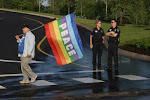

A Victory for Conscience and International Law
By Steve Clemens, Dec. 10, 2004
A jury of six women returned a verdict of “not guilty” in the trial of 4 Christian peacemakers in Minneapolis today. John and Marie Braun, Carol Masters, and Steve Clemens were charged with criminal trespass on July 21, 2004 when they attempted to enter the corporate headquarters of Alliant TechSystems in Edina, MN. The four were attempting to deliver a letter and documents to corporate officers concerning “Employee Liabilities of Weapons Manufacturers Under International Law.” After requesting to meet with one of four corporate officers, the four were arrested after they refused to leave the premises without at least an appointment to meet with them at a future date.
If convicted, the defendants could have faced up to 90 days in jail and/or a fine of up to $1,000. They chose to request a jury trial instead of accepting an offer to plead guilty in exchange for “community service”. Speaking to a jury, they felt, can help spread the word about International Law and the realities of these weapons.
The trial, presided over by Judge Regina M. Chu, focused on a provision in the MN trespass law which provides for “a claim of right”. The defendants successfully argued that it was reasonable for them to be on the property of this weapons manufacturer because of treaties signed by the United States. Quoting Article VI of the US Constitution where International Treaties signed by our government are identified as “the supreme law of the land”, the defendants then offered into evidence excerpts from the Hague and Geneva Conventions, the CCW Treaty, and the Nuremberg Principles. The Judge also permitted inclusion of articles the defendants had read prior to their nonviolent action that influenced their intent that day.
All four defendants testified in a moving fashion, bringing tears to some eyes in the courtroom. The International Law offered into evidence prohibits the manufacture, sale, or use of weapons which are indiscriminate. Those are weapons which continue to kill after a war has ended, those that aren’t limited to the field of battle, those causing unnecessary suffering and are inhumane, and those which cause long-lasting damage to the natural environment. The four testified that Alliant TechSystems is the primary manufacturer of anti-personnel landmines, cluster bombs, and depleted uranium weapons for the US Military. They described the effects of these weapons, showing them to be indiscriminate and thus illegal.
Two of the defendants, Marie Braun and Steve Clemens, testified about their trips to Iraq and the impact that made on them, causing them to take action against these weapons after seeing first-hand the results of their use on the civilian population of Iraq since the 1991 war. They testified that cluster bombs and depleted uranium weapons were used in even greater numbers in the war in Iraq that began in March 2003 and continues today.
Carol Masters told the jury about the effects of exposure to depleted uranium to US troops to remind all of us that they are being victimized as well as the Iraqi population. John Braun described the brutal and inhumane effects of landmines, cluster bombs and depleted uranium. He urged the jury to “look at the larger picture” when considering the charges against us.
While we celebrate this legal victory, there is much more work to do. Another group of four conscientious citizens from the Annathoth Community in Luck, WI are presently on trial for the same offense committed the week following the July 21 action. Four more groups of 3-5 people face trials for the same witness in the coming months. But while a modest celebration is in order (six sister citizens understood it today), we must continue to work for the day when Alliant TechSystems chooses or is forced to “beat its depleted uranium ‘swords’ into implements of peace.” For more information about this movement, please go to www.circlevision.org and click on the Alliant Action section.

Closing Argument at ATK 4 trial
Closing Argument
ATK Trial Dec. 10, 2004
Every Wednesday morning one of the vigilers, usually one of the nuns sitting in the back of this courtroom, holds up a sign at the ATK vigil. It reads, “Who Profits? Who Dies?” We have choices to make: Do we want to be a rogue nation or be part of the “community of nations”? Do we want to choose corporate wealth or commonwealth? Do we value Private Profit over Corporate Accountability?
We stipulated the facts in this case so we didn’t waste the time of the Edina Police by having to testify here at this trial.
In the opening arguments from both the Prosecution and the Defense you were told that this case comes down to one issue:
Did the Defendants have a Claim of Right when we came to the entrance of ATK headquarters to deliver the notebook of documents and refused to leave until we could at least get an appointment with one of the corporate officers?
In a few minutes, the Judge will give you her Jury Instructions for your deliberation. In it she defines Claim of Right as: “A good faith claim by the defendants that permission was given to them to be upon the premises by a statute, rule, regulation or other law.”
Judge Chu gives two conditions under which you, the jury, should determine if this is a bona fide (or good and truthful) claim of right:
1. If we, the defendants, believed we had a right to enter and remain on the premises; AND
2. If there were reasonable grounds for this belief, based on our knowledge of a statue, rule, regulation or other law of a federal or state agency.
Let’s focus in on some of these words:
Good Faith
Belief
Reasonable
I trust after hearing our testimony that you have found us to be sincere. I hope after hearing some of our own stories that you can tell that we honestly believe that International Law gives us the claim of right to be at Alliant Techsystems headquarters. We did not discover this “defense” after the fact to use it to justify or excuse our actions. We went to ATK’s entrance with the knowledge of this provision in the law and with conviction that our actions were justifiable under International Law. The question remaining is – is this belief reasonable?
Even though we readily admit we are not EXPERTS on all the nuances of International Law, it is our hope that we have demonstrated to you in our testimony our personal knowledge of both the letter and the spirit of these applicable International Laws. We have studied the wording. We have read the rulings of the United Nations regarding these illegal weapons. We have striven to educate ourselves about these issues. And we have asked ourselves this question: What do we wish the German people would have done when War Crimes were being committed by their governmental, military, and corporate leaders before and during WW II?
Another important word to focus on is INTENT.
We have testified that our intent was to deliver the notebook of documents to corporate officers of ATK, not to seek arrest. We did not have criminal intent; our intent was to take action to help prevent the targeting of civilians by indiscriminate weapons.
Mr. Wood couldn’t argue against the US Constitution when it states that these International Treaties signed by our government are the SUPREME law of the land. Supreme does not mean that it takes a back seat to a private property or a trespass law.
Mr. Wood did not contest that the weapons we have identified are indiscriminate. We have testified how these weapons fail to meet the restrictions placed on weapons allowable during war. They are not limited to the field of battle. The do not stop killing and injuring after the war has ended. The cancers, birth defects, and other dramatic consequences to human health show that these weapons fail the “humanness test”. And the long-term damage to the environment caused by the radioactive waste or unexploded cluster bombs will discourage or prevent citizens from being able to farm in these areas without severe risks.
We testified that these indiscriminate weapons are manufactured and sold by ATK. This company is seeking to make a profit off these weapons that the world community has denounced. We testified that the Nuremberg Principles remind us that we cannot hide behind local or national laws as an excuse to overlook the commission of what they call “War Crimes” and “Crimes against Humanity”. We dare not be “complicit” when these crimes are being committed. Until or unless local or national prosecutors are willing to enforce “the Supreme law of the land”, it is incumbent on those of us with knowledge of International Law to take nonviolent action to help bring this to public attention about the principles and value of these laws. The Red Cross calls on “national courts and public opinion” to help with the implementation of the laws of war.
Property rights should not override the right of the international community to be protected from these indiscriminate weapons. Property rights are not more important than stopping war crimes and crimes against humanity as defined by the Nuremberg Tribunals. The United States helped develop these rules, we cannot exempt ourselves from them when they are not convenient. Would we really argue about property rights if citizens “trespassed” at Auschwitz and tried to prevent the crimes committed there? To remain silent in the face of these crimes would be negligence.
Point nine of the stipulation, the agreement between the state and the defendants states: “The defendants remained nonviolent and courteous throughout this encounter with Alliant representatives and the Edina Police. To compare our actions to annoying and intrusive phone or door-to-door solicitors is both degrading and insulting to the deeply held moral convictions of these defendants. To compare concern about weapons which cause thousands of deaths and countless injuries and diseases to someone attempting to sell another consumer product or service debases the genuine concern we have expressed for the victims of these weapons. Mr. Wood told John Braun his “claim of right” was just an excuse for criminal conduct”, he is the one who is trivializing this case. This case is about very serious concerns.
We, the defendants, are a hope-filled people. We hope that the goodness of the American people can overcome our fears and help us re-join the world community.
Please, take some time. Read the exhibits presented. Read the judge’s instructions. We trust you to make the right decision. We have spoken. Now it is your turn to add your voices on behalf of the voiceless civilian victims of war and corporate greed. We can’t hide behind “Minnesota nice.” We can’t afford to act like “good Germans” and say we didn’t know what they were doing.
There are no “winners” in this case until all of us can work together to eliminate indiscriminate weapons from our world. We can start in our own back yard, in Edina, MN.
-Steve Clemens, Defendant
ATK Trial Dec. 10, 2004
Every Wednesday morning one of the vigilers, usually one of the nuns sitting in the back of this courtroom, holds up a sign at the ATK vigil. It reads, “Who Profits? Who Dies?” We have choices to make: Do we want to be a rogue nation or be part of the “community of nations”? Do we want to choose corporate wealth or commonwealth? Do we value Private Profit over Corporate Accountability?
We stipulated the facts in this case so we didn’t waste the time of the Edina Police by having to testify here at this trial.
In the opening arguments from both the Prosecution and the Defense you were told that this case comes down to one issue:
Did the Defendants have a Claim of Right when we came to the entrance of ATK headquarters to deliver the notebook of documents and refused to leave until we could at least get an appointment with one of the corporate officers?
In a few minutes, the Judge will give you her Jury Instructions for your deliberation. In it she defines Claim of Right as: “A good faith claim by the defendants that permission was given to them to be upon the premises by a statute, rule, regulation or other law.”
Judge Chu gives two conditions under which you, the jury, should determine if this is a bona fide (or good and truthful) claim of right:
1. If we, the defendants, believed we had a right to enter and remain on the premises; AND
2. If there were reasonable grounds for this belief, based on our knowledge of a statue, rule, regulation or other law of a federal or state agency.
Let’s focus in on some of these words:
Good Faith
Belief
Reasonable
I trust after hearing our testimony that you have found us to be sincere. I hope after hearing some of our own stories that you can tell that we honestly believe that International Law gives us the claim of right to be at Alliant Techsystems headquarters. We did not discover this “defense” after the fact to use it to justify or excuse our actions. We went to ATK’s entrance with the knowledge of this provision in the law and with conviction that our actions were justifiable under International Law. The question remaining is – is this belief reasonable?
Even though we readily admit we are not EXPERTS on all the nuances of International Law, it is our hope that we have demonstrated to you in our testimony our personal knowledge of both the letter and the spirit of these applicable International Laws. We have studied the wording. We have read the rulings of the United Nations regarding these illegal weapons. We have striven to educate ourselves about these issues. And we have asked ourselves this question: What do we wish the German people would have done when War Crimes were being committed by their governmental, military, and corporate leaders before and during WW II?
Another important word to focus on is INTENT.
We have testified that our intent was to deliver the notebook of documents to corporate officers of ATK, not to seek arrest. We did not have criminal intent; our intent was to take action to help prevent the targeting of civilians by indiscriminate weapons.
Mr. Wood couldn’t argue against the US Constitution when it states that these International Treaties signed by our government are the SUPREME law of the land. Supreme does not mean that it takes a back seat to a private property or a trespass law.
Mr. Wood did not contest that the weapons we have identified are indiscriminate. We have testified how these weapons fail to meet the restrictions placed on weapons allowable during war. They are not limited to the field of battle. The do not stop killing and injuring after the war has ended. The cancers, birth defects, and other dramatic consequences to human health show that these weapons fail the “humanness test”. And the long-term damage to the environment caused by the radioactive waste or unexploded cluster bombs will discourage or prevent citizens from being able to farm in these areas without severe risks.
We testified that these indiscriminate weapons are manufactured and sold by ATK. This company is seeking to make a profit off these weapons that the world community has denounced. We testified that the Nuremberg Principles remind us that we cannot hide behind local or national laws as an excuse to overlook the commission of what they call “War Crimes” and “Crimes against Humanity”. We dare not be “complicit” when these crimes are being committed. Until or unless local or national prosecutors are willing to enforce “the Supreme law of the land”, it is incumbent on those of us with knowledge of International Law to take nonviolent action to help bring this to public attention about the principles and value of these laws. The Red Cross calls on “national courts and public opinion” to help with the implementation of the laws of war.
Property rights should not override the right of the international community to be protected from these indiscriminate weapons. Property rights are not more important than stopping war crimes and crimes against humanity as defined by the Nuremberg Tribunals. The United States helped develop these rules, we cannot exempt ourselves from them when they are not convenient. Would we really argue about property rights if citizens “trespassed” at Auschwitz and tried to prevent the crimes committed there? To remain silent in the face of these crimes would be negligence.
Point nine of the stipulation, the agreement between the state and the defendants states: “The defendants remained nonviolent and courteous throughout this encounter with Alliant representatives and the Edina Police. To compare our actions to annoying and intrusive phone or door-to-door solicitors is both degrading and insulting to the deeply held moral convictions of these defendants. To compare concern about weapons which cause thousands of deaths and countless injuries and diseases to someone attempting to sell another consumer product or service debases the genuine concern we have expressed for the victims of these weapons. Mr. Wood told John Braun his “claim of right” was just an excuse for criminal conduct”, he is the one who is trivializing this case. This case is about very serious concerns.
We, the defendants, are a hope-filled people. We hope that the goodness of the American people can overcome our fears and help us re-join the world community.
Please, take some time. Read the exhibits presented. Read the judge’s instructions. We trust you to make the right decision. We have spoken. Now it is your turn to add your voices on behalf of the voiceless civilian victims of war and corporate greed. We can’t hide behind “Minnesota nice.” We can’t afford to act like “good Germans” and say we didn’t know what they were doing.
There are no “winners” in this case until all of us can work together to eliminate indiscriminate weapons from our world. We can start in our own back yard, in Edina, MN.
-Steve Clemens, Defendant
My Vote in 2004
My Vote in 2004
By Steve Clemens. October 2004
I agree with Anabaptist theologian John Howard Yoder when he wrote in 1976 that voting is probably the least significant political act in we should engage ourselves as Christians. More important than voting are acts of mercy, protesting in the streets, and working for real, substantive change.
During the primary season, I supported the Democratic candidacy of Rep. Dennis Kucinich, despite the fact that he never received more than 7% of the vote state-wide. (Incidentally, he did win our local caucus vote with close to 50% of the vote with 7 other challengers). Dennis called on people to vote their hopes, not their fears. To vote for what we dream for, not for what we are against. However, in the end, as a loyal mainstream party member, he endorsed the party nominee, albeit with not a lot of enthusiasm, calling for his supporters to “work within the system [party] for change.”
For me, there are several primary issues in the selection of a President: the present reality of empire coupled with an imperialistic theology which identifies America as “special, chosen, a beacon on the hill, light for the nations”, the growing and obscene gap between the rich and the poor both here in the US and around the world, our present (and historic) habit of choosing force [or threats of force] over international cooperation and community, our endangered political freedoms and the right [and duty] of dissent, and our stewardship of the environment. Hanging over virtually all of these issues is the domination of corporate interests and the inordinate role of money in our electoral process.
We have been told by some in our nation that at the center of this election are key moral issues. I agree. I just disagree on what are those issues. Abortion should be considered as a public policy issue because how we treat the most vulnerable is important. However, the question of when life becomes human is not readily answered in the political arena and, unfortunately, many of those hollering the loudest against abortion have not supported either effective birth control programs or adequately funded programs for needy children. I support a policy [advocated locally by State Senator John Marty] which calls for governmental support for both adoption and birth control education/supplies as a way of decreasing the number [and need?] of abortions.
The threat to the institution of marriage that gay or lesbian couples present is raised as another key moral issue. Homosexual partners in loving, supportive, and committed relationships are most certainly preferable to promiscuous and exploitative sexual behavior. Heterosexual divorce is a greater threat to the “traditional marriage” yet the second marriage [after a failed marriage] of some of my friends is clear evidence to me that most of we humans are created to thrive in committed and loving relationships. I am convinced that many of my gay and lesbian and bisexual friends were born with that minority sexual orientation and, as such, are especially loved by our creator who has a special compassion for the poor and the oppressed and excluded. For me, not only permitting but encouraging committed relationships for homosexuals is a Christian political position. My marriage is in no way threatened by the ability of others to marry.
Prayer in schools, public statues of the Ten Commandments, and keeping “under God” in the Pledge of Allegiance are also trumpeted as moral issues in the body politic but are like the two above more “wedge” issues to further divide us as a people and are more likely used to distract us from the real political choices we should be addressing. Incidentally, I don’t want politicians deciding what prayers are said in schools and I worry more about enforcing the “liberty and justice for all” before worrying about “under God” in the Pledge. I can’t recite the Pledge anyway since I’ve already “pledged allegiance” to the Kingdom of God.
The real issues
Our present wars in Iraq, Afghanistan, and “against terrorism” are but symptoms and manifestations of the reality that our nation has become a world-dominating empire. Coupled with the enormous economic power of multi-national corporations, the US is actively seeking hegemony over the entire globe [not to mention the incredibly serious present attempts to militarize and dominate space as well under the bi-partisan Star Wars program]. It must be said clearly- The war against Iraq was illegal [according to the Charter of the UN] and was based on lies and fear-mongering. While our attacks on the Taliban-led government of Afghanistan had more international support, our failure to spend any significant effort to re-build that nation is both dishonest and criminal.
“Terrorism” is a political term bandied about to discredit one group against another. When cities are fire-bombed [as in WW II] or vaporized by nuclear bombs, when villages are attacked by “contras” or other “paramilitary” groups we call “freedom fighters”, those on the receiving end experience the acts as terrorism. Acts like the tragedy of 9/11 are criminal and those involved should be apprehended and brought to trial. But so should political leaders who order the bombing of civilian areas, oversee a policy of “disappearances”, and target victims primarily on the basis of religion, race, or ethnicity.
But what about leaders who standby while millions die of preventable disease (malaria) when just a few hours-worth of the present US military budget (now over $1 billion/day) could eradicate it? Is that not a form of ‘terrorism” to the families who watch their children die? War and the threat and preparations for it are, and must be, predominating moral issues in the political realm. As President Eisenhower reminded us, "Every gun made, every warship launched, every rocket fired signifies, in the final sense, a theft from those who hunger and are not fed, those who are cold and are not clothed...."
When our national identity becomes confused with a theology of being “chosen” by God, we are at the brink of blasphemy. There is no Biblical basis for a “new Israel” and to proclaim that we are “a city on a hill” (to quote President Reagan) is in fact to confuse the Kingdom of God with a nation whose history is ripe with genocide (Native Americans), slavery (African-Americans), rape and plunder (the theft of Texas, New Mexico, Arizona and California from Mexico), genocide again (Philippine Islands), mass murder (fire bombing of Dresden, Tokyo, and the nuking of Hiroshima and Nagasaki), devastation of the environment (Agent Orange and napalm in Vietnam), and it continues with the use of depleted uranium munitions in Kosovo, Afghanistan, and Iraq (twice).
If we are a “chosen people”, when do we get exiled to Babylon for these sins against God and humanity? Manifest Destiny was a smoke-screen for the idolatry and avarice it masked. The hypocrisy and hubris of our policy and position that the US can have weapons of mass destruction but other nations cannot makes clear that our nation labors under the presumption that we are divinely-ordained. Our nation sells more weapons to other nations than all other nations in the world combined! Somehow that picture does not mesh well with the Biblical vision of the lion laying down with the lamb.
Our empire mentality has blinded us to what is clearly evident to peoples around the world. Having 5% of the world’s population, we consider it our birthright to consume way in excess of our share of the world’s resources. We’ve substituted “dominion” for “stewardship” and now are facing [or, if Republicans, still in denial about] global warming, pollution, extinction of species, … . We cannot trust “the market” to regulate itself. The market system is part of the fallen powers of domination and it is foolish (and idolatrous) to look to it for our salvation. Short-term profits have become our god and, in the process, have raped and plundered our environment and what used to be called “the commons”.
There appears to me that there are only slight differences between President Bush and Senator Kerry. Both have indicated that they will not challenge the policy of empire- Kerry just wants it to have a little more dressing of approval from the international community. Both have called for increases in military might at a time when the US outspends all other nations in the world combined! And to do this, social programs must be cut. Education, healthcare, social security, international humanitarian aid are all sacrificed on the altar of Mars.
Yes, some Democrats seem to pick and choose among new weapon systems while Republicans want even more than the Pentagon requests. Most of the weapon systems have nothing to do with “defense” – they are offensive weapons. Study after study has shown that investments in weapon systems always produce fewer jobs than investments in almost every other sector of the economy. The Pentagon has so much money that it presently can’t account for more than $1.2 trillion it has received in the past several decades. We’ve moved beyond acting out of fear and greed to outright foolishness yet neither major candidate nor political party is willing to say “the emperor has no clothes”.
Biblically, how one treats the poor is probably the key issue in evaluating the government. Not only is this a major theme of the Hebrew prophets, but Jesus talks more about economic issues than any other. The rapidly increasing chasm between the wealthy and those without in our society call us to confront again Jesus’ parable of “the rich man and Lazarus”. Our political process has become fatally corrupted by the undue influence wielded by corporate and other wealthy interests. Who is willing and able to speak on behalf of the poor? While Christians will have honest disagreements about taxes and other fiscal policy, the question must be asked as to whether the poor are being “left behind”?
Care for the natural environment is predominately a moral issue. God created our world and called it “tov” – very, very good. Our charge to be good stewards, care-takers of this gift, should not be traded like Esau’s birthright for a “mess of pottage”. It is a crime against the creator not to pursue renewable sources of energy like solar, wind, and geo-thermal when all of us are endangered by global warming and other climate-changing threats. Fuel efficiency standards for vehicles is a moral issue, of much greater significance in my perspective than whether or not to allow a sculpture or monument to the Ten Commandments on public (secular) property.
I don’t see either major political party sharing these concerns or addressing these issues. Our present political system of “winner takes all” makes voting for a minor party ineffective [at least in the short-term]. Yet I can’t in good conscience vote for either Kerry/Edwards or Bush/Cheney. I’d much rather vote what I’m for rather than what I’m against – although I don’t totally discount “voting against” the present administration as a way to signal to the rest of the world community that I totally reject unilateralism and the pre-emptive war policies presently invoked by the President. Ralph Nader has been fairly consistent in addressing many of the concerns I’ve raised and his call for all of us to take “citizenship” seriously goes beyond just saying “no” to the present structure. Yet his unwillingness to be subject to the discipline of a party platform smacks too much of American individualism rather than corporate accountability.
So how do I vote? Prayerfully. Confessionaly. And then continue to work within the political arena to raise the moral issues which must be addressed. I’m not proud that I live in a nation which has the highest per capita incarceration rate in the world. I’m saddened that with such great medical knowledge and equipment our infant mortality rate and other health measures show us to be behind more than a dozen other nations. Despite our economic wealth, the percentage of international aid given by our government to other needier nations is well below many others.
Instead of being feared for our military might, I want to live in a nation respected for its devotion to human rights and compassion. Instead of consuming a disproportionate amount of the world’s resources, I want to be a citizen of a nation providing leadership in protecting and conserving the environment. Let’s find a way to heal the divisions in our land and work together on these issues of moral value.
By Steve Clemens. October 2004
I agree with Anabaptist theologian John Howard Yoder when he wrote in 1976 that voting is probably the least significant political act in we should engage ourselves as Christians. More important than voting are acts of mercy, protesting in the streets, and working for real, substantive change.
During the primary season, I supported the Democratic candidacy of Rep. Dennis Kucinich, despite the fact that he never received more than 7% of the vote state-wide. (Incidentally, he did win our local caucus vote with close to 50% of the vote with 7 other challengers). Dennis called on people to vote their hopes, not their fears. To vote for what we dream for, not for what we are against. However, in the end, as a loyal mainstream party member, he endorsed the party nominee, albeit with not a lot of enthusiasm, calling for his supporters to “work within the system [party] for change.”
For me, there are several primary issues in the selection of a President: the present reality of empire coupled with an imperialistic theology which identifies America as “special, chosen, a beacon on the hill, light for the nations”, the growing and obscene gap between the rich and the poor both here in the US and around the world, our present (and historic) habit of choosing force [or threats of force] over international cooperation and community, our endangered political freedoms and the right [and duty] of dissent, and our stewardship of the environment. Hanging over virtually all of these issues is the domination of corporate interests and the inordinate role of money in our electoral process.
We have been told by some in our nation that at the center of this election are key moral issues. I agree. I just disagree on what are those issues. Abortion should be considered as a public policy issue because how we treat the most vulnerable is important. However, the question of when life becomes human is not readily answered in the political arena and, unfortunately, many of those hollering the loudest against abortion have not supported either effective birth control programs or adequately funded programs for needy children. I support a policy [advocated locally by State Senator John Marty] which calls for governmental support for both adoption and birth control education/supplies as a way of decreasing the number [and need?] of abortions.
The threat to the institution of marriage that gay or lesbian couples present is raised as another key moral issue. Homosexual partners in loving, supportive, and committed relationships are most certainly preferable to promiscuous and exploitative sexual behavior. Heterosexual divorce is a greater threat to the “traditional marriage” yet the second marriage [after a failed marriage] of some of my friends is clear evidence to me that most of we humans are created to thrive in committed and loving relationships. I am convinced that many of my gay and lesbian and bisexual friends were born with that minority sexual orientation and, as such, are especially loved by our creator who has a special compassion for the poor and the oppressed and excluded. For me, not only permitting but encouraging committed relationships for homosexuals is a Christian political position. My marriage is in no way threatened by the ability of others to marry.
Prayer in schools, public statues of the Ten Commandments, and keeping “under God” in the Pledge of Allegiance are also trumpeted as moral issues in the body politic but are like the two above more “wedge” issues to further divide us as a people and are more likely used to distract us from the real political choices we should be addressing. Incidentally, I don’t want politicians deciding what prayers are said in schools and I worry more about enforcing the “liberty and justice for all” before worrying about “under God” in the Pledge. I can’t recite the Pledge anyway since I’ve already “pledged allegiance” to the Kingdom of God.
The real issues
Our present wars in Iraq, Afghanistan, and “against terrorism” are but symptoms and manifestations of the reality that our nation has become a world-dominating empire. Coupled with the enormous economic power of multi-national corporations, the US is actively seeking hegemony over the entire globe [not to mention the incredibly serious present attempts to militarize and dominate space as well under the bi-partisan Star Wars program]. It must be said clearly- The war against Iraq was illegal [according to the Charter of the UN] and was based on lies and fear-mongering. While our attacks on the Taliban-led government of Afghanistan had more international support, our failure to spend any significant effort to re-build that nation is both dishonest and criminal.
“Terrorism” is a political term bandied about to discredit one group against another. When cities are fire-bombed [as in WW II] or vaporized by nuclear bombs, when villages are attacked by “contras” or other “paramilitary” groups we call “freedom fighters”, those on the receiving end experience the acts as terrorism. Acts like the tragedy of 9/11 are criminal and those involved should be apprehended and brought to trial. But so should political leaders who order the bombing of civilian areas, oversee a policy of “disappearances”, and target victims primarily on the basis of religion, race, or ethnicity.
But what about leaders who standby while millions die of preventable disease (malaria) when just a few hours-worth of the present US military budget (now over $1 billion/day) could eradicate it? Is that not a form of ‘terrorism” to the families who watch their children die? War and the threat and preparations for it are, and must be, predominating moral issues in the political realm. As President Eisenhower reminded us, "Every gun made, every warship launched, every rocket fired signifies, in the final sense, a theft from those who hunger and are not fed, those who are cold and are not clothed...."
When our national identity becomes confused with a theology of being “chosen” by God, we are at the brink of blasphemy. There is no Biblical basis for a “new Israel” and to proclaim that we are “a city on a hill” (to quote President Reagan) is in fact to confuse the Kingdom of God with a nation whose history is ripe with genocide (Native Americans), slavery (African-Americans), rape and plunder (the theft of Texas, New Mexico, Arizona and California from Mexico), genocide again (Philippine Islands), mass murder (fire bombing of Dresden, Tokyo, and the nuking of Hiroshima and Nagasaki), devastation of the environment (Agent Orange and napalm in Vietnam), and it continues with the use of depleted uranium munitions in Kosovo, Afghanistan, and Iraq (twice).
If we are a “chosen people”, when do we get exiled to Babylon for these sins against God and humanity? Manifest Destiny was a smoke-screen for the idolatry and avarice it masked. The hypocrisy and hubris of our policy and position that the US can have weapons of mass destruction but other nations cannot makes clear that our nation labors under the presumption that we are divinely-ordained. Our nation sells more weapons to other nations than all other nations in the world combined! Somehow that picture does not mesh well with the Biblical vision of the lion laying down with the lamb.
Our empire mentality has blinded us to what is clearly evident to peoples around the world. Having 5% of the world’s population, we consider it our birthright to consume way in excess of our share of the world’s resources. We’ve substituted “dominion” for “stewardship” and now are facing [or, if Republicans, still in denial about] global warming, pollution, extinction of species, … . We cannot trust “the market” to regulate itself. The market system is part of the fallen powers of domination and it is foolish (and idolatrous) to look to it for our salvation. Short-term profits have become our god and, in the process, have raped and plundered our environment and what used to be called “the commons”.
There appears to me that there are only slight differences between President Bush and Senator Kerry. Both have indicated that they will not challenge the policy of empire- Kerry just wants it to have a little more dressing of approval from the international community. Both have called for increases in military might at a time when the US outspends all other nations in the world combined! And to do this, social programs must be cut. Education, healthcare, social security, international humanitarian aid are all sacrificed on the altar of Mars.
Yes, some Democrats seem to pick and choose among new weapon systems while Republicans want even more than the Pentagon requests. Most of the weapon systems have nothing to do with “defense” – they are offensive weapons. Study after study has shown that investments in weapon systems always produce fewer jobs than investments in almost every other sector of the economy. The Pentagon has so much money that it presently can’t account for more than $1.2 trillion it has received in the past several decades. We’ve moved beyond acting out of fear and greed to outright foolishness yet neither major candidate nor political party is willing to say “the emperor has no clothes”.
Biblically, how one treats the poor is probably the key issue in evaluating the government. Not only is this a major theme of the Hebrew prophets, but Jesus talks more about economic issues than any other. The rapidly increasing chasm between the wealthy and those without in our society call us to confront again Jesus’ parable of “the rich man and Lazarus”. Our political process has become fatally corrupted by the undue influence wielded by corporate and other wealthy interests. Who is willing and able to speak on behalf of the poor? While Christians will have honest disagreements about taxes and other fiscal policy, the question must be asked as to whether the poor are being “left behind”?
Care for the natural environment is predominately a moral issue. God created our world and called it “tov” – very, very good. Our charge to be good stewards, care-takers of this gift, should not be traded like Esau’s birthright for a “mess of pottage”. It is a crime against the creator not to pursue renewable sources of energy like solar, wind, and geo-thermal when all of us are endangered by global warming and other climate-changing threats. Fuel efficiency standards for vehicles is a moral issue, of much greater significance in my perspective than whether or not to allow a sculpture or monument to the Ten Commandments on public (secular) property.
I don’t see either major political party sharing these concerns or addressing these issues. Our present political system of “winner takes all” makes voting for a minor party ineffective [at least in the short-term]. Yet I can’t in good conscience vote for either Kerry/Edwards or Bush/Cheney. I’d much rather vote what I’m for rather than what I’m against – although I don’t totally discount “voting against” the present administration as a way to signal to the rest of the world community that I totally reject unilateralism and the pre-emptive war policies presently invoked by the President. Ralph Nader has been fairly consistent in addressing many of the concerns I’ve raised and his call for all of us to take “citizenship” seriously goes beyond just saying “no” to the present structure. Yet his unwillingness to be subject to the discipline of a party platform smacks too much of American individualism rather than corporate accountability.
So how do I vote? Prayerfully. Confessionaly. And then continue to work within the political arena to raise the moral issues which must be addressed. I’m not proud that I live in a nation which has the highest per capita incarceration rate in the world. I’m saddened that with such great medical knowledge and equipment our infant mortality rate and other health measures show us to be behind more than a dozen other nations. Despite our economic wealth, the percentage of international aid given by our government to other needier nations is well below many others.
Instead of being feared for our military might, I want to live in a nation respected for its devotion to human rights and compassion. Instead of consuming a disproportionate amount of the world’s resources, I want to be a citizen of a nation providing leadership in protecting and conserving the environment. Let’s find a way to heal the divisions in our land and work together on these issues of moral value.
Statement to Alliant TechSystems - July 21, 2004

Why we are here
We are members of the group of protestors that gathers every Wednesday in front of Alliant TechSystems headquarters. As US citizens, people of faith and conscience, and as folk who care for the environment, we believe that we have a responsibility to non-violently voice our opposition to what ATK represents: making a profit over the manufacture and sale of weapons which indiscriminately kill civilians and contaminate the environment.
Alliant TechSystem manufactured cluster bombs that have been used in both wars against Iraq as well as in the wars in the Balkans and Afghanistan. ATK’s predecessor, Honeywell, made and sold millions of cluster bombs which continue to kill civilians in Laos, Cambodia, and Vietnam. The International Red Cross, Human Rights Watch, and numerous other NGOs and governments have called for at least a moratorium on the manufacture, sale, deployment, and use of these weapons.
ATK-manufactured depleted uranium munitions were used in the Balkans and Iraq. Tons of radioactive waste remains in those countries and will remain poisonous for billions of years until cleaned up. The United Nations Subcommittee on Human Rights has declared that DU weapons are illegal under International Law and has voted to ban them.
International Law is clear that weapons which are indiscriminate are prohibited, making the manufacture, sale, and use of such weapons illegal. (Hague Convention of 1907, Geneva Accords- Protocol I, and the CCW Treaty [banning and limiting the use of “certain conventional weapons”] are a few of the many “laws of war” that make cluster bombs, anti-personnel landmines, and DU munitions illegal)
We call on all employees of ATK to refuse any work manufacturing, promoting, and/or selling anti-personnel landmines, depleted uranium munitions, and cluster bombs. We call on ATK executives to convert their business to the manufacture of items which have peaceful applications and help preserve and protect our environment.
We urge you to read the documentation about these International Laws that we are attempting to present to ATK representatives this morning. You may find such documentation at the Alliant Action link on the web page: www.circlevision.org
In peace,
(signed by Marie Braun, John Braun, Steve Clemens, Carol Masters, and John Maus)
7/21/04
The “Gift” of International Law
The “Gift” of International Law
Commemoration Service at ATK, Memorial Day 2004
We have learned in our high school civics classes and are told time and again by our political leaders that the United States of America was founded on a set of beliefs that proclaim a basic right to “life, liberty, and the pursuit of happiness”. As a people we both celebrate and champion the rights and freedoms we enjoy. But when the federal government was being formed, when our Constitution was being written, those who proposed this new government insisted that we are also part of a community of nations around the world. In Article VI of the US Constitution our government states that any treaties made by our nation with other nations become “the supreme law of the land”.
Ever since the nature of military weaponry became more dangerous, there have been efforts put forth to place limits on the scope and nature of warfare. This began in the US during its Civil War where a transition from the musket to a bored rifle and the introduction to a Gattling machine gun greatly increased the number of casualties. Around the turn of the 20th Century, nations met in The Hague, Netherlands to discuss together how to mitigate the horrendous effects of “modern warfare”. In 1907, these nations adopted rules of warfare which have been called The Hague Conventions. The nations who signed this treaty agreed to prohibit the use of certain weapons, especially those employing poison and weapons which caused unnecessary suffering. It clearly stated that the means of injuring an enemy were limited by law. The US Government signed these treaties.
After the disastrous effects of two world wars, nations once again met, this time in Geneva, Switzerland to continue to work at the problem of how these recent wars were fought. In Geneva, special attention was directed at the issue of the killing and injuring of civilians- non-combatants who suffered during a war because of deliberate actions taken by their or other nations. New language was adopted for these treaties, called The Geneva Conventions, again limiting what military forces were permitted or prohibited from doing during a war. New regulations mandated treatment of “Prisoners of War” as well as proscribing or prohibiting weapons which were “indiscriminate”, meaning that they killed “innocent” civilians as well as opposing military forces. It was the understanding of the nations which were involved in developing these treaties that both individuals as well as nations should be held accountable for violations of “Humanitarian Law” or The Laws of War. The US Government signed these treaties.
In the aftermath of the Second World War, the US Government and its Allies of France, Great Britain, and the Soviet Union, convened a trial in Nuremberg, Germany to investigate and punish “war crimes, crimes against peace, and crimes against humanity”. The prosecution, led by The Chief Justice of the US Supreme Court, Robert Jackson, accused and convicted military, political, and corporate leaders under the Nazi regime. The Agreement For the Establishment of an International Military Tribunal for War Criminals in Europe became another treaty signed by the US Government. At the end of the trials at Nuremburg, 7 Principles, called The Nuremburg Principles, were adopted and became part of the Treaty establishing the United Nations. The US not only signed the treaty but was a major force in crafting these Principles and Charter for the UN. Principle 7 of the Nuremberg Principles states that “Complicity in a … war crime or a crime against humanity … is a crime under international law.”
Later Protocols or additions to the Geneva Conventions were written and adopted into law further limiting what weapons could be used in war. Specific mention was made to prohibit weapons which might cause “long-term and severe damage to the natural environment.” Again language was included to mandate distinguishing “between the civilian population and combatants”. This treaty was adopted in 1977. In 1980, an additional treaty, called The CCW because it prohibited or restricted the use of “certain conventional weapons” continued the march of international law in rejected the use of weapons which were “indiscriminate”, “caused superfluous or unnecessary suffering”, and/or caused widespread, long-term and severe damage to the natural environment. The stated goal of the treaty was to “putting an end to the production, stockpiling and proliferation of such weapons.” More recent United Nations organizations, including the UN Commission on Human Rights, have adopted a specific ban on depleted uranium weapons and cluster bombs among other “indiscriminate” weapons.
As a member of the UN and as a signatory to these treaties, these International Humanitarian Law provisions are to be treated as “the Supreme Law of the Land” as stated in our constitution.
International Law is clear that not only the use of these weapons but also the “manufacture and sale” of such weapons is a violation of the laws of war. The conviction of “war criminals” at Nuremberg included some of the corporate executives of German factories making weapons. Many of us here today have called on our political and military leaders to renounce these indiscriminate weapons. We are here today to remind the corporation officials that they too are in violation of International Humanitarian Law.
The State of Minnesota has written into its Criminal Trespass Law a provision for individuals to make a good faith “claim of right” to be on the property of another. The US Constitution tells us that these treaties we have signed “trump” or are “supreme” over local laws. The Nuremberg Principles remind us that “complicity” with this illegal manufacture and sale of these weapons is a crime as well.
I am grateful for the “gift” of International Law which helps call us back to be part of the community of nations. These laws are designed to help us overcome our blind patriotism and call us to accountability. I commend all of you here today that are protesting the existence of these weapons and who want to break the “silence” that protects them and those who make them.
Steve Clemens
May 31, 2004
Commemoration Service at ATK, Memorial Day 2004
We have learned in our high school civics classes and are told time and again by our political leaders that the United States of America was founded on a set of beliefs that proclaim a basic right to “life, liberty, and the pursuit of happiness”. As a people we both celebrate and champion the rights and freedoms we enjoy. But when the federal government was being formed, when our Constitution was being written, those who proposed this new government insisted that we are also part of a community of nations around the world. In Article VI of the US Constitution our government states that any treaties made by our nation with other nations become “the supreme law of the land”.
Ever since the nature of military weaponry became more dangerous, there have been efforts put forth to place limits on the scope and nature of warfare. This began in the US during its Civil War where a transition from the musket to a bored rifle and the introduction to a Gattling machine gun greatly increased the number of casualties. Around the turn of the 20th Century, nations met in The Hague, Netherlands to discuss together how to mitigate the horrendous effects of “modern warfare”. In 1907, these nations adopted rules of warfare which have been called The Hague Conventions. The nations who signed this treaty agreed to prohibit the use of certain weapons, especially those employing poison and weapons which caused unnecessary suffering. It clearly stated that the means of injuring an enemy were limited by law. The US Government signed these treaties.
After the disastrous effects of two world wars, nations once again met, this time in Geneva, Switzerland to continue to work at the problem of how these recent wars were fought. In Geneva, special attention was directed at the issue of the killing and injuring of civilians- non-combatants who suffered during a war because of deliberate actions taken by their or other nations. New language was adopted for these treaties, called The Geneva Conventions, again limiting what military forces were permitted or prohibited from doing during a war. New regulations mandated treatment of “Prisoners of War” as well as proscribing or prohibiting weapons which were “indiscriminate”, meaning that they killed “innocent” civilians as well as opposing military forces. It was the understanding of the nations which were involved in developing these treaties that both individuals as well as nations should be held accountable for violations of “Humanitarian Law” or The Laws of War. The US Government signed these treaties.
In the aftermath of the Second World War, the US Government and its Allies of France, Great Britain, and the Soviet Union, convened a trial in Nuremberg, Germany to investigate and punish “war crimes, crimes against peace, and crimes against humanity”. The prosecution, led by The Chief Justice of the US Supreme Court, Robert Jackson, accused and convicted military, political, and corporate leaders under the Nazi regime. The Agreement For the Establishment of an International Military Tribunal for War Criminals in Europe became another treaty signed by the US Government. At the end of the trials at Nuremburg, 7 Principles, called The Nuremburg Principles, were adopted and became part of the Treaty establishing the United Nations. The US not only signed the treaty but was a major force in crafting these Principles and Charter for the UN. Principle 7 of the Nuremberg Principles states that “Complicity in a … war crime or a crime against humanity … is a crime under international law.”
Later Protocols or additions to the Geneva Conventions were written and adopted into law further limiting what weapons could be used in war. Specific mention was made to prohibit weapons which might cause “long-term and severe damage to the natural environment.” Again language was included to mandate distinguishing “between the civilian population and combatants”. This treaty was adopted in 1977. In 1980, an additional treaty, called The CCW because it prohibited or restricted the use of “certain conventional weapons” continued the march of international law in rejected the use of weapons which were “indiscriminate”, “caused superfluous or unnecessary suffering”, and/or caused widespread, long-term and severe damage to the natural environment. The stated goal of the treaty was to “putting an end to the production, stockpiling and proliferation of such weapons.” More recent United Nations organizations, including the UN Commission on Human Rights, have adopted a specific ban on depleted uranium weapons and cluster bombs among other “indiscriminate” weapons.
As a member of the UN and as a signatory to these treaties, these International Humanitarian Law provisions are to be treated as “the Supreme Law of the Land” as stated in our constitution.
International Law is clear that not only the use of these weapons but also the “manufacture and sale” of such weapons is a violation of the laws of war. The conviction of “war criminals” at Nuremberg included some of the corporate executives of German factories making weapons. Many of us here today have called on our political and military leaders to renounce these indiscriminate weapons. We are here today to remind the corporation officials that they too are in violation of International Humanitarian Law.
The State of Minnesota has written into its Criminal Trespass Law a provision for individuals to make a good faith “claim of right” to be on the property of another. The US Constitution tells us that these treaties we have signed “trump” or are “supreme” over local laws. The Nuremberg Principles remind us that “complicity” with this illegal manufacture and sale of these weapons is a crime as well.
I am grateful for the “gift” of International Law which helps call us back to be part of the community of nations. These laws are designed to help us overcome our blind patriotism and call us to accountability. I commend all of you here today that are protesting the existence of these weapons and who want to break the “silence” that protects them and those who make them.
Steve Clemens
May 31, 2004
Rejecting A Politics of Hate, Greed, and Fear.
Rejecting a Politics of Hate, Greed, and Fear
Steve Clemens, April 4, 2004
It is no mistake that it is called “culture wars”. There is a “take no prisoners” mentality in our politics – ironic in a country that has one of the highest imprisonment rates in the world! It is a war where the object is not a negotiated settlement but a push for only “unconditional surrender”. And, most unfortunately, it is a Civil War in that it pits brother against brother, family against family, region against region- yet there is very little that is civil about it.
The political dust storm about “gay marriage”: is the concept of “marriage” between traditional heterosexual marriage really threatened and under attack? Do we really need to “defend marriage”? Haven’t Hollywood “celebrities” done enough to make light of this institution without trying to place the blame on gay/lesbian couples who seek the stability and recognition of a loving, committed relationship, trying to break the stereotypical image of promiscuity so often linked to homosexuality? Is this an issue which demands we change a Constitution which is designed to protect rights rather than to limit them?
In the abortion issue: can one be opposed to the idea of ending a developing life while striving to allow women in desperate situations a choice in consultation with a medical professional? While it is admirable for people to speak up on behalf of those who can’t, isn’t it ironic that so many of the voices “speaking” on behalf of the “unborn” remain silent when those who are already born live in poverty and hopelessness? Isn’t it ironic that many of the voices shout on behalf of the “unborn” are the first to “cast a stone” when the subject is capital punishment? Is one really “pro-life” when supporting the most powerful death-machine in military might that the world has ever known?
Why do we search in other countries for “weapons of mass destruction” while we continue to build and justify our own possession and threatened use of such?
We do have much to fear. When one nation with only 5% of the world’s population wants to continue a “lifestyle” which consumes at least 25% of the world’s resources, one must wonder how long this can continue before the masses rise up and demand a change? The exporting of our “culture” through TV, movies, and music has a way of putting the consumption disparities “in your face”.
Yet does our politics – the way we choose to organize our life together as a people, as a nation - need to be polarizing and based on fear and sometimes on hate? Are the divisions created to distract us from the growing chasm between the rich and poor in our own society (not to mention between us and the rest of the world, especially those in the southern hemisphere)?
Can we take time to stop the shouting and sloganeering to really listen to each other? Can we take time to explore why we feel afraid? Why we feel alienated from each other? Can we explore what our hopes and dreams are about?
Someone handed me a “business card” yesterday which read, “Vote ABB”. In smaller letters at the bottom it read, “Anybody but Bush”. Really? Hitler?, Saddam?, Fred Phelps? I can think of hundreds I wouldn’t support but why support anyone just to avoid someone else? Why not find a candidate who calls us to a vision of who we can be rather than who we are not?
When I travel abroad, I don’t want to have to apologize for being an American. I don’t want to secretly wish my passport read “Canadian”.
Steve Clemens, April 4, 2004
It is no mistake that it is called “culture wars”. There is a “take no prisoners” mentality in our politics – ironic in a country that has one of the highest imprisonment rates in the world! It is a war where the object is not a negotiated settlement but a push for only “unconditional surrender”. And, most unfortunately, it is a Civil War in that it pits brother against brother, family against family, region against region- yet there is very little that is civil about it.
The political dust storm about “gay marriage”: is the concept of “marriage” between traditional heterosexual marriage really threatened and under attack? Do we really need to “defend marriage”? Haven’t Hollywood “celebrities” done enough to make light of this institution without trying to place the blame on gay/lesbian couples who seek the stability and recognition of a loving, committed relationship, trying to break the stereotypical image of promiscuity so often linked to homosexuality? Is this an issue which demands we change a Constitution which is designed to protect rights rather than to limit them?
In the abortion issue: can one be opposed to the idea of ending a developing life while striving to allow women in desperate situations a choice in consultation with a medical professional? While it is admirable for people to speak up on behalf of those who can’t, isn’t it ironic that so many of the voices “speaking” on behalf of the “unborn” remain silent when those who are already born live in poverty and hopelessness? Isn’t it ironic that many of the voices shout on behalf of the “unborn” are the first to “cast a stone” when the subject is capital punishment? Is one really “pro-life” when supporting the most powerful death-machine in military might that the world has ever known?
Why do we search in other countries for “weapons of mass destruction” while we continue to build and justify our own possession and threatened use of such?
We do have much to fear. When one nation with only 5% of the world’s population wants to continue a “lifestyle” which consumes at least 25% of the world’s resources, one must wonder how long this can continue before the masses rise up and demand a change? The exporting of our “culture” through TV, movies, and music has a way of putting the consumption disparities “in your face”.
Yet does our politics – the way we choose to organize our life together as a people, as a nation - need to be polarizing and based on fear and sometimes on hate? Are the divisions created to distract us from the growing chasm between the rich and poor in our own society (not to mention between us and the rest of the world, especially those in the southern hemisphere)?
Can we take time to stop the shouting and sloganeering to really listen to each other? Can we take time to explore why we feel afraid? Why we feel alienated from each other? Can we explore what our hopes and dreams are about?
Someone handed me a “business card” yesterday which read, “Vote ABB”. In smaller letters at the bottom it read, “Anybody but Bush”. Really? Hitler?, Saddam?, Fred Phelps? I can think of hundreds I wouldn’t support but why support anyone just to avoid someone else? Why not find a candidate who calls us to a vision of who we can be rather than who we are not?
When I travel abroad, I don’t want to have to apologize for being an American. I don’t want to secretly wish my passport read “Canadian”.
The Sabbath, Jubilee, and Reflections on Work
The Sabbath, Jubilee, and Reflections on Work
Steve Clemens, March 2004
A recent call from my father shocked me. I shouldn’t have been shocked as I realized for a long time that while we share some similar values in our lives and faith, there are many ways we have chosen to part company, hopefully without judging the other’s values. Clearly the latter includes our politics yet more significantly it has also increasingly included our theology. The recent conversation centered on my “lack of a job” and my seeming acceptance of that status while Christine stepped forward to serve as the “breadwinner” for the household. I suspect that some of the discomfort my dad felt about the situation was the practical issue of how he was to respond to the questions of friends and relatives when they asked him “what is Steve doing nowadays?” In the past the answer could be given the “he is building houses with Habitat for Humanity” or “he is working with poor black families in South Georgia”.
So much of who I am has often been (for me as well) wrapped up in what “work” I did. Too often the “work” was only reflected in who signed the paycheck rather than what I thought my life was really about. Even during my 12 years working for Habitat, I frequently took time off from the workweek to participate in peace vigils or demonstrations, other activities related to my faith community or acts of justice, and even framed some of the work I was doing for Habitat so that I could include protecting the environment as a rationale for some of the donations I accepted and passed on to others. “What do you do?” was always easier to answer by saying “Habitat” as a short, polite response. Even the years at Koinonia Partners allowed the shortcut response to be “I live in an intentional Christian community in southwest Georgia.” When one doesn’t have a “job”, it is harder to come up with a shortcut answer beyond “I’m taking a Sabbatical Year”.
The decision to leave my employment took several years to make as I grew increasingly disenchanted with the direction the local affiliate took. As the emphasis grew on increasing the production number of houses, I had less and less opportunity to get to know the homebuying families or the myriad of volunteers. More and more the need was stressed to produce reports showing the increase in the value of inkind donations with large corporate donations clearly supplanting the “widow’s mite”-type of donations from individuals. It became harder to reconcile spending my time seeking donations from some of the same corporate entities that my faith and values called me to demonstrate against. My trip to Iraq plus the looming of a war gave me the impetus to take the leap and quit my job. The Biblical concept of a “sabbatical” neatly fit into the newly-created void.
Was this just another case of midlife crisis? If by midlife crisis one means re-examining what one does with who one hopes to be and trying other jobs to see if there is a better fit with ones values, it certainly could be that. I never have felt a call to a specific “vocation” other than to be a responsible “citizen” in both my politics and my faith: taking seriously what it means to be a citizen in the midst of one of the world’s great [sic] empires as well as a citizen of “the Kingdom (or reign) of God. For me, whatever “work” I do should be able to support and nurture the values I hold in both of these spheres.
It was a rabbi from Philadelphia, Arthur Waskow, who helped me remember what I’ve learned about the Sabbath. A workshop on “Free Time, Free People” at Sojourners 30th Anniversary Celebration in the summer of 2001 encouraged me to reassess my priorities and lifestyle. With much of my time and energy invested in my job at Habitat, I seemed to have less time for family, friends, and “enjoying life”. I have seldom lacked for money (due in part to a large inheritance passed on from my parents as well as a fairly frugal lifestyle also learned from my family of origin and reinforced by my 15 years at Koinonia.
When YHWH, the “breath of life” created our world, the scriptures said it was very good, creation reflected the abundance of God. In the midst of this work, the Biblical storyteller informs us that God “rested”, took a Sabbath- a time to rest, relax, reflect, and enjoy. This Sabbath principle is carried on in the Hebrew tradition as not only the 7th day but also the 7th year. After 7 sabbatical years, and addition year, a Jubilee Year follows. It is also a time to allow the land to remain fallow and “unproductive” as well as a time to restore the land to its original occupants as a mechanism of a radical economic redistribution which included forgiving debts and freeing slaves. 2003 served for me as a sabbatical year, 2004 is my time of Jubilee.
I must confess it is hard to lie fallow and remain unproductive in our society. How do you explain such to most people who have both engrained the “Protestant Work Ethic” and the spirit of Capitalism yet remain profoundly ignorant of the Biblical call to unproductiveness?
Steve Clemens, March 2004
A recent call from my father shocked me. I shouldn’t have been shocked as I realized for a long time that while we share some similar values in our lives and faith, there are many ways we have chosen to part company, hopefully without judging the other’s values. Clearly the latter includes our politics yet more significantly it has also increasingly included our theology. The recent conversation centered on my “lack of a job” and my seeming acceptance of that status while Christine stepped forward to serve as the “breadwinner” for the household. I suspect that some of the discomfort my dad felt about the situation was the practical issue of how he was to respond to the questions of friends and relatives when they asked him “what is Steve doing nowadays?” In the past the answer could be given the “he is building houses with Habitat for Humanity” or “he is working with poor black families in South Georgia”.
So much of who I am has often been (for me as well) wrapped up in what “work” I did. Too often the “work” was only reflected in who signed the paycheck rather than what I thought my life was really about. Even during my 12 years working for Habitat, I frequently took time off from the workweek to participate in peace vigils or demonstrations, other activities related to my faith community or acts of justice, and even framed some of the work I was doing for Habitat so that I could include protecting the environment as a rationale for some of the donations I accepted and passed on to others. “What do you do?” was always easier to answer by saying “Habitat” as a short, polite response. Even the years at Koinonia Partners allowed the shortcut response to be “I live in an intentional Christian community in southwest Georgia.” When one doesn’t have a “job”, it is harder to come up with a shortcut answer beyond “I’m taking a Sabbatical Year”.
The decision to leave my employment took several years to make as I grew increasingly disenchanted with the direction the local affiliate took. As the emphasis grew on increasing the production number of houses, I had less and less opportunity to get to know the homebuying families or the myriad of volunteers. More and more the need was stressed to produce reports showing the increase in the value of inkind donations with large corporate donations clearly supplanting the “widow’s mite”-type of donations from individuals. It became harder to reconcile spending my time seeking donations from some of the same corporate entities that my faith and values called me to demonstrate against. My trip to Iraq plus the looming of a war gave me the impetus to take the leap and quit my job. The Biblical concept of a “sabbatical” neatly fit into the newly-created void.
Was this just another case of midlife crisis? If by midlife crisis one means re-examining what one does with who one hopes to be and trying other jobs to see if there is a better fit with ones values, it certainly could be that. I never have felt a call to a specific “vocation” other than to be a responsible “citizen” in both my politics and my faith: taking seriously what it means to be a citizen in the midst of one of the world’s great [sic] empires as well as a citizen of “the Kingdom (or reign) of God. For me, whatever “work” I do should be able to support and nurture the values I hold in both of these spheres.
It was a rabbi from Philadelphia, Arthur Waskow, who helped me remember what I’ve learned about the Sabbath. A workshop on “Free Time, Free People” at Sojourners 30th Anniversary Celebration in the summer of 2001 encouraged me to reassess my priorities and lifestyle. With much of my time and energy invested in my job at Habitat, I seemed to have less time for family, friends, and “enjoying life”. I have seldom lacked for money (due in part to a large inheritance passed on from my parents as well as a fairly frugal lifestyle also learned from my family of origin and reinforced by my 15 years at Koinonia.
When YHWH, the “breath of life” created our world, the scriptures said it was very good, creation reflected the abundance of God. In the midst of this work, the Biblical storyteller informs us that God “rested”, took a Sabbath- a time to rest, relax, reflect, and enjoy. This Sabbath principle is carried on in the Hebrew tradition as not only the 7th day but also the 7th year. After 7 sabbatical years, and addition year, a Jubilee Year follows. It is also a time to allow the land to remain fallow and “unproductive” as well as a time to restore the land to its original occupants as a mechanism of a radical economic redistribution which included forgiving debts and freeing slaves. 2003 served for me as a sabbatical year, 2004 is my time of Jubilee.
I must confess it is hard to lie fallow and remain unproductive in our society. How do you explain such to most people who have both engrained the “Protestant Work Ethic” and the spirit of Capitalism yet remain profoundly ignorant of the Biblical call to unproductiveness?
Subscribe to:
Posts (Atom)