



3/28/03
Friends,
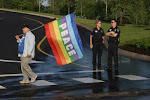
I think I set a record for a speedy arrest. I arrived at Senator Coleman's office at 4:30 knowing they normally closed at 5. Since I told them I planned to stay, they called the cops to be ready for me right at 5. I was cuffed, put in the squad car and taken downtown, put in a holding cell for 15 minutes while they did the paperwork and I was released by 5:35 without even the option of staying overnight if I wanted to! I have to call in 10 days to get an arraignment date for the misdemeanor of “trespass”. So, my fast continues as well as my prayers. Thanks for your support. You can check out www.iraqpeaceteam.org for updates on the folks in Baghdad.
Paul Thorsen and Carol Masters from the Community of St. Martin joined me for a while then left just before the arrest. It is great to have others join one in solidarity. But why the solitary witness? Is it because I’m so “pure” that I don’t want my witness to be “contaminated” by the intrusions of others? I think there are times for us to join the mass movements, to lend our voice to the chorus, to help show others by our numbers that we are not alone. We need to remind ourselves as well that we are not alone.
But I also strive to make a witness that more fully communicates what I value and who I am. So often, in the large crowds, the mass rallies and marches, there are voices raised that make me cringe and call me to ask, why am I here? Voices which seek to denigrate the other. Voices that increase the spiral of violence and hatred. If we really wish to speak on behalf of the voiceless children in Iraq, that voice won’t be heard among the catcalls against the President or the attempts to out-shout counter-demonstrators.
I am inspired by the story of the solitary Quaker who day after day vigiled with his sign outside the White House during the Vietnam War. The President of the United States took time out of his busy schedule to ask the Secret Service to remove him so he couldn’t see him every day and thus be reminded that all was not well. My friend Janelle reminded me that AJ Muste would often go by himself to demonstrate at nuclear weapons installations. When asked what he was accomplishing with such a solitary witness, he said it was “to keep the world [the militarists] from changing him.”
I’d like to propose we consider instituting a regular “solitary witness” at Senator Coleman’s office during this war. If one does not feel comfortable or confident enough to do it alone, go with a friend. But do it in small numbers, do it on a regular basis, so the staff of that office are reminded daily that this war will not go on without our dissent. Strategically, to tie up our court system with daily petty misdemeanors will be a nuisance. Already the Governor is threatening to try to charge dissenters with the costs of their arrests. In a time of budget crunching, we need to remind our government that this war will be costly. If we are going to jeopardize the lives of the Iraqi people, there need to be some costs here at home as well. If day-after-day our courts are tied up with prosecuting us for trespass at the Senator’s office, we will be sending a loud and clear message that “business as usual” can’t continue as long as we are engaging in this illegal and unjust war.
For those who are unable to risk arrest at this time, it isn’t necessary to be arrested to make this witness. You, too, can go to the Senator’s office to pray for the victims and perpetrators of this war. For me, getting arrested wasn’t the goal; making a faithful witness was. I think whether or not I was arrested was less important than my presence there, praying for peace. If others are interested, I’d be happy to share some of my photos of people from Iraq to take with you. Just go to the office and tell the staff you’ve come to pray for the people of Iraq. There are 4 chairs in the outer office so if several come the same day, that’s OK. The office closes at 5 PM so if you don’t wish to risk arrest, you can leave at that time.
Can we make our voices heard by our silence? I think we can. I think silence and prayerful presence speaks volumes. For those whose schedules allows, consider going once a week or once a fortnight. Maybe others can go to Sabo’s or Dayton’s offices as well to remind them of our continued opposition to this war and encourage them to continue to vote and speak against it. Maybe there is a military recruitment office in your neighborhood or area. That is also a good place for public prayer.
Will you join me? Will you lift your voice (sometimes in silence) to end this war?
Shalom,
Steve

Why I am a Christian and how it led me to Iraq
Why I am a Christian and how it led me to Iraq by Steve Clemens
Pilgrim Lutheran Church in St. Paul, Jan. 29, 2003
[Texts read previously: II Cor. 5-17-20; Excerpt from No Bars to Manhood by Daniel Berrigan (written during the Vietnam War, 1968)
We have assumed the name of peacemakers, but we have been, by and large, unwilling to pay any significant price. And because we want the peace with half a heart and half a life and will, the war, of course, continues, because the waging of war, by its nature, is total – but the waging of peace, by our own cowardice, is partial. … We take it for granted that in wartime families will be separated for long periods, that men will be imprisoned, wounded, driven insane, killed on foreign shores. In favor of such wars, we declare a moratorium on every normal human hope- for marriage, for community, for friendship, for moral conduct towards strangers and the innocent. We are instructed that deprivation and discipline, private grief and public obedience are to be our lot. And we obey. And we bear with it- because bear we must- because war is war, and good war or bad, we are stuck with it and its cost.
But what of the price of peace… . “Of course let us have the peace”, we cry, “but at the same time let us have normalcy, let us lose nothing, let our lives stand intact, let us know neither prison nor ill repute nor disruption of ties.” … we cry peace and cry peace, and there is no peace. There is no peace because there are no peacemakers. There are no makers of peace because the making of peace is at least as costly as the making of war – at least as exigent, at least as disruptive, at least as liable to bring disgrace and prison and death in its wake.
Super Bowl Sunday is probably a good time to talk about nonviolence: statistics identify this day as one of the most significant for the incidence of domestic abuse. As our culture glamorizes competition and brute force, there is the need for another perspective.
The scripture passage read, II Corinthians 5:17, “ If anyone is in Christ, there is a whole new world order; a whole new consciousness.” New values. New perspectives. A new order.
Our culture values rugged individualism, independence, competition, and militarism to protect our materialism. The call to emulate Jesus is a call to cooperation, community, interdependence, non-violence, and compassionate sharing.
Why do I choose to follow Jesus? Because the way of our culture leads to death and despair- both individually and ecologically. The way of Jesus leads to community and abundant life. How did I come to this realization?
Although I was raised within a Mennonite tradition, my parents embraced an Evangelical theology which privatized and proselytized the faith, discarding the witness of nonviolence and narrowing the scope of discipleship to a personal morality. When I turned 18 in 1968 and had to register for the military draft at the height of the Vietnam War, that faith was found wanting. I needed a faith that could provide answers to questions about injustice, violence, and domination. There was for me a real disconnect between my personal morality and what was being carried out in my name in Indochina.
I found that faith in the life, faith, and teaching of Jesus of Nazareth. The God that Jesus reveals is a God of compassion and forgiveness, not the judgmental patriarch I was led to in my evangelical heritage. I was pleased to discover my own neglected Mennonite-Anabaptist heritage which allowed me to follow a Jesus who not only called me to a personal morality but also a faith that had social and political implications. Registering as a conscientious objector to all war was initially only a personal, moral stand. But, after living and working with street gangs in north Philadelphia after my freshman year of college , I realized that I needed an ethic that allowed me to engage the social injustice around me.
As I began to study the history of the Christian Church before the rise of Constantine, I discovered that the Early Church was pacifist because of their understanding of the call of Jesus. As I was exposed to theologians such as John Howard Yoder and William Stringfellow, my faith was strengthened and it began to inform my politics and lifestyle choices.
Jesus’ call to love our enemies and not to return evil with evil is a call to take my responsibilities as a Citizen in the Kingdom or Reign of God more seriously than the demands placed on me as a citizen of the American Empire. When my nation of origin tells me that the people of Iraq are expendable because our government thinks their government is led by an evil person, the example of Jesus is instructive. Jesus was raised in a society of brutal oppression. Many of his family, friends, and followers hoped he would rise up and lead a revolt against the hated Romans. Instead, Jesus chose a route of nonviolent resistance to the oppressive structures of his time. Although it led to his execution by the Romans with the active collaboration of the religious authorities, the witness of both history and the Gospels is that God honored the faith and life of Jesus through his resurrection.
For me, it doesn’t matter if the resurrection is an historical fact or a mystical experience - it is clear that Jesus’ disciples were emboldened and radically changed by this whole experience. They turned their world “upside down” – or maybe they turned it right-side up! The early Christian Church clearly understood that the life and teaching of Jesus was a call to nonviolence with a special concern and compassion for the poor. My desire to follow Jesus led me to 1 ½ years of voluntary service with a church agency and then to join an intentional Christian community in southwest Georgia.
At Koinonia Partners, the Georgian community which became the birthplace of the Habitat for Humanity movement, I was introduced to one of the most significant theologians in the US in the 20th Century: Clarence Jordan. Dr. Jordan helped found this inter-racial community in the deep south during World War II and a commitment to nonviolence and the poor were central to it’s identity. Although Dr. Jordan died in 1969 and I didn’t arrive at the community until 6 years later, we had plenty of opportunity to read his “Cotton Patch” translations of the New Testament and listen to tape recordings of his sermons and teaching sessions. Shortly before I left for Iraq this fall, I ran into one of his quotes from 40 years ago:
“Wars are generally fought for material things; they’re not fought over ideals. After we get into them, we are told we are fighting for ideals. [but] We are fighting for oil and tin and rubber and markets, and as long as we insist on a standard of life that is so high above all the rest of the world, we’re going to have to pay for our standard of living with a lot of blood. I think we ought to reexamine the fact that Jesus was a pauper, and we should be committing ourselves to a very humble, simple way of life.” —Clarence Jordan 1963
My commitment to be faithful to the call of the Gospel has led me to some exciting and unusual places:
• I visited a man on death row in the Georgia State Prison for 10 years and vigiled at the county courthouse alongside of a model electric chair whenever the state of Georgia executed prisoners.
• Our small group of peacemakers began a weekly candlelight vigil at the gate to Fort Benning, GA in opposition to the training of Salvadoran soldiers in 1983 which has blossomed into a yearly protest which has been attended by more than 10,000 people of conscience each of the past 3 years. I continue to work to close the School of the Americas.
• Protests against nuclear weapons led to several prison sentences, including 6 months spent in a county jail and a federal prison in Texas in 1981. Blocking a train carrying 208 nuclear bombs through Georgia landed me in jail, again, several years later.
• I am part of an on-going peace witness at Alliant TechSystems, the weapons-maker headquartered in Edina that makes landmines, cluster bombs, and depleted uranium weapons- all weapons outlawed by International Humanitarian Law as indiscriminate weapons which kill and maim civilians. Last May, I spent a week in the Hennepin County Workhouse (the county jail) for a protest against Alliant cluster bombs which were dropped in Afghanistan the previous fall.
• Every Wednesday, I join more than 100 others on the Lake Street bridge between Minneapolis and St. Paul in holding signs against war and economic sanctions in Iraq.
*** [insert- see end of text]
In August, I heard Kathy Kelly, founder of Voices in the Wilderness, a group working to end the economic sanctions against the people of Iraq, when she spoke at a rally in Loring Park in Minneapolis. She asked those in attendance to consider traveling to Iraq if war appeared imminent, to stand beside and in solidarity with the Iraqi people as a testimony to our commitment to their well-being. She was forming an “Iraq Peace Team”- a group of Americans and other nationalities to live in Iraq and place themselves by hospitals, water treatment plants, electrical facilities and other locations necessary for the infrastructure of the country. These were all facilities that were bombed by allied forces in 1991, despite the fact that it is a war crime to target such civilian structures.
After prayer and a period of discernment with my family and my faith community, I requested a leave of absence from my employer, Twin Cities Habitat for Humanity, and awaited word that Iraq was willing to issue me a visa to come. Part of the discernment process of choosing to go to Iraq was considering the letter Voices in the Wilderness shared with us from the US government. It informed us that unauthorized travel to Iraq was punishable by up to 12 years in prison and up to $1 1/4 million in administrative fines by the US government for violation of the sanctions. We were told that several individuals have been fined $10,000. each for taking medicines to Iraq and, while we were in Baghdad, we received notice that Kathy Kelly and Voices in the Wilderness were being fined $10,000. each as well. These threats had to be considered in light of the call of my conscience.
I felt the need to travel to Iraq to tell the people that I am not their enemy and they are not mine. Jesus’ call to love our enemies must take precedence over my country’s declaration to wage war on that country. Traveling to Iraq while that country faced the threats of our bombs was a way to put my prayers for peace into action. It was a specific way to incarnate my faith and beliefs. Gandhi summed up this in his statement: “Be the change you believe in”.
One member of my discernment team, Peter Thompson, a local criminal defense lawyer, decided to join me. After discussions with our families and my employer, we decided to limit our time in Iraq to 2 weeks, although both of us wished to remain there for a longer period. A week before Thanksgiving we received a call asking if we could arrive in Amman, Jordan by December 1, so we could drive to Baghdad the next day.
We joined 3 others in Amman for the 12 hour drive through the Jordanian and Iraqi desert to get to Baghdad. There, we were joined by more than a dozen others including people from Sweden, Australia, Canada, as well as others from the US. We visited in a few of the homes of some near-by Baghdad residents and heard their stories. Most of these families were barely scraping by.
Amal, a school teacher was painting oil paintings at night after her 3 children were asleep to help supplement her $3.50/month salary as a teacher.
Achmed, the 14-year-old boy who greeted us everyday outside our hotel, dropped out of school to shine shoes on the sidewalk to help support his family.
Karima, a widow with her 9 children were facing eviction from their apartment because they couldn’t afford the $12./month payments.
The 250 Iraqi dinar note [hold it up] we carried around with us was worth $825. in 1990. Now it is worth 12 ½ cents.
Peter and 2 others volunteered each day at an orphanage run by nuns from Mother Theresa’s order for 15-20 children with cerebral palsy. When asked what they’ll do when the bombs come again, a nun replied, “we’ll cover them with blankets and stay and pray with them.” A school teacher in Basrah, when asked the same question, said, “We’ll send the children home, pray, and hope Saddam will defend them.”
The UN diplomat in charge of the United Nations Development Program in Baghdad, a man who attended Edison High School in Minneapolis and the University of MN as an exchange student from his native France, explained how the US representative on the 661 committee of the Oil for Food program routinely placed “holds” or denied importation of needed medicines or parts to repair damaged and dysfunctional water treatment plants. He asked us the question posed to him by a fellow UN diplomat, “Don’t you know that every day the economic sanctions and the threat of war against Iraq continue, America is creating 5,000 more Osama bin Ladens?
It was heartbreaking to tour the pediatric cancer ward in the Basrah Children’s Hospital. These children had no say in the policies of their government or ours but they were dying from the effects of the depleted uranium weapons made in Arden Hills, MN and used by US troops in 1991. To compound the tragedy unfolding over there, we learned that while only 147 US soldiers died in the war, more than 10,000 US soldiers have died in the 12 years since that war- most with ailments connected to “Gulf War Syndrome” which many doctors have linked to the use of these depleted uranium weapons. We were taken to the graveyard of scores of vehicles which carried civilians and troops that were mowed down in what US pilots later called “a turkey shoot” or “like shooting fish in a barrel” along the Highway of Death, south of Basrah. Americans never saw the pictures of US troops burying the dead Iraqis by bulldozer in 1991 because the Pentagon carefully censored what images were released to the media.
We toured water treatment plants that had been deliberately targeted in the ’91 war. Hundreds of water treatment plants are being restored one-by-one with the help of Veterans for Peace because the Iraqi government is denied importation of the needed filters, gaskets and valves by the US representative on the sanctions committee. The UN reports that more than 5,000 children die each month of preventable diseases linked to contaminated drinking water, dysentery and diarrhea. We made a banner which read “To Bomb this site is a War Crime” and carried it with us when we held a press conference at a large water treatment plant in Baghdad which had been bombed in 1991.
But I went to meet the people, to tell them of my sorrow and solidarity. At the graveyard of the vehicles contaminated with depleted uranium and other radioactive components which will remain radioactive for more than 4 ½ billion years, I gathered the five Iraqis traveling with us. I told them that even though I had spoken out, written letters, and demonstrated against the US-led war in 1991, what was done by my government to the Iraqi people was unforgivable—but I asked them for forgiveness anyway, and told them that they are my brothers and sisters. In those five minutes, it didn’t matter that they were Muslim and I was Christian. That we spoke different languages, ate different foods. We were all children of the same God and we needed to work together to stop this up-coming war. Tears were shed; we embraced and experienced the reconciliation that the Apostle Paul writes about in II Corinthians 5:17-20. [read]
We are “Ambassadors for Christ”- how is that for a demanding task?
We are charged with a mission to proclaim and work for reconciliation. It is a big task, let’s start by stopping this war.
“We cry ‘peace, peace’ and there is no peace because there are no peacemakers- because the making of peace is at least as costly as the making of war.” Are we willing to pay the price for being peacemakers?
Amen
Insert at ***
Galatians 2:20- “I am crucified with Christ: nevertheless I live; yet not I, but Christ, liveth in me: and the life which I now live in the flesh I live by the faith of the Son of God, who loved me, and gave himself for me.”
Dan Berrigan, in They Call Us Dead Men, writes that this passage is a call to us to risk our lives in the caused of peacemaking. If, as the Rite of Baptism illustrates, we die to self when we chose to follow Christ, we are truly liberated and can no longer be threatened by the state or other groups. If we have “been crucified with Christ”, there is nothing the state can threaten to do to us that we haven’t already voluntarily undergone. The state can jail us, they can ultimately execute us, but we have already voluntarily undergone this in following Jesus. This sense of liberation is more powerful than any government and gives one the freedom to act, as Clarence Jordan puts it, “in scorn of the consequences”.
When I scaled the fence surrounding the assembly plant for all nuclear weapons that the US makes in Amarillo, Texas, or when I sat on the railroad tracks in front of a train carrying over 200 nuclear bombs in Georgia, I did so in the confidence that in calling us to be peacemakers, Jesus also calls us to takes risks for peace. I believe God honors our acts of faithful obedience and gives us the gift of community to strengthen us in a journey which is counter-cultural.
For discussion: CSM vision statement:
We strive to be an ecumenical Christian community. Rooted in Scripture, sharing worship and ministry, we affirm active nonviolence, love of justice and peace, and the integrity of God's creation. Acknowledging our complicity in the materialism and oppression of the dominant culture, we seek to practice loving hospitality and care-filled stewardship of God 's gifts of ourselves, land, time and possessions. Through an ongoing process of action and reflection we seek to shape our lives according to our faith and the urgings of the Spirit. We commit ourselves to one another and to the way of Jesus Christ. Our community is open to all who share these values
Pilgrim Lutheran Church in St. Paul, Jan. 29, 2003
[Texts read previously: II Cor. 5-17-20; Excerpt from No Bars to Manhood by Daniel Berrigan (written during the Vietnam War, 1968)
We have assumed the name of peacemakers, but we have been, by and large, unwilling to pay any significant price. And because we want the peace with half a heart and half a life and will, the war, of course, continues, because the waging of war, by its nature, is total – but the waging of peace, by our own cowardice, is partial. … We take it for granted that in wartime families will be separated for long periods, that men will be imprisoned, wounded, driven insane, killed on foreign shores. In favor of such wars, we declare a moratorium on every normal human hope- for marriage, for community, for friendship, for moral conduct towards strangers and the innocent. We are instructed that deprivation and discipline, private grief and public obedience are to be our lot. And we obey. And we bear with it- because bear we must- because war is war, and good war or bad, we are stuck with it and its cost.
But what of the price of peace… . “Of course let us have the peace”, we cry, “but at the same time let us have normalcy, let us lose nothing, let our lives stand intact, let us know neither prison nor ill repute nor disruption of ties.” … we cry peace and cry peace, and there is no peace. There is no peace because there are no peacemakers. There are no makers of peace because the making of peace is at least as costly as the making of war – at least as exigent, at least as disruptive, at least as liable to bring disgrace and prison and death in its wake.
Super Bowl Sunday is probably a good time to talk about nonviolence: statistics identify this day as one of the most significant for the incidence of domestic abuse. As our culture glamorizes competition and brute force, there is the need for another perspective.
The scripture passage read, II Corinthians 5:17, “ If anyone is in Christ, there is a whole new world order; a whole new consciousness.” New values. New perspectives. A new order.
Our culture values rugged individualism, independence, competition, and militarism to protect our materialism. The call to emulate Jesus is a call to cooperation, community, interdependence, non-violence, and compassionate sharing.
Why do I choose to follow Jesus? Because the way of our culture leads to death and despair- both individually and ecologically. The way of Jesus leads to community and abundant life. How did I come to this realization?
Although I was raised within a Mennonite tradition, my parents embraced an Evangelical theology which privatized and proselytized the faith, discarding the witness of nonviolence and narrowing the scope of discipleship to a personal morality. When I turned 18 in 1968 and had to register for the military draft at the height of the Vietnam War, that faith was found wanting. I needed a faith that could provide answers to questions about injustice, violence, and domination. There was for me a real disconnect between my personal morality and what was being carried out in my name in Indochina.
I found that faith in the life, faith, and teaching of Jesus of Nazareth. The God that Jesus reveals is a God of compassion and forgiveness, not the judgmental patriarch I was led to in my evangelical heritage. I was pleased to discover my own neglected Mennonite-Anabaptist heritage which allowed me to follow a Jesus who not only called me to a personal morality but also a faith that had social and political implications. Registering as a conscientious objector to all war was initially only a personal, moral stand. But, after living and working with street gangs in north Philadelphia after my freshman year of college , I realized that I needed an ethic that allowed me to engage the social injustice around me.
As I began to study the history of the Christian Church before the rise of Constantine, I discovered that the Early Church was pacifist because of their understanding of the call of Jesus. As I was exposed to theologians such as John Howard Yoder and William Stringfellow, my faith was strengthened and it began to inform my politics and lifestyle choices.
Jesus’ call to love our enemies and not to return evil with evil is a call to take my responsibilities as a Citizen in the Kingdom or Reign of God more seriously than the demands placed on me as a citizen of the American Empire. When my nation of origin tells me that the people of Iraq are expendable because our government thinks their government is led by an evil person, the example of Jesus is instructive. Jesus was raised in a society of brutal oppression. Many of his family, friends, and followers hoped he would rise up and lead a revolt against the hated Romans. Instead, Jesus chose a route of nonviolent resistance to the oppressive structures of his time. Although it led to his execution by the Romans with the active collaboration of the religious authorities, the witness of both history and the Gospels is that God honored the faith and life of Jesus through his resurrection.
For me, it doesn’t matter if the resurrection is an historical fact or a mystical experience - it is clear that Jesus’ disciples were emboldened and radically changed by this whole experience. They turned their world “upside down” – or maybe they turned it right-side up! The early Christian Church clearly understood that the life and teaching of Jesus was a call to nonviolence with a special concern and compassion for the poor. My desire to follow Jesus led me to 1 ½ years of voluntary service with a church agency and then to join an intentional Christian community in southwest Georgia.
At Koinonia Partners, the Georgian community which became the birthplace of the Habitat for Humanity movement, I was introduced to one of the most significant theologians in the US in the 20th Century: Clarence Jordan. Dr. Jordan helped found this inter-racial community in the deep south during World War II and a commitment to nonviolence and the poor were central to it’s identity. Although Dr. Jordan died in 1969 and I didn’t arrive at the community until 6 years later, we had plenty of opportunity to read his “Cotton Patch” translations of the New Testament and listen to tape recordings of his sermons and teaching sessions. Shortly before I left for Iraq this fall, I ran into one of his quotes from 40 years ago:
“Wars are generally fought for material things; they’re not fought over ideals. After we get into them, we are told we are fighting for ideals. [but] We are fighting for oil and tin and rubber and markets, and as long as we insist on a standard of life that is so high above all the rest of the world, we’re going to have to pay for our standard of living with a lot of blood. I think we ought to reexamine the fact that Jesus was a pauper, and we should be committing ourselves to a very humble, simple way of life.” —Clarence Jordan 1963
My commitment to be faithful to the call of the Gospel has led me to some exciting and unusual places:
• I visited a man on death row in the Georgia State Prison for 10 years and vigiled at the county courthouse alongside of a model electric chair whenever the state of Georgia executed prisoners.
• Our small group of peacemakers began a weekly candlelight vigil at the gate to Fort Benning, GA in opposition to the training of Salvadoran soldiers in 1983 which has blossomed into a yearly protest which has been attended by more than 10,000 people of conscience each of the past 3 years. I continue to work to close the School of the Americas.
• Protests against nuclear weapons led to several prison sentences, including 6 months spent in a county jail and a federal prison in Texas in 1981. Blocking a train carrying 208 nuclear bombs through Georgia landed me in jail, again, several years later.
• I am part of an on-going peace witness at Alliant TechSystems, the weapons-maker headquartered in Edina that makes landmines, cluster bombs, and depleted uranium weapons- all weapons outlawed by International Humanitarian Law as indiscriminate weapons which kill and maim civilians. Last May, I spent a week in the Hennepin County Workhouse (the county jail) for a protest against Alliant cluster bombs which were dropped in Afghanistan the previous fall.
• Every Wednesday, I join more than 100 others on the Lake Street bridge between Minneapolis and St. Paul in holding signs against war and economic sanctions in Iraq.
*** [insert- see end of text]
In August, I heard Kathy Kelly, founder of Voices in the Wilderness, a group working to end the economic sanctions against the people of Iraq, when she spoke at a rally in Loring Park in Minneapolis. She asked those in attendance to consider traveling to Iraq if war appeared imminent, to stand beside and in solidarity with the Iraqi people as a testimony to our commitment to their well-being. She was forming an “Iraq Peace Team”- a group of Americans and other nationalities to live in Iraq and place themselves by hospitals, water treatment plants, electrical facilities and other locations necessary for the infrastructure of the country. These were all facilities that were bombed by allied forces in 1991, despite the fact that it is a war crime to target such civilian structures.
After prayer and a period of discernment with my family and my faith community, I requested a leave of absence from my employer, Twin Cities Habitat for Humanity, and awaited word that Iraq was willing to issue me a visa to come. Part of the discernment process of choosing to go to Iraq was considering the letter Voices in the Wilderness shared with us from the US government. It informed us that unauthorized travel to Iraq was punishable by up to 12 years in prison and up to $1 1/4 million in administrative fines by the US government for violation of the sanctions. We were told that several individuals have been fined $10,000. each for taking medicines to Iraq and, while we were in Baghdad, we received notice that Kathy Kelly and Voices in the Wilderness were being fined $10,000. each as well. These threats had to be considered in light of the call of my conscience.
I felt the need to travel to Iraq to tell the people that I am not their enemy and they are not mine. Jesus’ call to love our enemies must take precedence over my country’s declaration to wage war on that country. Traveling to Iraq while that country faced the threats of our bombs was a way to put my prayers for peace into action. It was a specific way to incarnate my faith and beliefs. Gandhi summed up this in his statement: “Be the change you believe in”.
One member of my discernment team, Peter Thompson, a local criminal defense lawyer, decided to join me. After discussions with our families and my employer, we decided to limit our time in Iraq to 2 weeks, although both of us wished to remain there for a longer period. A week before Thanksgiving we received a call asking if we could arrive in Amman, Jordan by December 1, so we could drive to Baghdad the next day.
We joined 3 others in Amman for the 12 hour drive through the Jordanian and Iraqi desert to get to Baghdad. There, we were joined by more than a dozen others including people from Sweden, Australia, Canada, as well as others from the US. We visited in a few of the homes of some near-by Baghdad residents and heard their stories. Most of these families were barely scraping by.
Amal, a school teacher was painting oil paintings at night after her 3 children were asleep to help supplement her $3.50/month salary as a teacher.
Achmed, the 14-year-old boy who greeted us everyday outside our hotel, dropped out of school to shine shoes on the sidewalk to help support his family.
Karima, a widow with her 9 children were facing eviction from their apartment because they couldn’t afford the $12./month payments.
The 250 Iraqi dinar note [hold it up] we carried around with us was worth $825. in 1990. Now it is worth 12 ½ cents.
Peter and 2 others volunteered each day at an orphanage run by nuns from Mother Theresa’s order for 15-20 children with cerebral palsy. When asked what they’ll do when the bombs come again, a nun replied, “we’ll cover them with blankets and stay and pray with them.” A school teacher in Basrah, when asked the same question, said, “We’ll send the children home, pray, and hope Saddam will defend them.”
The UN diplomat in charge of the United Nations Development Program in Baghdad, a man who attended Edison High School in Minneapolis and the University of MN as an exchange student from his native France, explained how the US representative on the 661 committee of the Oil for Food program routinely placed “holds” or denied importation of needed medicines or parts to repair damaged and dysfunctional water treatment plants. He asked us the question posed to him by a fellow UN diplomat, “Don’t you know that every day the economic sanctions and the threat of war against Iraq continue, America is creating 5,000 more Osama bin Ladens?
It was heartbreaking to tour the pediatric cancer ward in the Basrah Children’s Hospital. These children had no say in the policies of their government or ours but they were dying from the effects of the depleted uranium weapons made in Arden Hills, MN and used by US troops in 1991. To compound the tragedy unfolding over there, we learned that while only 147 US soldiers died in the war, more than 10,000 US soldiers have died in the 12 years since that war- most with ailments connected to “Gulf War Syndrome” which many doctors have linked to the use of these depleted uranium weapons. We were taken to the graveyard of scores of vehicles which carried civilians and troops that were mowed down in what US pilots later called “a turkey shoot” or “like shooting fish in a barrel” along the Highway of Death, south of Basrah. Americans never saw the pictures of US troops burying the dead Iraqis by bulldozer in 1991 because the Pentagon carefully censored what images were released to the media.
We toured water treatment plants that had been deliberately targeted in the ’91 war. Hundreds of water treatment plants are being restored one-by-one with the help of Veterans for Peace because the Iraqi government is denied importation of the needed filters, gaskets and valves by the US representative on the sanctions committee. The UN reports that more than 5,000 children die each month of preventable diseases linked to contaminated drinking water, dysentery and diarrhea. We made a banner which read “To Bomb this site is a War Crime” and carried it with us when we held a press conference at a large water treatment plant in Baghdad which had been bombed in 1991.
But I went to meet the people, to tell them of my sorrow and solidarity. At the graveyard of the vehicles contaminated with depleted uranium and other radioactive components which will remain radioactive for more than 4 ½ billion years, I gathered the five Iraqis traveling with us. I told them that even though I had spoken out, written letters, and demonstrated against the US-led war in 1991, what was done by my government to the Iraqi people was unforgivable—but I asked them for forgiveness anyway, and told them that they are my brothers and sisters. In those five minutes, it didn’t matter that they were Muslim and I was Christian. That we spoke different languages, ate different foods. We were all children of the same God and we needed to work together to stop this up-coming war. Tears were shed; we embraced and experienced the reconciliation that the Apostle Paul writes about in II Corinthians 5:17-20. [read]
We are “Ambassadors for Christ”- how is that for a demanding task?
We are charged with a mission to proclaim and work for reconciliation. It is a big task, let’s start by stopping this war.
“We cry ‘peace, peace’ and there is no peace because there are no peacemakers- because the making of peace is at least as costly as the making of war.” Are we willing to pay the price for being peacemakers?
Amen
Insert at ***
Galatians 2:20- “I am crucified with Christ: nevertheless I live; yet not I, but Christ, liveth in me: and the life which I now live in the flesh I live by the faith of the Son of God, who loved me, and gave himself for me.”
Dan Berrigan, in They Call Us Dead Men, writes that this passage is a call to us to risk our lives in the caused of peacemaking. If, as the Rite of Baptism illustrates, we die to self when we chose to follow Christ, we are truly liberated and can no longer be threatened by the state or other groups. If we have “been crucified with Christ”, there is nothing the state can threaten to do to us that we haven’t already voluntarily undergone. The state can jail us, they can ultimately execute us, but we have already voluntarily undergone this in following Jesus. This sense of liberation is more powerful than any government and gives one the freedom to act, as Clarence Jordan puts it, “in scorn of the consequences”.
When I scaled the fence surrounding the assembly plant for all nuclear weapons that the US makes in Amarillo, Texas, or when I sat on the railroad tracks in front of a train carrying over 200 nuclear bombs in Georgia, I did so in the confidence that in calling us to be peacemakers, Jesus also calls us to takes risks for peace. I believe God honors our acts of faithful obedience and gives us the gift of community to strengthen us in a journey which is counter-cultural.
For discussion: CSM vision statement:
We strive to be an ecumenical Christian community. Rooted in Scripture, sharing worship and ministry, we affirm active nonviolence, love of justice and peace, and the integrity of God's creation. Acknowledging our complicity in the materialism and oppression of the dominant culture, we seek to practice loving hospitality and care-filled stewardship of God 's gifts of ourselves, land, time and possessions. Through an ongoing process of action and reflection we seek to shape our lives according to our faith and the urgings of the Spirit. We commit ourselves to one another and to the way of Jesus Christ. Our community is open to all who share these values
Letters from Iraq- Dec. 18. Jonah and a Whale of a Lie- Back in the Belly of the Beast
Jonah and a Whale of a Lie- Back in the Belly of the Beast. 12/18/02
Minneapolis
I have returned from Baghdad. As I get re-acclimated to the US after my 2+ week sojourn, an uneasy feeling creeps back. With all the talk, all the bombast and threatening of going to war to rid the world of Saddam Hussein, there is usually one thing missing. Iraq has 23 million other people living, some barely surviving, in what has been identified as “the cradle of civilization”.
While Europe was in the midst of what has been referred to as “the Dark Ages”, intellectual though and the treasured writings of the Greeks were kept alive and flourished in Baghdad. As our world struggles to define the minimum parameters of what it means to be human, we can trace some of the beginnings of social structure to the law codes of Hammarabi. Again, culture springing from the Fertile Crescent between the Tigris and Euphrates Rivers.
We have been told a lie- that we can go to war with Saddam and somehow, mystically, it will remain a war with one person, not killing thousands, if not millions, of innocent Iraqis. Somehow, we can target Saddam Hussein without jeopardizing Achmed, Abdul, Abeer, Ali, Amal, Amil, Amira, Amal, Dhuha, Fatima, Hebe, Karima, Mahmoud, Mohammed, Mustafa, Nassim, Omar, Sattar, Whalid, Yassir, and …, all real, fresh-and-blood Iraqis I was privileged to meet. They are not my enemy. I pray that I do not become theirs.
When I despair of the crushing violence of an empire bent on domination of a world, I can, once again, re-visit the story of the prophet, Jonah, who finally, reluctantly, took his message of repentance to the heart of his contemporary empire, Assyria’s capitol, the great city of Nineveh. That city, now known as Mosul, is in the Kurdish section of northern Iraq, in the middle of what today’s empire has unilaterally declared (with the help and acquiescence of Great Britain) to be a “no-fly zone”. It isn’t really a no-fly zone – US and British warplanes regularly fly there, bombing, on average, every third or fourth day.
Nineveh, the scriptures tell us, listened to the message from God, delivered through Jonah, and repented. Jonah, however, had his heart set on the anticipated destruction of his enemy, and went into a funk over Nineveh’s change of heart. Today, even though we want to identify ourselves as “God’s chosen people”, we are the empire; and even though what has been identified as “our enemy” has agreed to allow UN inspection of their proclaimed disarmament, our President continues to call for war. He would do well to re-learn the message of that feisty, Minor Prophet of the Hebrew scriptures: God wants to have mercy on the great city because of the lives of the innocent people living there.
I have returned from Iraq, the land that now holds the burial site of the reluctant prophet, Jonah. Like Jonah, I find myself in the belly of a great beast, and I cry out to a God who desires mercy and compassion. Let us hear the call of God for our own repentance and not wreak the havoc and destruction we threaten on a people who have already experiences the terrors and costs of war and continue under a war of economic sanctions.
The people of Nineveh (Mosul), Baghdad, Basrah, and Babylon are like you and me. We can see in their faces the same joys and sorrows. They, too, want their children to grow up in a world safe from threats. They, too, want to be able to drink clean water and not live in the fear of an earth contaminated by radioactive waste. It would cost a fraction of what we spend on armaments and munitions for this empire to insure clean water, adequate nutrition, and to allow Iraq to rebuild itself with its own revenues from the sale of oil.
Let us work together in this great land to repent of the evil we have planned under the guise of ridding the world of evil. Instead, let us strive to be #1 in compassion, healing, and reconciliation. What better way to once again to prepare our hearts for the coming of “the Prince of Peace”?
-Steve Clemens
Iraq Peace Team member
Minneapolis
I have returned from Baghdad. As I get re-acclimated to the US after my 2+ week sojourn, an uneasy feeling creeps back. With all the talk, all the bombast and threatening of going to war to rid the world of Saddam Hussein, there is usually one thing missing. Iraq has 23 million other people living, some barely surviving, in what has been identified as “the cradle of civilization”.
While Europe was in the midst of what has been referred to as “the Dark Ages”, intellectual though and the treasured writings of the Greeks were kept alive and flourished in Baghdad. As our world struggles to define the minimum parameters of what it means to be human, we can trace some of the beginnings of social structure to the law codes of Hammarabi. Again, culture springing from the Fertile Crescent between the Tigris and Euphrates Rivers.
We have been told a lie- that we can go to war with Saddam and somehow, mystically, it will remain a war with one person, not killing thousands, if not millions, of innocent Iraqis. Somehow, we can target Saddam Hussein without jeopardizing Achmed, Abdul, Abeer, Ali, Amal, Amil, Amira, Amal, Dhuha, Fatima, Hebe, Karima, Mahmoud, Mohammed, Mustafa, Nassim, Omar, Sattar, Whalid, Yassir, and …, all real, fresh-and-blood Iraqis I was privileged to meet. They are not my enemy. I pray that I do not become theirs.
When I despair of the crushing violence of an empire bent on domination of a world, I can, once again, re-visit the story of the prophet, Jonah, who finally, reluctantly, took his message of repentance to the heart of his contemporary empire, Assyria’s capitol, the great city of Nineveh. That city, now known as Mosul, is in the Kurdish section of northern Iraq, in the middle of what today’s empire has unilaterally declared (with the help and acquiescence of Great Britain) to be a “no-fly zone”. It isn’t really a no-fly zone – US and British warplanes regularly fly there, bombing, on average, every third or fourth day.
Nineveh, the scriptures tell us, listened to the message from God, delivered through Jonah, and repented. Jonah, however, had his heart set on the anticipated destruction of his enemy, and went into a funk over Nineveh’s change of heart. Today, even though we want to identify ourselves as “God’s chosen people”, we are the empire; and even though what has been identified as “our enemy” has agreed to allow UN inspection of their proclaimed disarmament, our President continues to call for war. He would do well to re-learn the message of that feisty, Minor Prophet of the Hebrew scriptures: God wants to have mercy on the great city because of the lives of the innocent people living there.
I have returned from Iraq, the land that now holds the burial site of the reluctant prophet, Jonah. Like Jonah, I find myself in the belly of a great beast, and I cry out to a God who desires mercy and compassion. Let us hear the call of God for our own repentance and not wreak the havoc and destruction we threaten on a people who have already experiences the terrors and costs of war and continue under a war of economic sanctions.
The people of Nineveh (Mosul), Baghdad, Basrah, and Babylon are like you and me. We can see in their faces the same joys and sorrows. They, too, want their children to grow up in a world safe from threats. They, too, want to be able to drink clean water and not live in the fear of an earth contaminated by radioactive waste. It would cost a fraction of what we spend on armaments and munitions for this empire to insure clean water, adequate nutrition, and to allow Iraq to rebuild itself with its own revenues from the sale of oil.
Let us work together in this great land to repent of the evil we have planned under the guise of ridding the world of evil. Instead, let us strive to be #1 in compassion, healing, and reconciliation. What better way to once again to prepare our hearts for the coming of “the Prince of Peace”?
-Steve Clemens
Iraq Peace Team member
Letters from Iraq- Dec. 15-16. Returning from Baghdad


Dec. 15-16, 2002 Returning from Baghdad
Our return trip to Amman is delayed by an hour because Dr. Swann has to go get his blood test for AIDs so he isn’t fined $200. at the border. Our faithful Baghdad “cab” driver, Mohammed drives him to the clinic and after some back and forth about why he is here and the fact that he is a doctor, he is charged only $25. instead of the usual $50. The reason he didn’t get the test before is that several people told him the copy of his recent test conducted in Canada would suffice but apparently he received information correcting that impression. As we head out of town, David asks Sattar if we can stop at a fruit stand and buy some bananas and oranges for our long trip. We see in the distance the new “mother of all mosques” that Saddam is building that will hold 45,000 worshippers- at a time when many families are barely scraping to get by. I wonder if they feel the same way some of the families in the Middle Ages must have felt when great sums were spent on Europe’s cathedrals.
The land between the Tigris and Euphrates is irrigated and we see people working in the fields or tending grazing sheep and goats. Soon after we get beyond the river valley created by the Euphrates, we see miles and miles of desert. Occasionally we spot a few Bedouin tents with a new wrinkle- pick-up trucks and other larger trucks instead of camels! We pass a few smaller cities where, Sattar explains to me, the government has given the people the land on which to build their house. Almost all new construction appears to be concrete construction. A few hours west of Baghdad, I spot a few Iraqi tanks in the desert. Sattar asks us not to take photos of them. We comply since we still have to cross the border and I’m wondering what might happen since I left the laptop computer I brought in Baghdad for those remaining there with the IPT. I told Cathy and Cliff to give it to a local family if it was not needed in the future.
When we arrive at the border, Sattar very efficiently gathers all our passports and visas and other documents and begins the processing while we wait outside the building. The large painting of Saddam is graced by a text in English and Arabic stating that we are welcome here and that he has instructed the workers to efficiently serve us. After about an hour or so, Sattar returns and the guard begins to inspect all our luggage. When he asks each of us how many US dollars we are carrying, I can see Sattar getting upset. I learn later that this guard is very out of line with this questioning since we have entered the country with the blessing of the foreign ministry and should not be asked to declare the money we are carrying. Although I only have $20 USD of my own money, Sattar suggests that Peter give me the money Kathy gave me to pay Sattar for the trip and for our meals and hotel and visas for Jordan. Since they have no record of how much money I brought into the country, it should be no problem, but it becomes one when the guard asks where the laptop computer is. When I reply that I left it in Baghdad, he said, “We have a problem”. I’m a little nervous- but not nearly as much as I’d be without Sattar by my side as we drive to meet with the guard’s supervisor. He tells Sattar he is hungry as we drive to the building in the back. The guard quickly stuffs two bananas into his mouth and consumes them before we arrive at the supervisors station. After a few minutes, the two supervisors tell me that I can go now, but I should be certain to fill in the proper forms for carrying money into the country next time I visit. Sattar has already explained who we are and the purpose of our trip so I have escaped any trouble. Sattar is asked for a “tip” by the original guard on the way back and when I ask Sattar how much is appropriate, the guard tell Sattar he wants $20. I pay the “tip” and we are allowed to proceed to the Jordanian border.
Sattar insists that he be allowed to buy us supper in Jordan when we stop just before sunset. He is such a generous and beautiful man. We pray that he might find a way to emigrate with his family to Canada although we realize it is a long-shot and an expensive undertaking. He drops us off at the Al Monzer Hotel after dark, driving us all the way into Amman, despite the regulations prohibiting Iraqis from driving in the capital city. It saves us both time and money at the end of a long day on the road. David is catching a plane in the very early morning and we say good-bye to Dean as well. We’ll say good-bye to Neville at 6:30 AM as we leave for the airport. Although our flight leaves at 10:40 AM, Kathy instructs us to get there at least 2 hours early to secure our seats.
The Royal Jordanian flight is quite full and the magic sheet Peter passes to his seat-mate starts a very friendly discussion with the Palestinian sitting next to him. He is from Ramalla and he excitedly tells the man sitting next to him about us. I am sitting next to an older Arabic woman who can’t read so he tells her about us as well. Peter and I discuss how we will answer the immigration form we are given prior to landing at Shannon airport in Ireland. The US has set up immigration there to attempt to prevent anyone from even landing on our soil who “should not be there”. Oh, the tentacles of empire that reveal our national arrogance! We decide to list Iraq since the question on the form asks what countries (plural) have you visited? Even though there is no visa stamp in our passports stating we have entered Iraq, our passports show we entered Jordan, left, and then re-entered, with a 2 week period unexplained. I’m glad to have my attorney traveling with me! Peter says making a false statement is a crime in and of itself and we should concentrate on why we were there rather than risk arrest for lying. We had previously talked about “pleading the 5th” on the form but felt that might raise more questions and delay our return to the states. As it turned out, neither the immigration official at Shannon or the customs official in Chicago asked any questions as we proceeded through.
We are back “home” with a large responsibility: we must share what we’ve experienced and increase our efforts to stop this war. We are grateful that we have many friends and loved ones who will share that burden with us.
Letters from Iraq- Dec. 14. Bishop Neville Pacificus

Iraq Dec 14, 2002
Bishop Neville Pacificus
At our 7 AM reflection time, Neville Watson brought his stole and ring. In his rich Aussie accent, he told us that the only time he has used his stole in his 47 years as a minister was in impersonating a priest. When a friend of his was leaving the Catholic priesthood to marry and no priest would consent to marry them, Neville, a man filled with the peace and joy of Christ, who radiates that love to those he meets, said he'd be happy to oblige. When asked by the bride to "dress like a priest", Neville replied he'd "not only dress as one, he'd act like one". After the ceremony, the Bride's mother said to Neville, "Thank you, Father, that was a beautiful service"!
When Neville traveled to Bosnia during the war there, he was asked to be present and say a few words at the burial of 17 kids who had been killed in the conflict. He didn't have his stole with him at the time and wished he had it to communicate that it was not only his grief he was sharing but wanted a symbol to show that the whole church was in mourning. He also told of seeing stoles worn by Army Chaplains in military uniforms after an Australian tragedy and decided if stoles could be used to bless war, he'd find a way to use a stole for peace.
On his stole are two symbols. The first, a cross, which Neville proclaimed was there to remind us to work for an end to the idea of sacred violence. The other, a bright red flower, the Australian desert pea, reminding us that the desert shall bloom but also a symbol of blood in the desert- especially appropriate for the violence that has been visited and once again threatened on this country.
Neville also brought a large ring with a big stone in the center, which had been given to him by Yassir, a local Iraqi who is unemployed. Neville remarked that it symbolizes the unimportant people, the ones forgotten, and left behind. It looks like a bishop's ring so Neville stated that he has been consecrated and appointed by the poor, Bishop Neville Pacificus.
He continued the parody by stating that the first homily of his Episcopate was one that was actually delivered almost 100 years ago by Rev. Charles E. Jefferson of Broadway Congregational Tabernacle Church in NYC after he helped organize the NY Peace Society. Entitled "Militarism and the Church", the sermon was preached May 3, 1908. [Please try to find a copy of this on the web and read it yourselves.] The sermon ends:
"Rather I do pray that God will give me grace and strength to fight unceasingly and with every ounce of energy of brain and heart against everything which my own conscience tells me is contrary to the will of God and the happiness of [humankind]; no matter what forces are arrayed against me and how utterly hopeless the outcome of my labor seems."
After reading the sermon, Neville proceeded to talk about the act central to Christians around the world. "On the night he was betrayed, Jesus...", Neville began. Betrayed is a bad translation of the word, he continued. It is really the shift between acting and being acted upon. It was the point of Jesus' ministry where he ceased acting and was acted upon. The meal Jesus was sharing with his disciples was the Passover yet when it became time to share the bread that was accompanied by the words, "the bread of affliction", Jesus said it was his body. When he took the cup, he also changed the accustomed prayer to reflect the cup of the new covenant. Neville then took Iraqi bread and passed it around to us and asked us to eat it until it was consumed. He then took a new bottle of purified water, (what has been a lifeline for us westerners here), and said, Jesus used wine - but for us it is this water, and he poured us a cup. After we all partook, he gave us the blessing of the God of Peace to go in peace and work for peace.
Upon ending his parody, he shared his sense of disappointment that although he clearly wants to be here with the Iraqi people when war breaks out, he might be denied re-entry into this country because of inappropriate actions by a fellow Aussie during his stay here. "If I am unable to come back, I can live with that- in fact if I can't come back, I'll probably be able to live much longer!" Neville then shared the conversation he had with an architect the other night as they were talking about the architect's two kids and Neville's 3 grandkids. Neville told the architect that he hoped his [the architect's] kids would grow up to live in a better world than we have left it. The architect, with sadness in his eyes said, "If they survive." His children are 9 and 11.
Cynthia had us gather in a circle to lay hands on and bless Neville as he leaves with Peter, David Swann, and me tomorrow. We gladly offered our prayers and thanks for this wonderful servant of God! Had I not been able to meet wonderful Iraqi families and kids and be here in a show of solidarity with them, this trip would have been worthwhile in just meeting and spending time with Neville Watson, peacemaker and ambassador for Christ.
-Steve
Letters from Iraq- Dec. 13
Dec. 13 Iraq journal
We met with Dr. Souad Al-Azzawi, an Asst. Professor of the College of Engineering of the University of Baghdad. She received her PhD in Environmental Engineering from the University of Colorado. Her topic was the results of the use of depleted uranium weapons used in Iraq during the “war of American Aggression” in 1991. Since more than 1 million Du-tipped munitions were used by the American forces in the southern part of Iraq during the brief war, scientists have noticed medical effects on the residents of this area and the soldiers fighting there which first started showing up in increasing numbers in 1995-96.
Although it was quite difficult to hear her presentation due to the size of the room and her accent, Dr. Al-Azzawi showed slides with the results of soil and air samples taken from the area in 1995. She stated that 44% of the population in that area south of Basrah are expected to get lung or other cancers and about 5% of these patients will develop fatal cases of cancers. The effects will usually start appearing within 10 years after exposure. As of 1998, cases of cancers have tripled in Basrah. 7.3% of the Iraqi troops will have the same problems. 31% of the livestock was also exposed. Besides the contamination of U-238, there is also contamination of radium which has very active gamma rays. The cancer rates appear to be increasing at a sharper rate since 1999. Although more tests are clearly needed, the WHO (World Health Organization under the UN) changed it’s mind about investigating the effects of the use of Du weapons in Iraq after pressure was brought to bear on it. Given the realities of the economic sanctions, Iraq is hard pressed to be able to conduct the thorough scientific studies needed in this area.
I asked about the effects of the radiation and heavy metals on the vast fields of tomatoes growing in the area close to the “Highway of Death” south of Basrah. She replied that although there are not recent tests that have been done, she personally would not consume fruits and vegetables grown in that area. However, we were told that tomatoes grown there are shipped all over the country.
We met with Dr. Souad Al-Azzawi, an Asst. Professor of the College of Engineering of the University of Baghdad. She received her PhD in Environmental Engineering from the University of Colorado. Her topic was the results of the use of depleted uranium weapons used in Iraq during the “war of American Aggression” in 1991. Since more than 1 million Du-tipped munitions were used by the American forces in the southern part of Iraq during the brief war, scientists have noticed medical effects on the residents of this area and the soldiers fighting there which first started showing up in increasing numbers in 1995-96.
Although it was quite difficult to hear her presentation due to the size of the room and her accent, Dr. Al-Azzawi showed slides with the results of soil and air samples taken from the area in 1995. She stated that 44% of the population in that area south of Basrah are expected to get lung or other cancers and about 5% of these patients will develop fatal cases of cancers. The effects will usually start appearing within 10 years after exposure. As of 1998, cases of cancers have tripled in Basrah. 7.3% of the Iraqi troops will have the same problems. 31% of the livestock was also exposed. Besides the contamination of U-238, there is also contamination of radium which has very active gamma rays. The cancer rates appear to be increasing at a sharper rate since 1999. Although more tests are clearly needed, the WHO (World Health Organization under the UN) changed it’s mind about investigating the effects of the use of Du weapons in Iraq after pressure was brought to bear on it. Given the realities of the economic sanctions, Iraq is hard pressed to be able to conduct the thorough scientific studies needed in this area.
I asked about the effects of the radiation and heavy metals on the vast fields of tomatoes growing in the area close to the “Highway of Death” south of Basrah. She replied that although there are not recent tests that have been done, she personally would not consume fruits and vegetables grown in that area. However, we were told that tomatoes grown there are shipped all over the country.
Letters from Iraq- Dec. 11. What Have We Done To the Garden of Eden?


What Have We Done To the Garden of Eden?
What have we done to the earth?
What have we done to our fair sister?
Ravaged, and plundered, and ripped her and bit her,
stuck her with knives in the side of her dawn,
tied her with fences, and dragged her down.
- Jim Morrison (The Doors), The End
The town now situated at the reputed site of the Garden of Eden lies amidst decay and desolation. A group of boys and young men play soccer on a bare patch of dirt, many in bare feet, just a couple of hundred yards from the two dysfunctional water treatment plants for the town of Qurnah. One draws its water from the legendary Euphrates River, the other from the equally famous, Tigris. We are in the "cradle of civilization" as we rush to snap photos of the sun going down, silhouetting the palm trees, some which have lost their fronds from the percussion of the bombings and shelling over the past 22 years. We are just north of Basrah, a city of 1.7 million.
The sediment tanks are full of mud from the intake from the river. The chemical mixing motor is broken. The chlorine, closely monitored by the UN because it is "dual use", and the alum are now added by hand, the operator explains. The pumps are leaking, needing new valves and gaskets, not to mention, new motors. The sand and gravel filtering tanks desperately need new filters. Without clean water, many young children will succumb to diarrhea, dysentery, or other water-borne diseases.


In the midst of grinding poverty, there are two signs of hope. We travel with Tom Satar, a Vietnam War Vet and member of Vets for Peace. This group is working in partnership with Life for Food and Development, the only non-profit organization recognized and accepted by the US, UN, and Iraq. The are working together to rebuild, one-by-one, the water treatment plants that we, in some cases, deliberately destroyed during the Gulf War, or, more frequently, crippled during the past 12 years of economic sanctions. Tom has traveled to Iraq four times, learning about these critical infrastructure plants. He is here to "inspect" these facilities and make recommendations to Vets for Peace and LIFE personnel back in the US and Canada to get the needed parts. We are also accompanied by Amil, a bright, young graduate student who works with LIFE to improve this deadly problem. These two plants will, hopefully, be next on the list for rehab if the needed funds can be raised. The group has spent over $250,000 USD to repair a much larger plant in a southern part of Basrah, and about $35,000 for each of several smaller plants we are scheduled to visit this morning.


The other sign of hope is the children. As they are let of the school across the street, they see this strange group of 5 Americans (one of us Japanese-born), 2 Australians, and 5 Iraqis gathered up on the platform that holds the sediment tanks and broken chemical mixers. They see our cameras and want to pose for pictures, scrambling, like most 6-12 year old boys, to get closest to the camera, some daring to begin to climb the metal staircase leading to our position. When I take their pictures, they are fascinated when they see their image appear on the digital screen. More and more kids arrive as word magically gets out about the visitors to their town. Yasko and Amira have wisely brought some balloons for the kids and Tom has a stash of M&Ms and other small chocolates to distribute before the temperature, in the mid-60s, melts them. Few girls are in sight as seems to be the custom in Iraq where many women have disappeared from public view. Those women we have seen in public in this southern city and more conservatively dressed than the few women we see on the streets in Baghdad. Here in the south, virtually all the women and most of the young girls have their heads covered. Black is definitely the dominate color for the older women, a few colors creeping in for the younger-set.
After driving around the corner to visit the second treatment plant, this one across the street from the banks of the Tigris, the kids follow closely behind, running to keep pace with us. Additional friends have now joined them as more classes have been let out. Older boys in their early and mid teens gather round, some holding their English class text book. (All secondary school students learn English as well as Arabic, Amira informs me.) We exchange names, shake hands, and I teach them the word "Peace", showing them the two-fingered salute of the fingers raised in a V. The younger boys understand when I say "Salaam" and practice this new English word. They do a better job than I do in pronouncing their names. They ask me to pronounce other English words, printed on their clothing, delighted to hear my pronunciation of the words: Calvin Klein, Reebok, Nike, Authentic Quality, leather. An older boy brought his bicycle so I use that word and we talk about brakes- front and rear, the seat, tires, pedals. More and more questions implying "how do you pronounce this?".
One older boy wants to trade pens with me but I'm unwilling to pick one boy out of the more than 50 to decide who would get what. The camera and the digital pictures have already created enough jealousy and competition. Some of the words on the brand-name clothing knock-offs are badly miss-spelled, including the word boldly printed above "Authentic Quality" which is a mis-mash of consonants that is impossible to pronounce as an English word - something like "Ptontpntpal".
The joy and laughter, the eagerness to learn, the life and vigor are a wonderful elixir for us. It is just what we needed when our previous visit before lunch was at the Basrah Children's Hospital where a young Pediatric Oncologist took us to meet five of his patients, all young girls from 4-15 years old, in terminal stages of cancer and other diseases suspected to have originated from the radiation of the depleted uranium weapons used in this area by the US Army and Air Force in 1991.


Each girl lies on her bed with her black-covered mother grieving along-side. The mothers essentially live at the hospital when their child is here. The doctors plead with us to try to provide up-to-date textbooks and medical journals which the US has denied them under the sanctions regime. Amira, a beautiful, middle-aged woman, born and raised in Babylon, is our guide and interpreter and knows we need to experience some signs of life after this sobering hospital visit, thus scheduling the next visit to the water treatment plant that is nearby a school.
Yet, in the midst of the stark reality of the increasing cancers, grotesque deformities, grinding poverty, contaminated water, and machinery gradually decaying and dying, a much larger threat looms over the Garden of Eden. My President, my nation, wants to use these vulnerable kids in a macabre game of "chicken" with the old ally-turned-adversary of his father. Threats of an impending war that no one else around the world wants (except for Israel, Britain, and the Military-Industrial Complex), place the Garden of Eden in jeopardy again. As if the crippling economic sanctions were not enough. They already are warfare-by-attrition and the results are just as deadly. They are a "neutron bomb" that leaves the building standing but gutted of all life.

The Crosby, Stills, and Nash song drifts through my head- "We've got to get ourselves, back to the Garden ...". Yes we do. We've got to get ourselves back to this Garden with medicines, tools, supplies, and love - not bombs and bullets laced with deadly radioactive material. With understanding and compassion, not with the arrogance of a world-class bully.
The electrical power was off for more than 1/2 hour last night and again this morning for the past hour. These water treatment plants, even if Tom and others are able to secure the needed parts and filters and can bring them in-country, by-passing the sanctions, still need electricity to pump the water. The electrical facilities, too, were bombed last time by US warplanes. What happens on the cancer wards when the lights go out? Will the lights go out all over "the Cradle of Civilization"? Can we call ourselves a civilization if we continue to respond to each other with mindless violence? We need answers soon!
- Steve Clemens
Basra, Iraq.
Dec. 12, 2002. 5:30 AM
Subscribe to:
Posts (Atom)